

Your cat comes over, settles beside you or on your lap, accepts a few strokes, and may even seem completely relaxed. Then they suddenly turn and bite your hand.
If you searched “cat bites me when I pet them,” start with the simplest useful response: stop touching your cat when the bite happens. Then look at what happened immediately before it.
A bite during petting tells you that the interaction should stop at that moment. It does not, by itself, prove that your cat was overstimulated, angry, affectionate, dominant, or in pain.
The better clues are when the bite happened, how long the petting had continued, where your cat was being touched, what changed in their body language, whether they could easily leave, and whether this behavior is new.
Quick Answer
When your cat bites during petting, stop the physical contact and give them space to choose what happens next.
Then look at the pattern. A bite that happens as soon as your hand approaches is different from one that occurs after repeated strokes. A bite triggered by touching one specific part of the body also deserves different attention from a bite that happens only after a long interaction.
The bite itself does not tell you the cause.
Veterinary behavior sources describe several possible contributors, including a low tolerance for prolonged physical contact, changing social preference, fear or discomfort with handling, increasing arousal, redirected arousal, and pain.
The most useful question is not simply, “Why did my cat bite?”
It is:
What changed before the bite happened?
Vet Check
A new change in how your cat responds to touch deserves more attention than a long-standing preference for short petting sessions.
Talk with your veterinarian if the biting started suddenly, if your cat reacts consistently when one particular area is touched, or if you also notice changes in movement, jumping, grooming, appetite, activity, hiding, or tolerance for handling.
Pain can reduce a cat’s tolerance for touch. Joint problems, discomfort involving the neck or back, skin conditions, ear problems, dental pain, and other medical conditions can all affect how a cat responds to handling.
Behavior alone cannot tell you which condition, if any, is present. That is why sudden or location-specific sensitivity should be medically evaluated rather than treated only as a behavior problem.
The AAHA Pain Management Guidelines emphasize that changes in normal behavior, movement, activity, social interaction, and daily routines can be important clues when veterinarians evaluate possible pain.
Table of Contents
Cat Bites Me When I Pet Them: What Could Be Happening?
You may see biting during petting described as petting-induced aggression.
This is a commonly used label for biting or other aggressive behavior that occurs during petting. The label describes when the behavior happens. It does not necessarily identify one underlying cause.
The Cornell Feline Health Center notes that the reasons some cats suddenly become aggressive during petting are not always clear. Increased stimulation is one possible explanation, but it is not the only one.
The Merck Veterinary Manual also distinguishes petting-related aggression from other situations such as pain-related aggression, redirected aggression, fear-related behavior, and play.
In one cat, the important clue may be how long the petting continued. In another, it may be the location of the touch. Another cat may have wanted to sit near a person without wanting continued physical contact.
If the behavior appears suddenly or happens only when one area is touched, possible pain becomes more important to investigate.
Use the bite as information that the current interaction needs to stop, not as proof of one particular motive.
First Look at When the Bite Happens
Timing is one of the most useful clues you have.
The Bite Happens as Soon as Your Hand Approaches
First ask whether your cat actually wanted to be touched.
A cat can approach you, sit beside you, climb onto your lap, or rub against you without necessarily asking for continuous stroking.
The VCA Animal Hospitals notes that some cats may seek warmth or companionship while showing much less interest in prolonged petting.
Fear of handling or an expectation of being restrained can also influence the response.
Instead of immediately reaching over your cat, offer your hand and see what they do. If they move toward your hand or deliberately reinitiate contact, that gives you more information than assuming their approach was permission for continuous touching.
The Bite Happens After Several Strokes
Look at duration, repetition, touch location, and body language.
Your cat may have been comfortable with the first few strokes and then wanted the interaction to stop.
During the next interaction, make the contact shorter and pause before reaching the point where biting usually occurs.
The goal is not to discover the maximum amount of petting your cat will tolerate. It is to find an interaction they can comfortably continue or end.
The Bite Happens Only After a Longer Petting Session
The length of the interaction becomes an important variable to test.
Try shorter sessions and see whether your cat remains relaxed or actively asks for contact to continue.
This still does not prove that your cat has reached a specific “overstimulation threshold.” You are observing whether shorter interactions produce a different response.
The Bite Happens When You Touch One Specific Area
Do not repeatedly touch that spot to test whether your cat will react again.
If one particular location consistently triggers tension, withdrawal, vocalization, swatting, or biting—especially when this is a new response—pain or discomfort should move higher on the checklist.
A veterinary examination is more useful than repeatedly provoking the reaction.
The Bite Happens After a Loud Noise or Another Exciting Event
Sometimes the petting is not the whole story.
A cat that has just become highly aroused by another animal, a frightening sound, or an event they cannot directly respond to may redirect that arousal toward a nearby person or animal.
Cornell describes redirected aggression as a situation in which a cat reacts toward a nearby target after becoming aroused by something else.
If your cat is already intensely focused, tense, or agitated, avoid reaching toward them and give them time and space rather than trying to calm them with more handling.
The Biting Suddenly Starts After Months or Years of Comfortable Petting
A new behavior deserves a new look.
If your cat previously tolerated or enjoyed petting and suddenly begins biting during touch, consider a veterinary evaluation.
Changes in pain, mobility, skin comfort, dental health, or general health may affect how a cat responds to handling.
Your Cat Can Want to Be Near You Without Wanting More Petting
One of the easiest mistakes to make is treating proximity as permission for unlimited touch.
Your cat may come to you because they want warmth, companionship, access to a comfortable resting place, food, play, or simply to be near you.
They may still prefer very little petting.
VCA specifically discusses cats that approach people or sit on their laps but become uncomfortable when the person interprets that approach as an invitation for continued stroking.
That does not mean the cat did not want social contact.
It means that being close to you and being touched continuously are not the same request.
If your cat repeatedly settles comfortably beside you until petting begins, experiment with simply sharing the space.
You may discover that your cat wants company more than they want your hand moving over their body.
Watch What Changes Before the Bite
Some cats show subtle changes before biting, but not every cat gives an obvious warning sequence.
Cornell describes changes such as enlarged pupils, stronger tail movement, and ears moving backward before some petting-related aggressive responses.
VCA also recommends paying attention to freezing, moving away, body tension, ear changes, and increased tail movement.
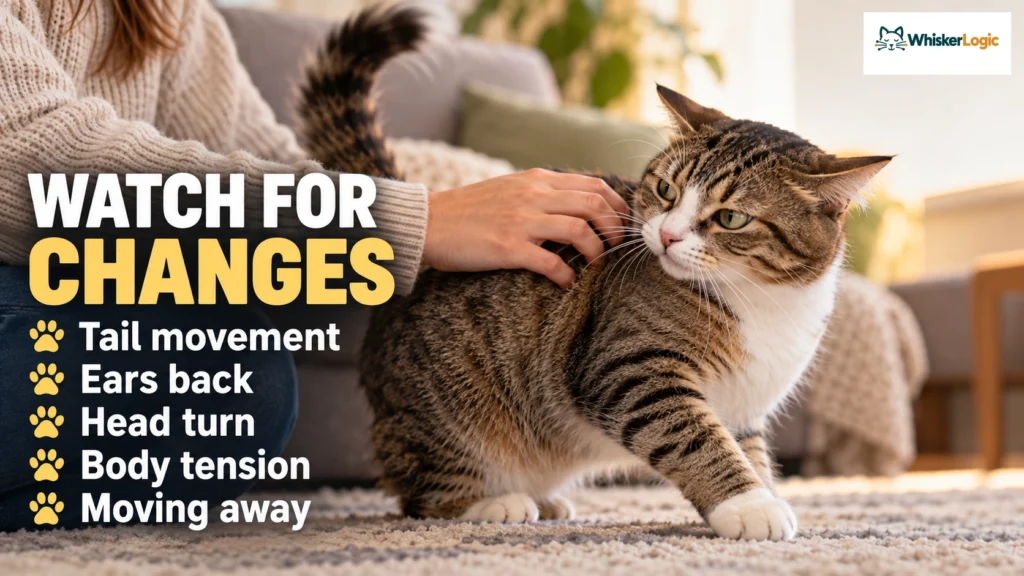
Your own cat may show only one small change.
A relaxed body may become slightly tense.
The tail may begin moving more strongly.
The ears may rotate backward.
Your cat may turn their head toward your hand, turn away from it, freeze briefly, twitch the skin along the back, or begin watching your hand more closely.
Do not wait for a hiss, growl, or dramatic swat before deciding the interaction should end.
A useful question is:
What changed compared with a few moments ago?
A cat that was loose and relaxed but suddenly becomes still and focused on your hand may already be giving you useful information.
Where You Pet Your Cat Can Change the Response
Touch location matters, but individual preference matters even more.
The 2022 AAFP/ISFM Cat Friendly Veterinary Interaction Guidelines describe the head and neck, especially areas around the facial glands, as commonly preferred locations for tactile interaction.
Some cats show more negative responses when touched farther toward the rear of the body or around the abdomen.
That does not mean every cat loves cheek scratches or that every cat hates belly petting.
Use those population tendencies only as a starting point.
Watch your own cat.
Does your cat actively rub their forehead, cheeks, or side of the face into your hand?
Do they remain relaxed when your hand moves along the back?
Does their posture change when you approach the rear body or belly?
If one particular location suddenly becomes sensitive, stop repeatedly testing it and discuss the change with your veterinarian.
Try Short Petting Sessions With a Check-In Pause
A useful way to reduce repeated biting is to stop treating petting as one continuous interaction.
Try this pattern:
Pet briefly → pause → observe → let your cat choose whether contact continues.
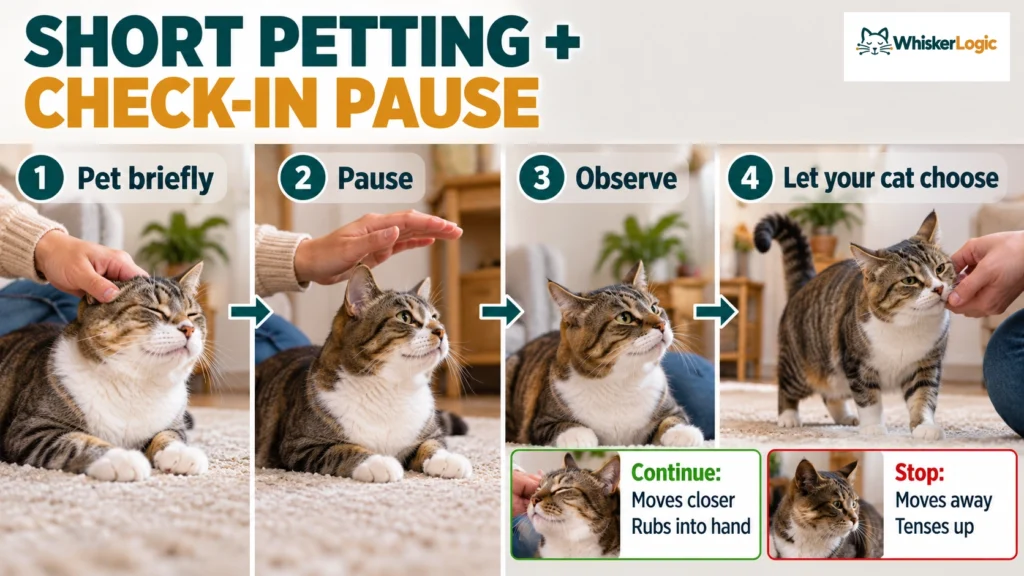
A peer-reviewed study on practical human-cat interaction guidelines emphasized giving cats more choice and control, watching their behavior carefully, and focusing touch on areas cats were more likely to accept.
The research protocol included short pauses so the person could see whether the cat chose to reinitiate contact. Cats exposed to the guideline-based interactions showed more affiliative behavior and fewer aggressive or conflict-related responses than during control interactions.
You can read the study through Frontiers in Veterinary Science.
The important lesson is not that every cat has a biological three- or five-second petting limit.
The useful principle is:
short contact + pause + voluntary continuation.
When you pause, your cat may rub into your hand, move closer, remain loose and relaxed, or deliberately reinitiate contact.
Those responses can suggest that continued interaction is welcome.
If your cat moves away, becomes tense, changes ear or tail position, turns away from your hand, or simply does not reinitiate contact, treat the pause as a good place to stop rather than assuming they want more.
What to Do the Moment Your Cat Bites
Stop touching immediately.
Do not grab your cat, hold them down, push the interaction further, or reach back in to test whether they will bite again.
Give your cat the opportunity to disengage without being restrained.
Do not punish them.
Cornell advises against physical punishment when managing feline aggression because confrontation can increase fear or conflict instead of improving the interaction.
Once the situation is calm, think about what happened before the bite.
Was the session longer than usual?
Had your cat’s body language changed?
Were you touching a different area?
Had something exciting or frightening happened immediately beforehand?
If your cat seems interested in interacting later but not in being touched, another activity may be a better choice. Play, a food puzzle, simple training, or quiet proximity can provide interaction without forcing another petting session.
When Pain Could Be Making Your Cat Less Tolerant of Touch
Pain moves higher on the checklist when the behavior changes suddenly.
This is especially important if a previously tolerant cat begins biting when touched, if only one body area triggers the reaction, or if the change appears alongside differences in mobility or daily behavior.
Changes in jumping, stiffness, grooming, appetite, activity, hiding, posture, or tolerance for handling can all be useful information for your veterinarian.
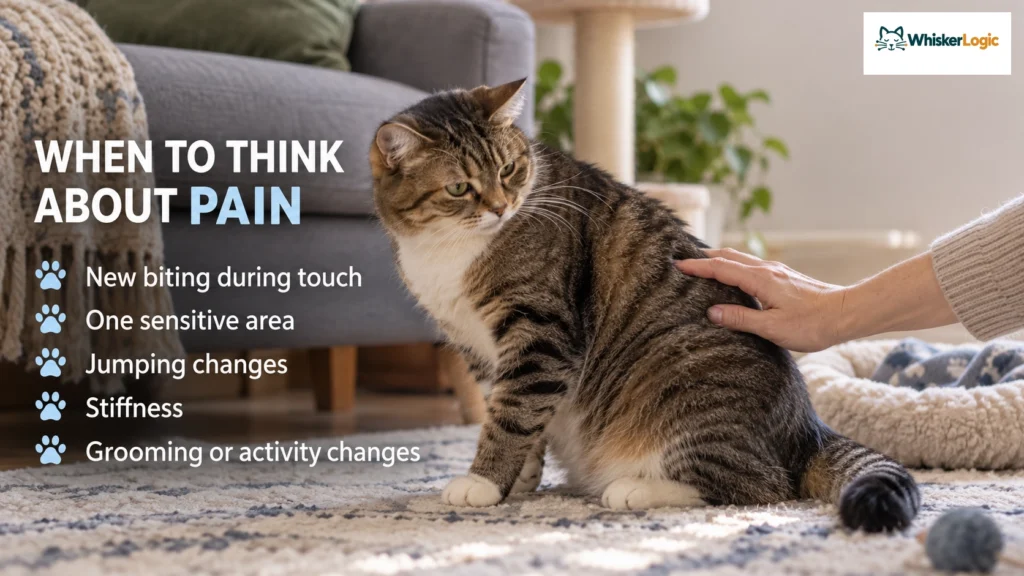
The AAHA Pain Management Guidelines emphasize that behavioral changes noticed by owners at home are an important part of evaluating pain in animals.
Possible discomfort can involve joints, the neck or back, the skin, the ears, the mouth, teeth, gums, or other parts of the body.
Do not try to identify the exact medical problem from the bite alone.
Use the change in behavior as a reason to seek veterinary evaluation when appropriate.
A cat that suddenly resists touch may need a medical assessment before anyone tries to “train out” the reaction.
How to Reduce Biting During Petting
The goal is not to make your cat tolerate as much touching as you want.
Start by finding interactions your cat can comfortably choose and end.
Let your cat initiate more of the contact. Begin with areas they consistently appear comfortable having touched. Keep early interactions short. Pause before the interaction becomes tense. Stop when you notice the first meaningful change in body language.
Make sure your cat has an easy way to move away rather than being trapped between your body, furniture, or your hands.
If your cat repeatedly seeks interaction but does not seem to want prolonged touch, try offering play, food-based enrichment, training, or quiet companionship instead.
For some cats that remain comfortable, Cornell describes using very brief petting paired with something positive such as food and gradually increasing the interaction only while the cat remains relaxed.
That does not mean every cat can or should learn to enjoy long petting sessions.
A cat that happily accepts a few cheek rubs and then chooses to sit beside you is not failing.
Respecting that preference may be exactly what prevents the next bite.
What Not to Do
Do not turn petting into a test of how much your cat will tolerate.
Avoid yelling, spraying water, tapping or hitting, prolonged restraint, forcing continued petting, holding the cat until they “calm down,” or deliberately provoking bites to discover their limit.
Do not assume purring means unlimited permission to continue.
Do not assume that approaching you means your cat wants continuous petting.
And do not repeatedly touch a body area that reliably triggers biting, particularly when the sensitivity is new.
Punishment and forced handling can make physical interaction more stressful rather than helping the cat feel safer.
Also avoid using the phrase “love bite” as though it explains the behavior.
A light nip and a deep puncture bite differ greatly in intensity and injury risk, but the bite itself does not prove affection or reveal the cat’s motive.
Look at what happened before the bite.
If the Bite Breaks Your Skin
If your cat’s teeth break your skin, take care of the injury before returning to the behavior question.
The Centers for Disease Control and Prevention recommends washing cat bites and scratches promptly with warm, soapy water.
Seek medical advice when the wound is serious, when redness, pain, warmth, or swelling develops, or when there are concerns about rabies vaccination status or tetanus protection.
Puncture wounds from cat teeth can become infected, so worsening symptoms should not be ignored.
Once the injury has been addressed, you can return to analyzing the interaction separately.
When to Get Veterinary or Behavior Help
Contact your veterinarian if the biting begins suddenly, repeatedly occurs when one specific body area is touched, or appears alongside changes in movement, appetite, grooming, activity, hiding, or general behavior.
Veterinary help is also appropriate when bites are severe, puncture injuries keep occurring, or the behavior becomes difficult to predict or manage safely.
If children or medically vulnerable people live in the household, lower the threshold for seeking professional help because repeated bites create a greater safety concern.
When pain or another medical condition is possible, veterinary evaluation should come before behavior training.
If medical causes have been assessed and your cat continues to bite despite shorter interactions, easier exits, and respect for their touch preferences, your veterinarian can help determine whether referral to a qualified veterinary behavior professional is appropriate.
Petting-related biting should also be kept separate from play biting.
A cat that chases and attacks moving hands during play is presenting a different reader situation from a cat that accepts petting and then bites during the interaction.
Likewise, a bite that follows an intense external event may involve redirected arousal rather than petting alone.
The context matters.
FAQ
Why does my cat bite me while purring?
Purring does not tell you by itself whether your cat wants petting to continue.
Look at the rest of their behavior. If their posture becomes tense, their tail changes, their ears move back, they focus on your hand, or they move away, stop petting even if they are still purring.
Why does my cat bite me after only a few pets?
Some cats prefer very brief physical contact. Others may dislike the location or style of touch.
Try shorter contact followed by a pause and see whether your cat actively reinitiates the interaction.
If a cat who previously enjoyed more petting suddenly begins biting after only a few touches, consider a veterinary evaluation.
Why does my cat bite when I pet their back?
Your cat may be less comfortable with touch in that area, or the location may be sensitive.
If touching the same spot repeatedly produces tension, withdrawal, vocalization, swatting, or biting—especially when this reaction is new—stop testing the area and talk with your veterinarian.
Does my cat bite me because they are overstimulated?
Possibly, but a bite does not prove overstimulation.
Veterinary sources describe several possible contributors to petting-related biting, including low tolerance for prolonged contact, increasing arousal, discomfort with handling, pain, redirected arousal, or simply wanting the physical interaction to stop.
Timing and context are more useful than automatically assigning one explanation.
Are cat “love bites” really affection?
A bite cannot prove affection by itself.
Instead of trying to name the bite, look at what was happening before it. Was your cat continuing to seek physical contact, or had their behavior already changed?
A gentle nip also carries a different injury risk from a deep puncture, regardless of the cat’s motive.
Should I stop petting my cat if they bite?
Yes.
Stop the physical contact at that moment and give your cat an opportunity to disengage.
Do not punish them or immediately begin petting again to see whether they will bite twice.
Can sudden biting during petting mean my cat is in pain?
It can.
Pain is one possible explanation, particularly when biting is new, happens when one specific body area is touched, or appears alongside changes in movement, jumping, grooming, appetite, activity, hiding, or tolerance for handling.
A veterinarian is needed to determine whether pain or another medical problem is actually present.
Why does my cat bite me when I pet them but still stay on my lap?
Your cat may want proximity without wanting continued physical contact.
Sitting on you can provide warmth, security, or companionship without necessarily being a request for continuous stroking.
Try allowing your cat to remain with you without immediately restarting the petting. Later, offer brief contact and pause to see whether they actively ask for more.
Sources
Cornell Feline Health Center — Feline Behavior Problems: Aggression
Merck Veterinary Manual — Behavior Problems of Cats
VCA Animal Hospitals — Cat Behavior Problems: Petting Aggression
2022 AAFP/ISFM Cat Friendly Veterinary Interaction Guidelines
Haywood et al. — Practical Human-Cat Interaction Guidelines