
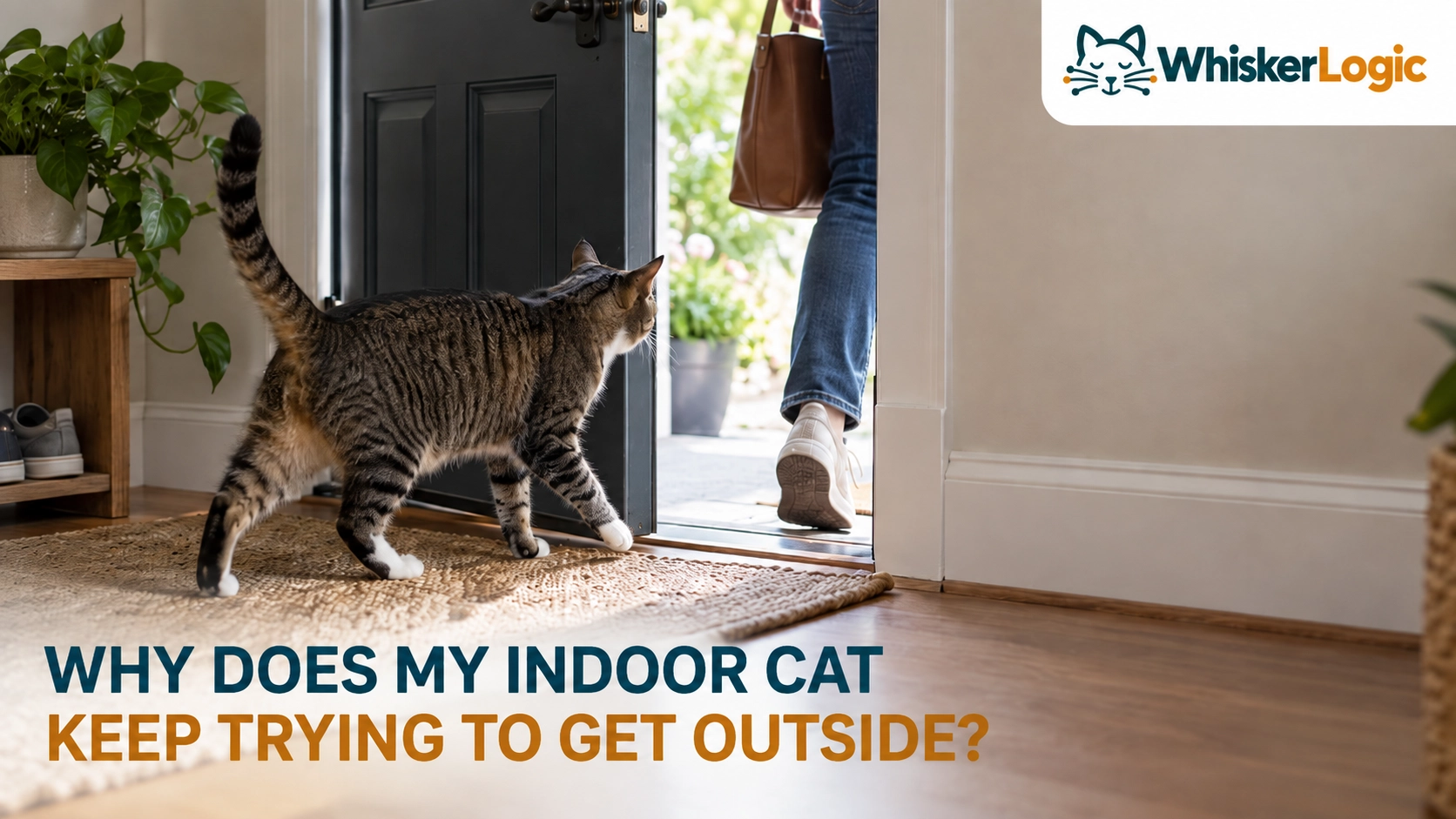
You crack the front door open, and your cat is already there—waiting, vocalizing, or trying to squeeze between your legs.
If your indoor cat keeps trying to get outside, the behavior tells you something important: getting through that door has become valuable to your cat. What it does not tell you, by itself, is why.
Your cat may be responding to interesting sights, scents, sounds, other animals, a learned door-opening routine, previous outdoor experience, reproductive motivation, or opportunities outside that are hard to recreate indoors. In some cases, the indoor environment may also need improvement.
The first priority is preventing an unsafe escape. Then you can observe the pattern, improve useful indoor opportunities, and teach your cat a safer behavior around doors.
Quick Answer
If your indoor cat keeps trying to get outside:
- Prevent escape first. Manage doors, visitors, deliveries, windows, and screens before relying on training.
- Watch the pattern. Notice when the behavior happens, what is outside, and what happens immediately before and after it.
- Do not assume boredom or unhappiness. Outdoor environments can be interesting even to cats living comfortably indoors.
- Look beyond basic care. Cats need opportunities to climb, hide, scratch, explore, stalk, chase, pounce, forage, rest, and make choices.
- Teach an alternative door behavior. A mat, perch, or other station away from the doorway can be reinforced gradually.
- Consider controlled outdoor access only if it suits the individual cat. A catio, secure enclosure, cat-safe fencing, or gradually introduced harness may be appropriate for some cats.
- Talk to your veterinarian if the behavior is sudden or comes with other changes, especially increased vocalization, restlessness, appetite or thirst changes, weight change, sleep changes, mobility changes, or signs of pain.
Wanting to investigate outside is not proof that your cat is unhappy indoors.
Vet Check
A cat that has always watched the door is different from a cat that suddenly becomes intensely restless, vocal, or determined to escape.
Veterinary evaluation becomes more important if the behavior is new or rapidly increasing, particularly in an older cat, or if you also notice:
- a major increase in vocalization
- difficulty settling
- appetite or thirst changes
- weight gain or loss
- changes in sleep
- changes in movement or mobility
- possible pain
- changes in activity
- disorientation
- other significant behavioral changes
Medical conditions can affect behavior, activity, sleep, vocalization, and restlessness. Door-focused behavior alone does not diagnose a medical problem, but a broader behavioral change deserves attention.
Table of Contents
Common Reasons an Indoor Cat Keeps Trying to Get Outside
There is no single explanation that can be diagnosed from door-dashing alone.
Start by treating the behavior as an observation:
Your cat is repeatedly trying to gain access to the other side of a door.
Then look for context before deciding what that means.
The Outside May Simply Be Interesting
An open door can expose your cat to changing smells, moving animals, people, wind, vegetation, sounds, sunlight, and unfamiliar spaces.
That can make the outdoors highly rewarding to investigate even when the cat’s indoor environment is generally good.
Interest in the outside world is therefore not, by itself, evidence of poor welfare indoors.
Hunting-Like Opportunities May Be Attracting Your Cat
Birds, insects, squirrels, blowing leaves, and other moving targets can trigger stalking, watching, chasing, and pouncing behavior.
A cat sitting intensely at a door or window may be responding to something specific outside rather than making a general statement about indoor life.
Your Cat May Have Learned a Door Routine
Cats learn from what happens around them.
If approaching a doorway, crying, scratching, or rushing forward has sometimes resulted in the door opening, access itself may become part of the learned sequence.
That does not mean the cat is deliberately being difficult. It means the consequences of the behavior may be helping maintain it.
Previous Outdoor Access May Matter
A cat that previously roamed outdoors already knows what is available beyond the door.
That history may make outdoor access especially valuable, but it still does not prove that previous outdoor cats can never adapt to indoor living.
Look at the individual cat rather than applying a universal rule.
The Indoor Environment May Need Improvement
Sometimes repeated door-focused behavior occurs alongside limited opportunities for climbing, scratching, play, exploration, foraging, hiding, or choice.
That possibility deserves investigation—but it should not be assumed from the door behavior alone.
Reproductive Motivation May Contribute
If your cat is sexually intact, reproductive motivation can contribute to roaming and efforts to reach other cats.
But door behavior can have multiple causes, and spaying or neutering should not be presented as a guaranteed cure for every cat that tries to escape.
First Figure Out What the Door Behavior Actually Looks Like
Before changing everything in your home, watch what actually happens.
The pattern often tells you more than the fact that your cat wants outside.
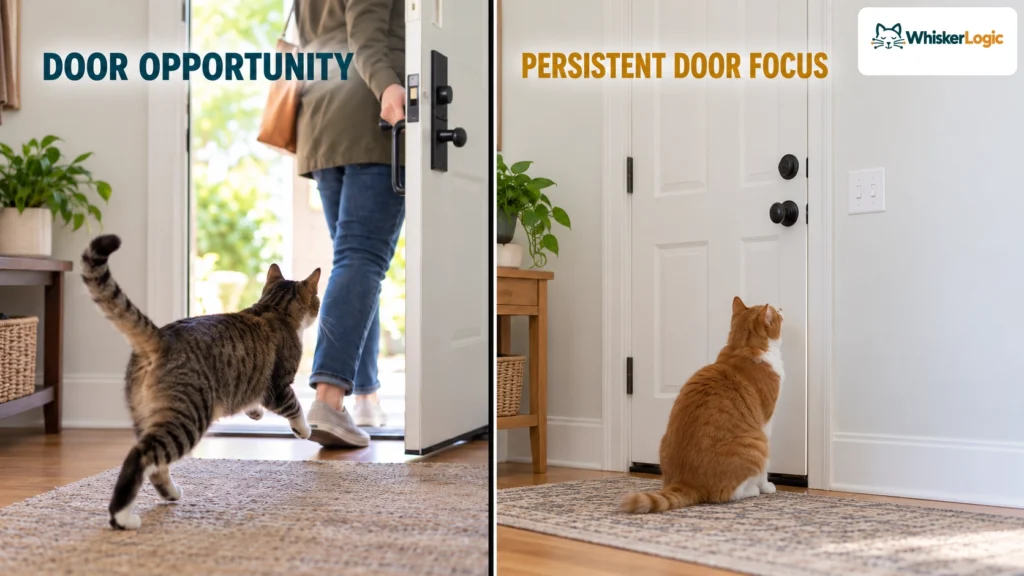
Observation: Your Cat Rushes Only When the Door Opens
The cat may appear relaxed most of the day but suddenly race toward the doorway when someone enters or leaves.
Possible interpretation: The opening itself may be the important opportunity. Your cat may have learned that an open door creates a brief chance to explore.
Action: Improve doorway management immediately and begin teaching a station away from the entrance.
Observation: Your Cat Waits at the Door and Vocalizes for Long Periods
This is different from opportunistic door-dashing.
Possible interpretation: Look at the whole situation. Is there another animal outside? Does this happen at predictable times? Did the cat previously go outdoors? Is the cat intact? Are useful indoor activities limited?
Action: Track timing and triggers across repeated episodes instead of assuming the vocalization means boredom.
Observation: Your Cat Is Focused on One Particular Door or Window
Possible interpretation: Something specific may be attracting attention in that location.
Action: Look outside from your cat’s perspective. Check for animals, movement, scents, feeding stations, people, or predictable activity.
Observation: The Behavior Started Suddenly
A sudden behavioral change deserves more attention than a long-standing habit.
Action: Look for other changes in vocalization, appetite, thirst, weight, sleep, activity, mobility, or comfort and discuss concerning changes with your veterinarian.
Observation: Your Cat Seems Interested in Almost Every Opening
This may reflect a strong tendency toward exploration, a history of outdoor access, highly rewarding outside experiences, environmental needs that deserve review, or a combination of factors.
The observation narrows the possibilities. It does not prove the cause.
What Is Outside That Your Cat Keeps Responding To?
Before asking, “What is wrong inside?” also ask:
“What is happening outside?”
Spend some time noticing what your cat can detect near the doorway or nearby windows.
Possible attractions include:
- birds
- squirrels
- insects
- neighborhood cats
- dogs
- people
- vehicles
- leaves and vegetation moving in the wind
- unfamiliar scents
- sounds that are much more noticeable to your cat than to you
- predictable outdoor routines
Pay attention to timing.
If your cat becomes intensely focused on the door when another cat regularly passes through the yard, that is useful information.
If the behavior appears when birds become active outside a particular window, that is useful information too.
Neither observation proves exactly what your cat is feeling. It gives you a better starting point for deciding what to change.
Check Whether Your Indoor Environment Meets More Than the Basics
Food, water, and a litter box are essential, but they are not the complete indoor environment.
Good indoor care should also give a cat meaningful opportunities to perform normal feline behaviors.
Look at your home through that lens.
Can Your Cat Get Up High?
Provide safe vertical spaces such as cat trees, sturdy shelves, window perches, or furniture arrangements that allow climbing and observation.
Different cats prefer different heights and locations.
Can Your Cat Retreat Somewhere Safe?
Cats benefit from places where they can rest without being disturbed.
That might include elevated beds, boxes, covered resting areas, quiet rooms, or other secure locations.
Can Your Cat Scratch Appropriately?
Offer stable scratching surfaces in useful locations.
The important question is not whether you own a scratching post. It is whether your cat has a scratching option with a location, orientation, and material the cat will actually use.
Does Your Cat Get Interactive Play?
Interactive play can allow stalking, chasing, pouncing, grabbing, and other hunting-like behaviors.
How your cat engages matters more than simply leaving toys on the floor.
Does Your Cat Ever Have to Search for Something?
Food puzzles, appropriate hidden food opportunities, and other forms of foraging can make part of the day more active and exploratory.
Does Your Cat Have Choices?
Choice matters.
Where can your cat sleep?
Where can your cat watch the room?
Can the cat move away from people or other pets?
Are important resources available without forcing the cat through a difficult social situation?
In multi-cat homes, distributing important resources can be especially useful so that one cat does not have to pass another cat to reach food, water, litter boxes, resting areas, or other valued locations.
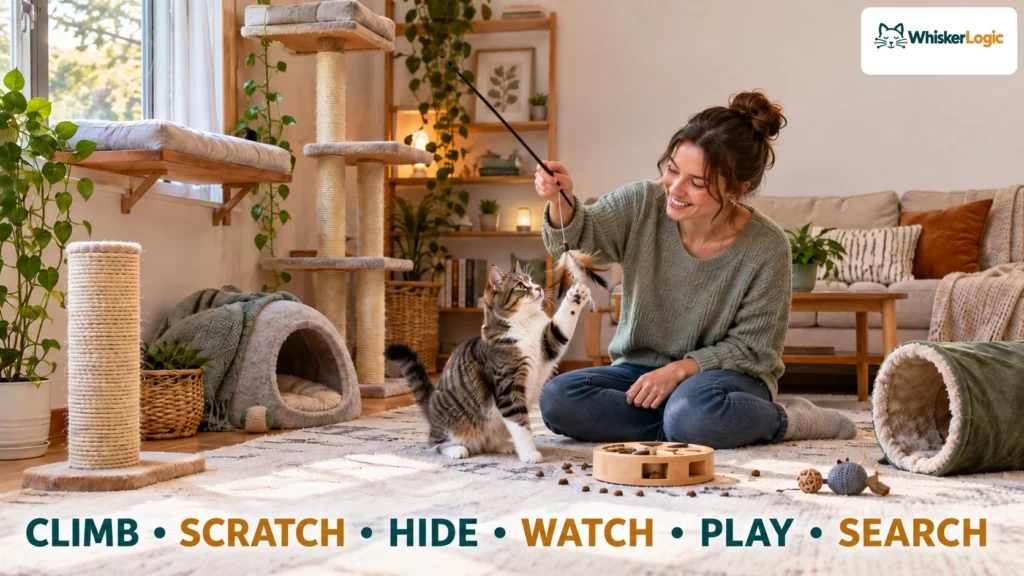
Give Your Cat Things to Do, Not Just Things to Own
Buying more toys is not automatically the same thing as improving your cat’s environment.
Instead of counting objects, ask which behaviors those objects actually make possible.
Stalk
Move an interactive toy in a way that gives your cat an opportunity to watch and stalk rather than repeatedly pushing the toy toward the cat.
Chase
Give your cat opportunities to pursue moving toys during interactive sessions.
Pounce
Allow moments when your cat can hide, watch, and then move toward a target.
Climb
Use stable vertical spaces that create real destinations rather than decorative structures your cat never visits.
Scratch
Place suitable scratching surfaces where scratching is likely to occur, including near resting areas or other meaningful locations.
Search
Use safe food-searching or foraging opportunities instead of serving every reward in exactly the same place.
Hide
Maintain quiet locations your cat can enter voluntarily.
Observe
A secure window perch or elevated observation spot can provide changing visual activity without requiring unrestricted outdoor access.
Choose
Give your cat multiple acceptable ways to rest, interact, explore, or disengage.
This is a more useful enrichment test than asking, “Does my cat have enough toys?”
A home can contain many toys and still offer very little meaningful activity if none of them support behaviors the cat actually wants to perform.
Stop the Escape Risk Before You Try to Change the Behavior
When an indoor cat keeps trying to get outside, management should come before training.
Training takes time.
An open front door can create an escape opportunity in seconds.
That is why you should reduce the immediate escape risk while teaching a safer routine.
Know Where Your Cat Is Before Opening an Exterior Door
Make checking for the cat part of the household routine, especially before bringing in groceries, carrying packages, or admitting visitors.
Use a Secondary Barrier When Practical
Depending on your home and your cat, this might be another closed door, an entry area, or another secure physical barrier between the cat and the exterior door.
The barrier needs to be appropriate for that individual cat. A short gate is not meaningful protection if the cat can easily jump over it.
Use Another Room During High-Risk Situations
Deliveries, repair visits, parties, moving furniture, and repeated trips through the front door can overwhelm normal door routines.
Temporarily placing the cat in a comfortable room with needed resources can be safer than trying to manage many repeated door openings.
Communicate With Everyone in the Household
Door safety works poorly if one person is training carefully while another regularly holds the door open.
Make sure children, visitors, and other household members understand the plan.
Check Windows and Screens Too
A cat focused on outdoor access may also investigate loose screens, damaged window barriers, or other possible exits.
Avoid Unnecessary Open-Door Time
Do not stand in an exterior doorway with the door wide open while expecting your cat to resist approaching it.
Management is not a failure of training.
It protects the cat and reduces opportunities to rehearse door-dashing while a safer habit is being built.
Teach Your Cat What to Do When the Door Opens
“Don’t run outside” is difficult to teach because it describes what you do not want.
A clearer goal is to teach a behavior your cat can perform.
For example:
When activity starts at the door, go to this mat or perch.
Choose a station far enough from the doorway that the cat is not sitting directly in the escape path.
Then build the behavior gradually.
Step 1: Make the Station Valuable
Reward your cat for approaching and spending time on the mat, perch, or chosen location.
At first, the exterior door does not need to be involved at all.
Step 2: Add Small Door-Related Movements
Once your cat understands the station, make a small movement toward the door.
Reward the cat for remaining at the station.
You might progress from touching the door handle to moving the door slightly.
Step 3: Increase Difficulty Gradually
When your cat is succeeding at one level, add a slightly more difficult version.
For example:
- touch the handle
- turn the handle
- move the door slightly
- open a very small gap
- open it a little farther
Do not jump from a closed door to standing with the door fully open.
If your cat repeatedly leaves the station, make the exercise easier again.
Step 4: Practice Normal Household Situations
Over time, training can include the movements that normally predict someone leaving or entering.
The goal is to build a strong alternative routine before expecting it to work during an exciting real-world doorway event.
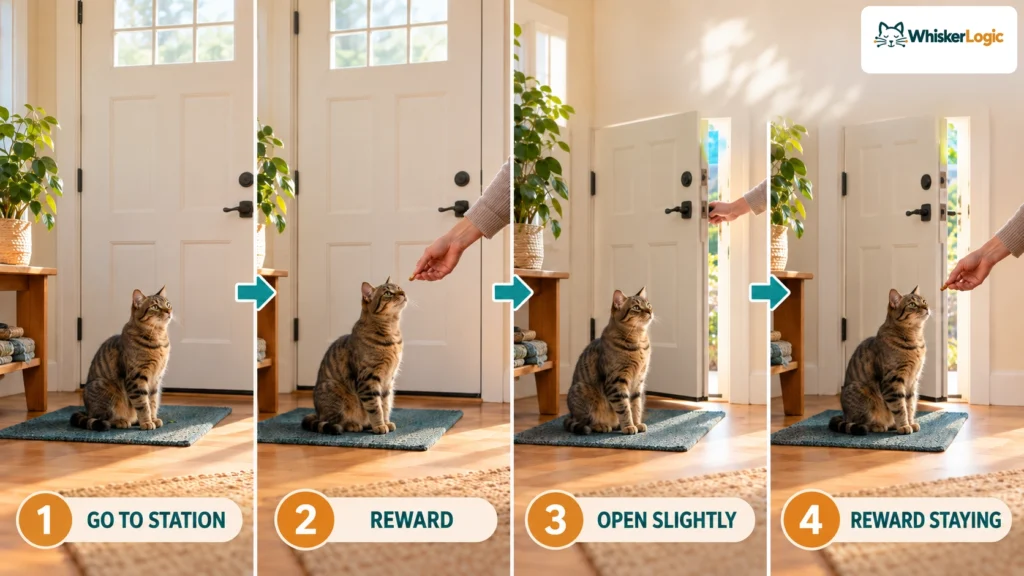
This is a practical application of positive reinforcement and shaping principles. It is not a guarantee that every cat will follow the same progression or learn at the same rate.
Do Not Accidentally Teach “Door-Dashing Makes the Door Open”
What happens immediately after a behavior can affect whether that behavior becomes more likely in the future.
Imagine this repeated sequence:
Cat cries at the door → cat scratches or rushes forward → human opens the door → cat gets outdoor access.
From the cat’s perspective, the behavior immediately before access may become part of a successful routine.
This does not mean you should ignore genuine welfare needs or never provide controlled outdoor time.
Instead, separate outdoor access from the unwanted door behavior.
For example, if you decide that controlled outdoor access is appropriate, create a predictable routine or cue that begins when your cat is calm and in the appropriate location.
Avoid making scratching, crying, or rushing the behavior that reliably makes the door open.
If Your Cat Used to Live Outdoors
Previous experience matters.
A cat that spent months or years exploring outdoors may react differently to indoor life than a cat that has never had outdoor access.
The outside may already contain familiar territories, smells, movement patterns, and activities that were previously part of the cat’s daily routine.
That history is useful context, but avoid the opposite extreme of assuming:
“Once a cat has been outside, the cat must always roam freely.”
Instead, look at the individual.
Can you provide better indoor opportunities?
Would secure outdoor access be appropriate?
Does the cat settle after interactive activities?
Is the cat focused on a particular outdoor stimulus?
Does the behavior occur at times that match the cat’s previous routine?
There is no universal adjustment timeline that applies to every former outdoor cat.
Could Reproductive Hormones Be Contributing?
If your cat is not spayed or neutered, reproductive motivation may contribute to roaming behavior or attempts to reach other cats.
This can be particularly relevant when a sexually intact cat also shows mating-related behaviors such as increased roaming, vocalization, marking, or strong interest in other cats.
But hormone-related behavior is only one possible contributor.
Spaying or neutering should not be presented as a guaranteed treatment for every cat that waits at the door or tries to escape.
If your cat is intact, discuss reproductive status and the cat’s overall health with your veterinarian.
Would a Catio or Harness Walk Help?
Possibly—but controlled outdoor access is an option, not a prescription.
Outdoor environments can provide movement, scents, sounds, exploration, climbing, and other changing stimulation.
Uncontrolled outdoor access also introduces hazards that are harder to manage, including traffic, injuries, infectious disease exposure, parasites, toxins, predators, and becoming lost or separated from home.
For some cats and households, controlled access may provide a useful middle ground.

Catio or Secure Enclosure
A secure outdoor enclosure can provide fresh air and changing outdoor sensory experiences while limiting free roaming.
A catio should not be presented as a guaranteed cure for escape attempts.
A cat may enjoy a catio and still remain interested in another door.
Cat-Safe Fencing
Some homes may be suitable for fencing systems designed to help contain cats.
The security of the entire setup matters more than simply labeling a yard “cat-safe.”
Harness and Leash
Some cats can learn to use a properly fitted harness through gradual, reward-based training.
Start indoors.
Let the cat become comfortable with the equipment before expecting the cat to explore outdoors in it.
Do not force a frightened, frozen, or highly distressed cat to continue simply because another cat enjoys walks.
Which Option Is Best?
It depends on the individual.
One cat may enjoy a catio.
Another may adapt well to a harness.
Another may do well with improved indoor opportunities without scheduled outdoor access.
Evidence does not support a universal claim that harness walks will either cause or prevent stronger demands to go outside.
Individual responses can vary.
What Not to Do
Do Not Squirt Your Cat With Water
It does not teach the safe alternative behavior you actually want.
Do Not Yell or Deliberately Frighten the Cat
Startling a cat near the door may increase fear or distress without teaching the cat what to do instead.
Do Not Use Physical Punishment
Punishment is unnecessary for teaching an alternative behavior and can interfere with positive learning.
Do Not Chase the Cat Away From the Door
Repeated chasing can turn doorway events into an even more arousing interaction.
Instead, manage access and teach a specific behavior away from the exit.
Do Not Repeatedly Open the Door Because the Cat Is Crying
If vocalizing or scratching reliably produces outdoor access, the sequence may become stronger.
Do Not Force a Frightened Cat Into a Harness
Harness training should progress gradually and positively.
Do Not Suddenly Allow Unrestricted Roaming Just to Stop the Vocalization
First consider safety, the cat’s individual history and needs, identification, veterinary care, local risks, and whether controlled alternatives are available.
Do Not Assume “More Toys” Will Fix Everything
The question is not how many objects your cat owns.
The question is what your cat can actually do in the environment.
Prepare for an Escape Even While You Prevent One
A cat that repeatedly tests exterior doors needs more than an escape-prevention plan.
The cat also needs an escape-preparedness plan.
Microchip Your Cat
Microchipping provides a permanent form of identification that cannot simply fall off outdoors.
Make sure the microchip is registered with current contact information.
Keep Contact Information Current
A registered chip is much less useful if the associated phone number or address is outdated.
Update the registration whenever your contact information changes.
Consider Appropriate Visible Identification
Where suitable and safe for the individual cat, visible identification can help someone quickly recognize that a found cat has a home.
Make Sure Household Members Know What to Do
If the cat slips outside, household members should know immediately rather than assuming someone else has already noticed.
Know where the microchip information is stored and which local veterinary practices, shelters, or animal services you would contact if the cat became lost.
Preparing for an escape does not mean accepting that one will happen.
It adds another safety layer if prevention fails.
When to Get Veterinary or Behavior Help
Talk with your veterinarian when door-focused behavior is part of a larger behavioral or physical change.
That is especially important when:
- the behavior begins suddenly
- an older cat develops new intense door-focused behavior
- vocalization increases significantly
- the cat seems unable to settle
- appetite changes
- thirst changes
- weight changes
- sleep changes
- movement or mobility changes
- the cat appears painful
- other major behavior changes appear
Behavioral help may also be useful when:
- escape attempts are frequent enough to create significant danger
- the cat becomes highly frustrated around doors
- fear or aggression develops around doorway management
- household members cannot manage the situation safely
- basic environmental changes and reward-based training are not improving the problem
A veterinarian can help determine whether medical factors need to be addressed first.
When needed, a qualified feline behavior professional or veterinary behaviorist can help develop a more individualized behavior plan.
FAQ
Why Does My Indoor Cat Suddenly Want to Go Outside?
If your indoor cat keeps trying to get outside suddenly, pay more attention to what else has changed.
A sudden change is more significant than long-standing curiosity. Check whether something outside has changed, such as another animal appearing nearby or a new household routine. Also watch for changes in vocalization, sleep, appetite, thirst, weight, mobility, activity, or comfort.
If the new door-focused behavior is part of a broader change, contact your veterinarian.
Is My Indoor Cat Unhappy if They Keep Trying to Escape?
Not necessarily.
Outdoor environments can be interesting because they contain changing scents, sounds, movement, animals, and places to explore.
Trying to get outside does not, by itself, prove poor welfare indoors.
It is still worth reviewing whether your cat has adequate opportunities for climbing, scratching, play, hunting-like activity, foraging, hiding, observation, and choice.
Is My Cat Bored if They Sit by the Door?
You cannot determine boredom from sitting by a door alone.
Observe when the behavior happens and what the cat appears to be responding to. Then evaluate the cat’s entire indoor environment rather than using one behavior as proof of boredom.
Should I Let My Indoor Cat Outside if They Keep Asking?
Repeated requests do not automatically mean unrestricted outdoor access is the best solution.
Start with escape prevention, indoor environmental needs, and door training.
If outdoor access is appropriate for your cat and home, controlled options such as a secure enclosure, cat-safe fencing, or gradual harness training may reduce some outdoor risks.
Will a Catio Stop My Cat From Trying to Escape?
Not necessarily.
A catio can provide useful outdoor stimulation and exploration, but it is not a guaranteed treatment for door-dashing.
Continue doorway management and training even if your cat uses an enclosure.
Can I Train My Cat Not to Run Out the Door?
You can teach a safer alternative behavior.
For example, train the cat to go to a mat or perch away from the entrance and reward staying there while door movements are introduced gradually.
Physical barriers and careful doorway management should remain in place while training develops.
Does Neutering Stop Cats From Trying to Go Outside?
Reproductive hormones can contribute to roaming in sexually intact cats, but escape attempts can also involve exploration, learned routines, outdoor stimuli, previous experience, or environmental factors.
Spaying or neutering should therefore not be treated as a guaranteed cure for door-dashing.
Discuss your cat’s reproductive status and individual situation with your veterinarian.
Will Harness Walks Make My Cat Want Outside More?
There is no strong basis for a universal answer.
Individual cats may respond differently.
If you use a harness, introduce it gradually and create a predictable routine rather than opening the door whenever the cat cries, scratches, or rushes toward it.
What Should I Do if My Indoor Cat Accidentally Escapes?
Act promptly.
Secure other pets and exits, check the immediate area carefully, and use familiar voices or routines without turning the situation into a frightening chase.
Make sure your cat’s microchip registration and contact information are current. If the cat cannot be located, contact appropriate local shelters, veterinary practices, animal services, and nearby neighbors.
Sources
Feline Veterinary Medical Association — Meeting the Physical and Emotional Needs of Indoor Cats
Feline Veterinary Medical Association — Indoor/Outdoor Lifestyle Position Statement
Feline Veterinary Medical Association — Positive Reinforcement Training Educational Toolkit
Merck Veterinary Manual — Behavior Problems of Cats
Tan, Stellato & Niel — Uncontrolled Outdoor Access for Cats: An Assessment of Risks and Benefits
VCA Animal Hospitals — Cat Behavior and Training: Enrichment for Indoor Cats
Feline Veterinary Medical Association — Microchip Identification of Cats Position Statement