
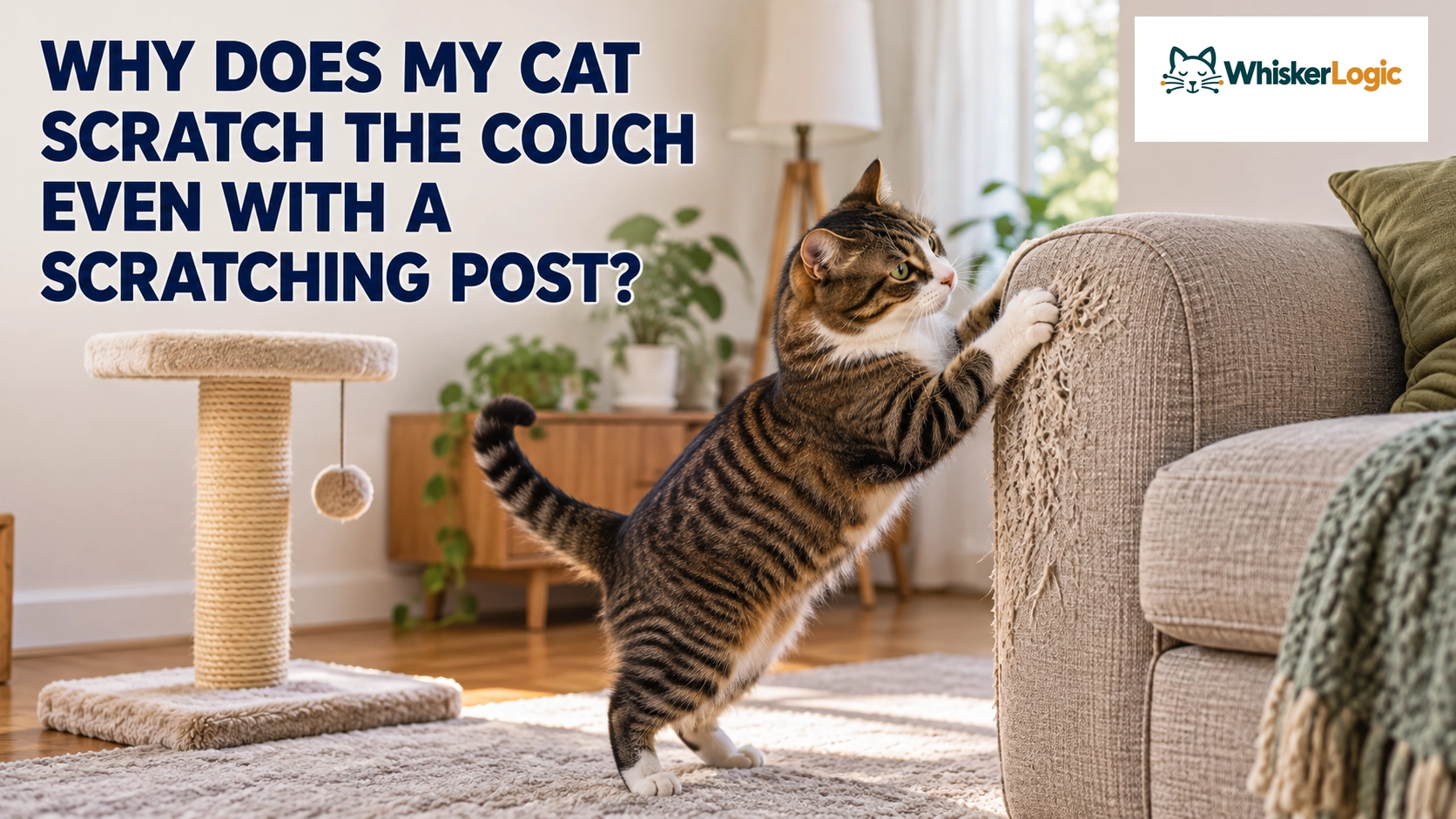
The scratching post is only a few feet away, but your cat walks past it, stretches against the arm of the couch, and scratches there again.
Cat scratches couch even with scratching post? The problem may not be a lack of scratching options. The couch may simply provide a better match for where, how, and what your cat wants to scratch.
Scratching is a normal feline behavior. It helps with claw maintenance and stretching and can leave both visible and scent-associated signals in the environment. The goal is not to stop scratching. It is to figure out why the couch is winning and give your cat an acceptable option that competes with it.
Quick Answer
A scratching post being available does not mean it provides the same scratching experience as the couch.
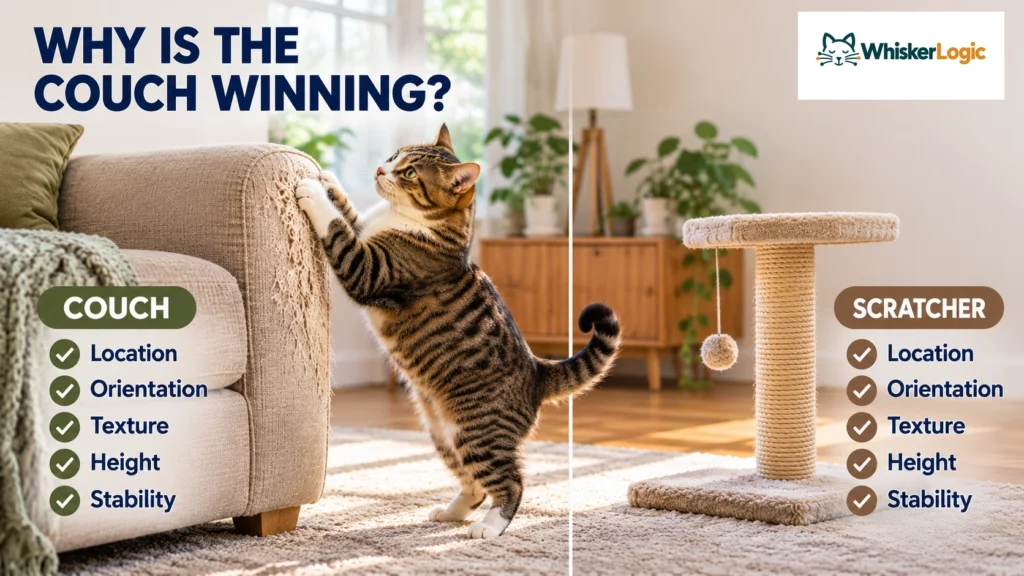
Compare the couch and the current scratcher for:
- location,
- vertical, horizontal, or angled orientation,
- texture,
- usable height,
- stability,
- the body movement your cat makes,
- and when and where the scratching happens.
Then put a better-matched scratching surface beside or very near the furniture your cat already scratches. Protect the furniture temporarily, reward appropriate scratching promptly, and do not punish your cat.
The key distinction is scratching availability versus scratching suitability.
Vet Check
A cat that has scratched the same couch for months or years is different from a cat whose scratching style suddenly changes.
Veterinary evaluation becomes more important if your cat suddenly stops using a scratching surface they previously used, particularly if you also notice changes in jumping, stairs, walking, activity, play, grooming, or sensitivity to touch.
This is especially important in older cats. A change from a previously preferred vertical scratcher to lower or horizontal surfaces can occur as physical needs change, but scratching behavior alone cannot diagnose pain or arthritis.
Cat Scratches Couch Even With Scratching Post: Why Does It Happen?
Availability does not equal suitability.
Your cat may have a scratching post and still choose the couch because the two options differ in ways that matter to the cat.
The couch may be more stable. It may provide a larger surface for stretching. Its upholstery may feel different under the paws. Its arm may allow a specific angle of pulling. Or it may be located exactly where your cat wants to scratch.
Research involving thousands of cat caregivers has found population-level differences in the use of different scratching structures and substrates. Those findings are useful starting points, but they do not establish one universally best scratching post.
Other field research has also found that material, angle, and length alone do not fully explain how often cats use designated scratching objects.
Instead of asking only:
“Why won’t my cat use the scratching post?”
ask:
“What does the couch provide that the scratching post does not?”
That question gives you something you can actually test.
Start With the Couch: What Is Your Cat Choosing?
Before buying another scratching post, observe the surface your cat already chooses.
The couch is giving you information about your cat’s scratching preferences.
Look at the location
Does your cat repeatedly scratch one particular couch arm or corner?
Notice whether that location is:
- near a favorite resting place,
- close to a window or door,
- along a frequently used route,
- or in a living area where people and cats spend a lot of time.
If the same location is targeted repeatedly, location may be part of the attraction.
Look at orientation
Watch the angle of your cat’s body and paws.
Does your cat stand up and pull downward on a vertical couch arm?
Scratch horizontally across carpet or a seat?
Use a sloped edge?
Cats can use vertical, horizontal, and angled scratching surfaces. The important question is which type your cat repeatedly chooses.
Look at the movement
Watch more than the paws.
Does your cat reach high, extend the front legs, lean back, pull downward, or perform a long full-body stretch?
Or does the cat remain low and rake across a horizontal surface?
A useful replacement should allow a similar movement.
Look at texture
Furniture fabric, carpet, cardboard, wood, and rope all provide different tactile experiences.
Some studies have found population-level preferences for certain materials, including rope-covered surfaces. But individual cats vary, and no single material has been shown to be best for every cat.
Use your cat’s repeated choices as evidence.
Look at timing
Notice when the scratching happens.
Does your cat scratch shortly after waking?
When entering a particular room?
Near a window or doorway?
During an active period?
Feline veterinary guidance notes that cats often scratch after waking, which is one reason an appropriate scratching surface near a favorite resting area can be useful.
Does the Scratching Post Match the Way Your Cat Scratches?
A vertical post is not necessarily an equivalent alternative for a cat that repeatedly scratches horizontally.
Likewise, a small horizontal pad may not compete well with a couch if your cat consistently stands tall, reaches upward, and pulls downward.
Use the furniture behavior as your guide.
If your cat scratches vertically, test a stable vertical scratching surface.
If your cat scratches horizontally, test a horizontal option.
If your cat repeatedly chooses an angled surface, test an angled scratcher.
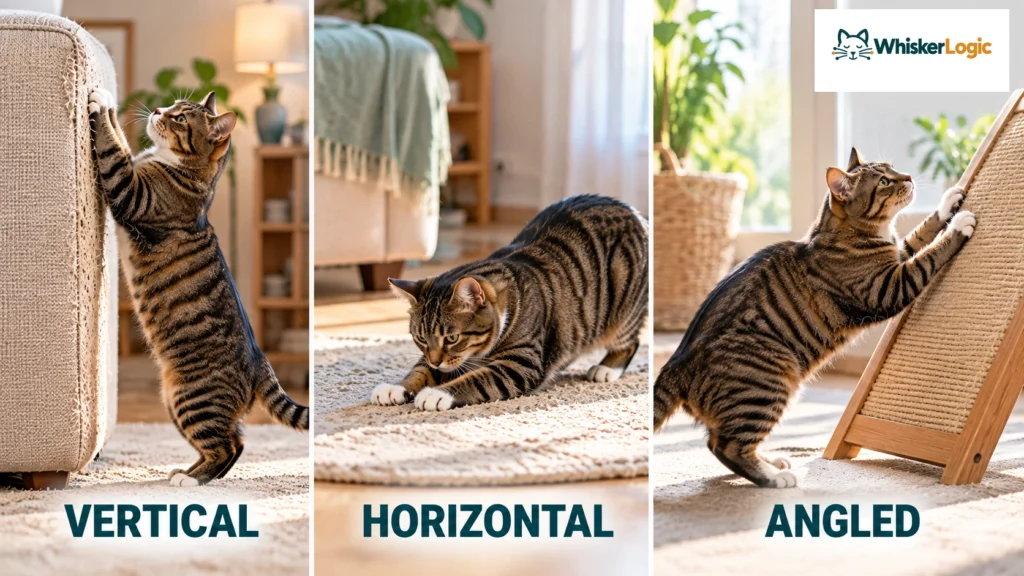
The point is not to decide which design cats are supposed to prefer.
It is to reproduce the scratching experience your individual cat is already choosing, but on a surface you are comfortable having scratched.
Is the Post Tall and Stable Enough for the Movement Your Cat Is Making?
Stability can be an important difference between a couch and a scratching post.
A couch barely moves when a cat leans back and pulls against it.
A lightweight scratching post may wobble, slide, rock, or tip.
If that happens, the post is not providing the same physical experience.
Watch your cat interact with the current scratcher. If it shifts under the cat’s weight or pulling force, stability is worth testing.
Height should also be considered in relation to the cat’s actual movement rather than an arbitrary number.
Ask:
Can my cat comfortably perform the same full-body scratching movement here that they perform on the couch?
A cat that reaches high against the couch needs enough usable vertical surface to perform that movement comfortably.
For a cat that prefers horizontal scratching, vertical height may be largely irrelevant.
Research has found some population-level associations between scratching-post dimensions and use, but those findings should not be turned into a universal rule such as “every cat needs a three-foot sisal post.”
Match the scratcher to the cat in front of you.
The Location May Matter More Than the Post
A well-designed scratching post can still lose to the couch if it is in a location your cat rarely uses.
Scratching has visual and scent-associated signaling functions, so where scratching occurs can matter as well as what is being scratched.
Useful places to test scratching surfaces can include:
- near favorite resting or sleeping areas,
- in living areas where people and cats spend time,
- near windows or doors,
- or beside an existing furniture-scratching target.
Do not automatically hide the scratching post in a remote corner because it looks better there.
A scratcher that fits the room aesthetically but is ignored by the cat is not solving the problem.
When a cat scratches the couch even with a scratching post nearby, however, location is not automatically the answer either. If both are already close together, compare orientation, texture, stability, usable size, and movement next.
Put the Replacement Where the Scratching Is Happening First
If one part of the couch is already the established scratching target, start there.
Place the new or better-matched scratcher beside, in front of, or as close as practical to the targeted area.
This gives the acceptable surface the best opportunity to compete directly with the couch.
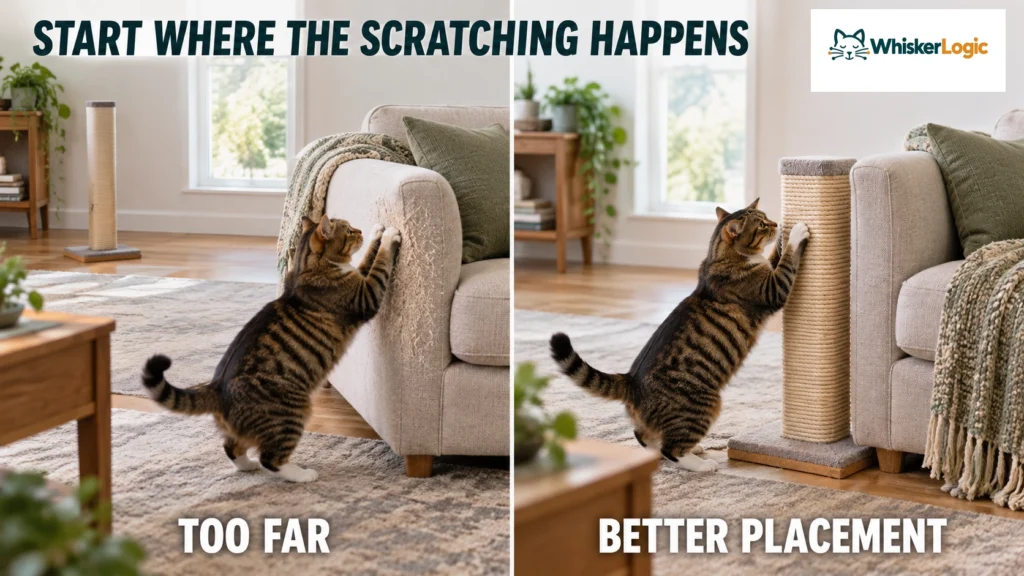
Do not immediately put it across the room just because that is where you eventually want it.
First answer a more useful question:
Will my cat choose this scratching surface when it is available at the location where scratching already happens?
Cornell’s feline behavior guidance recommends placing an appropriate scratching object near the area already being scratched and, once it is being used successfully, gradually moving it toward the desired location.
If the cat continues to use it, gradual repositioning can be tested.
If couch scratching returns as the scratcher is moved away, that is useful information: location may have been an important part of why the new option worked.
Test One Meaningful Difference at a Time
Changing everything at once may solve the problem, but it teaches you very little about what actually mattered.
Suppose your current scratcher is short, carpet-covered, vertical, and placed across the room.
You replace it with a taller rope-covered scratcher directly beside the couch.
If your cat suddenly uses it, what caused the change?
Was it:
- location,
- stability,
- height,
- texture,
- orientation,
- or a combination?
When practical, run simpler comparisons.
Observation: The cat scratches the couch arm vertically.
Test: Move the existing vertical scratcher beside that couch arm.
Result: Watch whether scratching shifts toward the post.
Adjustment: If it does not, test another meaningful difference such as texture, usable height, or stability.
Another example:
Observation: The cat ignores the vertical post but scratches the carpet.
Test: Offer a horizontal scratcher in the same general area.
Result: Compare use.
Adjustment: If the horizontal option is consistently chosen, orientation may be important for that cat.
This approach turns guessing into observation.
Give Your Cat More Than One Kind of Scratching Option
If your cat’s preferences are unclear, variety can help.
That does not mean buying several identical scratching posts.
Meaningful variety might include:
- vertical and horizontal options,
- different surface textures,
- different usable heights,
- or scratching surfaces in different relevant locations.
A large survey found that unwanted scratching was less common as the variety of scratching-post styles increased in the home. A 2022 cross-sectional study also found associations between several scratching resources or management practices and fewer caregiver reports of unwanted scratching.
These are associations, not proof that a specific number or type of scratcher will prevent furniture scratching in every home.
There is no evidence-based universal number of scratchers that every cat must have.
The useful question is whether your cat has meaningfully different acceptable options.
Reward the Scratcher You Want Your Cat to Use
When your cat uses the desired scratching surface, reward that choice promptly.
The reward should be something the individual cat values.
That may be:
- food,
- play,
- or preferred social interaction.
Current FelineVMA positive-reinforcement guidance recommends using treats, toys, or preferred human attention to encourage and reward appropriate scratching.
The sequence can be simple:
Cat uses the appropriate scratcher → something the cat values follows.
You do not need to turn every scratching event into a formal training session.
Consistency matters more than complexity.
Catnip can also be used to encourage interest in a scratching surface for cats that respond to it. But it is optional, not every cat responds to catnip, and it cannot compensate for a scratcher that is unstable or badly placed for that cat’s needs.
Protect the Couch While the New Habit Develops
You do not need to leave the furniture exposed while you work out what your cat prefers.
Temporary management can protect the target while the acceptable scratching option becomes more useful.
A suitable furniture protector or throw can help. Temporarily limiting access to a particular target may also be practical in some homes, as long as the cat still has access to important resources and an appropriate scratching surface.
But remember the difference between furniture protection and a behavior solution.
Covering the couch may protect it.
It does not tell you what your cat wants to scratch instead.
Pair temporary protection with an appropriate alternative.
The 2026 FelineVMA Positive Reinforcement Training Educational Toolkit recommends furniture or carpet protectors and throw blankets for established sofa or carpet scratching while an appropriate scratching surface is provided.
Its updated guidance also advises against using double-sided sticky tape as a punishment-based deterrent.
Do Not Punish Normal Scratching
Do not spray your cat with water, yell, chase, hit, physically correct, or deliberately frighten them for scratching.
Scratching is not revenge, spite, disobedience, or evidence that your cat is trying to dominate you.
It is a normal feline behavior occurring on a surface you would prefer the cat not to use.
Punishment also fails to answer the practical question:
What should the cat scratch instead?
FelineVMA’s current training guidance recommends positive reinforcement and warns against punishment-based approaches.
A 2022 survey study also found that caregiver reports of verbal and physical correction were associated with more reports of unwanted scratching, while rewarding appropriate scratching was associated with fewer reports.
Because the study was cross-sectional, it cannot prove direction of causation. Cats that scratched furniture more could also have been more likely to receive correction.
The practical approach remains the same:
Provide a better alternative and reinforce its use instead of punishing normal scratching.
When Increased Scratching May Be Part of a Bigger Change
Scratching furniture does not automatically mean your cat is stressed.
Start by checking the straightforward possibilities:
- Is the couch in the preferred location?
- Does it provide a different texture?
- Is it more stable?
- Does it allow a better stretch?
- Does its orientation match the cat’s preferred movement?
Then look at the broader context.
If scratching has noticeably increased or moved to new locations at the same time as other changes in the household or your cat’s behavior, those changes may be relevant.
A 2024 study examining 1,211 cats found associations between unwanted scratching and multiple cat-related and environmental factors. Because it was questionnaire-based and observational, those associations should not be treated as proof that one factor causes scratching in an individual cat.
The useful lesson is that scratching behavior can have more than one influence.
Do not diagnose “stress” from the couch alone.
When Age or Pain Could Be Changing How Your Cat Scratches
A long-standing preference and a sudden change should not be treated the same way.
Imagine that an older cat has used a vertical scratching post for years but begins avoiding it and now scratches low or horizontal surfaces instead.
That does not prove arthritis or another painful condition.
However, feline veterinary guidance notes that scratching-surface preferences may change with life stage and that changing physical comfort may affect how a cat chooses to scratch.
Look for changes beyond scratching, including:
- less jumping or hesitation before jumping,
- difficulty using stairs,
- altered walking or activity,
- reduced play,
- grooming changes,
- or increased sensitivity to handling.
Changes in mobility, daily activity, and normal routines can be relevant when veterinarians assess possible chronic pain.
If a new scratching pattern appears alongside physical or broader behavioral changes, veterinary evaluation is appropriate.
Do not diagnose pain from scratching behavior alone.
What to Try, in Order
1. Check whether anything changed suddenly
If scratching style or location changed suddenly—especially with mobility, grooming, activity, or other behavioral changes—contact your veterinarian.
2. Observe the couch scratching
Record the location, orientation, texture, body movement, height, and timing.
3. Compare the couch with the current scratching post
Ask what the couch provides that the post does not.
4. Identify the biggest mismatch
Location? Orientation? Texture? Stability? Usable height? Body movement?
Choose the strongest clue first.
5. Put a better-matched scratching surface at the furniture target
Give the alternative a fair chance to compete directly with the couch.
6. Protect the couch temporarily
Use neutral furniture management such as an appropriate protector or cover while keeping an acceptable scratching option available.
7. Reward appropriate scratching
Promptly provide food, play, or social interaction if that is valuable to your cat.
8. Test one meaningful variable at a time
When practical, change one major feature and observe what happens.
9. Offer meaningful variety if the preference remains unclear
Try genuinely different options instead of repeatedly adding the same type of post.
10. Do not rush to move a successful scratcher
Once your cat reliably uses it, test gradual relocation if necessary.
If furniture scratching returns, reconsider whether the original location was important.
11. Get veterinary or behavior help when needed
Seek veterinary evaluation for sudden physical or behavioral changes.
If medical concerns have been addressed but the scratching remains difficult to manage despite appropriate alternatives and positive reinforcement, ask your veterinarian or a qualified feline behavior professional for additional help.
When to Get Veterinary or Behavior Help
Contact your veterinarian if scratching changes suddenly or appears alongside changes in:
- jumping,
- walking,
- stairs,
- grooming,
- activity,
- play,
- sensitivity to touch,
- or other physical or behavioral patterns.
The purpose of the veterinary visit is not to diagnose a condition from scratching alone. It is to evaluate the broader change.
Behavior help can also be useful when furniture damage remains significant despite providing well-matched scratching surfaces, placing them where scratching actually happens, protecting the furniture, and reinforcing appropriate scratching.
The goal should remain replacement and reinforcement, not punishment.
FAQ
Why does my cat scratch the couch when a scratching post is right beside it?
Because location is only one part of the scratching experience.
The couch may still provide a preferred orientation, texture, stability, usable height, or body movement. Compare exactly how your cat uses the couch with how the post can be used.
Do all cats prefer sisal scratching posts?
No.
Some large surveys have found greater use of rope-covered scratching surfaces in certain groups of cats, but that is a population-level finding rather than a universal preference.
Individual cats can prefer different materials.
Should I put the scratching post next to the couch?
If the couch is the established scratching target, placing a well-matched scratcher beside or very near it is a useful first test.
This allows the acceptable surface to compete at the location your cat already chooses.
Can I move the scratching post later?
Yes.
Once your cat is using it reliably, gradual repositioning can be tested.
If couch scratching returns when the scratcher moves, the original location may have been an important part of why it worked.
Should I use double-sided tape on the couch?
It is not the preferred default in current FelineVMA positive-reinforcement guidance.
The 2026 toolkit recommends furniture protectors or throw blankets while providing an appropriate scratching alternative and advises against double-sided sticky tape as a punishment-based deterrent.
Does catnip help cats use scratching posts?
It can help attract some cats to scratching surfaces, but individual responses vary.
Catnip is optional and will not correct a major mismatch in location, orientation, stability, or scratching movement.
Why did my older cat stop using a vertical scratching post?
Scratching preferences can change as cats age, and physical comfort may influence how they choose to stretch and scratch.
A sudden switch from a previously favored vertical surface to lower or horizontal scratching is worth closer observation, especially if jumping, movement, stairs, grooming, play, or handling tolerance have also changed.
Contact your veterinarian if you notice those broader changes.
Should I replace a worn-out scratching post?
Not simply because it looks worn.
A well-used scratching post may remain highly valuable to your cat. Cornell specifically advises against discarding a post just because it looks ragged from successful use.
Replace or repair it if it becomes unsafe, unstable, or structurally unsound.
Does more scratching mean my cat is stressed?
Not by itself.
Scratching is normal feline behavior. Changes in scratching may occur alongside environmental or behavioral changes, but furniture scratching alone does not prove stress.
Look at the full context.
Will declawing stop furniture scratching?
Declawing should not be used as a behavior-management solution.
The Feline Veterinary Medical Association strongly opposes elective declawing. The procedure involves amputation of the third phalanx rather than simply trimming or removing the claw.
Scratching is a normal behavior that should be redirected toward appropriate surfaces rather than surgically eliminated.
Sources
Feline Veterinary Medical Association — Positive Reinforcement Training Educational Toolkit (2026)
Feline Veterinary Medical Association — Training Techniques for Addressing Undesirable Behaviors
Feline Veterinary Medical Association — Claw Friendly Educational Toolkit: Scientific Literature
Feline Veterinary Medical Association — Setting Up the Environment for Success
Cornell Feline Health Center — Feline Behavior Problems: Destructive Behavior
Owner Observations Regarding Cat Scratching Behavior: An Internet-Based Survey
Feline Veterinary Medical Association — Chronic Pain Educational Toolkit
Feline Veterinary Medical Association — Declawing Position Statement