
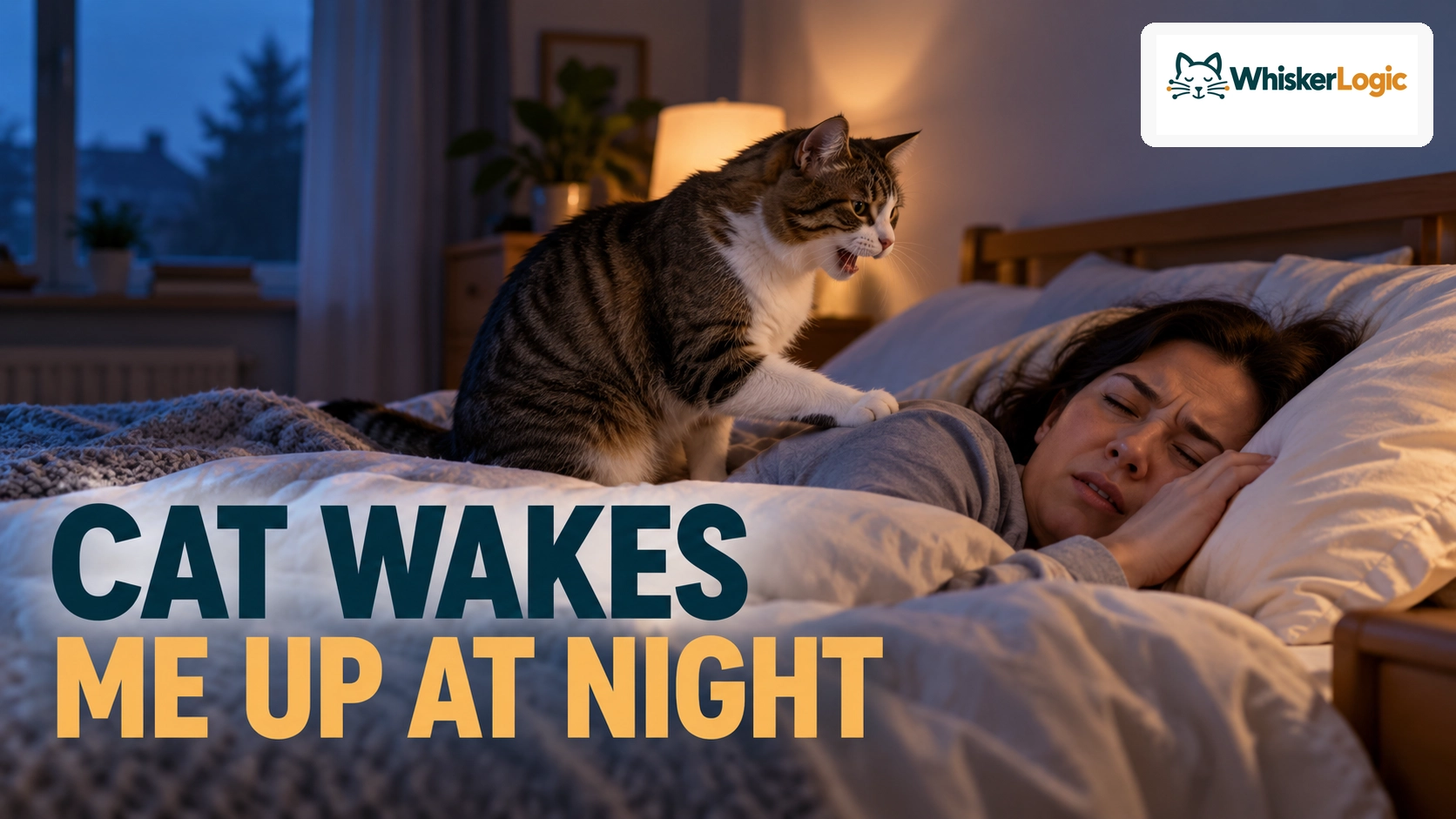
It is 4:30 a.m. Your cat is standing on your chest, meowing beside your face, pawing at you, walking across the bed, attacking your moving feet under the blanket, or knocking something off the dresser. You finally get up—and your cat immediately heads toward the food bowl, a closed door, or somewhere else they want to go.
If you keep thinking, “My cat wakes me up at night—why?”, start by separating two questions:
Why is your cat awake?
And:
Why does your cat involve you?
Those are not necessarily the same problem.
A cat quietly walking around the house while you sleep is different from a cat that repeatedly approaches your bed, vocalizes, paws you, scratches at a door, or creates another interaction that reliably gets a response.
Some cats show more activity around dawn or dusk, but domestic-cat activity patterns vary and can be influenced by light, feeding, environment, routine, and human interaction. So “cats are nocturnal” is not a sufficient explanation for a cat that repeatedly wakes the same person in the same way.
The most useful clue is often the entire sequence:
Time → What happened before → Wake-up behavior → Your response → What happened next
Once you can see that sequence clearly, you can make a targeted change instead of relying on generic advice such as “play more before bed” or “just ignore the cat.”
Quick Answer
If your indoor cat keeps waking you at night, first identify the exact pattern.
Record:
- what time it happens;
- what your cat does;
- what happened immediately beforehand;
- how you respond;
- what your cat gets afterward;
- and where your cat goes next.
Food, attention, play, access to another room, movement under the blanket, or another predictable outcome may sometimes help maintain the wake-up behavior.
If waking you consistently leads to breakfast, for example, your cat may learn that waking the person predicts food. A timed feeder can sometimes help by separating you waking up from food appearing.
Also review the cat’s full 24-hour routine—feeding, voluntary activity, interactive play, exploration, rest, and predictable social interaction—rather than focusing only on bedtime.
Do not punish nighttime waking.
And do not automatically ignore a new or unusual nighttime behavior before checking whether something medical or environmental has changed.
A sudden change, particularly in an older cat or one showing new vocalization, disorientation, restlessness, appetite or weight changes, increased thirst or urination, mobility changes, house-soiling, or possible pain, deserves veterinary attention.
Vet Check
Nighttime waking becomes more important to investigate medically when it is new, suddenly worse, or accompanied by other changes.
Contact your veterinarian if you notice nighttime waking along with signs such as:
- increased or unusual vocalization;
- confusion or disorientation;
- inability to settle;
- significant restlessness;
- changes in appetite;
- increased thirst or urination;
- unexplained weight change;
- reduced jumping or other mobility changes;
- suspected pain;
- house-soiling;
- or another substantial behavioral change.
Older cats deserve particular attention because pain, sensory decline, endocrine or metabolic disease, neurological problems, and age-related cognitive changes can all affect activity, vocalization, behavior, and sleep/wake patterns.
Nighttime meowing alone does not diagnose cognitive dysfunction or any other disease.
Table of Contents
Why Does My Indoor Cat Keep Waking Me Up at Night?
There is no single explanation that fits every cat.
If your cat wakes you up at night, possible pieces of the pattern include activity timing, food, human interaction, play, environmental triggers, learned household routines, or a physical or medical change.
Activity timing
Some cats show increased activity around parts of dawn and dusk, but individual patterns differ.
A controlled study comparing indoor and outdoor-housed cats found differences in daily activity and feeding rhythms depending on housing conditions and human interaction. The findings support the idea that feline activity patterns are flexible rather than identical across all cats.
That is why simply saying “cats are nocturnal” does not explain why your cat wakes you.
A learned feeding routine
If waking you repeatedly leads to breakfast, the wake-up behavior can become part of the feeding sequence.
Human interaction
Talking, touching, getting out of bed, opening a door, moving your feet, or otherwise responding may provide an outcome that matters to that particular cat.
Play or activity
Your cat may already be awake and looking for an activity. The important question is whether involving you has become an effective way to get one.
Environmental triggers
Another cat, wildlife, a sound, movement, or lights outside may wake your cat before your cat comes to wake you.
A predictable household routine
Cats can learn regular sequences involving people, doors, food, alarms, lights, and other repeated daily events.
A medical or physical change
When the behavior is new, especially in an older cat, medical causes deserve stronger consideration.
The first step should therefore be observation rather than assumption.
First Ask: Is Your Cat Awake, or Is Your Cat Waking You?
Imagine two cats that are both awake at 4 a.m.
One quietly walks around the home, looks out a window, eats from an available food source, explores for a while, and settles again.
The other jumps onto the bed, meows repeatedly, paws the caregiver’s face, knocks an object down, waits for a response, and then runs toward the kitchen.
Both cats were awake.
But only one pattern involves repeatedly bringing the sleeping person into the sequence.
That distinction changes what you need to investigate.
If the main issue is why your cat is awake, look closely at activity patterns, feeding, environment, outside triggers, physical comfort, and the overall daily routine.
If the main issue is why your cat wakes you, look especially closely at what happens after you respond.
A useful behavioral history can be kept very simple:
Before → Behavior → What happened next
For several nights, write down:
Before: What was happening immediately beforehand?
Behavior: What exactly did your cat do?
After: What did you do, what did the cat obtain, and where did the cat go next?
You may start seeing a repeated sequence that was difficult to notice when you were half asleep.
Watch What Happens Immediately After You Wake Up
This is one of the strongest clues in the entire problem.
Suppose your cat meows at 4:45 a.m.
You say their name.
The cat jumps onto the bed.
You pet them.
They settle beside you.
Human contact may be part of what keeps that sequence useful to the cat.
Now change the ending.
Your cat meows.
You get out of bed.
The cat runs toward the kitchen.
You serve breakfast.
Food becomes a stronger candidate.
Or:
Your cat scratches at the closed bedroom door.
You open it.
The cat walks into the bedroom.
Access may be the important outcome.
Another cat may attack moving feet under the blanket because your movement creates an interactive target.
The goal is not to call every case “attention-seeking.”
Instead, ask:
What useful outcome repeatedly follows this behavior for this particular cat?
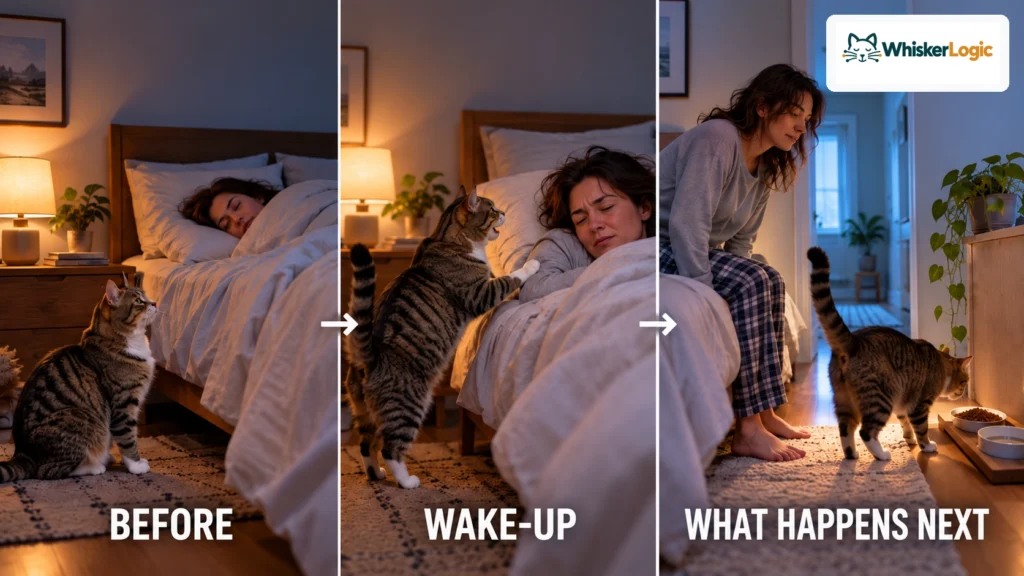
Then use four steps.
Observation
What exactly happened?
Interpretation
What outcome might the behavior be producing?
Test
Change the most plausible part of the sequence without changing several unrelated things at once.
Action
Keep, modify, or abandon the strategy depending on what happens.
If you change feeding, play, bedroom access, lighting, furniture placement, and several other variables simultaneously, you may never know which change mattered.
If Your Cat Wakes You for Breakfast
An early-breakfast pattern is one of the clearest examples of how a routine can become learned.
The sequence may look like this:
Cat vocalizes → person gets out of bed → breakfast appears
If that sequence happens repeatedly, waking the person can become a reliable predictor of food.
The Feline Veterinary Medical Association’s 2026 Positive Reinforcement Training Educational Toolkit specifically discusses cats waking caregivers early by vocalizing, pawing, or knocking items down and explains how feeding after the wake-up can inadvertently maintain the behavior.
This is not about blaming the caregiver.
At 4 a.m., giving the cat breakfast may simply be the fastest way to get back to sleep.
The problem is that the sequence can become extremely predictable.
Before assuming hunger is the entire explanation, observe what your cat actually does.
Does your cat immediately lead you to the food area?
Does eating reliably end the behavior?
Does the cat still wake you when food is already available?
Does the same wake-up behavior occur when the cat wants something other than food?
Hunger and learning that waking a human produces food can overlap, but they are not the same question.
Use a Timed Feeder to Take Yourself Out of the Food Routine
When food appears to be maintaining the pattern, a timed feeder can be particularly useful because it changes who—or what—predicts breakfast.
Instead of:
Wake human → human gets up → food arrives
the goal is to create:
Feeder cue → food arrives
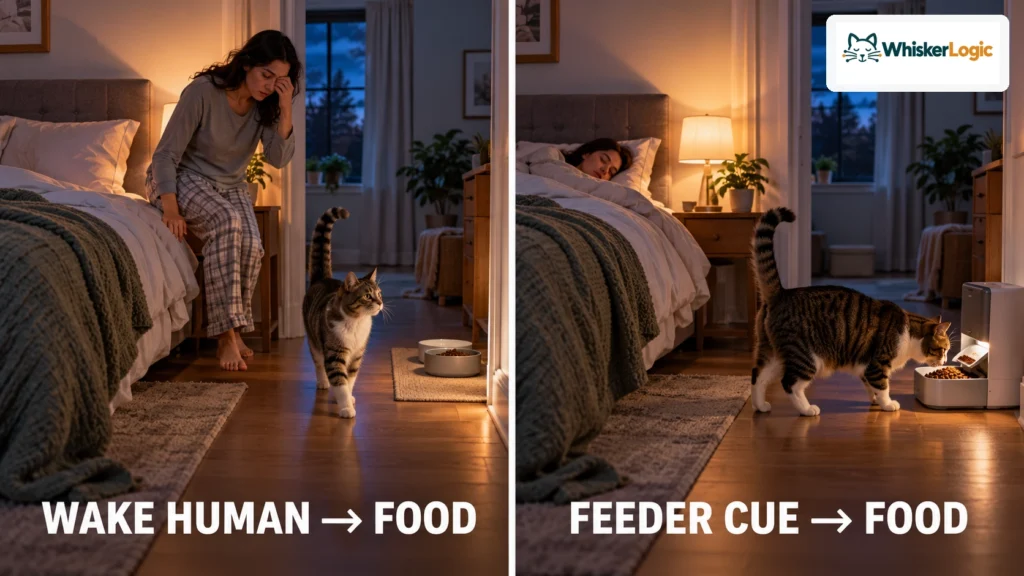
The FelineVMA toolkit recommends an automated feeder or food dispenser that can deliver food shortly before the cat would normally wake the caregiver.
There is no universal clock setting that fits every cat.
Do not assume that every household should set a feeder exactly 30 minutes earlier or follow an arbitrary seven-day adjustment schedule.
Use your cat’s actual pattern.
If the waking time is predictable, you can schedule the feeder shortly before the usual wake-up period and adjust based on what happens.
Any food delivered overnight or early in the morning should still fit within the cat’s appropriate daily feeding plan.
The goal is not to add another meal’s worth of calories simply because the food comes from a machine.
A timed feeder is also not a guaranteed solution.
It is most useful when the link between waking the person and receiving food is an important part of the problem.
If your cat eats from the feeder and then still comes to wake you, reassess what else your response may be providing.
Look at the Whole 24-Hour Routine, Not Just Bedtime
“Exhaust your cat before bed” is too simplistic.
A better question is:
What does your cat’s entire day look like?
Review:
- feeding times;
- interactive play;
- opportunities for climbing;
- exploration;
- food-searching or foraging;
- training or problem-solving;
- long periods with little meaningful activity;
- predictable interaction with people;
- evening routine;
- and resting opportunities.
Feline environmental guidelines emphasize providing appropriate opportunities for play, predatory behavior, food acquisition, safe resting, climbing, choice, and positive human interaction.
The FelineVMA’s indoor-cat guidance likewise emphasizes meeting physical, emotional, and behavioral needs rather than treating the indoor environment as simply a place containing food, water, litter, and toys.
The goal is not to keep your cat awake all day.
Cats naturally spend substantial periods resting.
Repeatedly waking a sleeping cat in an attempt to force nighttime sleep is not an appropriate enrichment plan.
Instead, provide meaningful opportunities for voluntary daytime and evening activity.
Give Your Cat Useful Activity, Not Just More Toys
A pile of unused toys on the floor is not the same thing as meaningful enrichment.
Think in terms of behaviors your cat can perform.
Can your cat:
- stalk and chase during interactive play?
- pounce and capture an appropriate toy?
- climb to useful elevated locations?
- search for part of their food?
- explore changing but safe areas?
- use an appropriate food puzzle?
- participate in short training sessions?
- receive predictable positive interaction with people?
The AAFP/ISFM Feline Environmental Needs Guidelines recommend opportunities for cats to express parts of the predatory sequence through play and active food acquisition.
Food puzzles can be one component of this approach.
But they should not be presented as a guaranteed treatment for nighttime waking.
A review of food puzzles in cats describes promising practical uses and potential benefits, while also noting limitations in the evidence and the fact that food puzzles were sometimes only one part of a broader behavioral plan.
Use food puzzles when they suit the individual cat—not because every indoor cat waking a caregiver must be bored.
What If Your Cat Wakes You for Attention or Play?
Food is not the only possible consequence.
Look at what your cat gets from you after waking you.
That might include:
- talking;
- petting;
- play;
- getting out of bed;
- movement under the blanket;
- opening a door;
- access to another room;
- or another predictable interaction.
Even pushing the cat away creates a response, although not every cat will find the same kind of interaction rewarding.
The useful question is not:
“Is my cat manipulating me?”
It is:
“Does my response help this particular behavior keep working?”
If nighttime interaction appears to be part of the pattern, create better opportunities for that interaction elsewhere.
You might provide predictable evening play, social interaction, and a calmer settling routine.
Then avoid making the disruptive nighttime behavior the most reliable way to start an interaction.
The goal is not merely to remove attention.
The goal is to make an alternative routine more useful and predictable.
What If Your Cat Scratches or Meows Outside the Bedroom Door?
Again, look at what happens when the behavior succeeds.
If scratching or meowing repeatedly causes you to open the bedroom door, gaining access may help maintain the sequence.
If bedroom separation is necessary, use it as management, not punishment.
Outside the bedroom, your cat should still have appropriate access to:
- water;
- litter;
- safe and comfortable resting places;
- and other necessary resources.
Do not yell through the door, throw objects, spray water, or use frightening devices.
If bedroom separation produces intense or escalating distress, reassess the situation instead of escalating the conflict.
And keep the reader situation clear.
If the main problem becomes the scratching behavior itself rather than nighttime access, see Why Does My Cat Scratch the Couch Even With a Scratching Post?.
Could Something Outside Be Waking Your Cat First?
Sometimes you are not the first part of the sequence.
Something outside may wake or arouse your cat first.
Possible examples include:
- another cat;
- wildlife;
- noises;
- moving lights;
- people or vehicles;
- or movement visible through a window.
Do not assume that one of these triggers exists.
Look for evidence.
Does your cat spend time staring through a particular window before coming to your bed?
Do they suddenly become alert, pace, vocalize, or move rapidly from the window toward you?
Does limiting access to that particular view during the problem period change what happens?
If there is a repeatable external trigger, practical environmental management may help.
If the larger problem becomes repeated door-dashing or attempts to leave the home, see Why Does My Indoor Cat Keep Trying to Get Outside?.
Do Not Reward the Wake-Up Pattern by Accident
When you are half asleep, the fastest way to stop a noisy behavior may be to give the cat exactly what they are asking for.
That is understandable.
But repeated consequences matter.
If meowing is followed by breakfast, pawing is followed by petting, or scratching is followed by a door opening, that sequence may become more likely to occur again.
Once medical concerns and basic needs have been addressed and you reasonably understand the pattern, try to stop making the wake-up behavior itself the route to the desired outcome.
For example:
Breakfast can come from a timed feeder rather than from waking you.
Interactive play can happen during a predictable evening routine rather than after your feet are attacked at 3 a.m.
Social attention can occur generously at appropriate times rather than being delivered specifically after repeated nighttime vocalization.
The cat does not need to be manipulative for any of this to happen.
The behavior only needs to have worked reliably before.
Expect the Pattern to Resist Change at First
A behavior that has repeatedly produced a useful outcome may not disappear immediately when that outcome changes.
Behavioral references describe the possibility of a temporary increase in frequency or intensity when reinforcement that previously maintained a behavior is removed.
That does not mean every cat follows a fixed pattern.
Do not expect:
“Three bad nights, and then it stops.”
There is no universal timeline.
A long-established or inconsistently reinforced behavior may be particularly persistent.
This is another reason to build a useful alternative rather than relying only on ignoring.
If food is maintaining the wake-up routine, a timed feeder gives the cat another predictable way for food to arrive.
If social interaction is important, scheduled positive interaction provides another route to it.
If the behavior becomes severely distressing, changes substantially, or begins to look different from the original pattern, reassess rather than assuming every escalation is simply part of learning.
What Not to Do
Do not use punishment to deal with nighttime waking.
Avoid:
- spray bottles;
- yelling;
- hitting or physical correction;
- throwing objects;
- compressed-air devices;
- ultrasonic or other startling devices;
- deliberately frightening the cat;
- physical restraint as punishment;
- forcing the cat to stay awake during the day;
- feeding every time the cat wakes you simply to stop the noise;
- automatically ignoring new nighttime vocalization without investigating it;
- or giving medications or sedatives without veterinary guidance.
Punishment does not address why the cat is awake or why the cat is involving you.
It can also introduce fear or stress into the situation.
A better plan uses:
observation + management + appropriate reinforcement + changes to the consequence of the wake-up behavior.
When an Older Cat Starts Waking You at Night
A cat with a long-standing 5 a.m. breakfast routine is a different situation from an older cat who suddenly begins wandering, crying, appearing confused, or struggling to settle at night.

New nighttime changes in senior cats deserve stronger medical caution.
Behavioral changes that may warrant veterinary investigation include:
- increased vocalization;
- disorientation;
- changes in interaction;
- altered sleep/wake patterns;
- unusual activity changes;
- house-soiling;
- anxiety;
- or new difficulty navigating familiar routines.
Some of these signs can occur with cognitive dysfunction, but they can also occur with other medical problems.
Do not diagnose cognitive dysfunction from nighttime meowing alone.
Pain can change nighttime behavior
Pain or discomfort can contribute to:
- restlessness;
- difficulty settling;
- vocalization;
- changes in movement;
- irritability;
- reduced jumping;
- and nighttime waking.
Those signs are not specific enough to diagnose pain on their own, but they are reasons to discuss the change with your veterinarian.
Hyperthyroidism is one example—not an assumption
Hyperthyroidism is one medical condition veterinarians may consider in mature or older cats showing compatible changes.
Possible associated signs include:
- increased activity;
- increased vocalization;
- weight loss;
- normal or increased appetite;
- increased thirst;
- and increased urination.
But a cat waking you at night does not mean the cat has hyperthyroidism.
Diagnosis requires veterinary assessment and appropriate testing.
The most useful distinction remains:
Has this been a long-standing routine, or is this a new behavioral change?
A sudden change deserves more medical caution.
What to Try, in Order
1. Check for new medical or behavioral changes
Before treating nighttime waking as a training problem, ask whether something else has recently changed.
Pay particular attention to sudden changes and changes in senior cats.
2. Record the exact wake-up time and behavior
Write down what your cat actually does.
For example:
- meows;
- paws your face;
- walks across you;
- knocks objects down;
- scratches the door;
- attacks moving feet;
- or repeatedly enters and leaves the room.
3. Record what happened immediately before
Was the cat already moving around?
Was there a noise?
Did something appear outside?
Did an automatic light turn on?
Did another household event occur?
4. Record what happens immediately afterward
Do you:
- feed the cat?
- pet them?
- speak?
- get out of bed?
- play?
- move your feet?
- open a door?
Then record what your cat does next.
5. Identify the most plausible outcome
Is waking you repeatedly producing:
- food;
- social interaction;
- play;
- access;
- movement;
- or another useful consequence?
Do not assume.
Follow the sequence.
6. Review the full 24-hour routine
Look at feeding, activity, interactive play, exploration, food-search opportunities, human interaction, and rest.
Do not focus only on bedtime.
7. Improve useful daytime and evening activity where needed
Provide appropriate opportunities for:
- interactive play;
- climbing;
- exploration;
- food searching;
- training;
- and positive social interaction.
Do not force your cat to stay awake.
8. If food is maintaining the pattern, separate waking you from food delivery
A timed feeder may help when early waking reliably leads to breakfast.
Use food from the appropriate daily feeding plan rather than simply adding calories.
9. Stop reinforcing the specific wake-up sequence once medical and basic needs have been addressed
If waking you has reliably produced a reward, stop making the disruptive behavior the route to that reward.
10. Reinforce calmer alternative routines
Provide predictable evening activity, feeding, interaction, and settling opportunities.
11. Manage bedroom access or environmental triggers when appropriate
Change access, visual triggers, nighttime resources, or sleeping arrangements when those factors are clearly involved.
Do not use those changes as punishment.
12. Change one major variable at a time
Give yourself a chance to determine what actually changes the pattern.
13. Reassess
Ask:
- Did the wake-up time change?
- Did the behavior change?
- Did the cat begin using another route to the same resource?
- Did nothing change?
Use the result to guide the next step.
14. Seek veterinary or qualified behavior help when needed
Get professional help when medical concerns are present, distress is severe, the behavior changes substantially, or the situation cannot be safely or practically managed.
When to Get Veterinary or Behavior Help
Contact your veterinarian when nighttime waking:
- starts suddenly;
- becomes markedly worse;
- develops in an older cat;
- includes new or increased vocalization;
- comes with disorientation or confusion;
- includes severe or persistent restlessness;
- occurs alongside weight or appetite changes;
- is associated with increased thirst or urination;
- occurs with mobility changes;
- raises concern about pain;
- appears alongside house-soiling;
- or occurs with other important behavioral or physical changes.
A detailed record can help.
Bring notes or videos when practical.
Record:
When did it happen?
What happened beforehand?
What exactly did the cat do?
What did you do?
What happened next?
This is far more informative than simply reporting, “My cat is noisy at night.”
If medical causes have been investigated but the nighttime behavior remains severe or difficult to manage, your veterinarian may recommend a qualified feline behavior professional or veterinary behaviorist.
FAQ
Why does my cat wake me up at 3 or 4 a.m.?
The time alone does not identify the cause. Look at what happens immediately before the wake-up and what your cat obtains afterward. Feeding routines, human interaction, activity patterns, and environmental triggers can all contribute.
My cat wakes me up at night for food. What should I do?
First confirm that waking you consistently leads to food. If it does, consider separating your involvement from food delivery. A timed feeder may help because the feeder—not waking you—begins to predict food.
Is my cat waking me because they are hungry?
Possibly, but hunger should not automatically be assumed. If waking you consistently results in breakfast, the learned sequence between waking the person and food delivery may also help maintain the behavior.
Should I ignore my cat when they wake me at night?
Not automatically. First check basic needs, whether the behavior is new, and whether there are medical warning signs. Once a long-standing pattern is reasonably understood, reducing the reward attached to the wake-up behavior may be appropriate, ideally while reinforcing a calmer alternative routine.
Will an automatic feeder stop my cat from waking me?
It may help when human-delivered food is maintaining the pattern. It is much less likely to solve waking that is maintained by attention, play, access, environmental triggers, discomfort, or another factor.
Should I play with my cat right before bed?
Evening interactive play can be useful, but do not treat it as a guaranteed cure or try to exhaust your cat. Look at the entire daily routine and provide appropriate voluntary activity throughout the day and evening.
Why does my cat wake me even though food is available?
Food may not be the important outcome. Your cat may be seeking interaction, play, movement, access to another area, or responding to something else in the environment. Watch what happens immediately after you wake up.
Why does my cat wake me for attention?
If meowing, pawing, or approaching you repeatedly results in petting, talking, movement, or another interaction, your response may help maintain the behavior. Provide predictable positive interaction at other times instead of making disruptive nighttime behavior the most reliable way to get it.
Why has my older cat suddenly started meowing at night?
A new nighttime behavior in an older cat deserves veterinary evaluation. Pain, sensory decline, metabolic or endocrine problems, neurological disease, and cognitive changes are among the possibilities a veterinarian may consider. Nighttime meowing alone does not diagnose the cause.
Should I keep my cat out of the bedroom?
Bedroom separation can sometimes be used as management, but not as punishment. Make sure your cat still has appropriate access to water, litter, safe resting places, and other necessary resources. If separation causes intense distress, reassess the situation.
Are cats naturally nocturnal?
It is too simplistic to describe every domestic cat as strictly nocturnal. Some cats show activity peaks around dawn or dusk, but activity patterns vary with the individual and can be influenced by environment, light, feeding, and human routines. Being awake at night also does not explain why a cat specifically wakes its caregiver.
Sources
- Feline Veterinary Medical Association — Positive Reinforcement Training Educational Toolkit
- Feline Veterinary Medical Association — Meeting the Physical and Emotional Needs of Indoor Cats
- Merck Veterinary Manual — Diagnosis of Behavior Problems in Animals
- Merck Veterinary Manual — Behavior Problems of Cats
- Merck Veterinary Manual — Treatment of Behavior Problems in Cats
- Merck Veterinary Manual — Medical Causes of Behavioral Signs
- Merck Veterinary Manual — Hyperthyroidism in Animals
- AAFP and ISFM — Feline Environmental Needs Guidelines
- Parker et al. — Comparison of Locomotor and Feeding Rhythms Between Indoor and Outdoor Cats Living in Captivity
- Dantas et al. — Food Puzzles for Cats: Feeding for Physical and Emotional Wellbeing