

Your cat may be relaxed on the couch until the doorbell rings. Seconds later, they are under the bed, behind the couch, or in another room—and they may not come out again until the house is quiet.
If your cat hides when guests come over, that does not automatically mean something is wrong. For many cats, retreating is a way to create distance, find a safer-feeling location, and keep some control over an unfamiliar situation.
The more useful question is not, “How do I stop my cat from hiding?” It is: Can my cat retreat safely, settle, and return to normal after the visit?
A cat that chooses a hiding place, remains safe there, and returns to normal afterward may simply be using retreat as a coping strategy. More active help becomes important when the fear is intense, prolonged, worsening, disrupts normal routines, leads to defensive aggression, spreads beyond visitor situations, or represents a new behavior change.
Quick Answer
When a cat hides when guests come over, hiding itself is not necessarily the problem.
Do not pull your cat out, carry them to the visitor, or block their escape. Give them access to a safe retreat and watch exactly when the hiding begins. The trigger may be the doorbell, the door opening, an unfamiliar voice, movement, direct approach, reaching, children, or the intensity of a noisy group.
Ask guests to reduce social pressure. They should avoid staring, following, repeatedly calling, reaching into hiding places, or trying to pick the cat up.
If your cat chooses to come closer, let them control the distance and whether the interaction continues.
For cats that need more help, gradual exposure paired with something positive can be useful—but only when the exposure is mild enough that the cat can remain reasonably comfortable.
If the hiding is new, worsening, happening without guests, or accompanied by changes in appetite, activity, mobility, grooming, litter-box habits, or general behavior, arrange a veterinary check.
Vet Check
There is an important difference between a cat that has always preferred to avoid visitors and a cat that suddenly becomes more withdrawn.
Contact your veterinarian if your cat previously tolerated guests but has started hiding suddenly, or if the hiding now happens even when no visitors are present.
Also watch for changes in:
- appetite or weight,
- drinking,
- activity,
- jumping or mobility,
- grooming,
- litter-box behavior,
- irritability,
- sleep or other daily routines.
Pain, illness, reduced mobility, and other medical problems can affect behavior, but hiding alone does not diagnose any particular condition.
Be especially attentive if an older cat develops new withdrawal or broader behavior changes. Do not assume a new change is simply part of aging.
Table of Contents
Why Your Cat Hides When Guests Come Over
A visitor changes several things in your cat’s environment at once.
There may be a doorbell or knock, an opening door, unfamiliar footsteps, a new voice, different scents, coats or bags, eye contact, movement, reaching hands, children, or several people talking at the same time.
Cats also differ individually in how much contact they prefer with unfamiliar people.
One cat may walk toward a visitor. Another may watch from a high perch. Another may disappear into the bedroom until the person leaves.
None of those patterns by itself means the cat is “antisocial” or “hates strangers.”
Instead, look at the entire sequence:
Arrival cue → Guest behavior → Cat response → Distance chosen → Recovery
What happened immediately before your cat retreated?
Could they get away easily?
What did they do once they reached their chosen distance?
And what happened after the guest left?
Those details tell you much more than the hiding alone.
Hiding Can Be a Coping Strategy, Not a Bad Habit
Cats benefit from having safe places where they can retreat when something in the environment feels uncertain.
That might be:
- under a bed,
- inside a covered bed or box,
- behind furniture,
- on a high perch,
- in another quiet room.
The important point is that the cat has an option to increase distance.
If your cat goes under the bed when visitors arrive, pulling them back out removes the strategy they were using to cope with the situation.
The goal is not to eliminate hiding.
A successful visit might look like this:
Guest arrives → cat retreats → cat remains safe → stress does not escalate → cat returns to normal afterward.
Your cat does not have to greet the visitor for the visit to count as successful.
Watch the Exact Moment Your Cat Decides to Hide
Instead of assuming your cat is simply afraid of “people,” watch the exact moment the behavior changes.
That can help identify which part of the visitor event may matter most.
The doorbell rings and your cat disappears before the door opens.
The arrival sound may be an important part of the trigger.
The visitor enters, but your cat remains visible until the person walks toward them.
Approach or social pressure may matter more than the visitor simply being present.
The visitor enters, sits quietly, and your cat watches from the other side of the room.
Your cat may tolerate the visitor when enough distance is available.
One quiet visitor arrives and your cat stays nearby, but several loud visitors cause an immediate retreat.
The intensity and unpredictability of the environment may matter.
These observations are clues, not diagnoses.
The purpose is to identify patterns you can use to make the situation easier.
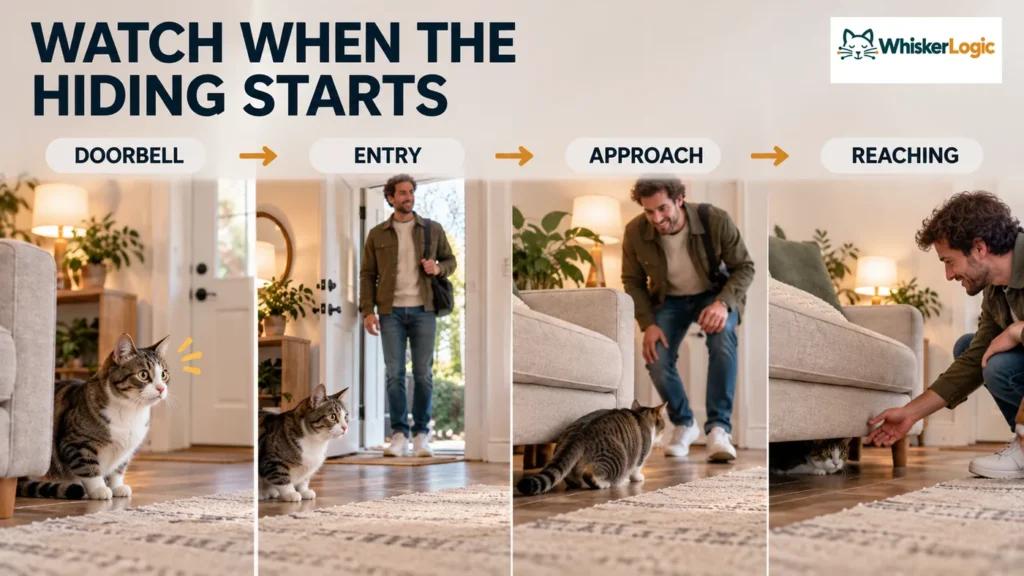
Is It the Guest, or One Part of the Guest’s Arrival?
Think of a visit as a sequence rather than one single stimulus:
sound → entry → movement → distance → gaze → approach → touch
Your cat may be comfortable with some stages and uncomfortable with others.
For example, a cat may tolerate a seated visitor across the room but retreat as soon as that person stands.
Another cat may remain visible until the visitor looks directly at them or reaches out.
Another may disappear at the sound of the doorbell before seeing anyone.
Other variables can include:
- knocking,
- unfamiliar voices,
- footsteps,
- unfamiliar scents,
- bags and coats,
- animal scents on clothing,
- children,
- fast movement,
- multiple visitors,
- furniture movement,
- loud conversation.
Breaking the visit into smaller parts gives you something specific to observe and, when necessary, work on.
You do not need to assume the cat has a general problem with people.
Give Your Cat a Safe Place Before Guests Arrive
Do not remove hiding places in an attempt to make your cat interact.
A safe retreat should already be available before the visitor arrives whenever possible.
For some cats, their normal hiding place or elevated perch is enough.
A separate quiet room can be especially useful when:
- many visitors are coming,
- children will be present,
- exterior doors will open frequently,
- the gathering will be loud,
- the cat has a history of defensive aggression,
- or the home layout makes it difficult for the cat to retreat safely.
A safe room should be familiar and comfortable—not a punishment.
For a longer visit, provide appropriate access to:
- water,
- a litter box,
- a comfortable resting area,
- a hiding place,
- familiar bedding or other appropriate resources.
If your cat already has a safe retreat elsewhere in the home and can reach it without being followed or cornered, automatically confining them is not always necessary.
Tell Guests to Ignore Your Cat at First
A visitor who is excited to meet your cat may accidentally increase the pressure by immediately focusing attention on them.
Ask guests to reduce social pressure when they arrive.
They should:
- avoid staring at the cat,
- avoid following the cat,
- avoid repeatedly calling the cat,
- never reach into a hiding place,
- avoid reaching toward a hesitant cat,
- avoid picking the cat up,
- sit calmly when practical,
- let the cat move away without following.
Children should never chase a cat that is trying to retreat.
Ignoring the cat initially does not mean being unfriendly.
It means giving the cat control over whether an interaction happens at all.
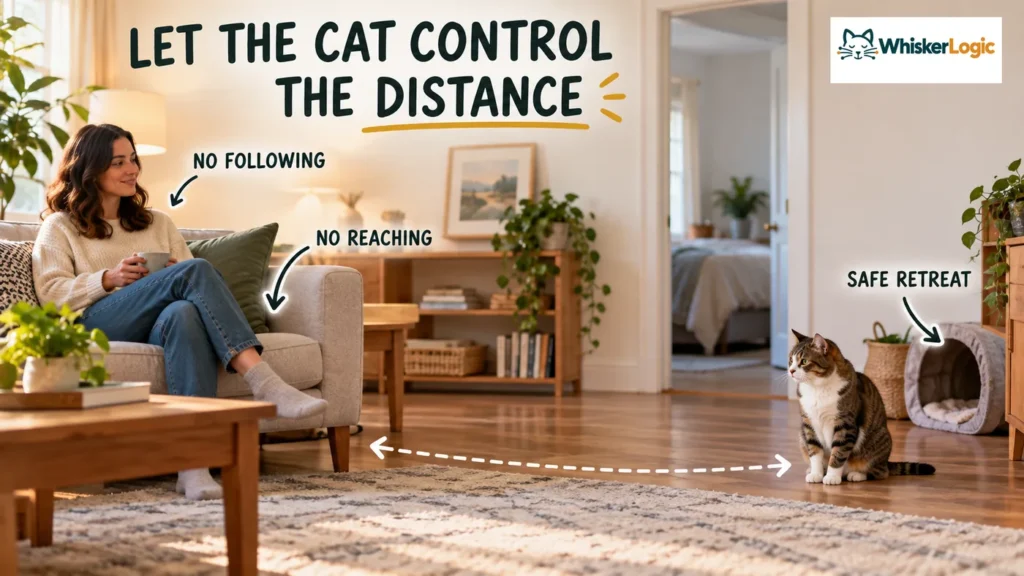
Let Your Cat Decide Whether to Approach
Coming out of hiding does not automatically mean, “Now pet me.”
A cat may come out simply to gather information.
They may:
- walk into the room,
- sniff something,
- cross behind furniture,
- take a treat,
- sit several feet away,
- watch the visitor,
- then leave again.
Do not turn the moment your cat appears into a sudden burst of attention.
Avoid having everyone stare at the cat, call them, reach toward them, surround them, or take close-up photographs.
If your cat chooses to approach, allow them to investigate at their own pace.
Even an approach does not automatically mean the cat wants to be touched.
The useful measure of progress is not how much petting the visitor gets.
It is how much choice and control the cat retains.
If your cat is comfortable approaching but biting begins specifically after petting starts, the touch itself may be the more relevant situation. See Why Does My Cat Bite Me When I Pet Them?.
What If Your Cat Comes Out but Stays Across the Room?
That can be a successful outcome.
A cat sitting several feet away and watching may have found a distance at which the visitor feels manageable.
Do not assume you need to reduce that distance.
If your cat remains settled, can leave whenever they choose, and does not become increasingly distressed, staying across the room may represent effective coping.
Some cats may eventually choose to come closer.
Others may continue to prefer watching visitors from a distance or from an elevated perch.
The goal is not to produce a cat that enjoys physical contact with every person who enters the home.
Should You Use Treats Around Guests?
Treats can be useful when they are used to create a positive association with a manageable version of the visitor situation.
But food should not be used to lure a frightened cat closer than they would otherwise choose to go.
For example, if your cat is comfortable remaining across the room while a quiet visitor sits on the couch, you might offer a valued treat at the cat’s chosen distance.
You do not need to keep moving the treat closer to the visitor.
Do not use food to trap your cat near someone, either.
And once the cat takes a treat, do not assume that means they are ready for more intense exposure or physical contact.
If a cat that normally values the reward cannot engage with it during the visit, consider whether the situation may currently be too intense for comfortable learning.
Food refusal by itself does not diagnose a specific problem.
How to Help Your Cat Get More Comfortable Gradually
When active training is appropriate, use gradual exposure rather than overwhelming exposure.
A practical sequence is:
- Identify the specific trigger.
- Reduce its intensity.
- Present it at a level the cat can handle.
- Pair that manageable exposure with something positive when appropriate.
- Increase the difficulty only while the cat continues to cope reasonably well.
This uses two behavior-modification principles: desensitization and counterconditioning.
Desensitization means starting with a weaker version of the trigger rather than immediately presenting the full-intensity situation.
Counterconditioning means pairing that manageable version with something the cat values.
The starting intensity matters.
If your cat is already showing intense attempts to escape, cannot settle, or is becoming defensive, increasing the exposure is unlikely to create a useful learning situation.
There is no universal timeline.
Do not expect your cat to reach a particular stage in a certain number of days or visits.
Train the Part of the Visit That Actually Triggers the Fear
Careful observation becomes especially valuable here.
Do not treat “having guests over” as one giant training exercise if only one part of the sequence produces the strongest response.

If the Doorbell Triggers the Hiding
Work with the doorbell separately from a full visitor arrival.
Start with an intensity that does not immediately produce the full response.
The goal is not repeated full-volume ringing until the cat stops reacting.
If Entry Is the Difficult Part
Your cat may tolerate visitor sounds but retreat when the door opens and an unfamiliar person walks inside.
Work with a lower-intensity version of that stage rather than immediately adding conversation, movement, approach, reaching, and touch.
If Standing or Walking Triggers the Retreat
A cat may tolerate a person who sits quietly but become uncomfortable when that person stands.
In that case, human movement may be the important variable—not the visitor’s mere presence.
If Approach Causes the Cat to Hide
Ask the visitor not to close the distance.
Let the cat determine whether that distance changes.
If Reaching Triggers the Response
Stop reaching.
Your cat may already tolerate the visitor until a hand moves toward them.
There is no reason to repeatedly add the part that makes the interaction harder simply because the cat remained in the room before that point.
Working on one meaningful variable at a time also makes it easier to see whether your changes are helping.
Do Not Force Your Cat to “Get Used to People”
Do not repeatedly expose a frightened cat to the full-intensity situation in the hope that they will eventually give up reacting.
Do not:
- pull the cat from under a bed,
- drag them from behind furniture,
- carry them toward a guest,
- hold them while someone pets them,
- block their escape,
- let children chase them,
- repeatedly reach into a hiding place,
- keep pushing visitors closer because the cat has not reacted yet.
Overwhelming exposure can make fear and avoidance worse rather than teaching the cat that visitors are safe.
If a cat cannot create distance, their behavior may escalate from retreat or freezing to hissing, swatting, or biting.
That does not mean every hiss, swat, or bite has the same cause.
The safety principle is simpler:
When a cat is trying to create distance, do not remove the escape option in the name of socialization.
What If Your Cat Hisses, Swats, or Bites Visitors?
Treat the immediate situation as a safety and distance issue.
Stop approaching the cat.
Allow them to retreat.
Increase the distance between the cat and the visitor, and use a door, barrier, or separate room when needed.
Do not punish the cat with:
- yelling,
- spray bottles,
- chasing,
- physical correction.
And do not keep testing how close the visitor can get after the cat has already shown that more distance is needed.
If biting occurs specifically during petting rather than during escape or visitor approach, see Why Does My Cat Bite Me When I Pet Them?.
If your cat repeatedly stalks or attacks moving feet and ankles during ordinary movement through the home rather than reacting defensively to visitors, that is a different behavioral situation. See Why Does My Cat Attack My Feet When I Walk?.
Severe or difficult-to-manage defensive aggression around visitors deserves professional help, especially when someone could be injured or safe management is becoming difficult.
When Hiding Is More Concerning
A cat that has always spent visitor time under the bed but resumes normal behavior after the house becomes quiet may simply have a stable preference for avoiding unfamiliar people.
Concern increases when the pattern changes.
Pay closer attention if your cat:
- remains highly distressed long after visitors leave,
- cannot settle,
- repeatedly freezes or trembles,
- becomes defensive because escape is difficult,
- stops or substantially alters normal eating or drinking,
- changes litter-box behavior,
- becomes much less active,
- starts hiding from familiar household members,
- becomes progressively more fearful,
- begins hiding even when no guests are present,
- or suddenly develops the behavior after previously handling visitors comfortably.
Recovery is an important part of the pattern.
Ask what happens after the visitor leaves.
Does your cat emerge, eat, play, rest, use the litter box, and resume normal household behavior?
Or does the disruption continue long after the visitor is gone?
A long-standing preference to avoid visitors is different from a broader behavioral change.
What to Try, in Order
- Decide whether the hiding is long-standing or new. A cat that has always avoided visitors presents a different situation from one that suddenly starts hiding.
- Check for medical or broader behavior changes. Look at appetite, weight, activity, mobility, grooming, litter-box use, irritability, and behavior outside visitor situations.
- Identify exactly when hiding begins. Watch the doorbell, door opening, voices, footsteps, movement, gaze, approach, reaching, children, and noise.
- Protect a safe retreat. Do not remove the hiding option to force interaction.
- Ask guests not to follow or force contact. No staring, reaching into hiding places, chasing, picking up, or repeated calling.
- Let your cat control distance. Remaining across the room or on a high perch may be a successful outcome.
- Identify the specific visitor variable producing the strongest response. Do not automatically label the entire problem as fear of people.
- Reduce the intensity of that variable when possible. More distance, quieter movement, fewer people, or a milder version of an arrival cue may help.
- Use rewards only while your cat is comfortable enough to engage. Do not use treats to lure the cat into contact they are trying to avoid.
- Practice gradual exposure when appropriate. Pair manageable versions of the trigger with positive experiences.
- Do not force progress. Your cat does not need to tolerate touch from visitors to demonstrate improvement.
- Watch recovery after visits. Returning to normal afterward is an important part of evaluating the situation.
- Seek veterinary or qualified behavior help when the fear is severe, new, worsening, prolonged, disruptive, or unsafe.
When to Get Veterinary or Behavior Help
Veterinary evaluation becomes especially important when hiding represents a new behavior change rather than your cat’s normal visitor response.
Arrange a veterinary check if your cat:
- suddenly starts hiding from visitors,
- starts withdrawing even without visitors,
- develops appetite or weight changes,
- becomes less active,
- has difficulty jumping or moving,
- changes grooming habits,
- develops litter-box changes,
- becomes unusually irritable,
- or shows other changes that could indicate discomfort or illness.
For a senior cat, new withdrawal deserves particular attention.
A long-standing preference to avoid visitors may remain stable throughout life, but a new behavioral change should not automatically be dismissed as “just aging.”
Veterinary or qualified behavior support is also appropriate when fear is so intense that gradual work cannot be done without repeated severe distress, when defensive aggression is increasing, when normal routines are consistently disrupted, or when there is a meaningful risk of injury.
FAQ
Is It Normal If My Cat Hides When Guests Come Over?
Yes, it can be. Some cats prefer to create distance from unfamiliar people and may spend most or all of a visit in a hiding place. The important questions are whether your cat can retreat safely, settle, maintain normal basic routines, and return to normal afterward.
Should I Bring My Cat Out to Meet Guests?
No. Do not pull your cat from a hiding place or carry them to a visitor. Give them the option to remain hidden or approach voluntarily.
Should Guests Try to Pet My Cat?
Not automatically. Even if your cat approaches, let them investigate before assuming they want physical contact. Coming closer may simply mean the cat wants to observe or sniff.
Why Does My Cat Hide When the Doorbell Rings?
The doorbell itself may be an important arrival cue. If your cat disappears before the visitor enters, the sound may be one useful part of the sequence to observe and, when appropriate, work on separately.
Should I Put My Cat in Another Room When Guests Visit?
Sometimes. A familiar quiet room can be useful during loud gatherings, visits involving children, frequent door opening, a history of defensive aggression, or situations where the cat cannot retreat safely. A cat that already has a safe retreat and can move through the home without being followed may not need automatic confinement.
Can Treats Help My Cat Become Less Afraid of Visitors?
They can be useful as part of counterconditioning when your cat is comfortable enough to eat and learn. Do not use treats to lure a frightened cat close to a visitor or keep them in a situation they are trying to leave.
Why Does My Cat Hide From Some Guests but Not Others?
Different visitors bring different combinations of voice, scent, movement, eye contact, approach, clothing, animal smells, and noise. Watch what happens immediately before your cat chooses to retreat rather than assuming all visitors affect the cat in the same way.
Will My Cat Eventually Stop Hiding From Guests?
Maybe, but completely stopping the hiding should not be the only measure of success. Some cats may always prefer more distance from visitors. Reducing unnecessary distress, preserving choice, and allowing normal recovery afterward are more useful goals.
Why Did My Cat Suddenly Start Hiding From Visitors?
A sudden change deserves more attention than a stable long-term pattern. Look for changes in appetite, activity, mobility, grooming, litter-box habits, or behavior outside visitor situations and discuss the change with your veterinarian.
Is Hiding Under the Bed Bad for My Cat?
Not necessarily. A hiding place can provide useful distance and security. The important questions are whether the location is safe, whether your cat can access necessary resources, whether they can settle there, and whether they return to normal after the visitor leaves.
Sources
- AAFP and ISFM Feline Environmental Needs Guidelines
- 2022 AAFP/ISFM Cat Friendly Veterinary Interaction Guidelines: Approach and Handling Techniques
- FelineVMA Positive Reinforcement Training Educational Toolkit
- Merck Veterinary Manual — Treatment of Behavior Problems in Cats
- VCA Animal Hospitals — Cat Behavior Problems: Fears and Phobias
- VCA Animal Hospitals — Cat Behavior Problems: Aggression Towards Visitors
- Cornell Feline Health Center — The Special Needs of the Senior Cat