

You walk past the couch, and your cat suddenly launches at your ankle, grabs your leg, bites, then releases and disappears around the corner. Later, it happens again in almost the same place.
If you are thinking, “my cat attacks my feet when I walk,” movement-triggered play or a predatory-style sequence is one strong possibility. But an ankle attack by itself does not tell you why it happened.
The useful clues are what happened immediately before the pounce, your cat’s body language, whether your movement triggered the approach, what the full attack looked like, how you responded, and what happened next.
Quick Answer
Moving feet can trigger stalking, chasing, pouncing, grabbing, and biting behavior in some cats. A repeated pattern such as wait → stalk → chase → pounce → grab → bite → release makes a play/predatory explanation more plausible, especially when the attacks occur along predictable walking routes or at predictable times.
But do not label every ankle attack as play. Fear, redirected arousal, pain, illness, or another behavioral change can produce biting in different contexts.
The most useful strategy for a predictable ambush is usually to get ahead of it: identify the location or time when your cat tends to wait for your feet, and redirect the sequence toward an appropriate moving toy before your cat makes contact with your skin.
Do not use hands or feet as toys, do not punish your cat, and avoid immediately turning a completed ankle bite into an exciting play session. New, escalating, painful-looking, or unpredictable attacks deserve stronger veterinary consideration.
Vet Check
Arrange a veterinary evaluation if the attacks appeared suddenly, became much more intense, or started unexpectedly in an adult or senior cat.
A vet check becomes especially important if you also notice changes in jumping or mobility, sensitivity to touch, grooming, appetite, general activity, hiding, irritability, or other broader changes in behavior.
Pain or illness can contribute to aggressive responses, but foot attacks alone cannot tell you that pain—or any specific medical condition—is the cause. The Merck Veterinary Manual notes that pain, discomfort, fear, play/predation, and redirected arousal can all be relevant in aggression toward people, which is why the surrounding context matters.
Table of Contents
My Cat Attacks My Feet When I Walk: What Does the Pattern Mean?
The first possibility to investigate is a movement-triggered play or predatory-style sequence.
Veterinary behavior literature describes misdirected predatory behavior toward people as a pattern that can be triggered by movement and may include stalking, chasing, catching, and biting. The same review notes that these episodes are often relatively quiet. (Common Feline Problem Behaviours: Owner-Directed Aggression)
That fits a cat that waits behind the couch, watches your ankles, follows as you move, pounces, grabs, bites, and then releases.
It does not prove that every cat attacking a moving foot is playing.
The same visible bite can occur in a completely different sequence.
A frightened cat may first retreat, crouch, hiss, or try to create distance before biting when a person continues to approach. A highly aroused cat that has just seen another cat outside may redirect that arousal toward a person walking nearby. Pain or illness may also change how a cat responds to movement, touch, or approach. (Merck Veterinary Manual)
That is why the target—your foot—is less informative than the whole event.
Think:
Before → Body language → Movement trigger → Attack sequence → Your response → What happens next
If the behavior happens during petting rather than while you walk, that is a different situation. See WhiskerLogic’s guide: Why Does My Cat Bite Me When I Pet Them?
First Watch What Happens Before the Pounce
The seconds before your cat touches your ankle may tell you more than the bite itself.
Instead of starting with “Why did my cat bite me?” reconstruct the event.
Was your cat already hiding behind furniture or waiting at a corner?
Were they watching your ankles before you moved?
Did the approach begin only after your foot passed?
Was the cat relatively quiet, or was there hissing or growling?
Did your cat first try to retreat?
Were you walking toward your cat when it happened?
Had another cat appeared outside a window?
Was there a loud or startling noise?
Did the attack happen at the same doorway, stair, hallway, or couch corner as previous attacks?
These details help separate a movement-triggered sequence from a defensive response or a cat that was already highly aroused for another reason.
Do not diagnose motivation from one body-language sign. Look for the pattern formed by several clues together.
Does the Attack Follow a Stalk → Chase → Pounce → Grab Pattern?
A repeated sequence is much more useful than the bite alone.
For example:
Your cat waits beside the hallway.
You begin walking.
The cat watches your moving feet.
They follow quietly.
They accelerate, pounce, grab your ankle, bite, release, and run away.
That sequence is more consistent with movement triggering play/predatory behavior than a bite that occurs after a frightened cat has been cornered or approached.
The review Common Feline Problem Behaviours: Owner-Directed Aggression describes a predatory sequence involving stalking, chasing, catching, and biting, with movement acting as an important trigger.
Still, treat the sequence as evidence to interpret—not proof of motivation.
Pay attention to what interrupts it, what makes it start, and what happens after contact.
Map Where the Ambush Keeps Happening
Location can turn an apparently random problem into a predictable one.
Some cats repeatedly wait:
- behind the same couch,
- at a hallway corner,
- beside the stairs,
- behind a doorway,
- or along a route their caregiver walks several times each day.
If the attacks keep happening in one place, record four things:
Location → Trigger → Sequence → Outcome
For example:
Hallway corner → person walks toward kitchen → cat stalks and pounces → person runs and cat chases
If the pattern is consistently “my cat attacks my feet when I walk through this hallway,” the location itself has become an important clue.
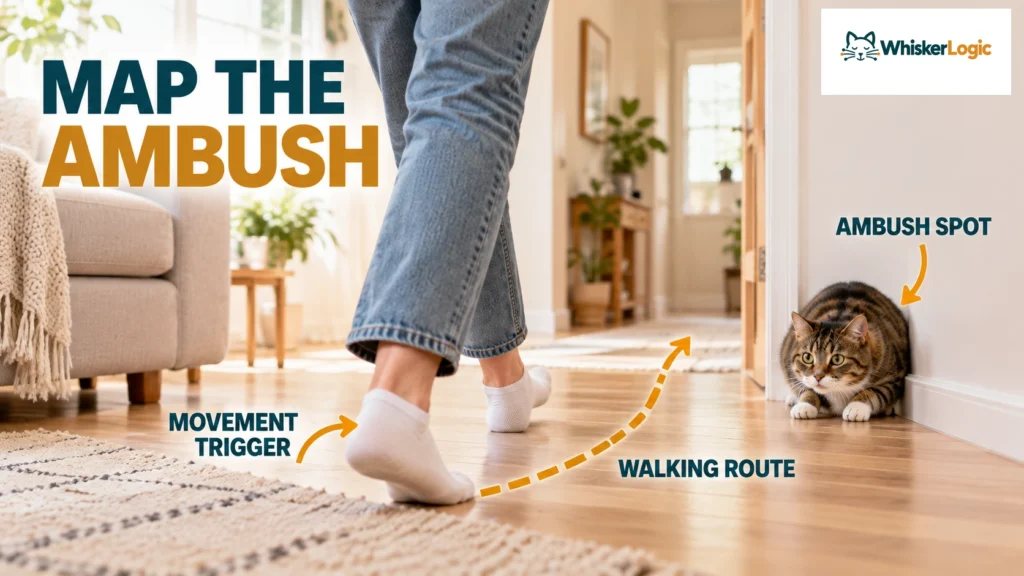
Now you have something you can test.
On another trip through that hallway, redirect your cat toward an appropriate toy before the usual pounce point.
If the cat shifts from watching your ankle to stalking and chasing the toy, that gives you useful information about the role movement and opportunity may be playing.
A map of repeated ambush spots also helps you prepare instead of reacting after teeth or claws have already reached your skin.
Look at When the Attacks Happen
Location is one clue. Timing is another.
Notice whether attacks cluster:
- shortly before a usual meal,
- during an evening activity period,
- soon after you arrive home,
- during the same repeated household routine,
- or after something stimulating has happened.
Do not assume there is one universal explanation.
An attack before dinner does not automatically mean hunger caused it. An evening attack does not automatically mean boredom caused it.
You are looking for predictability.
If your cat nearly always waits near the hallway at 7 p.m., that predictable window gives you an opportunity to provide appropriate object play before you reach the usual ambush.
What Happens Right After Your Cat Attacks?
Your response is part of the sequence too.
Imagine this pattern:
Cat waits → foot moves → cat attacks → person quickly pulls the foot away → cat chases → person throws a favorite toy
From the person’s perspective, the toy was an attempt to redirect the cat.
But timing matters.
The owner-directed aggression review warns that throwing a toy once the attack sequence has already begun can be a poor strategy because the resulting play may unintentionally reinforce the behavior. It also notes that continued body movement can help maintain a movement-triggered attack. (Common Feline Problem Behaviours: Owner-Directed Aggression)
This does not mean one thrown toy permanently “teaches” your cat to bite ankles.
It means consequences can influence behavior, so it is better to arrange the sequence differently:
Known ambush situation → appropriate moving toy appears → cat stalks/chases toy instead → skin never becomes the target
That distinction is central.
Redirect Before the Attack, Not After the Bite
The best moment to intervene is often when you notice the setup—not when your ankle is already in your cat’s mouth.
Watch for your cat:
- waiting at a known ambush point,
- crouching while watching your feet,
- following ankle movement,
- positioning near the route where attacks normally begin.
Then present an appropriate moving target before the pounce.
The 2026 FelineVMA Positive Reinforcement Training Educational Toolkit specifically addresses cats that nip at feet as people walk through the home and recommends redirecting the behavior toward an appropriate toy such as a dangling wand toy.
Move the toy away from your legs rather than around your bare feet.
The goal is not merely to distract the cat.
The goal is to change what the cat stalks, chases, pounces on, and catches.

Give the Hunting Sequence a Better Target
A useful alternative should offer more than a motionless toy lying on the floor.
For a cat whose behavior is strongly triggered by movement, use toys that allow some combination of:
stalk → chase → pounce → grab or capture
A wand or rod toy is useful because you can create movement away from your body while keeping your hands and legs out of the target area.
Let the cat catch the toy periodically rather than making every play session an endless chase.
The broader goal of feline environmental enrichment is to provide outlets for species-typical behaviors. The AAFP/ISFM Feline Environmental Needs Guidelines emphasize giving cats opportunities to express normal behaviors in appropriate ways.
You are not trying to eliminate stalking or pouncing.
You are changing the target.
Stop Teaching That Hands and Feet Are Toys
This is particularly important with kittens.
Wiggling toes under a blanket, inviting a kitten to attack fingers, wrestling with your hands, or deliberately teasing a kitten with moving feet can make human skin part of the play routine.
The AAHA/AAFP Feline Life Stage Guidelines advise against using hands or feet as toys with kittens because this can contribute to later scratching or biting injuries.
That does not mean every adult cat that attacks ankles was taught to do it as a kitten.
Do not assume a history you do not know.
The practical rule is simply:
From now on, toys—not skin—should provide the moving target.
Plan Play Around the Time the Ambush Usually Happens
“Play with your cat more” is incomplete advice.
Timing matters.
If your cat usually attacks your ankles when you walk through the living room after work, providing an interactive play opportunity before that routine may be more useful than adding an unrelated play session hours later.
If attacks happen before your evening routine, try getting ahead of that period.
The 2026 FelineVMA toolkit supports routine object play and recommends offering object play at least twice daily, noting that play can occur in short bursts. (FelineVMA Positive Reinforcement Training Educational Toolkit)
That is a general feline-care recommendation, not a guarantee that a certain number of sessions will stop ankle attacks.
For this particular problem, combine routine appropriate play with what you learned from your cat’s specific location, timing, trigger, and attack sequence.
What Should You Do During a Foot Attack?
Prevention is easier than managing the behavior after contact, but sometimes the ambush happens too quickly.
If the pattern clearly appears movement-triggered and you can do so safely, stop adding exciting movement to the interaction.
Do not run from the cat or turn the episode into a chase.
Protect yourself and allow the cat to disengage.
Do not grab a highly aroused cat with your bare hands.
Do not kick, hit, yell at, chase, or throw objects at the cat.
And once the cat releases, avoid immediately starting the most exciting toy game of the day as a direct consequence of the bite.
That does not mean you should tolerate being injured.
If attacks are intense, repeated, or difficult to interrupt safely, the priority shifts from training experiments to preventing injuries and getting professional help.
When It May Not Be Play
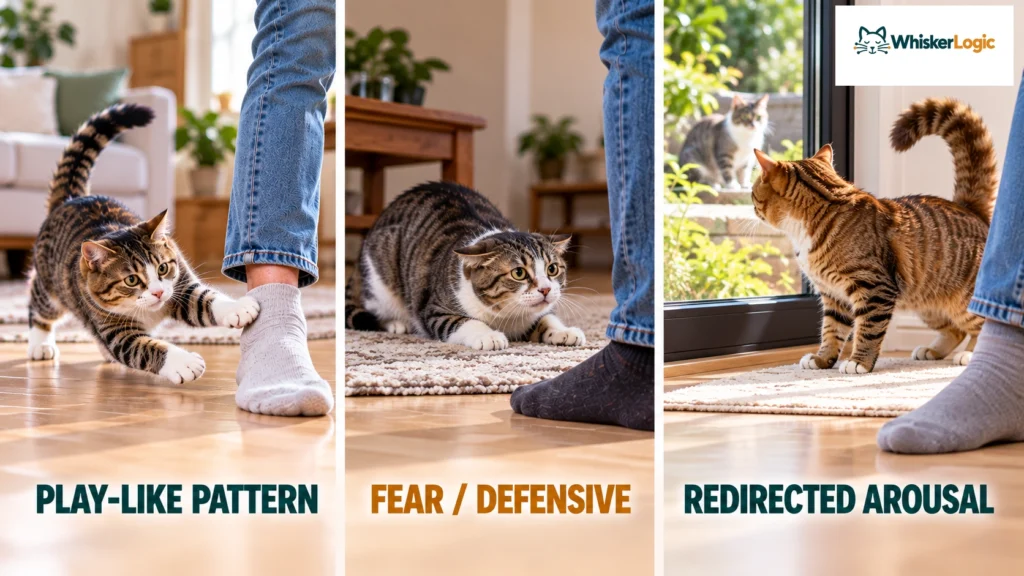
Fear or Defensive Context
A defensive event often looks different before the bite.
You may see the cat trying to retreat, crouching, becoming tense, flattening the ears, hissing, growling, or otherwise trying to increase distance.
The bite may happen when the person continues approaching and the cat feels unable to create enough space.
The Merck Veterinary Manual describes many forms of aggression other than play/predation as distance-increasing behavior and discusses characteristic defensive responses in fearful cats.
In that context, treating the event as a game and waving a toy close to the cat is not the first priority.
Create distance and identify what made the cat feel threatened.
Redirected Arousal
Sometimes your feet are not what started the event at all.
A cat may become intensely aroused after seeing another cat outside, watching wildlife, hearing a sudden noise, or experiencing another inaccessible stimulus.
Then a person walks nearby.
The cat attacks the available target.
The Merck Veterinary Manual describes redirected aggression as aggression toward a nearby person or animal when the cat is highly aroused by a stimulus it cannot access.
That requires different management from ordinary ambush play.
Pain or Medical Change
A new attack pattern can also be a clue that something broader has changed.
Pain, discomfort, or illness can alter how a cat responds to touch, movement, handling, or approach. (Merck Veterinary Manual)
Do not try to identify arthritis, neurological disease, or any other medical condition from ankle attacks alone.
Instead, look for the combination of sudden behavioral change plus other physical or behavioral changes, and let a veterinarian evaluate the cat.
What If Another Cat Outside Triggers the Attack?
Suppose your cat is sitting at the window watching an unfamiliar cat outside.
Their body becomes tense and highly focused.
You walk past.
Your cat turns and attacks your leg.
That sequence is very different from a cat quietly waiting behind the couch for your moving ankle.
Do not approach, pet, pick up, or carry a highly aroused cat unnecessarily.
When practical, reduce access to the trigger.
For an outdoor-cat trigger, that may mean closing a blind or using another visual barrier in the problem area.
The FelineVMA Positive Reinforcement Training Educational Toolkit recommends avoiding unnecessary handling of highly aroused cats and discusses environmental management when outside cats or other stimuli contribute to the problem.
Give the cat space and time to settle.
Do not treat redirected arousal as though the cat simply needs a play session.
Why Punishment Can Make the Problem Worse
Spray bottles, yelling, hitting, kicking, frightening the cat, throwing objects, or chasing them do not teach the cat what you want them to attack instead.
They can also add fear or arousal to an already difficult situation.
The FelineVMA Positive Reinforcement Training Educational Toolkit advises against punishment-based approaches and emphasizes positive reinforcement when teaching cats alternative behaviors.
The AAHA/AAFP Feline Life Stage Guidelines likewise recommend positive reinforcement rather than punishment when addressing unwanted behavior.
For a movement-triggered cat, the practical alternative is clearer:
Prevent access to skin when possible, provide an appropriate moving target before the attack, and reinforce the behavior you actually want.
What to Try, in Order
- Check whether the behavior is new. Sudden onset, rapid escalation, or accompanying physical changes move veterinary evaluation higher on the list.
- Record what happens immediately before each attack. Note what your cat was doing, what you were doing, and whether another stimulus was present.
- Map the location. Look for repeat ambush points such as corners, stairs, couches, and doorways.
- Record the timing. Look for predictable daily routines or stimulating events.
- Test whether movement reliably triggers the sequence. Watch for stalking, following, chasing, pouncing, grabbing, and releasing.
- Remove human hands and feet from play. Do not wiggle toes, wrestle with fingers, or invite pouncing on skin.
- Provide an appropriate moving object. Use a wand, rod, or other suitable toy that allows stalking, chasing, pouncing, and capture away from your body.
- Redirect before the ambush. Use the location and timing information you collected to present the alternative before skin contact occurs.
- Avoid making a completed attack the route to exciting play. Redirection is stronger when it happens before the bite.
- Do not punish. Avoid yelling, spraying, hitting, kicking, chasing, or frightening the cat.
- Manage different contexts differently. Fear requires distance. Redirected arousal requires space and trigger management. Possible pain or illness requires veterinary assessment.
- Reassess the pattern. Is the behavior becoming less frequent, less intense, or more predictable? Or is it worsening?
- Get veterinary or qualified behavior help when needed. Do not continue home experiments when household safety cannot be maintained.
When to Get Veterinary or Behavior Help
Get veterinary help sooner if:
- the behavior started suddenly,
- an adult or senior cat developed it unexpectedly,
- attack intensity is increasing,
- bites are severe or repeatedly break skin,
- attacks appear unpredictable,
- your cat seems painful or sensitive,
- mobility, jumping, grooming, appetite, activity, or general behavior has changed,
- attacks also occur when nobody is walking,
- redirected aggression is suspected,
- the cat is difficult to disengage from safely,
- or you cannot prevent injuries.
Professional behavior support also becomes more important when children, older adults, or other vulnerable people are exposed to repeated attacks.
Severe owner-directed aggression deserves an individualized assessment rather than repeated trial and error at home.
Human Bite Safety
If a cat bite breaks your skin, wash the wound promptly with soap and water.
Seek medical care for a serious or deep wound, or if redness, warmth, swelling, increasing pain, or other concerning signs develop. The CDC recommends prompt wound cleaning and medical attention for serious wounds or wounds showing concerning signs.
FAQ
Why does my cat attack my ankles when I walk past?
Movement may be triggering a stalking, chasing, pouncing, and grabbing sequence.
Look for what your cat does before the attack, where it happens, and whether movement reliably starts it rather than assuming the ankle bite itself proves play.
Why does my cat hide and jump at my feet?
Hiding at a predictable ambush location followed by watching, stalking, and pouncing when your feet move can support a movement-triggered play/predatory interpretation.
It is still worth checking the entire sequence and ruling out fear, redirected arousal, or sudden behavioral change.
Is my cat attacking my feet because they are bored?
Not necessarily.
Insufficient appropriate play opportunities may contribute in some cats, but “boredom” should not be used as a diagnosis.
Location, timing, body language, movement triggers, recent events, and what happens after the attack give you more useful information.
What should I do if my cat attacks my feet when I walk?
Start by identifying where and when the attacks normally begin.
Stop using hands and feet as play targets, and redirect your cat toward an appropriate moving toy before the usual pounce.
Also consider whether the behavior fits fear, redirected arousal, pain, or a sudden broader behavioral change rather than assuming every moving-foot attack is play.
Should I give my cat a toy after they bite my ankle?
A toy is useful as an alternative target, but timing matters.
It is better to present the toy when you notice the setup for an ambush than to make an exciting game happen immediately after every completed bite.
The latter may unintentionally make the attack more effective at producing play.
Why does my kitten keep attacking my feet?
Kittens commonly engage in play that includes watching, chasing, pouncing, and catching.
Keep human skin out of that routine and provide appropriate object play instead.
Do not encourage toe or finger attacks because they seem harmless while the kitten is small.
Why did my adult cat suddenly start attacking my legs?
A sudden new behavior in an adult or senior cat deserves more caution than a long-standing kitten ambush pattern.
Look for other changes in mobility, sensitivity, grooming, appetite, activity, hiding, or behavior, and discuss an unexplained new pattern with your veterinarian.
Why does my cat attack my feet but not other people?
Look for differences in the sequence rather than assuming your cat has a personal motive.
Your walking speed, usual route, response after the attack, daily routine, or interactions with the cat may differ from those of other people in the home.
Is attacking moving feet play or aggression?
The target alone cannot tell you.
A quiet sequence of waiting, stalking, chasing, pouncing, grabbing, and releasing can support a play/predatory interpretation.
Retreating, hissing, growling, defensive posture, intense pre-existing arousal, or a sudden unexplained behavioral change points toward other contexts that require different management.
Should I punish my cat for biting my ankles?
No.
Punishment can add fear or arousal and does not teach your cat an appropriate alternative behavior.
Focus on preventing the ambush when possible, redirecting toward suitable object play before contact, and addressing fear, redirected arousal, or medical concerns when those fit the context better.
Sources
FelineVMA — Positive Reinforcement Training Educational Toolkit
FelineVMA — Training Techniques for Addressing Undesirable Behaviors
Amat & Manteca — Common Feline Problem Behaviours: Owner-Directed Aggression
Merck Veterinary Manual — Behavior Problems of Cats
FelineVMA — AAFP/ISFM Feline Environmental Needs Guidelines