

You pick up your keys, put on your shoes, and head for the door. Your cat starts meowing, follows you to the exit, or begins crying as soon as the door closes.
If you are thinking, “My cat cries when I leave—does that mean separation anxiety?”, the crying alone cannot answer that question.
Some cats vocalize briefly around a departure and then settle. Others continue vocalizing and show additional changes while the person is gone. What matters most is the whole pattern: what happens before you leave, immediately after the door closes, during the time your cat is alone, and as the cat settles or recovers.
Quick Answer
Crying when you leave does not automatically mean your cat has separation anxiety.
Look at the whole separation sequence:
Departure cue → Door closes → Vocalization pattern → Alone-time behavior → Recovery
Pay particular attention to whether:
- the reaction starts with keys, shoes, a bag, or another departure cue;
- your cat cries only briefly or continues vocalizing;
- your cat remains focused on the door or begins pacing;
- your cat eventually eats, rests, explores, plays, or sleeps;
- other unusual behaviors happen specifically while you are away;
- the same crying happens when you simply close a bathroom or bedroom door;
- or the behavior is actually focused on getting through the exterior door.
If possible, record one or more ordinary departures. A camera does not diagnose separation anxiety, but it can show you what happens during the part of the event you normally cannot see.
If the vocalization is new—especially in an older cat or alongside appetite, weight, thirst, urination, activity, sleep, mobility, grooming, litter-box, or personality changes—start with a veterinary check.
Vet Check
New or substantially increased vocalization should not automatically be treated as a behavior problem.
Veterinary evaluation becomes more important when your cat:
- has suddenly started crying when you leave;
- now vocalizes more while you are home too;
- is older and showing a new pattern;
- has appetite or weight changes;
- drinks or urinates differently;
- has changes in mobility or activity;
- sleeps differently;
- seems disoriented;
- begins house-soiling;
- changes grooming habits;
- or shows broader personality or behavior changes.
The Merck Veterinary Manual emphasizes that behavioral assessment should include a detailed history and evaluation for medical conditions that could cause or contribute to behavioral signs.
Do not try to diagnose pain, cognitive dysfunction, hyperthyroidism, hypertension, or another medical condition from vocalization alone.
Table of Contents
Why Does My Cat Cry When I Leave the House?
There is no single explanation that fits every cat.
The most useful first step is to identify where in the departure sequence the reaction begins.
Your cat may be reacting to departure cues
The meowing may start before you are actually gone.
Watch what happens when you:
- pick up your keys;
- put on your shoes;
- grab a work bag;
- put on a coat;
- turn off certain lights;
- follow a familiar morning routine;
- or move toward the exit.
If vocalization begins before the exterior door opens, the door closing may not be the first meaningful trigger.
Becoming inaccessible may matter
Some cats vocalize when a familiar person becomes unavailable even though that person has not left the house.
Your cat might cry outside the bathroom, wait at a closed bedroom door, or vocalize when you move into another inaccessible part of the home.
That pattern should be distinguished from a response specifically associated with being left alone.
Routine or expectation may matter
Leaving the house usually involves a predictable sequence.
Your cat may have learned that certain actions predict a change in access to you, food, play, a doorway, or another part of the normal routine.
That tells you the departure sequence has become behaviorally meaningful.
It does not tell you the exact emotional motivation.
A broader separation-related problem is also possible
A broader separation-related problem deserves more attention when vocalization is part of a repeated cluster that may include:
- agitation;
- pacing;
- persistent door focus;
- inappropriate elimination;
- destructive behavior;
- unusual withdrawal or inactivity;
- or other changes closely linked to the owner’s absence.
The goal is not to choose a diagnosis from this list.
The goal is to identify the pattern.
My Cat Cries When I Leave—Does That Mean Separation Anxiety?
No. Vocalization is a behavioral sign, not a diagnosis.
If your cat cries when you leave but then walks away, rests, eats, explores, or otherwise returns to normal activity, that is a different pattern from prolonged or repeatedly returning vocalization accompanied by agitation and other absence-linked behaviors.
Research also suggests that feline responses to separation should not automatically be treated as one simple behavioral construct.
A 2023 study published in Behavioural Processes examined multiple behaviors associated with separation from a human companion and identified several distinct components rather than one single separation mechanism.
That distinction matters.
A cat reacting to departure cues may not be showing the same pattern as a cat protesting whenever a person becomes inaccessible. Neither pattern is automatically equivalent to a broader separation-related disorder.
Research specifically on separation-related problems in cats remains limited.
A 2020 PLOS ONE questionnaire study investigated owner-reported behaviors that might be consistent with separation-related problems. The study can help identify behaviors worth investigating, but a questionnaire result is not the same thing as a clinical diagnosis.
The safer question is therefore not:
“Does this meow prove separation anxiety?”
It is:
“What else happens across the separation sequence?”
First Find Out What Happens After the Door Closes
This is often the missing information.
You hear your cat crying as you leave.
Then you walk away.
What happens five minutes later? What does the cat actually do while you are gone?
If possible, set up a home camera or securely positioned phone during one or more ordinary departures.
Do not deliberately make the absence unusually long just to test your cat.
Watch for:
- whether vocalization continues or stops;
- whether it stops and starts repeatedly;
- whether your cat stays at the exit;
- pacing or repeated movement between locations;
- whether your cat eats;
- whether your cat explores;
- whether your cat plays;
- whether your cat chooses a resting place;
- whether your cat sleeps;
- and whether normal activity gradually resumes.
Researchers studying cats during periods of owner absence have used direct video observation rather than relying only on what owners see before leaving or after returning. One example is this PLOS ONE study of cat behavior during owner separation.
A camera gives you a better behavioral timeline because you are not present during the most important part of the event.
It is an observation tool, not a diagnostic test.
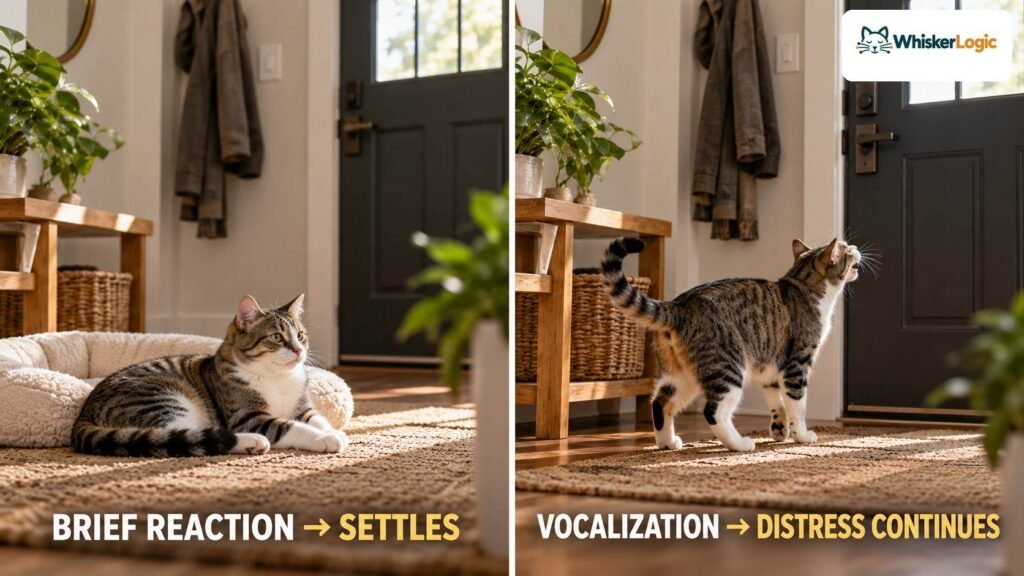
Does Your Cat Settle, or Does the Distress Continue?
The distinction between an initial departure reaction and a continuing pattern is especially useful.
| What you observe | What it may mean | What to check next |
|---|---|---|
| Cat vocalizes around departure, then walks away and rests, eats, explores, or behaves normally | A brief departure reaction may fit better than persistent separation-related distress | Check whether this pattern is consistent across ordinary departures |
| Vocalization continues or repeatedly returns with agitation, pacing, persistent door focus, or other behavioral changes | Broader separation-related distress becomes more important to investigate | Review the complete video and look for other absence-linked behaviors |
| Cat reacts similarly whenever any closed door separates you | Inaccessibility may be an important part of the pattern | Compare exterior departures with ordinary closed-door situations |
| Cat repeatedly tries to get through the exterior door whether or not you are leaving | Outdoor access may be part of the situation | Separate exit-seeking from separation from the person |
Do not create a stopwatch rule.
There is no approved point at which a certain number of minutes of crying automatically becomes separation anxiety.
Duration is useful information, but only as part of the larger pattern.
A cat’s behavior before, during, and after the vocalization matters more than a single number.
Watch What Happens Before You Leave
Do not start your observation when the door closes.
Start earlier.
Ask:
- Does your cat begin following you when you pick up your keys?
- Does putting on your shoes trigger vocalization?
- What happens when you pick up your bag?
- Does a coat matter?
- Does your morning alarm begin the sequence?
- Does the behavior happen at a predictable time?
- Is your cat calm until you approach the exit?
- Does the same pattern happen when your schedule changes?
Write down the sequence.
For example:
Keys → cat follows → shoes → meowing starts → person approaches door → vocalization increases → door closes
This tells you much more than simply writing:
“Cat has separation anxiety.”
It records what you actually observed before interpreting it.
What If Your Cat Cries Whenever You Become Inaccessible?
This is an important comparison.
Notice what happens when you remain at home but temporarily become inaccessible.
For example:
- you close the bathroom door;
- you close the bedroom door;
- you work behind a closed office door;
- or you move into an area the cat cannot enter.
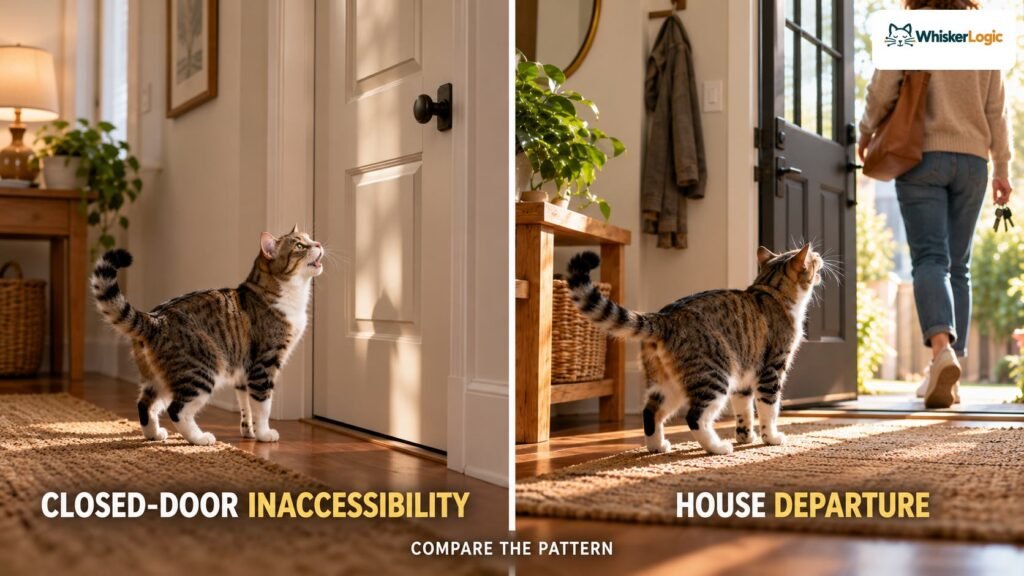
If your cat responds by following you, v⅘ocalizing, waiting at the barrier, or focusing intensely on the closed door, then inaccessibility itself may be relevant.
The 2023 separation study found distinct behavioral components related to separation, supporting the idea that reactions to departure cues and responses to becoming inaccessible should not simply be collapsed into one explanation.
That still does not diagnose the motivation.
It gives you a useful comparison:
Does the behavior require you to leave the house, or does it happen whenever the cat temporarily loses access to you?
Is the Problem Your Absence, or Access to the Door?
Sometimes the exterior door is important for another reason.
Watch whether your cat:
- tries to rush through the door;
- waits at exits even when nobody is leaving;
- repeatedly tries to follow people outside;
- becomes intensely interested whenever the exterior door opens;
- or door-dashes even when the person is returning immediately.
In that situation, outdoor access may be part of the behavior.
That is different from assuming the cat is distressed because you are disappearing.
If your cat’s main pattern is trying to get through the exterior door, see Why Does My Indoor Cat Keep Trying to Get Outside?.
For the current problem, keep the central question focused on this:
What changes when the familiar person becomes unavailable?
Look for Other Behaviors That Happen Only When You Are Gone
Crying becomes more informative when you know what happens alongside it.
Behaviors worth documenting can include:
- prolonged or repeatedly returning vocalization;
- agitation;
- pacing;
- persistent attention to the exit;
- inappropriate urination or defecation;
- destructive behavior;
- unusual withdrawal or inactivity;
- and other consistent changes associated with separation.
The 2020 PLOS ONE study on separation-related problems in domestic cats included several behavioral signs reported by owners.
But these behaviors should still be interpreted cautiously.
Many are not specific to separation-related problems and can occur for other behavioral or medical reasons.
Ask:
Does this behavior appear mainly when the person is gone?
If your cat vocalizes, eliminates outside the litter box, seems restless, or behaves differently both when you are present and when you are absent, that changes the picture and may make veterinary investigation more important.
Vocalization directed at a caregiver who is still present can also belong to a different routine. If the real problem occurs during the night rather than during absence, see Why Does My Indoor Cat Keep Waking Me Up at Night?.
Use a Camera to Build the Separation Timeline
Instead of evaluating individual behaviors in isolation, build a simple timeline:
Departure cue → Door closes → Vocalization → Alone-time behavior → Recovery
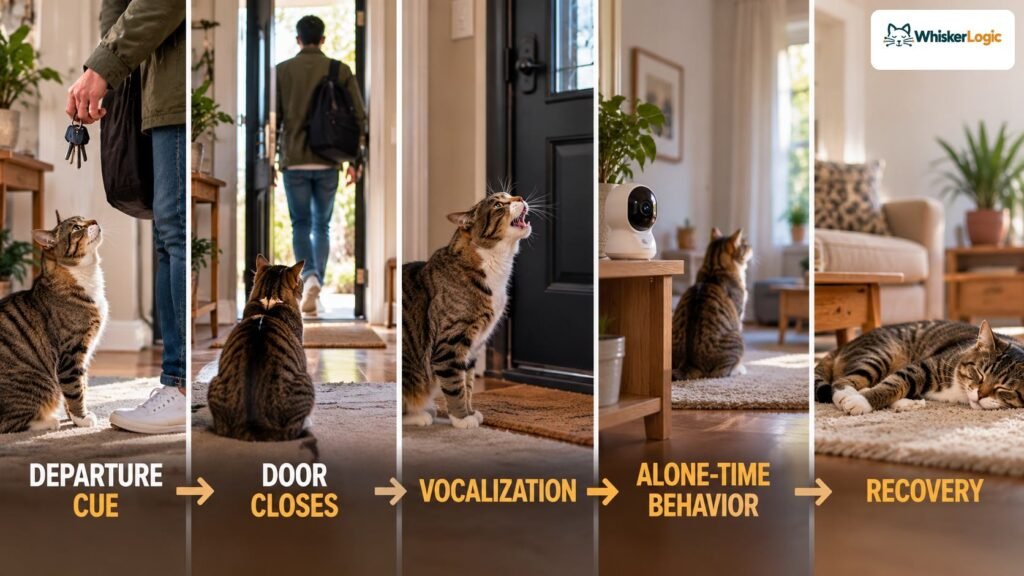
1. Departure cue
What happened first?
Keys?
Shoes?
A bag?
A particular routine?
Movement toward the door?
2. Door closes
Does the behavior intensify?
Does it continue unchanged?
Does it stop?
3. Vocalization pattern
Does your cat give a few calls?
Does the crying continue?
Does it stop and then repeatedly start again?
Record what happens rather than deciding in advance what it means.
4. Alone-time behavior
What happens next?
Does your cat remain fixed on the exit?
Pace?
Move repeatedly between the same locations?
Or does the cat begin eating, exploring, resting, playing, or sleeping?
5. Recovery
Does your cat return to ordinary behavior while you are still gone?
This entire sequence is more useful than the statement:
“My cat cries when I leave.”
If professional help becomes necessary, video plus a clear timeline can give the veterinarian or behavior professional much better information.
Support the Whole Indoor Routine, Not Just the Moment You Leave
It is easy to focus entirely on the few seconds around the front door.
But your cat’s overall indoor environment matters too.
Current Feline Veterinary Medical Association guidance on indoor cats emphasizes meeting cats’ physical, emotional, and behavioral needs through an appropriate environment.
Useful foundations can include:
- comfortable resting locations;
- safe hiding places;
- elevated areas or perches where appropriate;
- opportunities for scratching;
- interactive play;
- opportunities for foraging;
- properly located resources;
- predictable positive interaction with people;
- and a reasonably stable daily routine.
These measures support feline welfare.
They should not be presented as a guaranteed treatment for separation-related distress.
Environmental support is a foundation, not proof of a cure.
Give Your Cat Something Appropriate to Do While You Are Away
Some cats will use independent activities once the owner leaves.
Reasonable options may include:
- a food puzzle the cat already understands and uses comfortably;
- safe food-foraging opportunities;
- comfortable resting areas;
- suitable window or elevated perches;
- and toys that are safe to leave available without supervision.
Do not introduce a difficult new puzzle immediately before leaving and assume it will distract a distressed cat.
Watch what actually happens.
If your cat comfortably uses the activity after you leave, that is useful information.
If the camera shows that your cat ignores food, toys, and resting areas while remaining intensely focused on your departure, that is useful information too.
Do not promise that enrichment or toys will stop the crying.
Do Not Get Another Cat Just to Fix This Problem
Do not adopt another cat solely because your current cat cries when you leave.
The 2020 PLOS ONE study found an association between reported separation-related problems and several household or management characteristics, including whether other animals lived in the home.
But an association is not treatment evidence.
The study does not show that bringing another cat into the household will cure an existing separation-related problem.
A new cat creates a new social relationship that can result in:
- affiliation;
- tolerance;
- avoidance;
- competition;
- or conflict.
You cannot predict that outcome from departure vocalization.
Get another cat only if you genuinely want another cat and can appropriately manage the introduction and long-term multi-cat household—not as therapy for crying when you leave.
Should You Practice Short Departures?
Short or gradual departures may sometimes be incorporated into a structured behavior-modification plan.
But there is not enough feline-specific evidence to justify giving every cat the same schedule.
Do not automatically follow a progression such as:
Do not use a fixed, universal departure schedule.
The relevant level depends on the individual cat and the behavioral pattern.
If video shows significant distress, a veterinarian or appropriately qualified behavior professional can help determine whether gradual departures are suitable and design them so the cat is not repeatedly pushed beyond its distress threshold.
The purpose is not to make the cat “get used to it” through repeated severe reactions.
What Not to Do
Do not punish your cat for crying.
Avoid:
- yelling;
- spray bottles;
- aversive devices;
- shouting through a camera;
- suddenly locking the cat somewhere merely to stop the sound;
- getting another cat as a treatment;
- unprescribed calming medication;
- sedatives;
- CBD;
- or unprescribed supplements.
Do not describe the cat as:
- manipulative;
- dramatic;
- needy;
- or deliberately trying to make you feel guilty.
Those labels assign a motivation that the crying alone cannot establish.
Also avoid invented departure rules such as:
- ignore your cat for 20 minutes before leaving;
- never say goodbye;
- wait 30 minutes before greeting the cat after returning.
There is no universal fixed departure ritual supported by the evidence used here.
Keep departures calm and predictable while you investigate the actual behavior pattern.
When an Older Cat Suddenly Starts Crying More
A cat that has given the same brief departure meow for years presents a different situation from an older cat that suddenly begins vocalizing much more.
Do not assume new vocalization is simply part of aging.
Cornell Feline Health Center’s guidance on older cats advises owners not to dismiss new health or behavioral changes as normal old age.
Pay attention to:
- weight loss or gain;
- appetite changes;
- increased drinking;
- increased urination;
- changes in sleep;
- disorientation;
- reduced mobility;
- apparent pain;
- new house-soiling;
- changes in grooming;
- activity changes;
- or broader personality changes.
Cornell also discusses altered sleep, disorientation, house-soiling, and increased vocalization among possible signs seen with cognitive dysfunction in older cats.
These signs do not diagnose cognitive dysfunction—or any other disease—by themselves.
They are reasons to involve your veterinarian.
What to Try, in Order
Use the crying as a behavior to investigate rather than a diagnosis to assign.
- Decide whether the crying is new or long-standing.
A sudden change deserves more medical attention than a stable pattern your cat has shown for years. - Check for medical or broader behavior changes.
Look at appetite, weight, drinking, urination, mobility, sleep, grooming, litter-box behavior, activity, orientation, and personality. - Identify the departure cues.
Notice whether keys, shoes, a bag, an alarm, a coat, the time of day, or movement toward the exit starts the response. - Record an ordinary departure if possible.
Use a camera or securely positioned phone to see what happens after you leave. - Determine whether your cat settles.
Look for a transition from crying or door focus to ordinary activity such as resting, exploring, eating, playing, or sleeping. - Look for other absence-linked behaviors.
Document repeated pacing, agitation, door focus, house-soiling, destructive behavior, withdrawal, or other changes. - Compare closed-door situations while you are home.
If your cat reacts whenever you become inaccessible, that distinction matters. - Separate outdoor-access behavior from separation itself.
A cat trying to get outside may focus on the exterior door for reasons that are not identical to losing access to you. - Support the overall indoor environment.
Provide suitable resting, hiding, perching, scratching, play, foraging, resources, and predictable positive interaction. - Provide appropriate independent activities.
Use options the cat already handles comfortably and safely. - Do not punish the behavior or add another cat as treatment.
Neither action explains why the behavior is happening. - Get professional help when the pattern is persistent, severe, new, worsening, or unclear.
Bring your notes and video when possible.
When to Get Veterinary or Behavior Help
Seek veterinary help when vocalization is new, substantially worsening, occurs alongside physical or broader behavioral changes, or appears as a new behavior in a senior cat.
Veterinary or qualified behavior help becomes especially important when you see:
- prolonged or repeatedly escalating distress;
- several behaviors occurring specifically during absence;
- inability to settle;
- repeated house-soiling associated with absence;
- destructive behavior that creates a risk of injury;
- self-injury;
- sudden onset;
- disorientation or other new senior-cat changes;
- a worsening pattern;
- or reactions so severe that the caregiver cannot leave without a major response.
A useful assessment should consider both medical and behavioral possibilities.
Bring video if you have it.
A clear record of what happens before, during, and after separation is much more useful than the label “separation anxiety” alone.
FAQ
Does it mean separation anxiety if my cat cries when I leave?
Not necessarily. Crying is one behavioral sign. Look at departure cues, what happens after the door closes, whether your cat settles, whether other behaviors appear specifically during your absence, and whether the same reaction occurs when you simply become inaccessible at home.
Why does my cat meow when I pick up my keys?
Your keys may have become a reliable departure cue. Research has identified reactions to companion-departure cues as one part of feline separation-related behavior, but reacting to keys alone does not diagnose separation anxiety.
Why does my cat cry at the door after I leave?
The door may be where access to you was lost, so your cat may remain focused there immediately after departure. But also check whether your cat frequently focuses on the exterior door because it wants outdoor access. What happens after the initial reaction helps distinguish the patterns.
Should I use a camera to watch my cat when I am gone?
Yes, if you can set one up safely. A camera can show whether vocalization continues, whether your cat remains door-focused or agitated, and whether the cat eventually eats, explores, rests, or sleeps. It provides observation, not a diagnosis.
How do I know if my cat settles after I leave?
Look for a transition back to ordinary behavior. That might include leaving the door area, resting, sleeping, exploring, eating, or interacting normally with the environment. Do not use a fixed number of minutes as a diagnostic cutoff.
Why does my cat cry when I close any door?
If your cat reacts when you close a bathroom or bedroom door while you are still home, becoming inaccessible may be relevant. That pattern should be compared with what happens when you actually leave the house rather than automatically being labeled separation anxiety.
Will getting another cat help?
Do not get another cat solely to stop this behavior. Observational research showing an association between the presence of other animals and reported separation-related behavior does not prove that adding another cat treats an existing problem.
Should I leave toys or a puzzle feeder when I go out?
You can provide safe activities your cat already uses comfortably, including suitable food puzzles, foraging opportunities, resting areas, perches, or independent toys. They can support a good indoor environment, but they are not guaranteed treatments for separation distress.
Should I ignore my cat before I leave?
There is no universal evidence-based rule requiring you to ignore your cat for a fixed period before leaving. Avoid arbitrary rituals such as ignoring the cat for 20 or 30 minutes. A calm, predictable routine and careful observation are better starting points.
Why has my older cat suddenly started crying when I leave?
New vocalization in an older cat deserves veterinary attention, particularly if you also notice changes in appetite, weight, thirst, urination, sleep, mobility, orientation, grooming, litter-box behavior, or personality. Do not assume a new behavior is simply old age.
Sources
- Behavioural Responses to Separation From Human Companion in the Domestic Cat: A Survey-Based Study — Behavioural Processes, 2023
- Identification of Separation-Related Problems in Domestic Cats: A Questionnaire Survey — PLOS ONE, 2020
- Diagnosis of Behavior Problems in Animals — Merck Veterinary Manual
- Meeting the Physical and Emotional Needs of Indoor Cats — Feline Veterinary Medical Association
- Cats and Owners Interact More With Each Other After a Longer Duration of Separation — PLOS ONE, 2017
- Loving Care for Older Cats — Cornell Feline Health Center
- Cognitive Dysfunction — Cornell Feline Health Center