
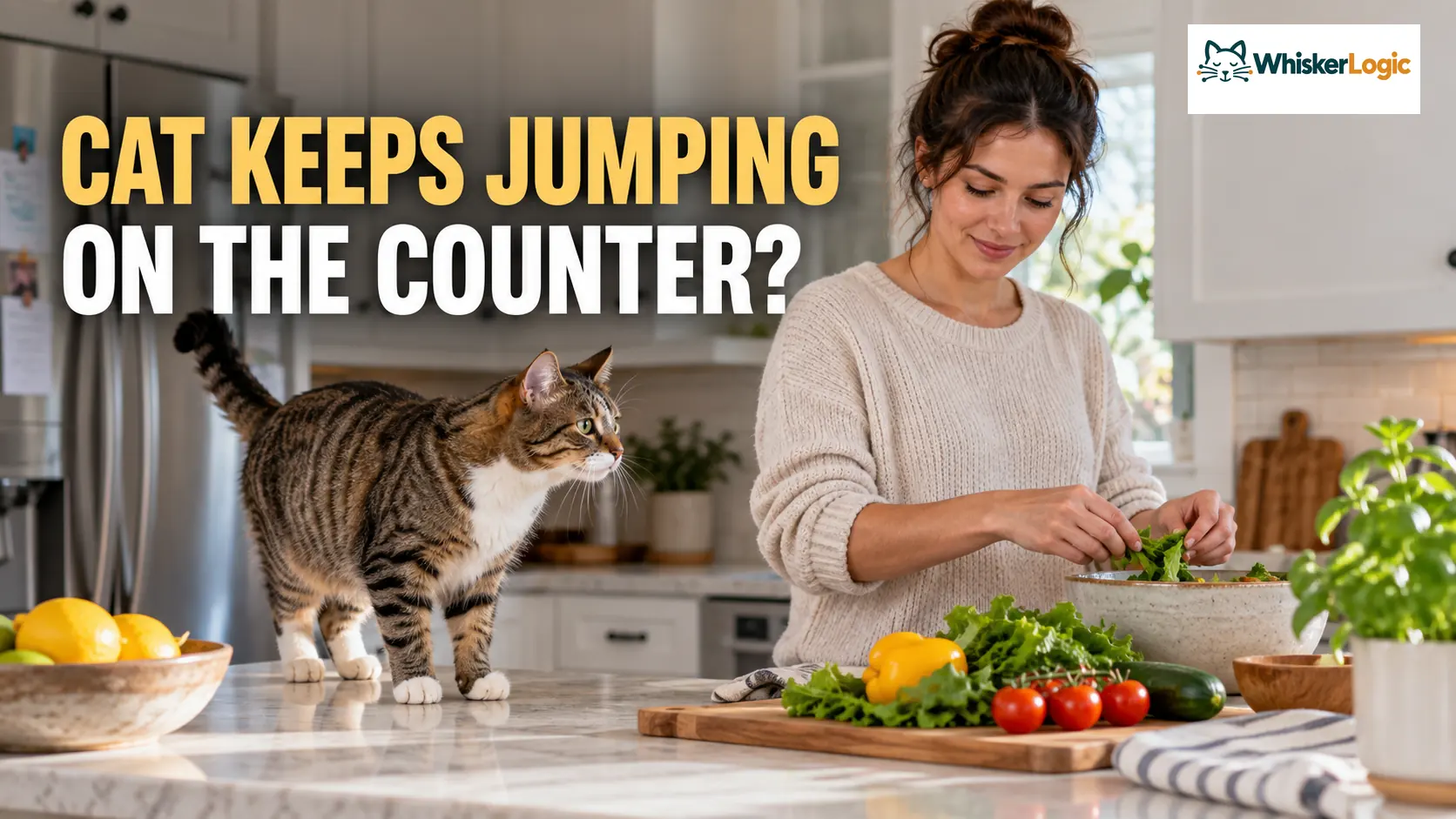
You put your cat back on the floor, turn around, and a minute later they are on the counter again.
If your cat keeps jumping on the counter, repeatedly putting them back on the floor may stop the behavior for a moment, but it does not necessarily change what makes the counter worth returning to.
The useful question is not whether your cat is being stubborn or “knows they are not supposed to be there.” It is what that particular counter provides—and what happens before and after your cat jumps onto it.
The counter may offer food opportunities, interesting smells, height, proximity to you, a view of kitchen activity, or a learned history of finding something worthwhile there. Once you identify the likely payoff, you can reduce it, provide an alternative that genuinely competes with the counter, and reinforce the place you actually want your cat to use.
Quick Answer
If your cat keeps jumping on the counter, first watch when the behavior happens and what your cat seems to gain from being there.
Then work on three things together:
- Reduce what makes the counter rewarding, such as accessible food, crumbs, dirty dishes, or a predictable human response.
- Provide a safe alternative that competes with the counter—especially if your cat wants height, a view of you, or proximity to kitchen activity.
- Reinforce your cat for choosing that alternative, ideally before the counter jump happens.
Avoid yelling, spraying water, frightening your cat, or trying to make the counter scary. Current FelineVMA guidance favors teaching and reinforcing desirable behavior rather than relying on punishment, which can contribute to fear-anxiety without teaching the cat what to do instead.
Vet Check
Counter jumping by itself is usually a behavior and environment question, not a diagnosis.
However, contact your veterinarian if the behavior appears suddenly, changes dramatically, or occurs alongside changes in appetite, weight, thirst, activity, mobility, or broader behavior or personality.
A sudden change does not prove that your cat has a medical condition. It simply means there may be more to investigate than training alone. Cornell veterinary guidance similarly notes that newly appearing counter jumping can warrant a broader health check when it occurs alongside changes such as appetite or activity changes.
Table of Contents
Why Your Cat Keeps Jumping on the Counter
The simplest answer is that something about the counter continues to make returning worthwhile.
That does not mean every cat is jumping up for the same reason.
For one cat, the important part may be food preparation. For another, it may be the elevated view. Another cat may jump up mainly when a person enters the kitchen because the counter puts them close to that person at working height.
FelineVMA specifically identifies several possible reasons cats get onto counters, including associations with food, access to food, proximity to people, and a lack of suitable nearby perches.
Instead of focusing only on the jump, look at the entire sequence:
When → What the counter offers → What the cat gets → What the person does → What happens next
For example:
Food preparation → food smells and proximity to the owner → cat jumps onto the counter → owner gets a treat to make the cat get down → cat jumps down and eats the treat
That does not prove the cat deliberately jumped onto the counter “to demand a treat.”
But if a similar sequence happens repeatedly, jumping onto the counter may become part of a pattern that continues to produce something valuable.
First Ask: What Does the Counter Give Your Cat?
Before trying to stop the behavior, ask what the counter may provide that the floor does not.
Possibilities include:
- food or the possibility of finding food;
- food smells;
- an elevated observation point;
- proximity to you;
- a view of food preparation;
- access to household activity;
- a place that has produced rewards in the past.
“Cats like high places” may be true, but it is not a complete explanation.
Cats benefit from access to safe vertical space and elevated locations as part of an appropriate feline environment.
But height alone does not explain why a particular cat chooses the kitchen counter instead of another elevated surface.
The more useful question is:
What does this counter provide at the exact time my cat chooses it?
Watch When Your Cat Jumps Up
Timing can reveal more than the jump itself.
For a few normal kitchen routines, use this sequence:
Observation → Interpretation → Check → Action
Observation
Notice what happens immediately before your cat jumps up.
Does your cat appear when:
- you begin preparing food?
- the refrigerator opens?
- a plate is placed on the counter?
- you enter the kitchen?
- you sit down to eat?
- the kitchen becomes quiet?
- the counter appears empty?
Then watch what your cat does after reaching the counter.
Do they investigate the work surface?
Look toward food?
Sit and watch you?
Walk toward the same part of the counter?
Seek interaction?
Leave quickly if nothing happens?
Interpretation
Ask what the counter may be providing in that situation.
Do not decide that your cat is being defiant or manipulative. Look for a practical payoff instead.
Check
Watch what you do immediately afterward.
Do you talk to your cat?
Pick them up?
Produce a treat?
Open a food container?
Begin playing?
Chase them?
Even a response intended to stop the behavior can become part of the sequence worth repeating.
Action
Reduce the likely payoff where practical and begin reinforcing an alternative behavior or location that meets the same need more safely.
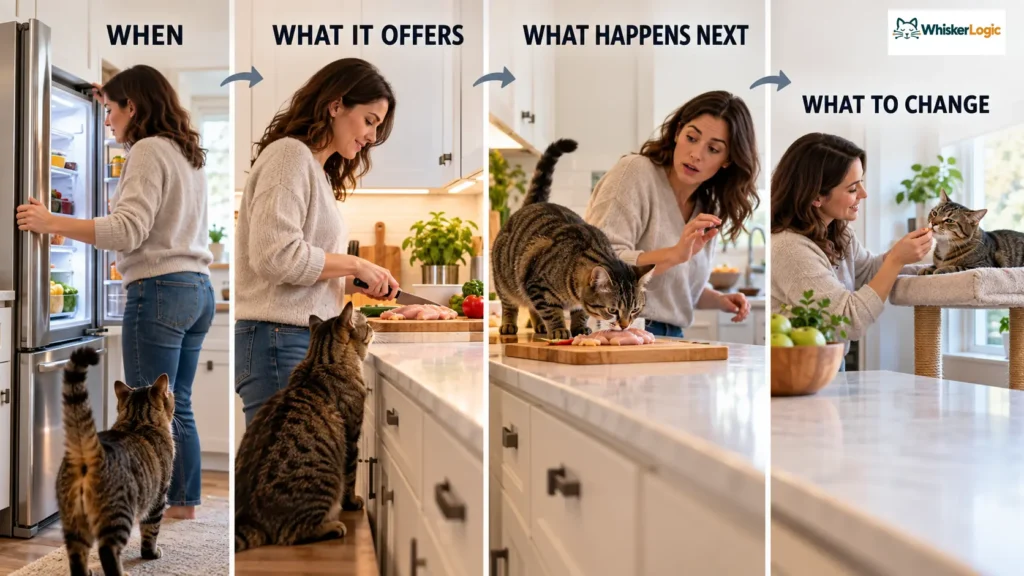
Food Can Keep the Counter Worth Checking
A counter does not need to contain a full meal every time for it to remain interesting.
Crumbs, dirty plates, occasional scraps, food preparation, or food previously given from the counter can all contribute to its history.
FelineVMA specifically notes that cats may learn an association between the counter and food and that caregivers can unintentionally strengthen counter jumping through food-related responses.
Start with straightforward management:
Keep accessible food away.
Clean up crumbs and food residue.
Remove dirty plates when practical.
Avoid feeding your cat directly from the counter.
And pay attention to whether food reliably appears immediately after your cat jumps up.
Food is not the explanation for every cat, but it is one possibility worth testing rather than assuming.
Are You Accidentally Rewarding the Jump?
This is one of the easiest patterns to miss.
Imagine this sequence:
Your cat jumps onto the counter.
You want them down.
You reach for a treat.
You toss it onto the floor.
Your cat jumps down and eats it.
From your perspective, you rewarded getting off the counter.
But the larger sequence may become:
Jump onto counter → person produces food → jump down → receive food
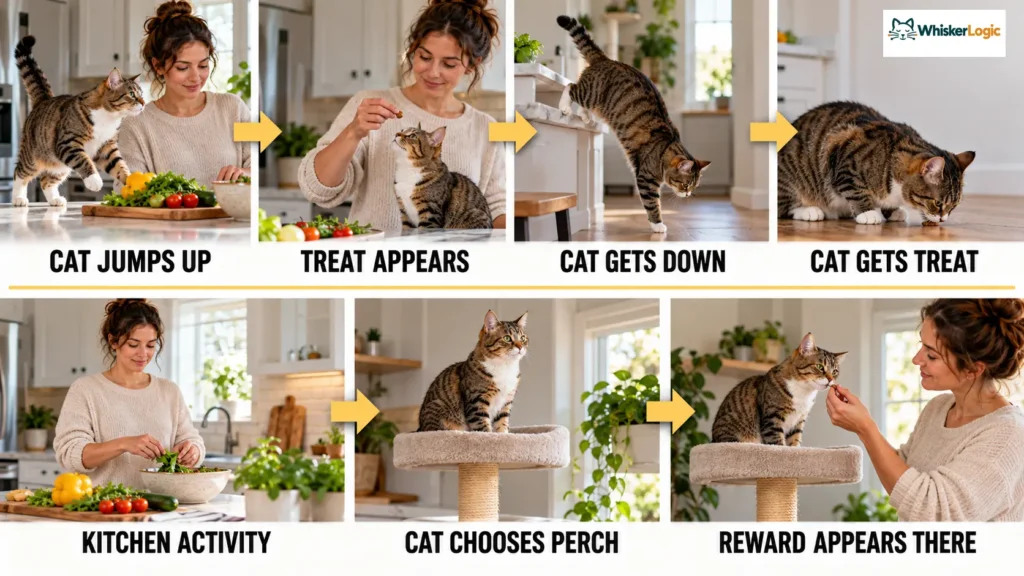
FelineVMA uses this type of counter-jumping sequence as an example of how a caregiver’s response can inadvertently reward the behavior they are trying to stop.
This does not mean treats are bad or that food rewards should not be used.
The important question is which behavior makes the reward appear.
Whenever possible, reinforce the behavior you want before or independently of the unwanted jump.
For example:
Kitchen activity begins → cat chooses approved perch → reward appears there
That gives the cat a useful alternative sequence to learn.
Watching what happens after a behavior is important in other household routines too. If your cat’s main problem is repeatedly waking you during the night, see Why Does My Indoor Cat Keep Waking Me Up at Night?.
Give Your Cat a Better Place to Watch You
If height, observation, or proximity to you matters, simply removing the cat from the counter may leave the original motivation unchanged.
Instead, provide a place where your cat can do an acceptable version of what they were trying to do.
A useful alternative perch should be:
- safe;
- stable;
- sufficiently elevated if height matters to your cat;
- positioned where your cat can observe the relevant household activity;
- close enough to compete with the counter if proximity matters;
- positioned so it does not become an easy launching point directly onto the counter.
There is no universal correct height or distance.
The setup should depend on what your cat appears to value.
FelineVMA’s counter-training guidance similarly recommends providing a desirable elevated perch from which a cat can observe someone working in the kitchen without easily jumping directly from that perch to the counter.
A Cat Tree in Another Room May Not Compete With the Counter
You may already have a perfectly good cat tree.
But that does not automatically make it a useful alternative to a kitchen counter.
Suppose your cat is interested in the counter while you prepare dinner.
The counter may offer:
height + your presence + food smells + kitchen activity
while a cat tree in another room provides:
height

Those are not necessarily equivalent from your cat’s perspective.
This is why simply buying another cat tree is not the main solution.
The alternative needs to compete with the specific things that make the counter valuable.
The same principle applies to scratching. A scratching post does not necessarily solve furniture scratching if its location, orientation, texture, stability, or other features do not match what the cat is seeking. If that is another problem in your home, see Why Does My Cat Scratch the Couch Even With a Scratching Post?.
Do not ask only:
“Does my cat have a perch?”
Ask:
“Does my cat have a perch that competes with this counter in this situation?”
Teach the Alternative Before You Need It
Do not wait until a pan is hot, food is being chopped, and your cat is already standing on the counter to introduce the alternative.
Teach it during calm moments first.
Use this progression:
Set up the alternative → make it useful → reinforce voluntary use → practice when the kitchen is calm → use it during real kitchen routines
Two simple training approaches can help.
Capturing
Capturing means rewarding your cat when they voluntarily perform the behavior you want.
If your cat chooses the approved perch without being asked, reinforce that choice.
You are showing the cat:
Choosing this place pays off.
Luring
Luring means using something your cat values to guide them toward the desired location during training.
For example, during a calm practice session, you might use an appropriate food reward or another preferred reward to guide your cat toward the perch and reinforce them there.
FelineVMA includes both luring and capturing among positive-reinforcement techniques for teaching desirable alternatives.
You do not need a clicker to use this plan.
What matters most is making the desired location clear and worthwhile.
What Should You Do When Your Cat Is Already on the Counter?
First determine whether there is an immediate safety hazard.
If your cat is beside a hot stove, sharp knife, unsafe food, chemical, or breakable object, immediate safety comes before the training plan.
Calmly prevent access or move your cat away safely when necessary.
Avoid turning the situation into yelling, chasing, spraying, or another frightening interaction.
Also be careful about automatically producing a treat every time your cat gets onto the counter. If that sequence becomes predictable, it may help maintain the behavior.
Once the immediate situation is safe, return to the larger questions:
What made the counter valuable?
Can that payoff be reduced?
Can you reinforce the approved alternative before the next jump?
The long-term goal is not to win each individual confrontation.
It is to change what happens across repeated kitchen routines.
Keep the Counter From Paying Off
Training is harder if the counter continues to provide rewards while you are teaching an alternative.
Look for rewards you can reasonably remove.
That may include:
- accessible food;
- crumbs and food residue;
- dirty dishes;
- food handed directly from the counter;
- predictable attention that occurs only after the cat jumps up.
FelineVMA’s counter guidance recommends keeping human food off accessible surfaces while reinforcing use of a desirable alternative perch.
You do not need to make the counter frightening.
You are trying to make it less rewarding.
At the same time, make the approved location more worthwhile.
Both sides of that equation matter.
What If My Cat Jumps Up Only While I’m Cooking?
That pattern gives you useful information.
Cooking may combine several things your cat values at the same time:
- food smells;
- food movement;
- your presence;
- refrigerator activity;
- the possibility of finding something edible;
- an interesting place from which to watch.
Do not wait for the busiest cooking period to begin training.
Practice the approved perch first when the kitchen is calm.
Once your cat is voluntarily using it, begin reinforcing that choice during simple kitchen activities.
During genuinely dangerous food preparation, management may be more appropriate than trying to conduct a training session.
VCA also recommends management during meals or food preparation when access to food is difficult to control.
What If My Cat Keeps Jumping on the Counter When It Looks Empty?
An empty counter can still have value.
Your cat may be interested in:
- height;
- the view;
- your location;
- household activity;
- lingering food smells;
- a history of finding food there.
So “there is no food there right now” does not necessarily rule out a learned food association.
It also does not prove that food is the reason.
Watch what happens next.
Where does your cat go once they are on the counter?
What do they investigate?
Do they watch you?
Do they repeatedly check one area?
Do they stay when you leave?
Those observations can help distinguish what the counter may be providing.
Why Yelling or Spraying Water Can Backfire
Yelling, squirting water, chasing, or startling your cat does not teach them which location you want them to use instead.
FelineVMA specifically advises against punishment-based approaches such as spraying a cat with water on the counter. Its training guidance explains that punishment can contribute to fear-anxiety and interfere with learning, while positive reinforcement teaches desirable behavior more directly.
A cat may also learn that the unpleasant consequence is associated with your presence.
That does not give you a reliable alternative behavior when you are not standing nearby.
The goal is not:
Make the counter frightening.
The goal is:
Make the counter less rewarding and the approved alternative more worthwhile.
Kitchen Safety Comes Before Training
A kitchen can become dangerous quickly.
Immediate hazards may include:
- hot stovetops or pans;
- sharp utensils;
- breakable objects;
- unsafe foods;
- cleaning products.
You do not need to turn a dangerous cooking period into a behavior-training session.
When the kitchen is temporarily unsafe, management comes first.
That may mean safely restricting access during the dangerous part of food preparation when practical and without using punishment.
Then return to the training plan during a calmer period.
Think of the difference this way:
Management protects the cat during the immediate situation.
Training changes what happens in future situations.
Many households need both.
What to Try When Your Cat Keeps Jumping on the Counter
1. Identify when it happens
Watch the situation immediately before the jump.
Do not begin by assuming a cause.
2. Identify what the counter offers
Look for food opportunities, height, proximity, observation, smells, or another repeatable payoff.
3. Watch what happens after the jump
Your own response may be part of the pattern.
Notice whether jumping triggers food, attention, conversation, play, or another consequence your cat may value.
4. Remove obvious counter rewards
Keep food inaccessible, clear crumbs, remove dirty dishes when practical, and avoid routinely feeding your cat from the counter.
5. Choose a competing alternative
If your cat values height or proximity, provide a stable location that offers those features without becoming a direct bridge onto the counter.
6. Make the alternative useful
Use rewards your individual cat actually values.
That may be food, play, attention, or another appropriate reinforcer.
7. Capture voluntary use
When your cat chooses the approved location without first jumping onto the counter, reinforce that choice.
8. Practice when nothing dangerous is happening
Build the behavior during calm kitchen periods before asking your cat to use it during a more difficult routine.
9. Add real kitchen routines gradually
Use the alternative during normal household activity once your cat understands that it is a worthwhile place to be.
10. Manage unsafe moments
Hot surfaces, sharp tools, unsafe foods, chemicals, and breakable objects are reasons to prioritize immediate access control.
11. Reassess instead of blaming the cat
If the plan is not working, ask:
What does the counter still provide that the alternative does not?
Do not assume failure means your cat is stubborn.
Behavior change does not follow one guaranteed timeline. How quickly the pattern changes can depend on reinforcement history, how valuable the counter is, how well the alternative competes, consistency, and the individual cat.
When to Talk to Your Veterinarian or a Behavior Professional
Talk with your veterinarian if counter jumping appears suddenly or is accompanied by changes in:
- appetite;
- weight;
- thirst;
- activity;
- mobility;
- broader behavior or personality.
Do not diagnose hyperthyroidism, pain, cognitive disease, or another medical condition from counter jumping itself.
The behavior is only one observation.
Veterinary evaluation becomes more useful when that observation appears as part of a larger change.
If the behavior remains difficult to manage despite a consistent environmental and reward-based plan—or if significant fear or anxiety is involved—your veterinarian can also help you decide whether support from a qualified feline behavior professional is appropriate.
FAQ
Why does my cat jump on the counter when I cook?
Cooking may combine several rewards: food smells, movement, your presence, and the possibility of finding food. Watch what your cat actually does after jumping up. If observing you appears important, a nearby safe perch may compete better than an elevated location in another room.
Should I spray my cat with water?
No part of this plan requires spraying your cat. FelineVMA specifically advises against using a water squirt bottle for counter jumping and recommends positive reinforcement of desirable behaviors instead.
Why does my cat return after I put them down?
Because placing your cat on the floor does not necessarily change what makes the counter rewarding. Food, height, proximity, smells, observation, or another payoff may still be available.
Should I give my cat a treat to get them off the counter?
Be careful with the sequence.
If jumping onto the counter reliably causes you to produce a treat, the entire routine may become rewarding.
Whenever possible, reinforce your cat for using the approved location before or independently of the counter jump.
Does aluminum foil work?
Some popular advice recommends foil, sticky surfaces, or other unpleasant textures because some individual cats may avoid them.
They are not the core WhiskerLogic approach here.
The primary plan is to identify and reduce what makes the counter rewarding, manage unsafe moments, provide a competitive alternative, and reinforce the behavior you want.
You do not need to build the training plan around startling or frightening your cat.
Where should I put the alternative perch?
Place it where it can compete with the reason your cat uses the counter.
If your cat wants to watch you in the kitchen, the perch may need to be close enough for your activity to remain visible.
It should be stable and safe, and it should not be positioned as an easy launching point directly onto the counter.
There is no universal correct height or distance.
Can an older cat learn to use another location?
Positive-reinforcement training can be used with cats of different ages. FelineVMA notes that this type of training can be performed at any age.
Make sure the alternative is physically comfortable and accessible for the individual cat.
If an older cat suddenly begins behaving differently or shows mobility, appetite, weight, thirst, activity, or other broader changes, talk with your veterinarian.
What if the counter is empty?
The counter may still provide height, a view, proximity to you, interesting smells, or a history of finding something worthwhile there.
Watch what your cat does after reaching it instead of assuming that food must be physically present at that moment.
Should I lock my cat out of the kitchen?
Temporary access restriction can be reasonable management when the kitchen is genuinely unsafe, provided it can be done safely and without punishment.
It should not replace the longer-term work of identifying what maintains the behavior and teaching a safer alternative.
Why did my cat suddenly start jumping on counters?
A new household routine or new reward may be involved, but sudden behavior change deserves more attention than a long-standing habit.
If the new counter jumping occurs alongside appetite, weight, thirst, mobility, activity, or broader behavior changes, contact your veterinarian.
Sources
- FelineVMA — Training Techniques for Addressing Undesirable Behaviors
- FelineVMA — Positive Reinforcement Training Educational Toolkit
- FelineVMA — Positive Reinforcement of Cats Position Statement
- AAFP/ISFM — Environmental Needs Guidelines
- Cornell University College of Veterinary Medicine — Baker Pet Talks: Tips From Cornell Experts
- VCA Animal Hospitals — Feeding a Cat Who Is a Glutton