
You notice teeth marks on a phone charger. Or you catch your cat biting the cord behind a lamp, computer, or appliance.
If you have a cat chewing electrical cords, the first question is not why they are doing it. The first question is whether the cord is live, damaged, or accessible enough to create an electrical hazard.
Make dangerous cords inaccessible first. Then look at the pattern: Does your cat target only certain cords? Are loose or moving cables more likely to be bitten? Does your cat also chew other non-food objects? And, most importantly, are pieces actually being swallowed?
Cord chewing alone does not prove that your cat has pica, is bored, is anxious, has a nutritional deficiency, has dental disease, or has another medical disorder.
Urgent Safety Warning: If Your Cat Bit a Live Electrical Cord
If your cat has bitten through, mouthed, or received a shock from a live electrical cord, treat it as an emergency.
Do not touch your cat while they may still be in contact with electrical current. Disconnect or shut off the power source only if you can do so safely, then seek emergency veterinary care.
Do not wait to see whether symptoms appear after a known or suspected electrical shock.
Electrical injuries can cause burns as well as serious respiratory, cardiac, and neurological complications. Visible external injury is not always present, so the absence of an obvious burn does not establish that the cat is unharmed.
Concerning signs after electrical exposure may include difficulty breathing, collapse or loss of consciousness, severe weakness, seizures or tremors, oral burns, or other significant abnormal behavior following electrical contact.
Do not apply creams, ointments, ice, or other home treatments to a suspected electrical burn unless a veterinarian specifically directs you to do so.
Quick Answer
If your cat chews electrical cords, physically protect the cords first.
Unplug unused cables where practical, secure loose cables, reroute accessible cords, use suitable protective cord covers or conduit, and stop using visibly damaged electrical cords.
Then observe the pattern.
A cat that mainly bites one loose charger or dangling cable may be interacting with that particular object during play or investigation. A cat that repeatedly chews plastic, fabric, rubber, string, cardboard, and other non-food objects—or swallows pieces—needs a broader assessment.
Chewing is also not the same as ingestion. A study of feline pica and chewing behavior specifically distinguished cats that chew non-food objects from cats that actually ingest them.
Appropriate play, food puzzles, exploration, and other environmental opportunities can provide safer outlets, but they do not replace physically protecting electrical cords.
Vet Check
There are two different veterinary situations to separate.
Emergency Now
Seek emergency veterinary attention if your cat has had known or suspected contact with a live electrical cord, particularly if the cord was bitten through or an electrical shock may have occurred.
Difficulty breathing, collapse, loss of consciousness, seizures or tremors, severe weakness, oral burns, or other serious changes after electrical contact also require urgent attention.
Do not wait for symptoms after a known electrical shock.
Schedule a Veterinary Evaluation
A non-emergency veterinary evaluation becomes more important if:
- your cat repeatedly chews many different non-food materials
- the behavior is becoming more frequent or intense
- your cat swallows pieces
- vomiting or other gastrointestinal changes develop
- appetite or weight changes occur
- you suspect mouth or dental discomfort
- the behavior begins suddenly in an adult cat
- other health or behavior changes appear
Broader repetitive oral behavior can have medical or behavioral contributors, so the pattern should be evaluated rather than assuming a diagnosis from cord chewing alone. Merck Veterinary Manual describes oral repetitive behaviors as including chewing or ingesting materials such as fabric, plastic, rubber, paper, cardboard, and string, and recommends ruling out disease processes in affected cats.
Table of Contents
Why Is My Cat Chewing Electrical Cords?
There is no single explanation that applies to every cat.
Cats may mouth or chew household objects during exploration or play. Cornell Feline Health Center notes that chewing can occur as part of play and investigation, particularly in kittens.
The useful question is what your cat is actually doing and under what circumstances.
Does the behavior happen when a thin charger hangs over the edge of a desk? Does your cat paw at it first? Does the cable move when touched? Does your cat ignore the same cable when it is firmly secured?
Those observations may suggest that accessibility, movement, position, texture, or some combination of those variables is relevant to that particular interaction.
That is different from a cat that repeatedly seeks many types of non-food material throughout the home.
Veterinary behavior references describe repetitive oral behaviors that may include licking, sucking, chewing, or ingesting materials such as plastic, fabric, rubber, paper, cardboard, and string. Because different medical and behavioral factors may be involved, chewing alone should not be used to diagnose the cause.
First: Make the Cord Inaccessible
Do this before experimenting with training techniques.
The safest electrical cord is one your cat cannot reach.
Depending on the room and the type of cable, practical changes can include:
- unplugging unused cords where practical
- routing cords where the cat cannot reach them
- securing loose cables so they do not hang or swing
- moving chargers out of reach when they are not being used
- positioning cords behind furniture when this can be done safely
- using suitable cord covers or protective conduit
- blocking access to areas containing cords that cannot yet be secured
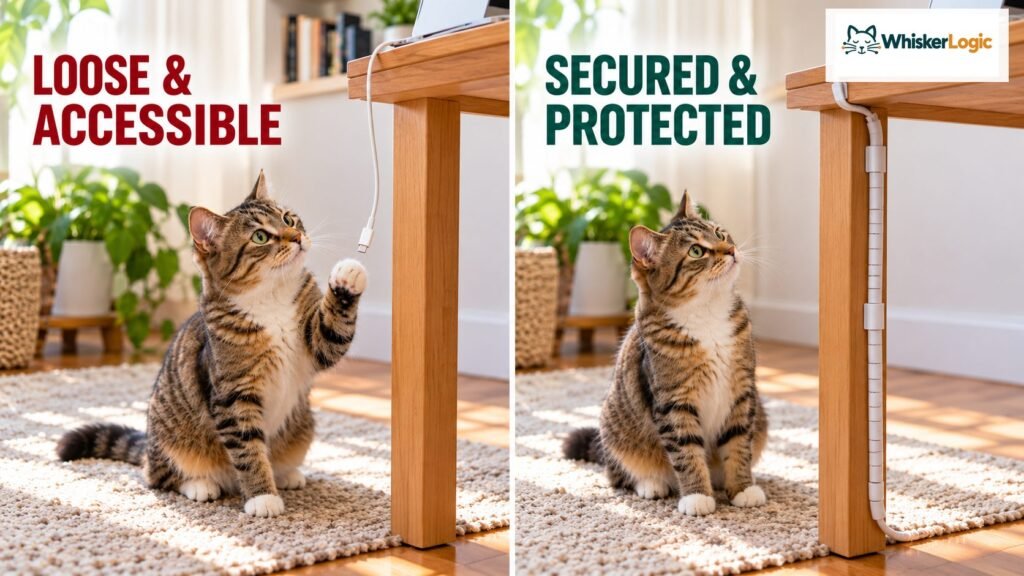
Cornell Feline Health Center specifically recommends tying up cords or placing them in heavy cord protectors to reduce access.
If a cable is visibly damaged, stop using it.
Do not make continued use of a damaged electrical cord part of your behavior-management plan. Replace the damaged cable or have the electrical issue appropriately addressed rather than relying on tape, deterrent spray, or the hope that your cat will leave it alone.
Does Your Cat Chew Cords, or Everything Else Too?
This distinction can help determine whether you are mainly dealing with one accessible household hazard or a broader oral-behavior pattern.

Mostly Cord-Specific
Imagine this sequence:
Loose charger hangs from a desk
→ the cable moves
→ the cat paws at it
→ the cat bites it
→ the cat shows little or no interest in unrelated non-food objects
That pattern may fit a more object-specific play or investigation context.
It does not prove why your cat is chewing.
Instead, it gives you something useful to check: remove the movement and access.
Secure the cable completely and observe whether interest in that specific cord changes.
Broader Non-Food Chewing
Now consider a different pattern.
Your cat repeatedly seeks out cords, plastic, fabric, rubber, string, shoelaces, cardboard, or other non-food objects.
The cat may chew multiple materials, tear pieces off, or sometimes swallow them.
That broader pattern deserves more veterinary attention than an occasional attempt to bite one accessible charger.
Do not automatically label it pica or compulsive behavior. Document exactly what your cat targets, whether pieces disappear, how often the behavior occurs, and whether other physical or behavioral changes are present.
Chewing a Cord Does Not Automatically Mean Pica
The terms chewing and ingestion should not be treated as interchangeable.
In a study of pica and chewing behaviors in privately owned cats, researchers specifically distinguished chewing an object from actually ingesting it. Some cats ingested certain materials while only chewing others. The researchers noted that chewing could represent a separate behavioral category worthy of further study.
For practical purposes, ask:
Does my cat leave tooth marks or destroy the object, or are pieces actually being swallowed?
A cat that bites a charger and leaves punctures in the insulation is not automatically showing the same behavior as a cat that repeatedly consumes plastic, fabric, thread, rubber, or another non-food material.
That distinction matters both for understanding the pattern and for deciding whether veterinary evaluation is becoming more important.
Watch Which Cords Your Cat Targets
Instead of starting with a theory, collect observations.
Ask:
- Is it usually a thin phone charger?
- Does the cable hang from a desk or nightstand?
- Is it loose on the floor?
- Does it move when your cat touches it?
- Does it shift while you use the connected device?
- Is the behavior limited to one room?
- Does it happen mainly when you are nearby?
- Does it seem to happen mainly when your cat is alone?
- Does your cat target only one type of cable or material?
- Does your cat paw at the cord before biting it?
- Are there only tooth marks, or are pieces missing?
You are looking for a repeatable pattern, not trying to prove a diagnosis.
For a cat chewing electrical cords, comparing a securely managed cable with the previously loose or dangling setup may reveal whether movement and accessibility are part of the pattern.
Do not leave a dangerous cord accessible just to perform that comparison.
Does Movement Make the Cord More Interesting?
For some cats, a loose or moving cable may become part of play or investigation.
A charger hanging from a desk may move when pawed. A laptop cable may shift while the device is being handled. A thin cable may swing when your cat brushes against it.
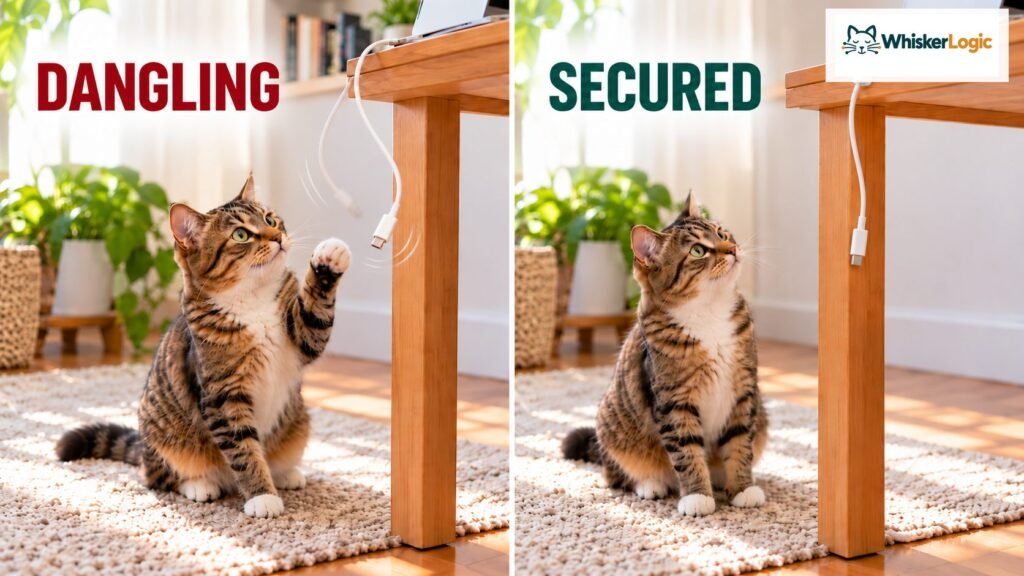
That does not mean the cord necessarily “looks like a snake,” and movement does not prove that hunting behavior is the cause.
Test the observable variable instead.
Secure the cord so it cannot swing or move freely.
If your cat repeatedly approaches the loose version but shows much less interest once the cable is secured, movement or accessibility may be contributing to that particular interaction.
The solution is still to keep the cord protected.
What If My Cat Bites Cords Only During Play?
First, remove electrical cords from the play environment.
Do not wiggle a charger, move a cable for your cat to chase, or intentionally let your cat play with household wiring—even when the cord is unplugged.
You do not want cords to become objects that are sometimes available for play and sometimes dangerous.
Instead, offer appropriate interactive play away from the cables.
FelineVMA environmental guidance recommends opportunities for play and predatory behavior and notes that interactive toys can allow cats to chase and periodically capture a target. Food puzzles can provide another form of activity.
That does not mean more play will automatically stop cord chewing.
The electrical cord still needs to be physically protected.
What If My Cat Chews Plastic, Fabric, Rubber, or String Too?
Broader chewing changes the question.
Instead of asking only, “Why does my cat like this charger?” ask:
What non-food materials does my cat repeatedly seek out, and does the behavior include ingestion?
Merck Veterinary Manual describes feline oral repetitive behaviors involving materials such as fabric, plastic, rubber, paper, cardboard, and string, and notes the importance of excluding possible medical contributors.
The pica and chewing study also found that cats could chew some materials while ingesting others, reinforcing why the exact behavior matters.
Write down what your cat targets and whether pieces are missing.
That information may be more useful during a veterinary evaluation than simply reporting that your cat “chews strange things.”
What If My Cat Swallows Pieces?
Once pieces are swallowed, the situation is no longer only a cord-management or training problem.
Cable coating, plastic, rubber, fabric, string, and other foreign material can cause gastrointestinal complications. Not every swallowed object causes an obstruction, but foreign bodies can become lodged in the gastrointestinal tract.
Cats are particularly at risk from linear foreign bodies such as string, yarn, and similar materials. These can become anchored and damage the intestine as intestinal movement pulls against them.
Contact your veterinarian if you know or suspect that your cat swallowed part of a cord or another non-food object.
Do not try to make your cat vomit at home unless a veterinarian specifically instructs you to do so. VCA Animal Hospitals specifically advises against inducing vomiting when a cat has swallowed foreign objects such as plastic, paper, string, or wool.
If string, thread, or another linear object is visible from your cat’s mouth, do not pull it. Merck Veterinary Manual warns that pulling an embedded linear foreign body may lead to intestinal perforation.
If string or similar material is protruding from the anus, do not pull it either. Contact a veterinarian for guidance.
Vomiting, appetite loss, lethargy, abdominal discomfort, or other gastrointestinal changes after suspected foreign-material ingestion increase the importance of prompt veterinary assessment.
Give Your Cat Safer Ways to Play and Investigate
Once electrical access is controlled, provide appropriate alternatives.
Depending on your individual cat, these may include:
- sturdy cat-safe toys
- supervised interactive prey-style play
- toys the cat can safely chase and capture
- suitable food puzzles
- climbing and exploration opportunities
- safe objects specifically designed for feline play
Strand-like interactive toys should be supervised and stored away after play.
Do not leave loose string, ribbon, thread, shoelaces, or similar swallowable material available as a substitute for electrical cords.
FelineVMA guidance supports play, predatory behavior, safe environmental opportunities, and food puzzles as parts of a cat-supportive home environment.
The alternative should also make sense for the behavior you actually observe. A cat attracted to moving objects may need different safe outlets from a cat that repeatedly seeks a particular texture.
That same principle—looking at what the original target provides before choosing an alternative—is useful when a cat scratches the couch even with a scratching post.
None of these alternatives makes an exposed electrical cord safe.
Why Physical Cord Protection Matters More Than Bitter Sprays
Physical access control should be the main strategy.
A taste deterrent depends on the cat contacting the cord and finding the taste unpleasant. A physical barrier is intended to prevent access in the first place.
For a cat chewing electrical cords, that difference matters because the object being protected may carry live electrical current.
A spray should never be the only thing standing between your cat and an accessible live cable.
If you choose to consider a commercial taste deterrent as a secondary measure, check that the product is suitable for the specific surface or equipment and follow the manufacturer’s instructions.
Do not allow a deterrent product to create false confidence around an exposed electrical cord.
What Not to Put on Electrical Cords
Do not improvise with substances such as essential oils, cayenne, chili, hot sauce, homemade liquids, unknown chemical mixtures, or arbitrary household products.
The central strategy is not to make the cord taste worse.
It is to make the electrical hazard inaccessible.
What Should You Do If You Catch Your Cat Chewing a Cord?
Your response depends on the electrical risk.
If the Cord Is Unplugged and Undamaged
Calmly interrupt access.
Move your cat away if necessary, secure the cord, and provide an appropriate alternative once the unsafe sequence has ended.
Avoid yelling, hitting, spraying your cat with water, chasing the cat, or other punishment.
The first goal is to remove access to the unsafe object and make the safer option easier to choose.
If the Cord May Be Live or Damaged
Electrical safety comes first.
Do not grab your cat if they may still be in contact with electrical current.
Safely disconnect or shut off the electrical source first.
If live electrical contact occurred or is suspected, seek emergency veterinary attention rather than waiting to see whether symptoms develop.
Once the immediate risk has passed, remove the damaged cable from use.
Cat Chewing Electrical Cords: What to Try, in Order
Use this sequence rather than trying several unrelated fixes at once.
- Inspect the situation. Determine whether the cord is live, unplugged, or visibly damaged.
- Remove access to electrical hazards. Unplug unused cords where practical and prevent your cat from reaching live or unsafe cables.
- Secure loose and dangling cables. Reduce movement and easy access.
- Use suitable physical cord protection. Cord covers, conduit, rerouting, or appropriate furniture placement can create a real barrier.
- Observe exactly which cords are targeted. Note location, thickness, movement, timing, and accessibility.
- Compare loose versus secured cords. Observe whether dangling or movement consistently predicts interest.
- Check other non-food objects. Look for chewing of plastic, fabric, rubber, cardboard, string, or other materials.
- Determine whether pieces are actually swallowed. Chewing and ingestion are not the same behavior.
- Provide safe play and exploration opportunities. Interactive play, suitable toys, environmental opportunities, and appropriate food puzzles may provide safer outlets.
- Avoid punishment and unsafe DIY repellents.
- Seek veterinary evaluation when the pattern broadens. Persistent or escalating chewing, ingestion, gastrointestinal signs, appetite or weight changes, suspected oral discomfort, sudden onset, or other health changes deserve professional assessment.
- Treat suspected electrical shock as an emergency. Do not wait for symptoms.
When to Get Veterinary Help
Emergency Now
Seek emergency veterinary care after known or suspected electrical contact with a live cord.
That includes a cat that bites through a plugged-in cable even if they appear normal immediately afterward.
Emergency signs may include difficulty breathing, collapse or loss of consciousness, seizures or tremors, severe weakness, significant neurological changes, or visible electrical burns.
Electrical injury can involve more than the visible point of contact, so the absence of an obvious external burn does not reliably rule out significant injury.
Schedule a Veterinary Evaluation
Arrange veterinary evaluation when chewing occurs across many types of non-food material, the behavior is persistent or worsening, pieces are swallowed, vomiting or other gastrointestinal changes occur, appetite or weight changes appear, oral discomfort is suspected, the behavior begins suddenly in an adult cat, or other physical or behavioral changes are present.
Your veterinarian can evaluate the broader pattern without assuming from cord chewing alone that the cause is pica, boredom, anxiety, nutritional deficiency, dental disease, or another specific condition.
FAQ
Does Chewing Electrical Cords Mean My Cat Has Pica?
No.
A cat chewing electrical cords does not automatically have pica.
Research distinguishes chewing non-food objects from actually ingesting them. Some cats chew certain materials without swallowing them. Repeated ingestion of non-food objects deserves broader veterinary evaluation, but a damaged charger by itself is not enough to diagnose pica.
Why Does My Cat Chew Phone Chargers?
Phone chargers are often thin, accessible, and left hanging from beds, desks, or tables. Some also move when touched or while the connected device is being used.
Those features may make a charger part of play or investigation for some cats, but they do not prove the motivation.
Secure the charger and observe whether the pattern changes.
Why Does My Cat Only Chew Thin Cords?
Cord thickness may be one part of the pattern, but check what else changes with those cords.
Thin cables may also differ in flexibility, accessibility, location, or movement.
Instead of assuming thickness itself is the cause, compare those variables.
How Can I Safely Cover Electrical Cords?
Use suitable cord covers or protective conduit and reroute or secure cables where practical.
Cornell Feline Health Center recommends tying up cords or placing them in heavy cord protectors to reduce access.
If a cord is already damaged, covering it is not a reason to continue using it. Replace or appropriately address the damaged cable.
Are Cord Protectors Enough?
They can be an important layer of protection, but the safest setup may also involve rerouting, securing loose sections, unplugging unused cables, and blocking access to cords that cannot be safely enclosed.
If your cat begins chewing the protector itself, reassess the setup rather than assuming the problem is solved.
Should I Spray Bitter Apple on Electrical Cords?
Do not rely on a taste deterrent as your primary safety strategy.
Physical access control is more important because it aims to prevent contact with the electrical cord in the first place.
If you consider a commercial product, confirm that it is appropriate for the specific surface or equipment and follow the manufacturer’s directions.
Do not use essential oils, hot sauce, chili, or homemade mixtures on electrical cords.
What If My Cat Swallowed Part of a Cord?
Contact your veterinarian.
Swallowed plastic, rubber, cable coating, string, or another foreign material can cause gastrointestinal complications, although ingestion does not automatically mean an obstruction has occurred.
Do not induce vomiting unless a veterinarian specifically directs you to do so, and do not pull visible string or thread.
What Should I Do If My Cat Got an Electrical Shock?
Make sure the electrical source is no longer dangerous without touching your cat while they may still be in contact with live current.
Then seek emergency veterinary care.
Do not wait to see whether symptoms develop, and do not attempt to treat electrical burns at home.
Why Does My Kitten Chew Cords?
Kittens may chew objects as part of exploration and play. Cornell Feline Health Center notes that kittens commonly chew as they explore.
That does not make electrical-cord chewing safe or something to wait for the kitten to outgrow.
Protect the cords now and provide safe objects and supervised play opportunities instead.
Can More Play Stop Cord Chewing?
Do not depend on play alone.
Appropriate interactive play and environmental opportunities can give your cat safer ways to chase, capture, investigate, and forage. FelineVMA specifically recommends opportunities for play and predatory behavior and discusses interactive toys and food puzzles.
But play does not make an accessible electrical cord safe and cannot guarantee that the chewing will stop.
Physical cord protection still comes first.
Sources
- Merck Veterinary Manual — Lightning Strike and Electrical Injury in Animals
- Merck Veterinary Manual — Behavior Problems of Cats
- Merck Veterinary Manual — Gastrointestinal Obstruction in Small Animals
- Cornell Feline Health Center — Feline Behavior Problems: Destructive Behavior
- Cornell Feline Health Center — Beware Holiday Hazards
- Feline Veterinary Medical Association — Your Cat’s Environmental Needs: Practical Tips for Cat Caregivers (2026)
- Demontigny-Bédard et al. — Characterization of Pica and Chewing Behaviors in Privately Owned Cats
- VCA Animal Hospitals — Holiday Safety Tips for Cat Owners
- VCA Animal Hospitals — Emergencies in Cats