
You find tooth marks on a leaf, or catch your cat chewing the same houseplant again. If you have a cat eating houseplants, the first question is not whether your cat is bored, trying to vomit, or missing something in their diet.
The first question is simpler and more important:
What plant is your cat eating, and is it safe for cats?
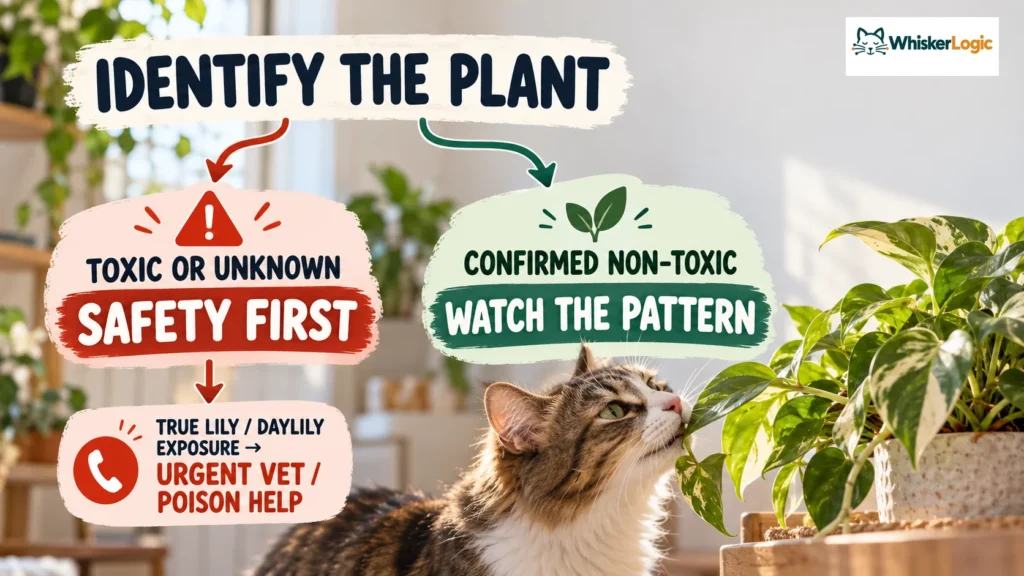
If the plant is toxic or you cannot identify it, deal with the exposure risk before trying to explain the behavior. If the plant is confirmed non-toxic, then look at the pattern: occasional leaf nibbling is different from repeatedly swallowing plant material, vomiting afterward, or eating other non-food objects.
Urgent Plant Safety Check
If your cat has eaten a plant known to be toxic, swallowed part of an unidentified plant, or developed concerning signs after plant exposure, contact a veterinarian, emergency veterinary clinic, or animal poison-control service promptly.
Known or suspected exposure to a true lily or daylily requires immediate veterinary or poison-control contact. Do not wait for symptoms.
Lilies in the Lilium genus and daylilies in the Hemerocallis genus can cause severe kidney injury in cats. Relevant exposure can include leaves, flowers, stems, pollen, and even contaminated vase water.
ASPCA — Which Lilies Are Toxic to Pets?
Do not try to make your cat vomit at home unless a veterinarian or veterinary poison specialist specifically directs you to do so. Do not use home antidotes or improvised treatments.
Quick Answer
If your cat keeps eating houseplants:
- identify the plant first;
- if it is toxic or unknown, prevent further access and get veterinary or poison-control guidance;
- treat true-lily or daylily exposure as urgent;
- if the plant is confirmed non-toxic, determine whether your cat is only nibbling or actually swallowing it;
- look for repeated vomiting, health changes, or ingestion of other non-food materials;
- block access to unsafe plants rather than relying on punishment;
- remember that cat grass is an alternative, not protection from toxic plants.
Plant eating by itself does not prove that your cat is sick, bored, anxious, nutritionally deficient, trying to vomit, or trying to remove hairballs.
Vet Check
Urgent Poison Concern
Contact a veterinarian or animal poison-control service promptly for:
- known or suspected true-lily or daylily exposure;
- ingestion of a known toxic plant;
- concerning ingestion of a plant you cannot identify;
- repeated vomiting after possible toxic exposure;
- severe drooling;
- marked weakness or lethargy;
- difficulty breathing;
- neurologic signs;
- collapse; or
- another major physical or behavioral change after plant exposure.
This is not an exhaustive list.
Routine Veterinary Evaluation
Arrange a veterinary evaluation if plant eating is persistent or escalating, especially with repeated vomiting, appetite or weight changes, diarrhea, mouth pain, sudden onset in an adult cat, or repeated ingestion of other non-food materials.
Table of Contents
Cat Eating Houseplants: Why Does It Keep Happening?
There is no single established explanation for every cat that eats plants.
Cats may investigate leaves with their paws and mouths. Movement, texture, dangling leaves, or grass-like foliage may become part of normal investigation or play.
Cornell notes that houseplant chewing can occur during exploratory or play behavior, while research on plant eating also shows that cats may eat plants while otherwise appearing healthy.
Cornell Feline Health Center — Destructive Behavior in Cats
That does not mean every cat is doing it for the same reason.
Do not automatically conclude that your cat is:
- bored;
- anxious;
- nutritionally deficient;
- sick to their stomach;
- trying to vomit; or
- trying to remove hairballs.
Instead, ask:
What does your cat eat, how much do they swallow, when does it happen, and what happens afterward?
Those observations are more useful than assigning a motive from plant eating alone.
First Identify the Plant
Before deciding what the behavior means, determine exactly what plant your cat can reach.
Check the plant label if you still have it. When possible, find both the common name and the scientific name.
That matters because common plant names can be confusing, and different plants may share similar names while having very different toxicity risks.
Keep a clear photo of:
- the whole plant;
- the leaves;
- stems;
- flowers, if present; and
- the plant label.
Photo-identification tools can help narrow the possibilities, but image recognition alone should not be treated as definitive.
Check the suspected plant against an authoritative veterinary toxicity resource such as:
ASPCA Toxic and Non-Toxic Plants Database
The ASPCA database is useful, but no single list contains every plant.
If your cat swallowed plant material and you still cannot identify the plant confidently, contact a veterinarian or animal poison-control resource instead of guessing.
If the Plant Is Toxic or You Are Not Sure What It Is
If the plant is toxic or remains unidentified after possible ingestion, stop focusing on why your cat ate it.
Focus on the exposure.
Prevent further access and gather useful information for the veterinarian or poison-control specialist.
Have ready, when possible:
- the plant label;
- the suspected common and scientific names;
- clear photos;
- the part of the plant that appears damaged;
- whether pieces are missing;
- whether you saw your cat swallow material; and
- any physical or behavioral changes afterward.
Do not induce vomiting or use a home treatment unless a veterinary professional specifically directs you to do so.
True Lilies Are Different
True lilies deserve special attention because the consequences for cats can be severe.
The major kidney-toxicity concern involves plants in the Lilium genus and daylilies in the Hemerocallis genus.
These plants can cause acute kidney injury in cats.
Relevant exposure can include:
- leaves;
- flowers;
- stems;
- pollen; and
- water from a vase containing the lilies.
A cat can also be exposed after pollen gets onto the coat and is later swallowed during grooming.
ASPCA — Which Lilies Are Toxic to Pets?
Known or suspected exposure to a true lily or daylily is not a watch-and-wait behavior problem.
Contact a veterinarian or veterinary poison-control service immediately.
Do not wait for symptoms to appear.
Not Every “Lily” Has the Same Toxicity
The word lily in a common plant name does not tell you exactly what kind of poisoning risk you are dealing with.
True lilies in the Lilium genus and daylilies in the Hemerocallis genus are associated with severe kidney injury in cats.
Plants such as peace lilies and calla lilies are different plants with different toxic mechanisms.
For example, peace lilies contain insoluble calcium oxalate crystals that can cause oral irritation, drooling, vomiting, and difficulty swallowing.
Peace lilies should not be described as harmless, but they do not represent the same Lilium/Hemerocallis kidney-toxicity pattern.
The practical lesson is simple:
Identify the actual plant instead of relying only on the common name.
Non-Toxic Does Not Mean Edible
Finding a plant listed as non-toxic is reassuring, but it does not turn that plant into cat food.
The ASPCA notes that eating plant material can still cause vomiting or gastrointestinal upset even when the plant itself is classified as non-toxic.
ASPCA Toxic and Non-Toxic Plants Database
Think of non-toxic as meaning that the plant is not known for the specific toxic effects associated with poisonous plants.
It does not mean your cat can safely eat unlimited amounts.
If your cat repeatedly swallows substantial pieces of a non-toxic plant and then vomits, develops diarrhea, loses appetite, or otherwise seems unwell, the non-toxic classification does not make those signs irrelevant.
Watch Which Plants Your Cat Targets
When you are dealing with a cat eating houseplants repeatedly, the pattern matters more than assigning a motive from one incident.
Observe what your cat actually does.
Ask:
- Does your cat target one plant or several?
- Are the preferred leaves thin or grass-like?
- Are they long or dangling?
- Does your cat paw at the leaves before biting them?
- Is the plant new?
- Does the behavior happen in one room?
- Does it happen during active play?
- Does it happen mostly when your cat is alone?
- Does your cat chew and drop pieces?
- Are pieces actually missing?
- Does your cat eat potting soil?
- What happens immediately afterward?
One clue is not enough to establish the cause.
A cat batting a dangling leaf during play presents a different immediate situation from a cat repeatedly swallowing pieces of several plants.
But neither pattern, by itself, proves why the cat is doing it.
Does Your Cat Nibble, or Actually Swallow the Plant?
These are not identical behaviors.
A cat may bite a leaf, leave tooth marks, tear at it, or spit pieces out.
Another cat may chew pieces off and swallow them.
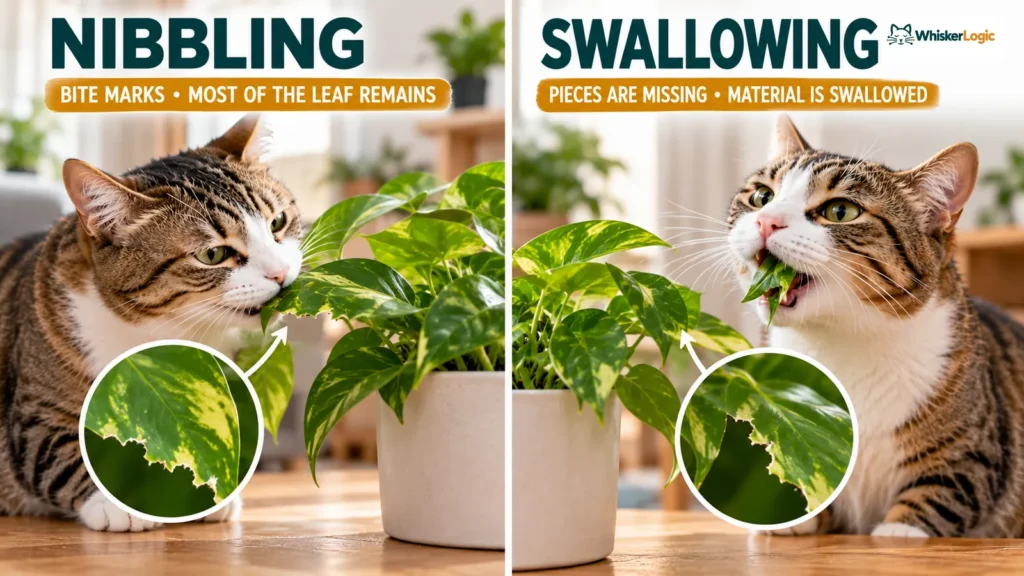
Look for the difference.
Nibbling
You may see:
- tooth marks;
- ragged leaf edges;
- brief chewing;
- pieces left behind.
Swallowing
You may notice:
- pieces of the plant disappearing;
- repeated chewing followed by swallowing;
- missing sections of leaves;
- repeated ingestion rather than occasional investigation.
Actual ingestion matters because the cat is exposed to whatever is in or on the plant.
Repeated swallowing, especially with vomiting or other health changes, deserves more attention than an occasional nibble of a confirmed non-toxic plant.
Plant Eating Does Not Automatically Mean Your Cat Is Sick
Seeing your cat eat a plant can make illness seem like the obvious explanation.
The evidence does not support assuming that from plant eating alone.
A 2021 study examining plant-eating behavior in domestic cats found that most cats were reported as appearing normal before eating plants.
That finding does not support the simple idea that cats generally eat plants because they already feel sick.
Characteristics of Plant Eating in Domestic Cats — Animals, 2021
That does not mean medical problems can never be involved.
Repeated vomiting, appetite changes, weight loss, diarrhea, mouth pain, or a sudden new ingestion pattern should still be evaluated.
The important distinction is:
Plant eating alone does not diagnose illness.
Do Cats Eat Plants to Make Themselves Vomit?
Current evidence does not justify saying that cats deliberately eat plants in order to make themselves vomit.
In the 2021 research, many cats ate plants without appearing ill beforehand.
Some cats did vomit afterward.
But vomiting after plant eating does not prove that vomiting was the cat’s goal.
Characteristics of Plant Eating in Domestic Cats — Animals, 2021
If your cat eats a leaf and vomits later, you can say that vomiting followed the plant ingestion.
You cannot tell from that event alone whether:
- the plant irritated the gastrointestinal tract;
- another factor caused the vomiting; or
- the cat deliberately intended to vomit.
Repeated vomiting still deserves veterinary attention.
It simply should not be explained automatically as purposeful plant eating.
What About Hairballs?
The idea that cats eat plants specifically to remove hairballs is also not settled.
The larger 2021 study did not find the pattern researchers would expect if plant eating were simply a strategy for removing swallowed hair.
Characteristics of Plant Eating in Domestic Cats — Animals, 2021
A much smaller 2025 study found something interesting but far more limited.
Researchers examined six regurgitated plant samples from only two cats. They observed microscopic plant structures interacting with cat hair in the regurgitated material.
Plant Eating Behavior in Domestic Cats: Support for the Hair Evacuation Hypothesis — 2025
That may suggest a possible physical interaction between some plant material and swallowed hair.
But two cats and six samples cannot establish why cats generally eat plants.
For now, the evidence does not justify telling owners:
“Your cat eats plants because it needs to remove hairballs.”
Is Eating Houseplants a Sign of Pica?
Not by itself.
Occasional plant nibbling is not enough to diagnose pica.
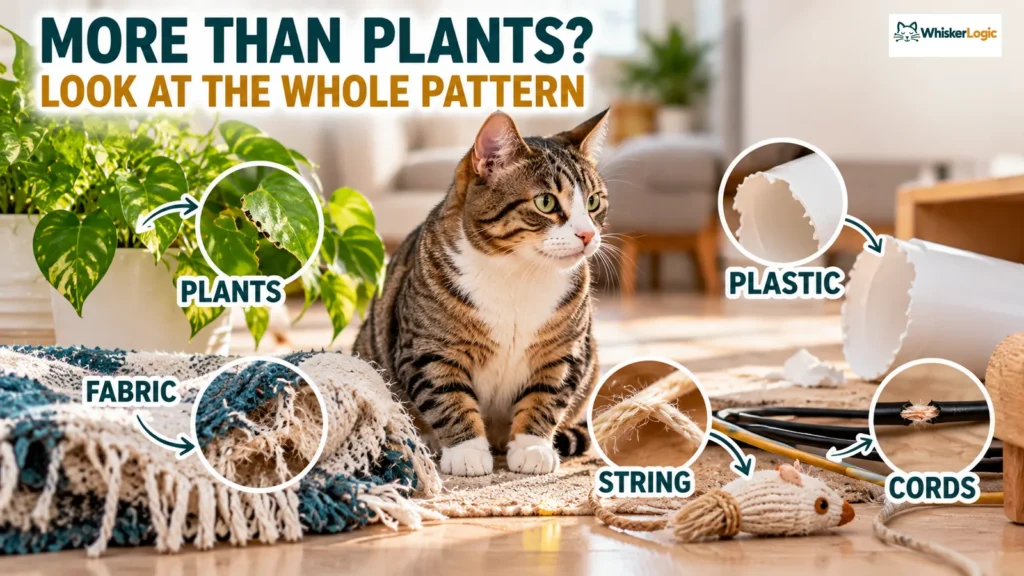
A more useful question is whether plant eating is part of a broader, persistent pattern of chewing or swallowing things that are not food.
Merck describes feline oral repetitive behaviors that may involve materials such as:
- fabric;
- plastic;
- rubber;
- paper;
- cardboard; and
- string.
Medical conditions, including gastrointestinal problems, can also be relevant when these behaviors are persistent.
Merck Veterinary Manual — Behavior Problems of Cats
So do not label your cat based on a chewed leaf alone.
Look at the full pattern.
Does Your Cat Eat Other Non-Food Objects Too?
Look beyond the houseplants.
Does your cat repeatedly chew or swallow:
- plastic;
- fabric;
- rubber;
- cardboard;
- string;
- shoelaces;
- electrical cords; or
- other non-food objects?
If so, tell your veterinarian.
Repeated ingestion of non-food material raises different concerns from isolated plant nibbling.
Swallowed objects can cause gastrointestinal obstruction, and linear objects such as string can be especially dangerous.
Merck Veterinary Manual — Gastrointestinal Obstruction in Small Animals
If electrical cords are part of the pattern, see:
Why Does My Cat Chew Electrical Cords? How to Stop It Safely
The point is not to diagnose pica from one behavior.
It is to recognize when the problem has expanded beyond occasional plant chewing and deserves broader veterinary evaluation.
Block Access to Unsafe Plants
For toxic plants, physical prevention comes first.
Do not build your safety plan around the fact that your cat has ignored a plant before.
Cats can:
- jump onto shelves;
- climb furniture;
- reach hanging pots;
- access windowsills;
- investigate bouquets; and
- reach places that appear inaccessible from floor level.
Cornell recommends preventing access when cats chew houseplants.
Cornell Feline Health Center — Destructive Behavior in Cats
Do not rely on punishment.
Avoid:
- yelling;
- squirt bottles;
- frightening the cat; or
- chasing the cat away repeatedly.
These approaches do not remove the exposure risk.
Also avoid adding new hazards to the plant or soil.
Do not use essential oils, mothballs, irritating spices such as cayenne or chili, or homemade chemical mixtures as DIY plant deterrents.
Physical access management avoids introducing another possible exposure.
Can Cat Grass Help?
A verified cat-safe grass, such as suitable oat grass, may give some cats another plant to investigate or chew.
Cornell includes oat grass among possible alternatives for cats interested in vegetation.
Cornell Feline Health Center — Destructive Behavior in Cats
But this distinction matters:
Cat grass is an alternative, not a safety barrier.
It does not:
- guarantee that your cat will stop eating other plants;
- make a toxic plant safe to leave accessible;
- treat pica;
- prove a nutritional deficiency;
- treat anxiety; or
- provide a proven hairball treatment.
If you offer cat grass, you still need to remove or block access to unsafe plants.
Check More Than the Plant
The plant itself is not the only possible exposure.
Think about what may have been applied to the leaves or added to the soil.
That can include:
- pesticides;
- insecticides;
- fertilizers;
- herbicides;
- systemic treatments; or
- other chemical residues.
Cornell includes pesticides, fertilizers, and other household or garden chemicals among potential hazards to cats.
Cornell Feline Health Center — Common Cat Hazards
A plant being classified as non-toxic does not automatically answer every safety question if the cat is also chewing treated leaves or digging in treated soil.
If you suspect chemical exposure, keep the product label and contact a veterinarian or poison-control service for specific guidance.
What to Try, in Order
- Identify every plant your cat can access. Include bouquets, hanging plants, cuttings, and plants on shelves.
- Check toxicity using an authoritative veterinary source. Use both common and scientific names when possible.
- Remove toxic and unidentified plants from access. Do not rely on previous lack of interest.
- Treat true-lily or daylily exposure as urgent. Contact a veterinarian or veterinary poison-control service immediately.
- Determine whether your cat nibbles or actually swallows plant material. Look for missing pieces and observe what happens during chewing.
- Watch which plants and situations are involved. Note leaf shape, movement, location, timing, and what happens before and after the behavior.
- Check for other non-food chewing or ingestion. Plastic, fabric, rubber, cardboard, string, shoelaces, and cords can show that the pattern extends beyond plants.
- Consider a verified cat-safe plant or grass option if appropriate. Treat it as an alternative, not protection from toxic plants.
- Do not rely on punishment or unsafe DIY deterrents. Prevent access instead.
- Check pesticides, fertilizers, and other plant treatments.
- Seek veterinary help when poisoning risk, repeated vomiting, health changes, or broader ingestion are present.
When to Call a Veterinarian
Urgent / Poison Concern
Seek prompt veterinary or animal poison-control guidance for:
- suspected Lilium or Hemerocallis exposure;
- ingestion of a known toxic plant;
- concerning ingestion of an unidentified plant;
- repeated vomiting after possible toxic exposure;
- severe drooling;
- marked weakness or lethargy;
- difficulty breathing;
- neurologic signs;
- collapse; or
- another significant abnormal change after plant exposure.
This list is not exhaustive.
For true lilies and daylilies, do not wait for symptoms before contacting veterinary help.
Schedule a Veterinary Evaluation
Arrange veterinary evaluation when plant eating is persistent, increasing, or associated with:
- repeated vomiting;
- appetite changes;
- weight changes;
- diarrhea or another ongoing gastrointestinal change;
- mouth pain or difficulty eating;
- sudden onset in an adult cat;
- repeated swallowing of plant material; or
- repeated chewing or swallowing of other non-food objects.
The goal is not to diagnose the cause from plant eating alone.
It is to determine whether the behavior is isolated or part of a broader medical or ingestion pattern.
FAQ
Why does my cat keep eating my houseplants?
There is no single proven reason. Plant interaction can occur during investigation or play and may also occur in otherwise healthy cats. First identify the plant and rule out toxicity, then observe what your cat actually chews or swallows.
Does eating plants mean my cat is sick?
Not necessarily. Plant eating can occur in cats that appear healthy. Repeated vomiting, appetite or weight changes, diarrhea, pain, or a sudden new pattern should still be discussed with a veterinarian.
Do cats eat plants to make themselves vomit?
Current evidence does not support assuming that this is the purpose. Vomiting may occur after plant eating, but that does not prove the cat ate the plant in order to vomit.
Do cats eat plants because of hairballs?
The evidence is not settled. Larger research does not support a simple hairball explanation, while a very small 2025 study found a possible interaction between plant structures and hair in regurgitated material.
Is eating houseplants a sign of pica?
Plant nibbling alone is not enough to make that conclusion. Persistent chewing or swallowing of multiple non-food materials deserves veterinary evaluation.
What should I do if I do not know what plant my cat ate?
Prevent further access, save the plant or clear photos, and contact your veterinarian or an animal poison-control resource rather than guessing about toxicity.
Are lilies toxic to cats?
True lilies in the Lilium genus and daylilies in the Hemerocallis genus can cause severe kidney injury in cats. Known or suspected exposure requires immediate veterinary or poison-control contact.
Is a peace lily the same as a true lily?
No. Peace lilies are not Lilium or Hemerocallis plants. They can still cause oral and gastrointestinal irritation, but they do not have the same kidney-toxicity pattern as true lilies and daylilies.
Can I give my cat cat grass instead?
You can consider a verified cat-safe grass such as suitable oat grass. But it is an alternative, not a substitute for removing toxic plants.
Why does my cat still eat houseplants even with cat grass?
Providing cat grass does not guarantee that a cat will stop interacting with other plants. Unsafe plants still need to be kept inaccessible.
Can a non-toxic plant still make my cat vomit?
Yes. Non-toxic does not mean edible. Plant material can still cause vomiting or gastrointestinal upset.
Sources
- ASPCA Animal Poison Control — Toxic and Non-Toxic Plants
- ASPCA — Which Lilies Are Toxic to Pets?
- ASPCA — Peace Lily
- Cornell Feline Health Center — Destructive Behavior in Cats
- Cornell Feline Health Center — Common Cat Hazards
- Merck Veterinary Manual — Houseplants and Ornamentals Toxic to Animals
- Merck Veterinary Manual — Behavior Problems of Cats
- Hart et al. — Characteristics of Plant Eating in Domestic Cats, Animals, 2021
- Plant Eating Behavior in Domestic Cats: Support for the Hair Evacuation Hypothesis, 2025