
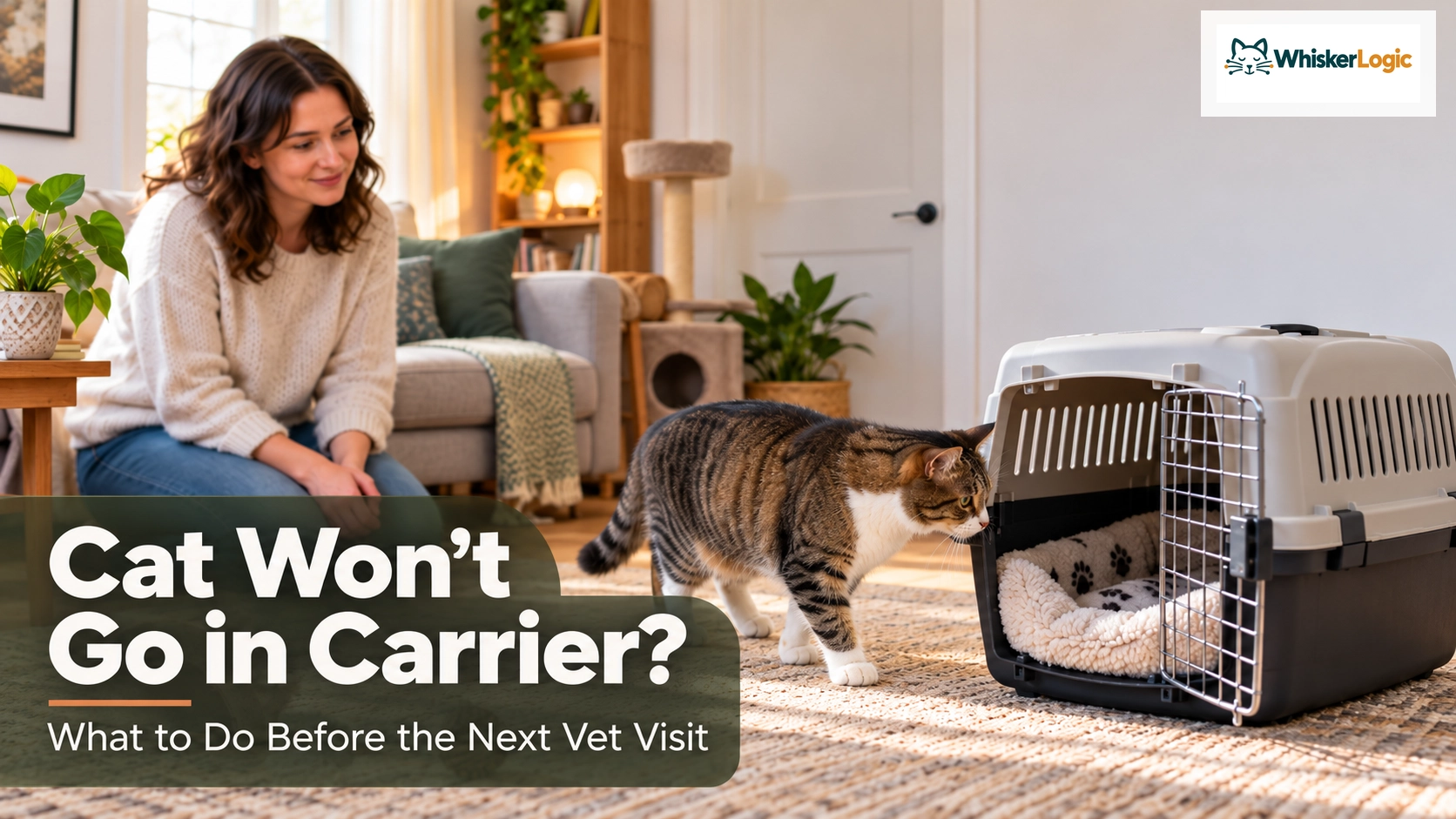
The carrier comes out, and your cat disappears under the bed. Or your cat walks toward it, then backs away as soon as the door moves.
If you searched “cat won’t go in carrier”, the most useful first step is to separate two different problems: getting to a veterinary appointment that is happening now, and making future carrier trips easier.
If the appointment is today, focus on safe, calm transport with as little chasing and struggling as possible. For future visits, the better long-term plan is to make the carrier part of normal home life and train the sequence gradually: approach, entry, door closure, lifting, movement, and travel.
Do not assume the carrier itself is always the only trigger. Some cats resist as soon as they see it. Others enter willingly but become distressed when the door closes, when the carrier is lifted, in the car, or only at the veterinary practice. Current feline veterinary guidance treats these as different potential stressors rather than one identical problem.
Quick Answer
- If the appointment is today: avoid a prolonged chase. When practical, use a quiet contained room, reduce access to hard-to-reach hiding places before loading begins, move slowly, and contact the clinic if loading is becoming unsafe or impossible.
- For future visits: leave the carrier accessible at home so it does not appear only before stressful trips.
- Find the exact step where resistance begins: seeing the carrier, approaching it, entering, door movement, confinement, lifting, movement, the car ride, or the veterinary practice.
- Build voluntary entry before adding door closure.
- Train door movement, lifting, and short movement as separate steps.
- Do not use treats to lure your cat inside and then unexpectedly trap them.
- If your cat is comfortable in the carrier but distressed only during travel, discuss the travel pattern with your veterinarian.
- A sudden change in carrier tolerance deserves more attention, especially if it comes with mobility, handling, appetite, sleep, or broader behavior changes.
- If severe fear repeatedly prevents necessary veterinary care, ask your veterinarian in advance whether an individualized pre-visit medication plan may be appropriate.
Vet Check: When Carrier Refusal May Need More Than Training
Carrier refusal is often a behavior and transport problem, but behavior alone cannot tell you whether pain, nausea, fear, or another medical issue is involved.
Veterinary review becomes more important if the refusal is new or sudden, especially if your cat previously entered the carrier without much difficulty. Watch for other changes such as reluctance to jump, altered movement, difficulty bending or turning, a reaction when being lifted or touched, appetite changes, sleep changes, or broader behavior changes.
Pain can affect behavior and learning, but carrier refusal by itself does not prove that your cat is painful.
Also tell your veterinarian if travel repeatedly causes drooling, lip-licking, vomiting, marked vocalization, or intense distress. Veterinary guidelines recognize that nausea, pain, and anxiety may contribute to transport problems and recommend discussing those patterns with the veterinary team rather than diagnosing or medicating them at home.
If fear or aggression repeatedly prevents an examination or necessary treatment, contact the clinic before the next visit. The veterinary team may need to adjust the visit plan and decide whether a prescribed pre-visit medication is appropriate.
Do not delay urgent veterinary care while waiting for carrier training to improve.
If your cat needs urgent care and you cannot safely load or transport them, contact your veterinary clinic or an emergency veterinary service for transport guidance rather than improvising a dangerous restraint method.
Table of Contents
Why Won’t My Cat Go in the Carrier?
When your cat won’t go in the carrier, it is tempting to summarize the problem as, “My cat hates the carrier.”
That may be too simple.
For some cats, the carrier itself becomes a predictor of what happens next. If it normally appears just before the cat is chased, captured, confined, carried to the car, driven somewhere unfamiliar, and handled at a veterinary practice, the sight of the carrier can start the avoidance sequence before the trip even begins.
The 2026 FelineVMA Positive Reinforcement Training Educational Toolkit specifically explains that chasing a fearful cat and forcing them into a carrier can increase future fear and avoidance associated with the carrier.
But other cats do not resist until later.
Possible contributors include confinement, door movement, unstable carrying, car motion, unfamiliar sights and sounds, previous stressful handling, the veterinary environment, or physical discomfort.
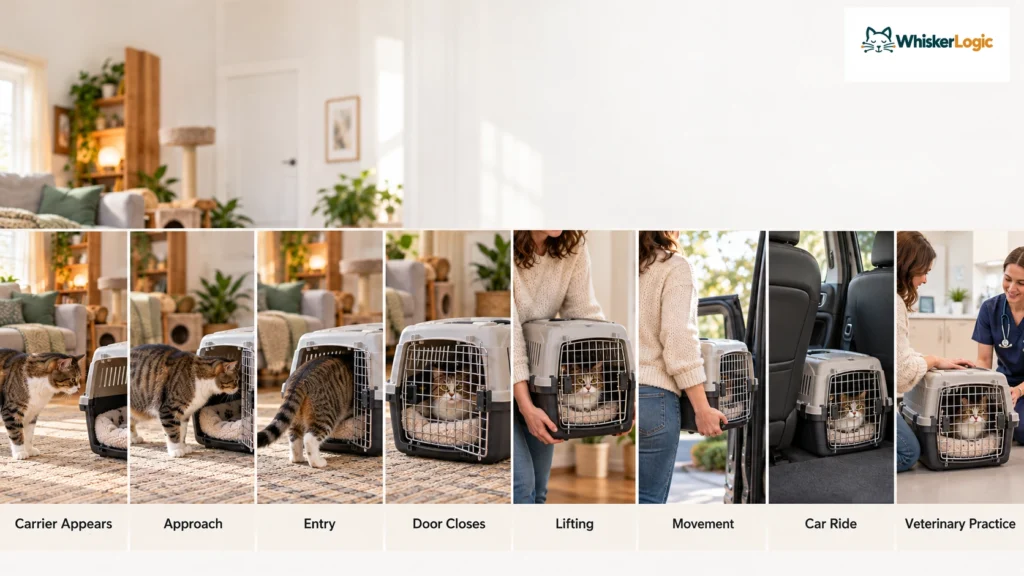
Think of the visit as a sequence:
Carrier appears → approach → entry → door movement and closure → lifting → movement through the home → car ride → veterinary practice
The useful question is not simply, “Does my cat hate the carrier?”
Ask:
At what exact step does resistance begin?
The Veterinary Experience Can Start at Home
A veterinary visit can involve several stressors rather than one single event.
The carrier appears. The cat is confined. The carrier moves. There is a car ride. Then there are unfamiliar smells, sounds, people, animals, handling, and possibly discomfort related to illness or a procedure.
The 2022 ISFM/AAFP Cat Friendly Veterinary Environment Guidelines describe how stressors can accumulate from preparation at home through transport and the veterinary visit—a pattern often described as stressor stacking.
That is one reason it helps to identify the earliest step that becomes difficult.
Cat Won’t Go in Carrier? First Find Where the Resistance Begins
Before changing carriers, trying stronger rewards, or assuming your cat needs medication, observe the sequence.
Does your cat disappear as soon as the carrier appears?
The carrier itself may have become a predictor of what follows. Start by making its presence less unusual.
Will your cat approach the carrier but not enter?
Work on comfortable approach and voluntary entry before worrying about the door.
Will your cat enter if the door stays open but react when it moves?
Treat door movement and confinement as a separate training step.
Is your cat comfortable inside until the carrier is lifted?
Work on stable lifting and very small amounts of movement separately.
Is your cat calm in the carrier at home but distressed in the car?
The transport experience may be the bigger problem.
Does the problem appear mainly at the veterinary practice?
Discuss clinic handling, waiting, fear, pain, and pre-visit planning with your veterinarian.
These observations do not diagnose the cause. They help you stop treating several different problems as though they were identical.
If the Vet Appointment Is Today, Do This Differently
If your cat won’t go in the carrier and the appointment is today, an appointment in an hour is not the time to begin a full carrier-training program.
Training is for improving future visits. Today, the goal is to get necessary veterinary care while avoiding an escalating chase if possible.
If practical, place your cat in a quiet, familiar room before loading begins. Choose a space with fewer inaccessible hiding places, close the door, and prepare the carrier before approaching the cat. Familiar bedding can make the setup less unfamiliar.
Move slowly and quietly. Avoid repeated failed grabbing attempts.
If your cat remains calm enough to approach or enter voluntarily, a preferred reward may help.
If the carrier has a top opening or removable top, that can sometimes make access easier, but the goal is still safe transport—not forceful wrestling.
If loading is becoming unsafe or impossible, call the veterinary clinic. They can advise you based on the urgency of the visit and your cat’s history.
If your cat needs urgent care, do not cancel or delay that care simply because carrier training is incomplete.
Don’t Chase Your Cat Around the House
A repeated pattern of:
carrier appears → chase → capture → forced loading
can teach the cat that the carrier predicts something worth avoiding.
FelineVMA guidance specifically warns that chasing and forcing a fearful cat into a carrier can strengthen fear and future avoidance. It also advises against punishment-based methods such as loud corrections or spray bottles.
So do not make yelling, repeated cornering, spray bottles, rough restraint, or a series of failed grab attempts your normal loading strategy.
This is not a matter of the cat being stubborn.
Avoidance is information.
Find the point where the sequence becomes too difficult and change that step before asking for more.
Make the Carrier Part of Normal Home Life
If the carrier only appears before a stressful trip, its appearance can become meaningful long before your cat goes inside.
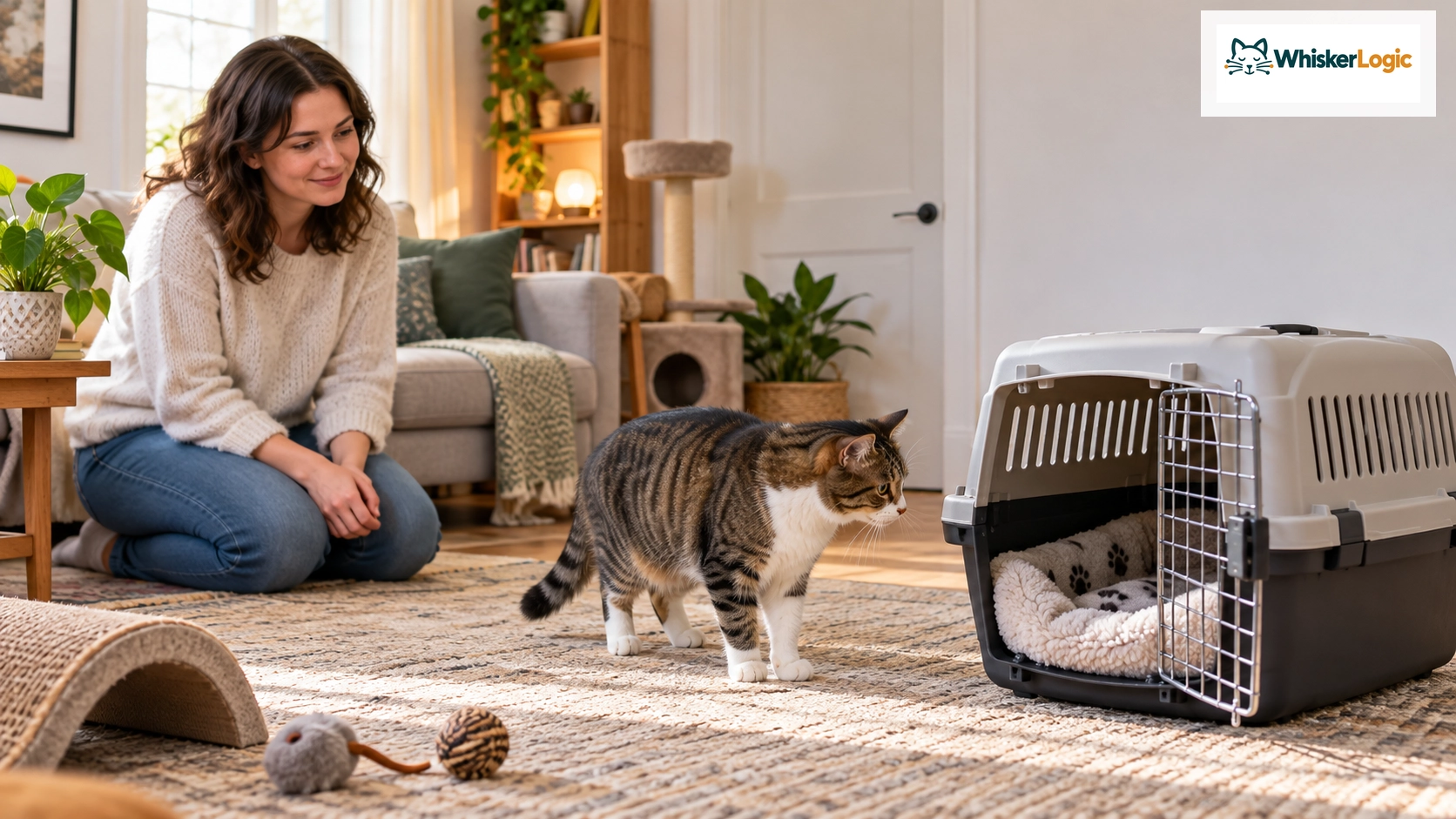
When practical, leave the carrier accessible in an area where your cat already spends time.
Keep the door open, add familiar bedding, and allow your cat to investigate it without immediately following that investigation with confinement or travel.
FelineVMA caregiver guidance recommends keeping the carrier in a familiar part of the home and using familiar bedding to help create more positive carrier experiences.
You can add a preferred reward, toy, or another positive experience when your cat is comfortable approaching.
But leaving the carrier out alone does not guarantee that the whole problem will disappear.
A cat may become comfortable resting inside and still dislike the door closing, being lifted, or riding in the car. Those later steps need their own practice.
Start With Approaching the Carrier, Not Closing the Door
Training works better when the requested behavior is small enough that the cat can succeed without becoming highly fearful.
For carrier work, that may look like:
carrier visible → comfortable approach → standing at the opening → head or feet inside → full voluntary entry
The exact progression does not need to follow a fixed calendar.
Move forward according to the cat in front of you.
If your cat starts hiding, crouching, hissing, growling, freezing, or showing another clear protective response, do not keep increasing the challenge.
FelineVMA training guidance emphasizes positive reinforcement and notes that fear and distress interfere with learning.
Make the next attempt easier rather than adding more pressure.
Teach Voluntary Entry
The long-term goal is not simply to get your cat inside once.
The goal is for entering the carrier to become a behavior your cat can perform without a chase.
Reward progress toward entry.
Depending on the cat, the useful reward may be food, play, social interaction, or another experience the cat values.
You can build toward:
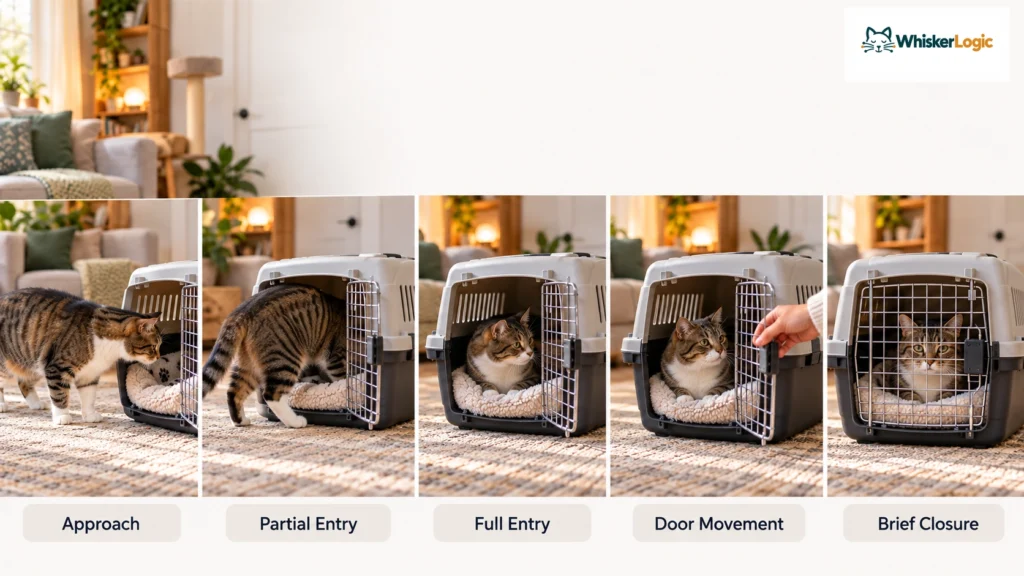
approach → partial entry → full entry → remaining inside briefly
Do not rush to close the door simply because your cat finally steps inside.
Treats Are Not a Trick
Treats can support positive reinforcement.
But “put food inside and slam the door when the cat goes in” turns the reward into a setup for unexpected confinement.
Use food, play, or another valued reward to reinforce voluntary behavior—not to trick the cat into a step they were not prepared for.
Train the Door Separately
A cat can happily sit inside an open carrier and still panic when the door starts to move.
Entry and confinement are not the same skill.
Once voluntary entry is comfortable, make door movement its own training step.
Depending on your cat, the progression might be:
touch the door → move it slightly → move it farther → brief closure → reopen → gradually build comfortable closed-door time
Reward calm behavior at a level your cat can handle.
If closing the door causes a major change in behavior, return to an easier version instead of repeatedly pushing through the reaction.
Then Practice Lifting and Movement
A closed carrier sitting on the floor is different from a carrier suddenly leaving the ground.
Once your cat is comfortable entering and tolerating brief closure, movement becomes its own training step.
Start with very small changes rather than immediately carrying the cat through the house and into the car.
Progress from a brief stable lift to short movements within the home and, eventually, transport practice when appropriate.
When carrying the carrier, support it from underneath when possible instead of letting it swing from the handle.
Feline veterinary guidance recommends stable, predictable movement and supporting the carrier rather than carrying it by the handle alone.
What If Your Cat Is Fine in the Carrier but Hates the Car?
If your cat voluntarily enters at home but becomes distressed only once the vehicle moves, carrier entry may not be the main problem.
Watch when the behavior changes.
Does distress begin when the carrier reaches the car?
When the engine starts?
Only once the vehicle moves?
During turns or longer trips?
Travel-related distress may include marked vocalization, drooling, lip-licking, vomiting, or intense agitation.
These signs can occur with nausea, fear, or other transport-related problems, so do not use them to diagnose motion sickness or anxiety on your own.
Tell your veterinarian exactly what happens and when.
That timing can help the veterinary team decide whether the problem may involve fear, nausea, pain, or another transport issue.
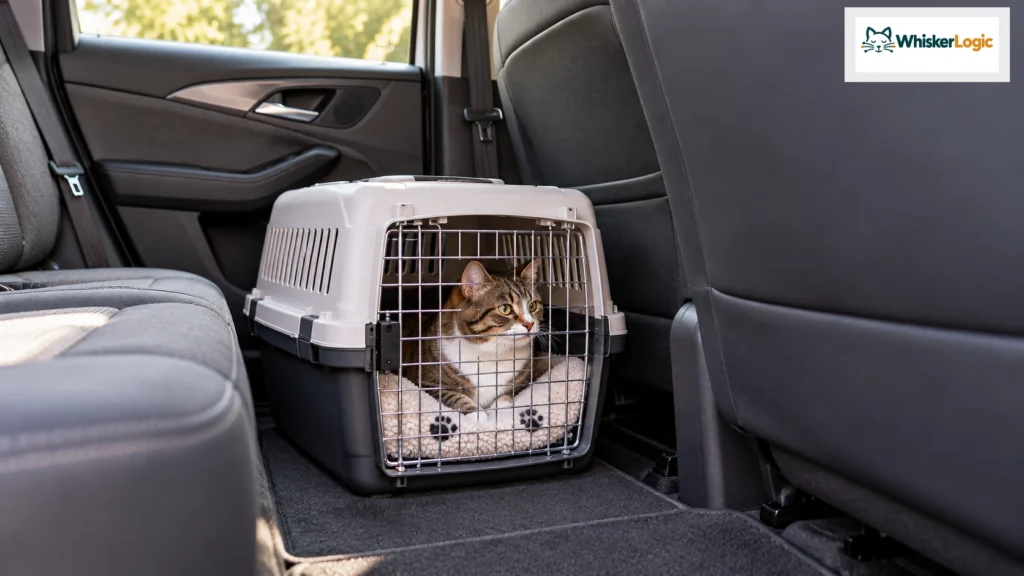
For vehicle travel, keep the carrier stable and secure.
The 2025 FelineVMA Transportation of Cats in Motor Vehicles Position Statement recommends placing carriers on the floor behind a front seat unless an appropriate crash-tested system is being used.
If you have other cats at home, the return from a veterinary visit can create a separate social problem. If another cat starts hissing or reacting to the returning cat, see Why Is My Cat Hissing at My Other Cat After a Vet Visit?
Does the Type of Carrier Matter?
Carrier design can make handling easier, but buying a different carrier is not a complete behavior plan.
Useful features include:
- secure construction;
- enough room for the cat to fit comfortably;
- good stability;
- easy cleaning;
- practical front access;
- a top opening when useful;
- a removable top when practical.
A removable top can be useful at the veterinary practice because parts of the examination may be possible while the cat remains in the lower half instead of being pulled through the carrier door.
That does not mean one carrier design is universally best.
Look at the actual problem.
If your cat enters easily but becomes distressed only in the car, changing the opening style may do little about the main trigger.
If access requires awkward reaching and struggling, design may matter more.
What If Treats Don’t Work?
A cat that ignores treats is not necessarily being stubborn.
Consider what the failure may be telling you:
- fear is too high;
- the step is too difficult;
- the reward is not valuable to that cat;
- the environment or timing is poor;
- the cat may be uncomfortable or painful.
FelineVMA guidance notes that fearful or distressed cats may be less able to learn and may even refuse highly valued food. Physical health can also affect learning.
Reduce the difficulty before increasing pressure.
If your cat will not enter for a treat, reward approaching the carrier first.
If food is not useful but play or preferred social interaction is, use the reward that matters to that cat.
What If My Cat Panics Before Every Vet Visit?
When every visit involves intense panic, aggression, repeated failed loading attempts, or an examination that cannot be completed, carrier training may need to be only one part of the plan.
Contact your veterinarian before the next visit and describe exactly where the sequence breaks down.
The veterinary team may recommend changes to transport, arrival, waiting, handling, or the examination plan.
For some cats, a veterinarian-prescribed pre-visit medication may also be appropriate.
Clinical studies have found that veterinarian-directed use of medications including gabapentin and pregabalin can reduce fear, anxiety, or stress associated with transportation and veterinary visits in selected cats.
The medication, dose, timing, and safety considerations must be determined by the veterinarian for the individual cat.
Do not give human medication on your own.
Do not use another animal’s prescription.
Do not reuse an old prescription without confirming with your veterinarian that it is still appropriate.
Medication also does not replace carrier preparation, environmental management, and positive handling.
Could Pain Be Making Carrier Entry Harder?
Sometimes the most important clue is not that a cat dislikes the carrier.
It is that the cat used to tolerate the process and suddenly does not.
Look for other changes:
- Does lifting cause a reaction?
- Is your cat jumping less?
- Are stairs, bending, turning, or climbing different?
- Has your cat become more defensive about being touched?
- Have activity, appetite, sleep, grooming, or other routines changed?
Pain can affect behavior, mobility, emotional state, and the ability to participate comfortably in training.
But carrier refusal does not diagnose pain.
Pain is one possible reason that new, handling-related resistance deserves veterinary attention, especially when other physical or behavioral changes are present.
What to Try, in Order
- Identify exactly when resistance begins. Watch the whole sequence instead of labeling everything “carrier fear.”
- If the appointment is imminent, avoid a prolonged chase. Use a calm, contained setup when practical.
- Do not delay urgent care for a training program. Call the clinic or emergency service for transport guidance if you cannot safely proceed.
- For future visits, leave the carrier accessible at home.
- Add familiar bedding and positive experiences.
- Reward approaching before requiring entry.
- Build voluntary entry.
- Add door movement and closure gradually.
- Practice lifting and short movement separately.
- Check whether the car—not the carrier—is the true trigger.
- Reassess carrier design if access or handling is awkward.
- Ask your veterinarian beforehand about severe fear, repeated travel nausea, possible pain, or a prescribed pre-visit medication plan.
When to Get Veterinary or Behavior Help
Contact Your Veterinarian When
- carrier refusal is suddenly new;
- lifting or handling appears painful;
- broader health or mobility changes are present;
- travel repeatedly causes drooling, lip-licking, or vomiting;
- severe fear or aggression repeatedly prevents necessary veterinary care.
Contact the clinic before future appointments if previous visits have been so difficult that the veterinary team could not safely examine or treat your cat.
That gives the team time to design an appropriate plan.
Consider Behavior Help When
- avoidance is long-standing and severe;
- gradual training repeatedly breaks down even after the steps are made easier;
- aggression around carrier handling creates a safety problem;
- you cannot safely practice the training steps.
Your veterinarian can help rule out medical contributors and advise whether referral to a qualified feline behavior professional or veterinary behaviorist is appropriate.
Frequently Asked Questions
Why does my cat run away when they see the carrier?
The carrier may have become a predictor of capture, confinement, movement, a car trip, or veterinary handling.
Previous fearful carrier experiences can strengthen avoidance.
But the carrier itself is not always the only trigger, so observe what happens later in the sequence too.
How do I get my cat into a carrier for a vet visit today?
If your cat won’t go in the carrier today, do not try to complete a long-term training program minutes before the appointment.
When practical, use a quiet contained room, prepare the carrier before loading begins, limit inaccessible hiding places without chasing your cat, and move slowly.
If loading becomes unsafe or impossible, call the clinic.
Do not delay urgent care because training is incomplete.
Should I leave the cat carrier out all the time?
Leaving it accessible in a familiar area can help prevent it from appearing only before stressful trips.
Add familiar bedding and let your cat investigate voluntarily.
But leaving it out alone may not solve fear of door closure, lifting, or car travel.
Can I use treats to train my cat to enter the carrier?
Yes, if food is genuinely rewarding to your cat.
Play or preferred social interaction may work better for some cats.
Use the reward to reinforce voluntary behavior, not to lure your cat inside and unexpectedly trap them.
What if my cat goes in but panics when I close the door?
Treat door movement and confinement as a separate training problem.
Begin with small door movements and progress toward brief closure only while your cat remains comfortable enough to participate.
Why is my cat fine in the carrier but cries in the car?
That pattern suggests the transport experience may be more important than entry itself.
Tell your veterinarian exactly when the distress begins, especially if travel also involves drooling, repeated lip-licking, vomiting, or severe agitation.
Is a top-loading carrier better for cats?
It can be useful, but it is not universally better.
Top access or a removable top may reduce awkward handling, and a removable top can sometimes allow veterinary examination while the cat remains in the lower half.
Security, stability, size, and the individual cat also matter.
Should I force my cat into the carrier?
Repeated chasing and forced loading should not be your training strategy because they can strengthen fear and future avoidance.
If veterinary care is needed immediately, the priority shifts from training to safe transport, but prolonged wrestling is still not the goal.
If you cannot load your cat safely, contact the clinic or emergency veterinary service for guidance.
Can my veterinarian prescribe something before the visit?
Yes.
For cats with severe travel or veterinary fear, a veterinarian may decide that a prescribed pre-visit medication plan is appropriate.
Research supports veterinarian-directed options for selected cats, but medication choice, dose, and timing must be individualized.
Do not use human medication, another pet’s prescription, or leftover medication without veterinary instruction.
Could pain make my cat resist the carrier?
Possibly.
Pain can affect mobility, handling tolerance, emotional responses, and behavior.
A sudden new refusal—especially with difficulty jumping, moving, bending, or being lifted—deserves veterinary attention.
Carrier refusal alone does not prove pain.
How long does carrier training take?
There is no reliable fixed timeline.
Progress depends on the individual cat and on which part of the carrier sequence is difficult.
Move forward according to your cat’s behavior rather than assigning a fixed number of days to each step.
Sources
- FelineVMA — 2026 Positive Reinforcement Training Educational Toolkit
- FelineVMA — 2025 Transportation of Cats in Motor Vehicles Position Statement
- 2022 AAFP/ISFM Cat Friendly Veterinary Interaction Guidelines: Approach and Handling Techniques
- 2022 ISFM/AAFP Cat Friendly Veterinary Environment Guidelines
- Cat Friendly Homes — Getting Your Cat to the Veterinarian
- van Haaften et al. — Effects of a Single Preappointment Dose of Gabapentin on Signs of Stress in Cats During Transportation and Veterinary Examination
- Lamminen et al. — Pregabalin Alleviates Anxiety and Fear in Cats During Transportation and Veterinary Visits
- FelineVMA — Chronic Pain Educational Toolkit