
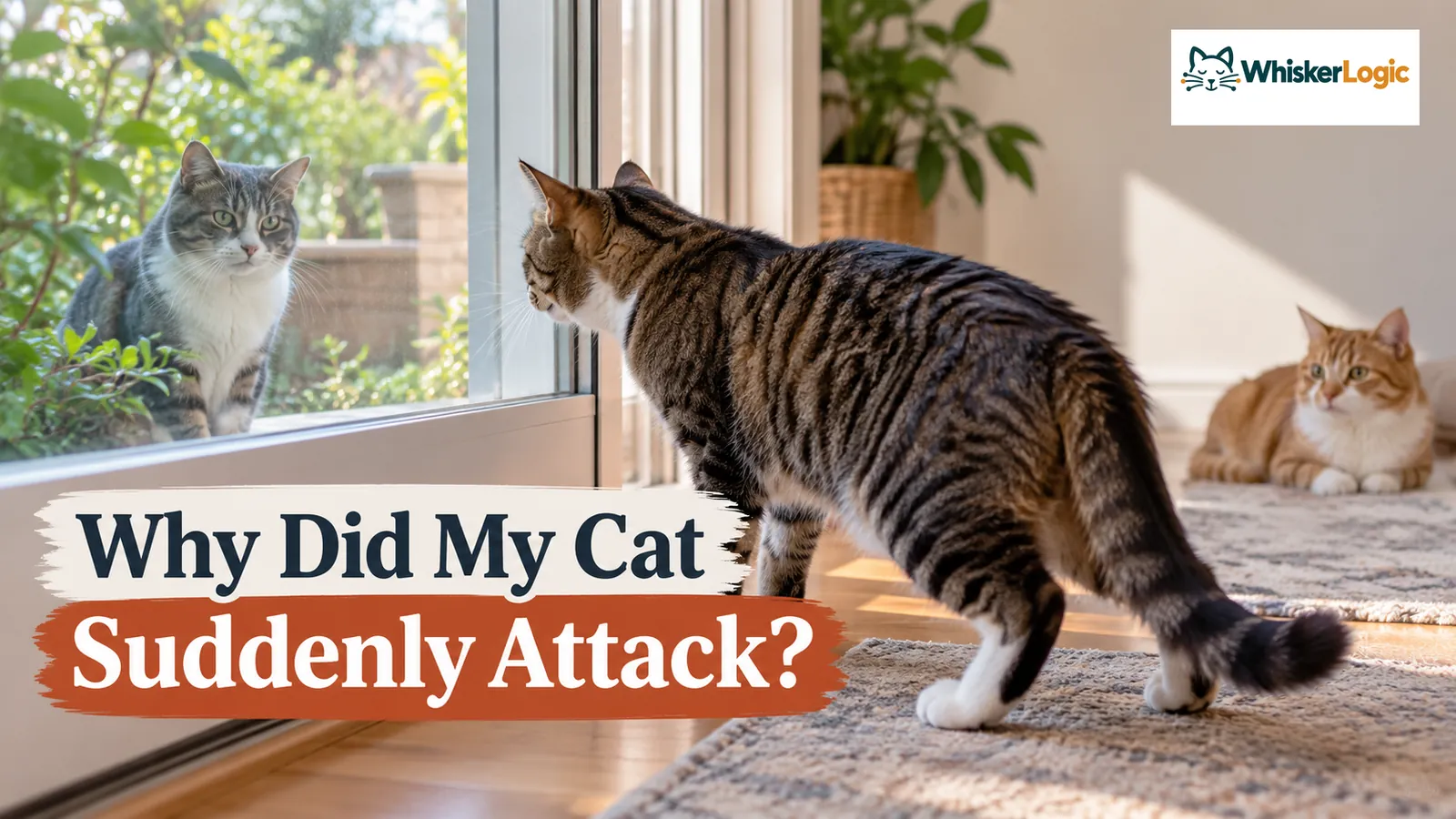
Your cat sees another cat through the window, freezes or starts growling—and then suddenly turns on you or another cat in the house.
If your cat gets aggressive after seeing another cat outside, the person or pet who gets attacked may not have been the original trigger. When a cat becomes intensely aroused by an outside cat they cannot reach, aggression can sometimes be redirected toward a nearby person or animal.
This is called redirected aggression. But seeing an outdoor cat does not automatically prove that redirected aggression caused the attack. The timing, your cat’s body language, who approached next, and what happened after the outside cat disappeared all matter.
Most importantly, do not reach for, pick up, corner, or punish a cat who is intensely aroused. Create distance first and reduce access to the outside trigger when you can do so safely.
Quick Answer
An outside cat may trigger intense arousal even when your indoor cat cannot physically reach them. If a nearby person or household cat is attacked immediately afterward, that person or pet may be a redirected target rather than the original cause of the reaction.
Give the cat space. Do not pick them up, pet them to calm them, corner them, yell at them, or punish them.
If possible without approaching the aroused cat, block or reduce the view of the outside cat.
If another household cat was attacked and tension continues afterward, separate the cats safely rather than putting them immediately back together.
Do not use a fixed number of minutes or hours to decide that your cat has calmed down. Recovery varies. Watch the cat’s behavior and wait for the overall pattern of arousal to settle.
If aggression appears suddenly without a clear outside-cat sequence, happens in unrelated situations, accompanies possible pain or other behavior changes, or becomes severe or difficult to manage safely, arrange veterinary evaluation.
Vet Check
Redirected aggression is only one possible explanation for sudden aggression.
Medical problems can also contribute to behavior changes, including aggression. Pain, neurologic problems, endocrine disease, sensory changes, and other health conditions can affect behavior.
Veterinary evaluation becomes especially important if:
- there is no clear outside-cat trigger;
- aggression also happens in unrelated situations;
- the pattern is new in an adult or senior cat;
- touch appears painful;
- mobility changes;
- appetite changes;
- sleep or activity changes;
- other normal behaviors change;
- aggression becomes unusually severe or escalating;
- or you cannot safely manage the cat.
Do not try to diagnose pain, hyperthyroidism, neurologic disease, cognitive dysfunction, or another medical condition from aggressive behavior alone.
Table of Contents
Cat Gets Aggressive After Seeing Another Cat Outside: What May Be Happening
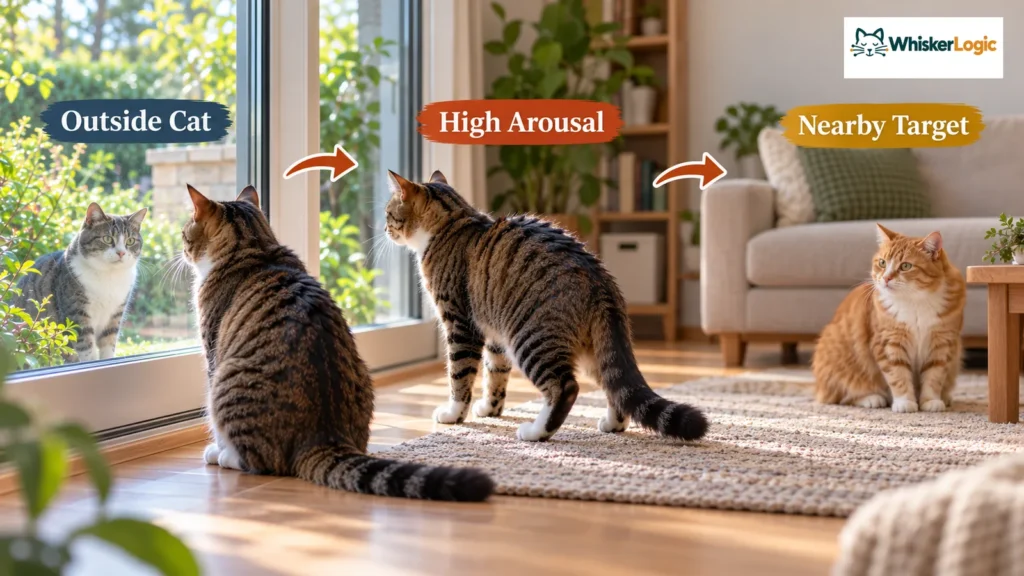
A common redirected-aggression sequence can look like this:
An unfamiliar cat appears outside.
Your cat becomes intensely focused on that cat.
A window, glass door, screen, or other barrier prevents direct access.
Then you or another household cat approaches, walks past, or enters the area.
Your cat attacks the nearby person or animal instead.
The Merck Veterinary Manual describes redirected aggression as aggression that may occur when a cat becomes aroused by a stimulus they cannot access, including another cat outside.
The Cornell Feline Health Center gives a similar example: a cat sees an outdoor or stray cat through a window, cannot respond directly to it, and redirects aggression toward a person or another cat.
That pattern makes redirected aggression one possibility.
It does not mean:
“An outdoor cat was present, therefore redirected aggression definitely caused the attack.”
The sequence still needs to make sense.
The Cat That Gets Attacked May Not Be the Trigger
The person or household cat that receives the attack may simply have been nearby while the resident cat was highly aroused.
That does not mean your cat suddenly hates you.
It does not mean your cat suddenly hates the other household cat.
And it does not prove that a dominance relationship has changed.
The important distinction is:
Trigger → arousal → available target.
The outside cat may have triggered the arousal, while the person or household cat became the target because they approached or happened to be nearby.
There is an important second part, however.
Even when the household cat was not the original trigger, the attack itself can create a new problem.
The attacked cat may become fearful, defensive, or avoidant. The attacking cat may also remain tense.
This means an incident that began with an outside-cat trigger can sometimes turn into ongoing tension between the cats inside the home.
Look at What Happened Right Before the Attack
When a cat gets aggressive after seeing another cat outside, the most useful information often comes from reconstructing the sequence rather than looking only at the attack.
Ask:
What did your cat notice?
Did another cat suddenly appear outside a window, glass door, screen, patio door, or open doorway?
What changed in your cat’s body language?
Did your cat:
- freeze;
- stare;
- stiffen;
- crouch;
- growl;
- hiss;
- lash the tail;
- puff up;
- pace;
- stalk;
- or repeatedly orient toward the outside cat?
Could your cat reach the outside cat?
A physical barrier between your cat and the stimulus is particularly relevant when considering redirected aggression.
Who moved or approached next?
Did you reach toward your cat?
Did another household cat walk into the room?
Did a cat pass behind them while they were still staring through the window?
How quickly did the attack follow?
An attack that follows immediately after intense arousal at an inaccessible cat fits the redirected-aggression pattern more closely than an attack that happens much later with no continuing connection to the event.
What happened after the outside cat disappeared?
Did your cat:
- continue pacing;
- remain fixated on the window;
- stalk another cat;
- growl or hiss;
- search nearby windows;
- remain stiff;
- or react strongly to normal movement nearby?
Timing and sequence matter.
Do not interpret the attack as an isolated event.
Signs Your Cat Is Too Aroused to Approach Safely
Possible signs of intense arousal may include:
- a fixed stare;
- dilated pupils;
- ears rotated back or flattened;
- a stiff or crouched posture;
- piloerection or raised fur;
- tail lashing;
- growling;
- hissing;
- stalking;
- swatting;
- lunging;
- repeated orientation toward the trigger.
These signs are not a diagnostic checklist.
Not every cat will show all of them, and the same behavior can occur in different emotional contexts.
Focus especially on a change from that individual cat’s normal behavior and on the overall pattern.
If your cat is intensely staring, growling, hissing, swatting, lunging, stalking, pacing, or holding a highly tense posture, that is a reason to increase distance—not a reason to test whether the cat will tolerate being touched.
What Should You Do Right Now?
Safety comes first.
Move people and other animals away from the intensely aroused cat when this can be done safely.
Give the cat space and a route away from the situation.
If you can block the view of the outdoor cat without approaching the resident cat, close blinds, curtains, or another visual barrier.
Do not pursue the cat if they retreat.
Do not corner them.
Do not reach toward their face or body.
Do not try to physically force them to calm down.
If two household cats are confronting each other, do not put your hands between them.
The 2024 AAFP Intercat Tension Guidelines recommend using an inanimate visual barrier to reduce eye contact when appropriate and specifically caution against trying to pick up cats during tense interactions.
The purpose of a barrier is not to frighten the cats.
It is to interrupt visual access and make safe separation possible without placing your hands between them.
Do Not Pick Up an Intensely Aroused Cat
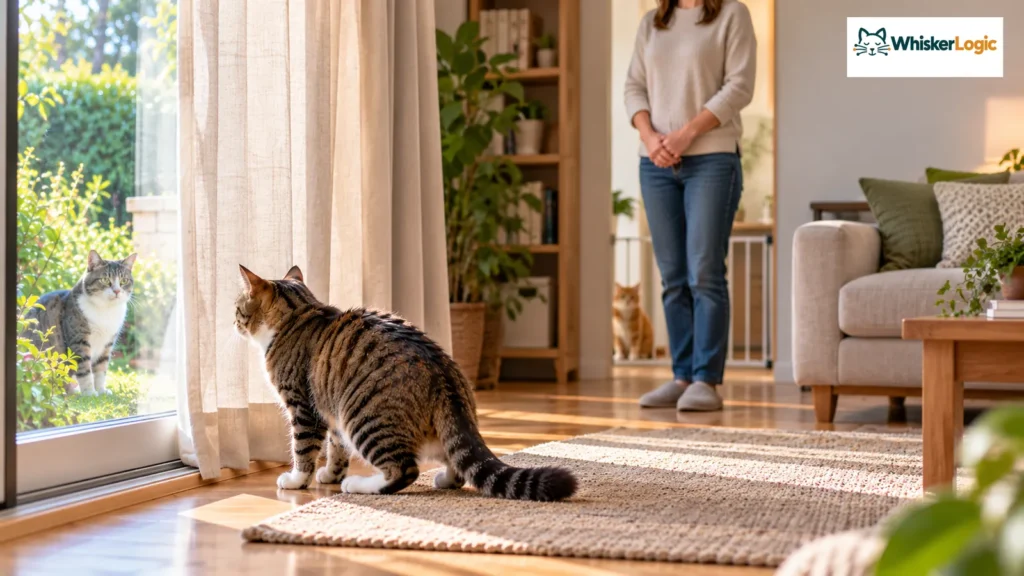
Picking up your cat may feel like the fastest way to remove them from the window.
During intense arousal, it can instead put your hands, arms, and face within reach of a cat who is already prepared to react.
Do not test whether your cat “knows it is you” by touching them.
Do not hold them against their will.
Do not pet them to prove that they are calm.
Give the cat enough space to disengage first.
The AAFP guidelines specifically advise caregivers not to attempt to pick up cats during tense interactions and instead recommend safer methods for reducing visual contact and separating them when needed.
What If Your Cat Redirects Aggression Toward You?
If your cat turns toward you after becoming intensely focused on an outdoor cat, move away if you can do so safely.
Do not chase the cat through the house.
Do not corner them.
Do not attempt to restrain them.
Do not punish them.
Once you are safely separated, minimize unnecessary interaction while the cat remains highly aroused.
In a redirected-aggression sequence, you may have been the available target rather than the cause of the original arousal.
That does not make the attack harmless.
Owner-directed aggression still requires careful attention to safety. A review in the Journal of Feline Medicine and Surgery emphasizes risk assessment and owner safety when dealing with feline aggression.
If a bite or scratch breaks the skin, wash the area promptly. Seek appropriate human medical advice for serious wounds or if the wound becomes red, painful, warm, swollen, or otherwise concerning. The CDC’s guidance on cats and bites or scratches provides additional information.
What If Your Cat Redirects Aggression Toward Another Cat?
The outside cat may leave while tension inside the home continues.
The attacked cat may:
- hide;
- avoid the other cat;
- stare defensively;
- hiss;
- growl;
- swat;
- flee;
- or become hesitant about moving through the home.
The attacking cat may also remain aroused and continue staring, searching, stalking, or reacting strongly when the other cat moves.
Do not immediately put the cats together again to see whether they will “work it out.”
If tension remains, separate them safely.
Each cat should have access to appropriate resources in their temporary area, including food, water, litter, resting areas, and safe places as needed.
The 2024 AAFP guidelines specifically reject forcing cats to “work it out” and recommend reducing tension, providing separated resources, and using appropriate management.
If chasing develops into an ongoing post-incident pattern, see Why Does My Cat Chase My Other Cat? for help evaluating whether one cat can still disengage and move freely.
Don’t Use a Fixed Timer to Decide When Your Cat Is Calm
Do not assume:
“Thirty minutes have passed, so the cat must be fine.”
Do not assume:
“They have been separated for two hours, so it is safe to put them together.”
Recovery varies by cat and by situation.
Instead of watching the clock, watch the cat.
Signs that arousal may be decreasing include:
- no longer fixating on the original trigger;
- more relaxed movement;
- no stalking or threatening posture;
- no growling or hissing;
- returning toward normal exploration;
- resuming normal activities.
Look at the overall behavior, not one isolated sign.
For example, accepting a treat does not by itself prove that the cat is ready for close contact with you or another cat.
Resume interaction only when the cat’s behavior—not simply elapsed time—suggests that arousal has genuinely dropped enough for safe contact.
Can One Incident Change the Relationship Between Your Cats?
It can.
But it does not always happen.
An aggressive incident may create fear or defensive anticipation between cats that previously lived together without obvious problems.
Afterward, you may see:
- avoidance;
- hiding;
- defensive staring;
- hissing;
- growling;
- swatting;
- fleeing;
- pursuit;
- or ongoing tension.
That does not mean the relationship is permanently ruined.
The 2024 AAFP Intercat Tension Guidelines note that an external trigger—such as an outdoor cat—can disrupt the relationship between resident cats, including cats that previously had a positive relationship.
Watch what happens afterward.
Can both cats move freely?
Can either cat leave without being pursued?
Do they pass one another normally?
Does one cat repeatedly stare, block, follow, or chase the other?
If you need help interpreting later interactions after the immediate incident has resolved, Are My Cats Playing or Fighting? explains how to evaluate mutual participation, disengagement, pursuit, and post-interaction behavior.
When Do the Cats Need a Gradual Reintroduction?
If both cats return to their usual behavior and there is no continuing tension, a formal reintroduction may not be necessary.
But if they remain:
- wary;
- defensive;
- avoidant;
- threatening;
- persistently focused on each other;
- or unable to share space comfortably,
do not force normal proximity.
Start with safe separation.
Provide each cat with the resources they need.
Reduce unnecessary visual and social pressure.
Then restart contact gradually.
The AAFP guidelines describe gradual reintroduction with controlled visual access and later supervised physical proximity, with progression based on the cats’ responses.
Increase exposure only while body language remains manageable.
If tension increases again, reduce the difficulty rather than forcing the interaction forward.
The goal is not to make the cats interact.
The goal is to allow them to experience each other again without repeated fear, pursuit, or confrontation.
There is no universal reintroduction timetable.
Let the cats’ behavior determine the pace.
Reduce the Outside-Cat Trigger
Once everyone is safe, prevention begins with identifying where and when the outside-cat exposure happens.

Possible strategies include:
- closing blinds or curtains during predictable visits;
- using appropriate privacy film or another visual barrier;
- temporarily limiting access to a triggering window;
- moving an attractive resting station away from a problem window when necessary;
- identifying times when the outdoor cat commonly appears;
- removing external attractants on your property where appropriate.
The 2024 AAFP guidelines specifically recommend blocking visibility of outdoor cats when outside-cat exposure contributes to intercat tension.
Cornell also identifies reducing or avoiding access to the triggering stimulus as an important part of preventing redirected aggression.
Do not use harmful methods to drive away outside cats.
Avoid poisons, dangerous traps, aggressive confrontation, or other unsafe deterrents.
What If the Outside Cat Keeps Coming Back?
You may not be able to control where a neighbor’s cat, community cat, stray cat, or other outdoor animal goes.
Focus on what you can control.
Reduce repeated surprise exposure through problem windows or doors.
Use blinds, curtains, privacy barriers, room access, or furniture placement when appropriate.
If the outside cat tends to appear at predictable times, managing indoor access during those periods may help.
Do not repeatedly expose your cat to the outdoor animal at full intensity in the hope that they will eventually “get used to it.”
Uncontrolled exposure can repeatedly trigger the same high-arousal sequence.
Behavior modification, when appropriate, should occur at an intensity the cat can manage rather than by repeatedly provoking a strong reaction.
Visual blocking will not solve every case.
But reducing unpredictable, high-intensity exposure can make the situation safer while you determine whether further veterinary or behavior help is needed.
Why Punishment Can Make the Problem Worse
Do not use:
- spray bottles;
- yelling;
- clapping at the cat;
- hitting;
- scruffing;
- chasing;
- or deliberate startling.
Punishment does not identify or remove the original trigger.
It may add another frightening or unpleasant event while the cat is already highly aroused.
The Merck Veterinary Manual advises avoiding positive punishment because it can increase fear, anxiety, and aggression.
Cornell likewise cautions that physical punishment can increase fear or anxiety and worsen aggression.
Punishment around another household cat may also contribute to negative associations with that cat or the situation.
Use:
environmental management + safety + distance + reinforcement-based behavior work when appropriate.
What to Try, in Order
- Identify what happened immediately before the episode.
Determine what your cat saw or heard and whether an outdoor cat was present. - Create distance from an intensely aroused cat.
Move people and other animals away when this can be done safely. - Do not grab, corner, punish, or pick up the cat.
- Reduce the outside visual trigger when safe.
Close a blind, curtain, or other visual barrier without approaching the aroused cat. - Separate household cats if tension remains.
Do not immediately put them together again after an attack. - Wait for behavioral recovery rather than using a fixed timer.
- Check whether aggression occurs only in this outside-cat sequence or in other situations too.
- Manage predictable windows, doors, and outside-cat visits.
- Use gradual reintroduction if household cats remain tense.
- Arrange veterinary review for sudden, unexplained, painful, broader, severe, or escalating aggression.
- Seek qualified behavior help if injuries, repeated incidents, failed reintroductions, or safety problems continue.
When to Get Veterinary or Behavior Help
Veterinary Review
Contact your veterinarian if aggression:
- occurs without a clear outside-cat trigger;
- happens in unrelated situations;
- begins suddenly in an adult or senior cat;
- accompanies possible pain;
- occurs with mobility changes;
- occurs with appetite or sleep changes;
- appears with other changes in normal behavior;
- becomes increasingly severe;
- or becomes difficult to manage safely.
Physical health problems can influence behavior directly or indirectly.
The goal of veterinary evaluation is not to assume that the problem is medical.
It is to make sure that a medical contributor is not being overlooked.
Behavior Help
Ask your veterinarian about qualified behavior support when:
- episodes continue despite trigger management;
- people or animals are injured;
- household cats cannot coexist safely;
- reintroduction repeatedly breaks down;
- aggression becomes difficult to predict;
- or safe separation becomes difficult for the household to manage.
The 2024 AAFP guidelines recommend specialist behavior involvement for complex or difficult intercat-tension cases.
Professional behavior help is not a sign that you failed.
Some situations require a more detailed assessment of the trigger, environment, health, learning history, and relationship between the cats.
FAQ
Why does my cat attack me after seeing another cat outside?
If your cat gets aggressive after seeing another cat outside and attacks you while still intensely aroused, redirected aggression is one possibility. You may have been the nearest available target rather than the original trigger.
Do not assume this explanation automatically, however. Look at the timing and the entire sequence.
Why does my cat attack my other cat after seeing a cat outside?
A household cat may become the nearby target when the resident cat is intensely aroused by an outside cat they cannot reach.
If tension continues after the outside cat disappears, separate the household cats safely instead of putting them immediately back together.
What is redirected aggression in cats?
Redirected aggression can occur when a cat becomes highly aroused by a stimulus but cannot respond directly to it, then directs aggression toward another nearby target.
An indoor cat seeing an inaccessible outdoor cat through a window is a commonly cited example.
Does my cat hate my other cat now?
Not necessarily.
The other household cat may not have caused the original reaction.
However, the attack itself can create fear, avoidance, defensive behavior, or continuing tension that may need to be managed.
How long does redirected aggression last in cats?
There is no single reliable duration.
Recovery varies between cats and situations.
Use the cat’s behavior rather than a fixed cooling-off timer to decide when it may be safe to resume contact.
How do I know when my cat has calmed down?
Look at the whole pattern.
Your cat should no longer be intensely fixating, stalking, threatening, growling, hissing, or moving with a highly tense posture and should be returning toward normal behavior.
Do not use one behavior—such as accepting a treat—as proof by itself.
Should I pick up my cat after they see another cat outside?
Not while your cat is intensely aroused.
Picking them up places your hands and body within reach and can increase your risk of injury.
Give the cat space instead.
Should I separate my cats after redirected aggression?
If an attack occurred and tension remains afterward, temporary separation is appropriate.
If the cats remain uncomfortable around each other, a gradual reintroduction may be needed.
How do I stop my cat from seeing outdoor cats?
Depending on your home, options can include:
- blinds;
- curtains;
- privacy film;
- another appropriate visual barrier;
- limiting access to a problem window;
- or changing furniture placement.
The goal is to reduce repeated high-intensity exposure to the trigger.
Should I punish my cat for redirected aggression?
No.
Punishment can increase fear and arousal and may worsen aggression or create additional negative associations.
Focus on safety, distance, environmental management, and appropriate behavior modification instead.
Can redirected aggression happen again?
Yes.
If the same triggering situation happens again, another episode is possible.
Identifying predictable triggers and reducing uncontrolled exposure can lower the opportunity for the same sequence to repeat.
When should I call my veterinarian?
Arrange veterinary evaluation when aggression is sudden without a clear trigger, occurs in unrelated situations, accompanies possible pain or broader behavior changes, appears as a new problem in an adult or senior cat, becomes severe or escalating, or cannot be managed safely.
Sources
- Merck Veterinary Manual — Behavior Problems of Cats
- Cornell Feline Health Center — Feline Behavior Problems: Aggression
- Rodan I, Ramos D, Carney H, et al. — 2024 AAFP Intercat Tension Guidelines: Recognition, Prevention and Management — Journal of Feline Medicine and Surgery
- Amat M, Manteca X — Common Feline Problem Behaviours: Owner-Directed Aggression — Journal of Feline Medicine and Surgery
- VCA Animal Hospitals — Cat Behavior Problems: Aggression Redirected
- CDC — Cats: Healthy Pets, Healthy People