
You reach for your cat’s paw, bring out the nail clippers, and suddenly the paw disappears. Your cat stiffens, pulls away, or tries to leave. Keep going, and you might get a hiss, a swat, or even a bite.
If you’re thinking, “My cat won’t let me trim nails,” the answer usually isn’t to hold your cat more firmly.
Start by finding the first step your cat finds difficult. Is it touching the paw, holding it, extending a claw, seeing the clippers, or making the actual cut?
Each step can be practiced separately, with rewards and opportunities for your cat to disengage.
You don’t need to finish every nail in one sitting. One calmly trimmed nail—or a comfortable practice session without cutting anything—can help build a more manageable routine.
Quick Answer
If your cat resists nail trims, find the earliest point where resistance begins and practice that step at an easier level.
- Paw touch causes withdrawal: Start with brief contact, reward, and release.
- Holding the paw causes resistance: Practice shorter, gentler holds.
- Claw extension is difficult: Teach it as a separate movement.
- The clippers trigger avoidance: Introduce their appearance, movement, contact, and sound gradually.
- The first cut causes distress: Stop, check for possible discomfort, and return to an easier step when appropriate.
- Your cat accepts one nail but not another: End the session without forcing completion.
Watch for early changes in your cat’s behavior and stop before handling becomes a struggle.
Sudden resistance, sensitivity involving one paw or toe, limping, or an injured nail deserves veterinary consideration.
The goal is voluntary participation, not finishing every nail at any cost.
Vet Check: When Nail-Trim Resistance May Need Medical Attention
Nail-trim resistance is not always a training problem. Handling a paw or extending a claw may sometimes be uncomfortable or painful.
Contact your veterinarian if:
- Your cat previously accepted nail trims but suddenly refuses them.
- One paw or toe seems more sensitive than the others.
- You notice swelling, a broken or torn nail, bleeding, or limping.
- A claw is severely overgrown or curling toward the paw pad.
- Your cat reacts to paw contact outside nail-trimming sessions.
- You notice changes in walking, jumping, mobility, or tolerance for handling.
- Nail care is necessary, but your cat cannot be handled safely at home.
Seek prompt veterinary care for a nail growing into the paw pad, a torn nail, significant bleeding, marked pain, or limping.
Do not repeatedly manipulate a painful-looking paw to investigate it, and do not attempt to pull off a damaged nail.
These signs do not prove a particular medical condition. They mean that physical discomfort or injury should be considered before assuming the resistance is behavioral.
Table of Contents
Why Won’t My Cat Let Me Trim Their Nails?
A cat that refuses nail trimming may be reacting to one particular part of the process rather than the entire procedure.
Some cats accept a gentle paw touch but dislike having the paw held. Others tolerate a brief hold until someone presses a toe to extend a claw.
Another cat may be comfortable with paw handling but become wary when the clippers appear.
And some cats only react when the clippers contact the nail or make a cut.
Possible contributors include unfamiliar handling, an earlier uncomfortable experience, fear of being unable to leave, or physical discomfort. More than one factor may be involved.
That means the same outward response—pulling a paw away, for example—can occur for different reasons.
Rather than assuming your cat hates nail trims or is refusing to cooperate, ask:
What happens immediately before the first sign of resistance?
The answer helps you decide what to practice, what to make easier, and whether the response might warrant veterinary attention.
First Find the Step Where Your Cat Starts to Resist
Nail trimming is a sequence of separate interactions:
Paw touch → Paw held briefly → Claw extended → Clippers appear → Clippers approach → Nail touched → Clip happens → Next nail
Observe the earliest step that changes your cat’s behavior.
Do not deliberately continue until your cat hisses, swats, or bites just to discover their limit.
If Your Cat Resists Paw Touch
The difficulty begins before you reach the clippers.
Your cat may be uncomfortable with contact or anticipating what usually happens afterward.
Try a shorter, gentler touch to the lower leg or paw, followed by a reward and release.
For now, do not add a hold.
If Your Cat Accepts Touch but Resists Being Held
Touching a paw and keeping it in your hand are different experiences.
Practice a momentary, loose hold. Reward and release before your cat feels the need to pull away.
Do not tighten your grip when your cat withdraws.
If Your Cat Resists Claw Extension
Your cat may accept the paw being held but dislike pressure on the toe.
Return to comfortable toe contact, then gradually introduce the gentle pressure needed to expose a claw.
Do not assume this movement will be accepted simply because ordinary paw touching is tolerated.
If Your Cat Reacts When the Clippers Appear
The tool itself—or what it predicts—may be concerning.
Start with the clippers visible at a comfortable distance, without reaching for your cat’s paw.
Gradually work toward having them nearby.
If Your Cat Reacts When the Clippers Approach
Seeing the clippers across the room is different from watching them move toward a paw.
Practice the approach separately, starting far enough away that your cat remains comfortable.
If Your Cat Pulls Away When the Clippers Touch the Nail
Practice a brief, gentle touch without cutting, followed by a reward and release.
If a particular nail appears painful or your cat reacts unusually strongly, stop and seek veterinary advice.
If Your Cat Reacts to the Actual Cut
The cutting sensation, sound, pressure, or a previous unpleasant experience may matter.
Do not assume which explanation is correct.
If there are signs of pain or a sudden change, seek veterinary input. Otherwise, return to an easier training step and work toward a conservative safe-tip trim.
If Your Cat Accepts One Nail but Resists the Next
Your cat may have reached their limit for that session.
Stop there.
You have learned something useful: one nail was manageable, but continuing was not.
Learn the Early Signs That Your Cat Needs a Break
You do not need to wait for hissing, swatting, or biting before ending a nail-trim attempt.
Earlier signs that the interaction is becoming difficult may include:
- Repeated paw withdrawal.
- Turning the head or body away.
- Unusual stiffening or stillness.
- Changes in tail movement.
- Watching your hand or the clippers more closely.
- Trying to change position or leave.
- Hesitating to approach the practice area.
- Refusing a reward your cat normally enjoys.
- Retreating or hiding.
Growling, hissing, swatting, and biting are clear reasons to stop handling immediately.
These are not universal diagnostic signs. A particular movement or posture may have different meanings depending on the cat and the situation.
Focus on changes from your individual cat’s normal behavior, especially when several changes happen together.
For example, if your cat was comfortably accepting gentle paw contact but begins repeatedly pulling away as you extend a claw, that change tells you to make the step easier.
If your cat stops accepting a normally valued treat, consider whether the interaction has become too difficult. However, continuing to eat does not guarantee that a cat feels comfortable.
When you notice increasing tension, stop, allow your cat to disengage, and reconsider the difficulty of the next practice session.
Don’t Try to Hold Your Cat More Firmly
A struggling cat can make stronger restraint seem like the quickest solution.
But holding your cat down can remove their ability to escape an uncomfortable interaction and may increase fear or defensive behavior.
The Feline Veterinary Medical Association’s 2026 Respectful Handling of Cats position statement emphasizes choice, a sense of control, and minimizing distress. It explicitly rejects scruffing, tight restraint, boxing down, and other forceful restraint techniques.
For nail care at home, the goal is cooperative handling.
You may gently support your cat’s paw or use a comfortable position your cat willingly accepts.
That is different from immobilizing a cat who is actively trying to escape.
Avoid scruffing, pinning, squeezing, tight towel restraint as a routine training method, or gripping the paw more firmly because your cat struggles.
Do not punish hissing, swatting, or attempts to leave.
Food should not be used as a trap. Distracting your cat with a treat and then unexpectedly grabbing or pinning them does not teach voluntary participation.
Instead, let your cat experience manageable handling, predictable release, and rewards for willingly participating.
If you cannot safely trim a necessary nail without forceful restraint, contact your veterinary team rather than escalating the struggle.
Start With Paw Touch Before You Clip a Nail
If your cat dislikes paw handling, begin training without trying to clip anything.
Choose a quiet, familiar setting and a time when your cat is awake, receptive, and comfortable interacting.
Have a reward ready that your cat values. This may be a small food treat, brief play, or another positive interaction.
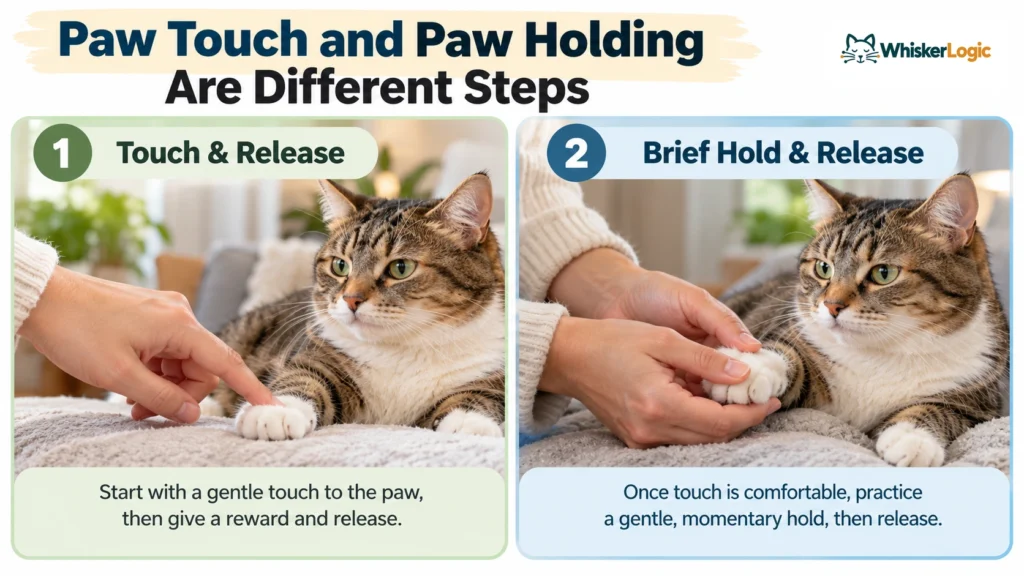
Begin With Brief Contact
Lightly touch your cat’s lower leg or paw.
Reward the interaction and remove your hand.
The touch should be short enough that your cat remains comfortable.
If paw contact is already difficult, start with an easier location on the leg and work toward the paw gradually.
Make Contact Slightly Longer
Once a brief touch is consistently manageable, increase its duration a little.
Reward and release.
If your cat pulls away, shorten the touch again.
Introduce a Brief Paw Hold
Rest your fingers gently around the paw without gripping it tightly.
Reward and let go.
Do not immediately extend a claw.
Practice Touching the Toes
When paw holding becomes manageable, gently touch an individual toe.
Reward and release.
You are helping your cat learn that each small interaction is predictable and does not automatically lead to a full nail trim.
There is no need to complete all of these steps in one session.
Advance when your cat comfortably accepts the current step repeatedly without increasing distress.
Teach Your Cat to Accept Claw Extension
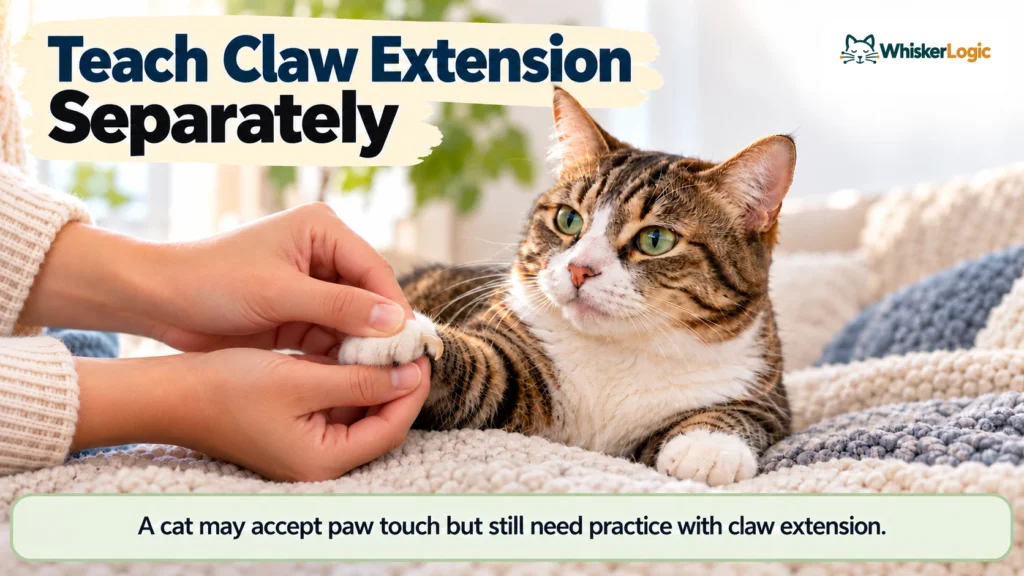
A cat may allow you to touch or hold a paw but withdraw when you apply pressure to expose a claw.
Treat this as a separate behavior.
Begin only when ordinary paw and toe handling are comfortable.
Gently support the paw and apply minimal pressure to start extending a claw.
At first, a small movement may be enough.
Reward your cat and release the pressure.
Gradually work toward exposing the claw briefly, keeping the interaction comfortable and predictable.
Do not hold the paw until your cat gives up resisting.
Release it before your cat has to struggle to get free.
Some cats will find this movement easier than others. Progress should depend on your cat’s response, not a fixed training schedule.
If one toe or claw consistently causes an unusually strong reaction—particularly if this is new—stop working on that area and consult your veterinarian.
Introduce the Clippers Separately
Comfortable paw handling does not automatically mean your cat is ready for the clippers.
The tool introduces additional sights, movements, sounds, and sensations.
Practice those elements in manageable stages.
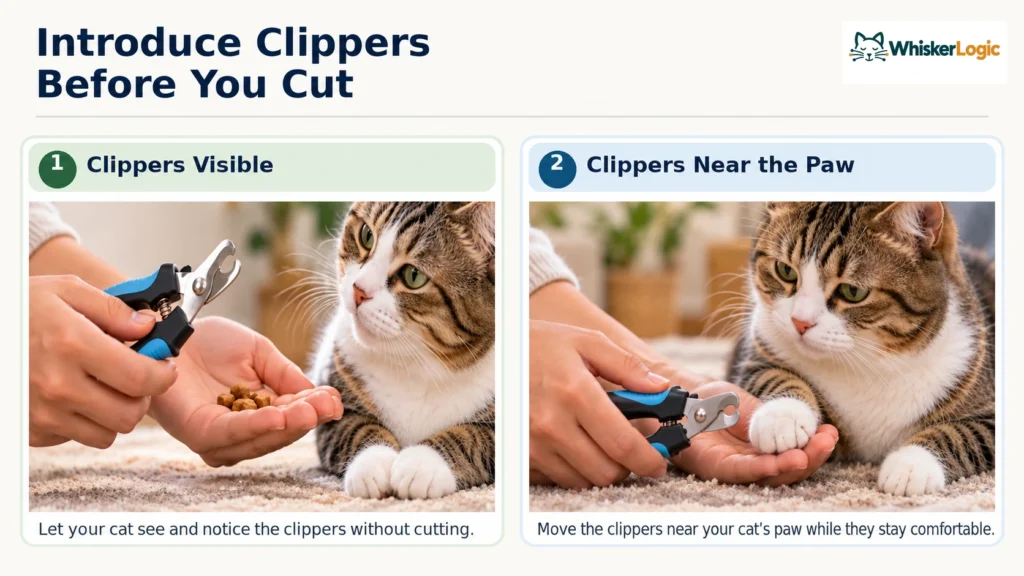
First: Let the Clippers Be Visible
Place the clippers at a distance where your cat can notice them without appearing distressed.
Reward comfortable behavior.
Over future practice sessions, gradually bring them closer if your cat remains willing to participate.
Next: Hold the Clippers Nearby
Pick up the clippers without reaching for the paw.
Later, practice a familiar paw touch while holding the clippers in your other hand.
Keep the interaction brief.
Then: Let the Clippers Approach the Paw
Move the clippers toward the paw only as far as your cat comfortably accepts.
Reward and move them away.
If your cat becomes tense, return to a greater distance.
Practice Touching the Nail Without Cutting
When your cat accepts claw extension and the approaching clippers, briefly touch the safe outer portion of the nail with the clippers.
Do not cut yet.
Reward, release, and reassess.
Introduce the Clipping Sound If Necessary
If the sound appears to worry your cat, practice briefly closing the clippers at a comfortable distance, without holding the paw.
Reward comfortable participation.
Only bring the sound and paw handling together when those individual steps are manageable.
Finally: Make a Conservative Cut
When your cat accepts the preceding steps and you can clearly identify a safe cutting point, trim a small portion of one nail tip.
Reward your cat and release the paw.
You do not need to continue immediately to another nail.
Clip One Nail, Then Reassess
One nail can be enough for a successful session.
The FelineVMA’s Claw Counseling guidance supports trimming a few nails at a time, offering breaks, and using positive reinforcement.
After trimming one nail, pause.
Observe whether your cat remains comfortable, is free to leave, and seems willing to participate again.
If your cat withdraws, stiffens, turns away, or tries to leave, end the session.
You can work on another nail during a future comfortable interaction.
There is no mandatory number of nails to trim, and completing every paw is not the measure of a successful training session.
You may also end a session after comfortable paw handling or clipper contact without trimming anything.
The important distinction is between building a repeatable routine and repeatedly pushing your cat beyond what they can manage.
If a nail needs urgent attention, however, seek veterinary help rather than postponing necessary care until training is complete.
What If Treats Don’t Work?
If your cat ignores treats or stops accepting them during training, do not assume they are being stubborn.
Consider whether:
- The current handling step is too difficult.
- The interaction lasts too long.
- The clippers are too close.
- Several unfamiliar steps are happening together.
- The reward is not especially valuable at that moment.
- Your cat is already frightened or uncomfortable.
- Pain may be involved.
Start by reducing the difficulty.
Practice a shorter touch, return to a familiar movement, or move the clippers farther away.
You can try another reward your cat enjoys, including brief play or another positive activity.
Reward behaviors your cat voluntarily offers.
Do not wait until your cat is absorbed in food and then unexpectedly grab the paw.
If your cat remains highly distressed despite smaller steps, ask your veterinarian or a qualified feline behavior professional for guidance.
If handling appears painful, prioritize a veterinary assessment.
How to Avoid Cutting the Quick
Inside a cat’s claw is a sensitive structure called the quick, which contains blood vessels and nerves.
Cutting into it can cause pain and bleeding.
The aim of routine nail trimming is to remove an appropriate sharp tip, not to make the nail as short as possible.
On some lighter-colored claws, the pink quick may be visible.
On darker or less transparent claws, it may be difficult to identify clearly.
Use suitable, sharp nail clippers and make conservative cuts.
Trim only the portion you can confidently identify as safe, staying well away from the quick.
Avoid guessing how much can be removed or relying on a universal cutting distance. Claws vary in size, shape, and appearance.
If you cannot confidently determine where to cut, ask your veterinary team to demonstrate the technique using your own cat.
The VCA guide to trimming a cat’s nails provides additional information about nail anatomy and conservative trimming.
Remember that being able to identify the quick and having a cat who comfortably accepts clipping are separate requirements.
Both matter.
What If You Accidentally Cut the Quick?
Accidentally cutting the quick can cause pain and bleeding.
Stop the trim instead of immediately moving to another nail.
For minor bleeding, pet styptic powder is commonly used to help stop the bleeding.
Contact your veterinarian if bleeding is significant, does not stop, or is accompanied by marked pain or limping.
A torn or badly damaged nail also needs veterinary attention. Do not pull off a damaged nail yourself.
After the immediate problem is addressed, return to easier handling steps before attempting another trim.
A painful experience may affect how your cat responds during future sessions.
What If Your Cat Suddenly Starts Refusing Nail Trims?
A cat that has always disliked paw handling presents a different situation from one that previously accepted nail trims and suddenly starts refusing them.
A new response makes physical discomfort more important to consider.
Possible warning signs include:
- Resistance involving one particular paw or toe.
- Limping or favoring a foot.
- Swelling, bleeding, or visible nail damage.
- A broken, torn, or severely overgrown claw.
- Difficulty jumping or moving normally.
- New sensitivity during lifting or other handling.
- Broader changes in activity, grooming, hiding, or behavior.
Do not repeatedly press on a sensitive toe to confirm that it hurts.
Contact your veterinary team for evaluation.
These changes cannot establish a diagnosis on their own. An examination may be needed to determine whether an injury, painful condition, or another health issue is involved.
What About Older Cats?
Older cats may require additional attention to their claws.
The Cornell Feline Health Center’s senior-cat guidance notes that aging cats can develop claws that are thicker, more brittle, or overgrown.
Some older cats may also experience changes in mobility or tolerance for handling.
However, age does not tell you why an individual cat is resisting a nail trim.
If your older cat develops new paw sensitivity, unusual claw changes, or difficulty moving, discuss those changes with your veterinarian instead of automatically attributing them to aging.
What If the Nails Need Trimming Right Now?
Gradual training can make future nail care easier, but sometimes a nail needs attention before your cat is ready to participate comfortably.
If the Nails Are Long but There Is No Obvious Injury
Contact your veterinary team if the nails need trimming and you cannot handle your cat safely at home.
They can help determine how soon the nails need attention and whether professional nail care is appropriate.
You can continue working on cooperative handling separately.
If a Claw Is Growing Toward or Into the Paw Pad
Do not wait for training to progress.
An overgrown claw pressing into or penetrating the pad needs prompt veterinary attention.
Do not force the paw into position or attempt to remove a deeply embedded claw yourself.
If a Nail Is Broken, Torn, or Bleeding
Contact your veterinarian promptly, particularly when there is significant bleeding, pain, limping, or damage close to the nail base.
Do not pull off a torn nail.
Injury care takes priority over training.
If Your Cat Cannot Be Safely Handled
Stop home attempts that lead to escalating distress or defensive behavior.
Explain to your veterinary team exactly where the nail-trim process becomes difficult and whether the response is new.
The veterinarian can assess the need for care, recommend an appropriate approach, and discuss professional handling assistance or veterinarian-directed medication when necessary.
Do not administer calming medication without veterinary direction.
You do not need to overpower your cat to complete necessary nail care at home.
What to Try, in Order
Use this sequence as a practical plan. Move forward according to your cat’s comfort rather than following a fixed calendar.
- Identify the first difficult step. Observe whether resistance begins with touching, holding, claw extension, the clippers, nail contact, or the cut itself.
- Choose a calm setting. Practice when your cat is comfortable, receptive, and free to disengage.
- Reward brief paw contact. Start with a gentle touch, followed by a reward and release.
- Build paw holding gradually. Practice momentary, loose holds rather than increasing pressure.
- Teach claw extension separately. Introduce gentle toe pressure in small, manageable steps.
- Introduce the clippers without cutting. Practice their appearance, proximity, and movement.
- Practice touching the nail. Briefly bring the clippers into contact with a safe portion of the nail without making a cut.
- Trim a conservative safe tip. Make a cut only when your cat is comfortable and you can identify where it is safe to trim.
- Reassess after each nail. Notice early changes in behavior and stop before the interaction becomes a struggle.
- Build additional nails gradually. Work toward another nail during future comfortable sessions without forcing a completion target.
- Stop for possible medical concerns. Sudden resistance, localized sensitivity, injury, limping, or severe overgrowth may require veterinary attention.
- Use veterinary assistance when necessary. If nail care cannot safely wait and home handling is not manageable, contact your veterinary team.
After each session, ask yourself:
Was my cat comfortable enough to repeat that step, or should I make the next attempt easier?
That question is more useful than counting how many nails you managed to finish.
When to Get Veterinary or Behavior Help
When to Contact Your Veterinarian
Veterinary help is important when resistance appears suddenly, seems painful, or involves a particular paw or toe.
Seek guidance for broken or torn nails, swelling, limping, severely overgrown claws, mobility changes, or sensitivity during handling outside nail-trim sessions.
Your veterinary team can also help when necessary nail care cannot be completed safely at home.
When to Seek Behavior Help
Additional behavior support may be useful if your cat has long-standing intense fear of paw handling, repeatedly swats or bites during practice, or cannot progress despite reducing the difficulty.
Ask your veterinarian about a qualified professional experienced in feline behavior and cooperative-care training.
If your cat bites during ordinary stroking rather than procedural paw handling, that is a different interaction. Our guide, Why Does My Cat Bite Me When I Pet Them?, explains how to evaluate biting specifically associated with petting.
For nail trims, continue to focus on the earliest difficult step, reduce the challenge before distress escalates, and seek professional help when pain or safety may be involved.
FAQ
My cat won’t let me trim nails. What should I do first?
Identify where resistance begins. Start with the earliest difficult step—such as paw touch, holding, claw extension, or clipper contact—and practice an easier version with rewards and release. Do not begin by holding your cat more tightly.
Why does my cat hate nail trims?
Your cat may dislike a particular handling movement, the clippers, or the cutting sensation. Previous unpleasant experiences or physical discomfort may also contribute. Observe the first step that triggers resistance rather than assuming the entire procedure is the problem.
Why does my cat pull their paw away when I trim nails?
Your cat may be uncomfortable with the touch, the length of the hold, the next expected action, or the handling of a sensitive area. Release the paw and reduce the difficulty. New or localized sensitivity should be discussed with your veterinarian.
Should I hold my cat down to cut their nails?
No. Do not pin, scruff, tightly restrain, or immobilize a struggling cat to force a nail trim. Practice cooperative handling and seek veterinary assistance when necessary care cannot be completed safely.
Do I have to trim every nail in one sitting?
No. You can stop after one nail or a few nails if that keeps the session manageable. It is also acceptable to practice handling without clipping anything.
How do I get my cat used to having their paws touched?
Begin with brief, gentle contact followed by a valued reward and release. Gradually build toward longer touch, brief paw holding, toe contact, and claw extension. Progress according to your cat’s behavior.
What if my cat bites during nail trims?
Stop handling immediately and give your cat space. Do not punish or restrain them more firmly. Repeated biting, intense fear, or sudden defensive behavior may warrant veterinary or qualified behavior-professional guidance, especially if pain is possible.
What if my cat suddenly refuses nail trims?
Consider whether a paw, toe, or nail may be uncomfortable. Look for swelling, injury, limping, mobility changes, or sensitivity outside nail-trim sessions without repeatedly provoking a reaction. Contact your veterinarian for assessment.
How do I avoid cutting the quick?
Trim only a small safe tip that you can confidently identify. Avoid cutting near the quick, which contains nerves and blood vessels. If you are uncertain where to cut, ask your veterinary team for a demonstration.
What should I do if I accidentally cut the quick?
Stop trimming. Styptic powder is commonly used for minor bleeding. Seek veterinary help if bleeding is significant or persistent, the nail is torn, or your cat appears very painful or lame.
Can a veterinarian trim my cat’s nails?
Yes. Your veterinary team can provide or arrange appropriate nail care, particularly when home handling is unsafe or a nail is injured or severely overgrown. They can also demonstrate a safe trimming technique.
How long does nail-trim training take?
There is no fixed timeline. Progress depends on the individual cat, previous experiences, and the specific step being trained. Advance when your cat comfortably accepts the current interaction, and return to an easier step when distress increases.
Sources
The following veterinary and feline-welfare references informed this guide:
- Feline Veterinary Medical Association — 2026 Respectful Handling of Cats to Minimize Fear and Pain at the Veterinary Visit
- Feline Veterinary Medical Association — Claw Counseling: Living Alongside Cats with Claws (2025)
- Cat Friendly Homes — Trimming Your Cat’s Nails
- VCA Animal Hospitals — How to Trim a Cat’s Nails
- VCA Animal Hospitals — Handling Exercises for Trimming Nails and Brushing Teeth
- Cornell Feline Health Center — The Special Needs of the Senior Cat