
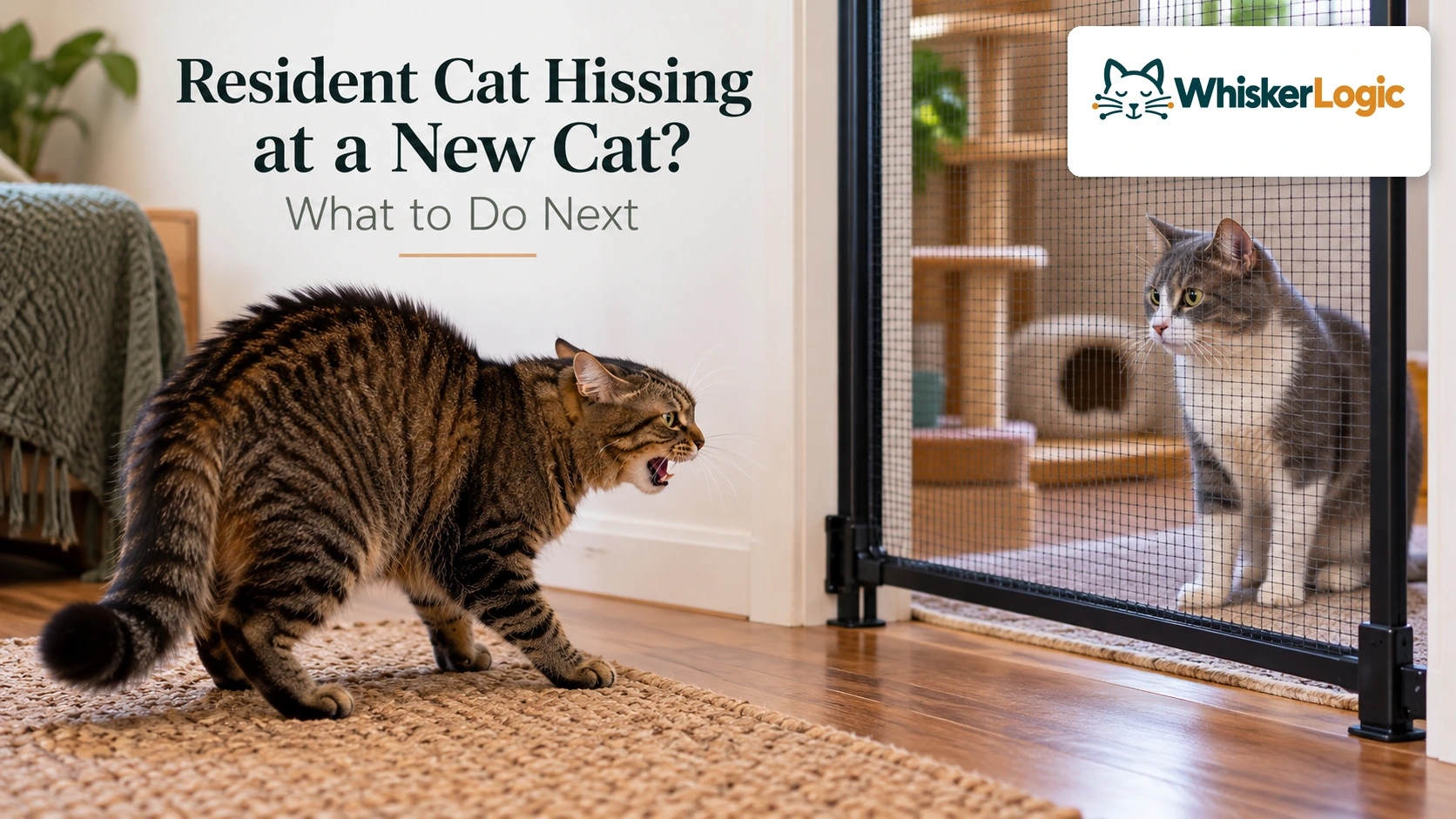
Your new cat is in a transition room. Your resident cat approaches the closed door, stares at the gap, and hisses. Maybe the hissing begins only after the cats see each other through a barrier—or during their first supervised time in the same room.
A resident cat hissing at a new cat does not automatically mean the introduction has failed. But the hissing is useful information: this stage may be more difficult than one or both cats are ready for.
Don’t punish the warning or force the cats closer. Identify where the tension began, create more distance, and return to the last comfortable introduction step when needed. Let both cats’ behavior—not a fixed schedule—determine what happens next.
Resident Cat Hissing at New Cat? The Quick Answer
If your resident cat is hissing at your new cat:
- Identify the stage. Did the reaction begin with scent, a closed door, visual access, or direct contact?
- Reduce exposure. Increase distance or go back to the last stage both cats handled comfortably.
- Don’t punish the hiss. Avoid yelling, spray bottles, startling, and forced contact.
- Protect separate resources. Both cats need accessible food, water, litter boxes, resting areas, hiding places, and scratching options.
- Watch both cats. An interested newcomer does not mean the resident cat is ready—or vice versa.
- Advance based on behavior. Look for relaxed movement, disengagement, and normal activities, not a particular number of days.
- Act safely if tension escalates. Use a suitable barrier to block sight lines; never put your hands between confronting cats.
An isolated hiss followed by a comfortable retreat is different from repeated hissing with growling, fixation, or chasing. The entire interaction matters.
Before You Continue: When a Veterinary Check Matters
Stress isn’t the only possible contributor to a behavioral change. Contact your veterinarian if either cat appears painful or ill, stops eating normally, changes litter-box habits, suffers an injury, or shows a sudden severe change in behavior. Seek prompt veterinary attention for bite wounds and other injuries. Straining to urinate without producing urine is an emergency.
The new cat should receive appropriate veterinary evaluation before integration, including discussion of vaccinations, parasites, and infectious-disease risks. Consult your veterinarian early if either cat has significant medical needs.
Hissing alone cannot diagnose a medical problem. Pain or illness, however, can affect a cat’s tolerance of another animal.
Table of Contents
Why Is My Resident Cat Hissing at My New Cat?
Hissing often functions as defensive, distance-seeking communication: a cat is uncomfortable and wants more space. An unfamiliar cat’s scent, movements, or approach may contribute, but hissing alone doesn’t prove fear, aggression, hatred, or permanent incompatibility.
Read it together with posture, distance, movement, and recovery. A cat that briefly hisses and walks away is showing something different from one that remains rigid, growls, watches the doorway without looking away, or blocks another cat’s exit.
Ask what happened immediately before the hiss and whether the cat could retreat. Did the reaction fade after distance increased? Was the other cat approaching or following?
This isn’t a contest to establish which cat is in charge. The 2024 AAFP Intercat Tension Guidelines caution against interpreting household tension as an attempt to create a dominance hierarchy. The practical question is which part of the introduction is too demanding right now.
First Ask: At What Introduction Step Did the Hissing Start?
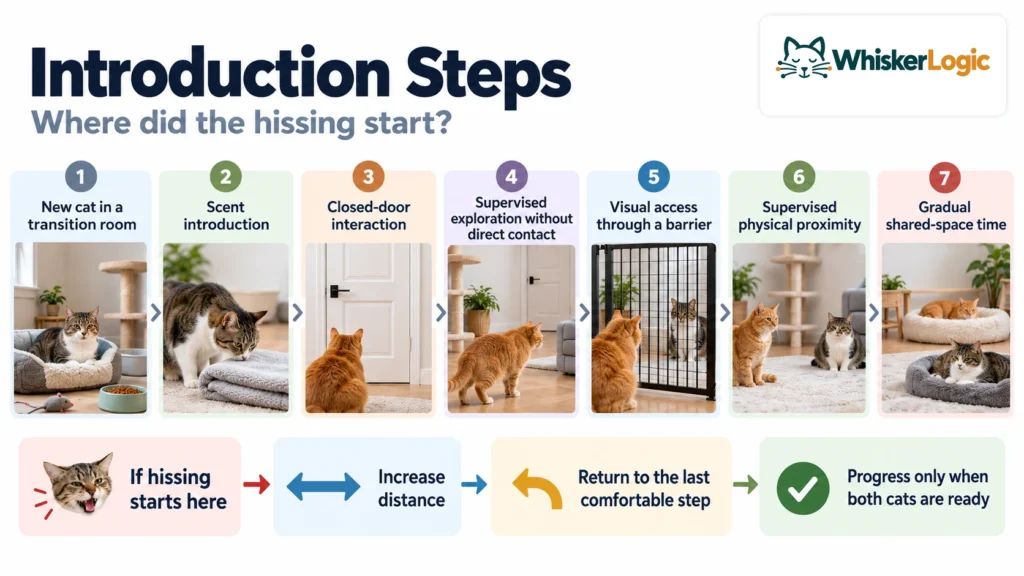
A new-cat introduction is a sequence, not one meeting. Pinpointing the stage where hissing appeared tells you what to adjust.
| Introduction stage | What to observe | What to do if tension appears |
|---|---|---|
| 1. New cat in a transition room | Fear of sounds or activity outside; resident cat fixated near the door | Protect the room and reduce activity close to its entrance |
| 2. Scent exposure | Hissing at bedding, avoidance, growling, agitation | Reduce scent intensity; let the cat approach voluntarily |
| 3. Closed-door interaction | Door camping, pawing under the door, fixation | Stop the session and add distance or a buffer barrier |
| 4. Supervised exploration without contact | Distress during separate access to shared areas | Shorten exploration and keep the resident cat secure and comfortable elsewhere |
| 5. Visual access through a barrier | Hard staring, hissing, stiff posture, attempts to reach through | Increase distance, partially cover the view, or return to closed-door activities |
| 6. Supervised physical proximity | Stalking, swatting, lunging, chasing, cornering | Separate safely and return to an easier stage |
| 7. Gradual shared-space time | Blocking, hiding, repeated avoidance, disrupted daily activities | Reduce shared time and review resources and routes |
Only introduce the next challenge when both cats are comfortable enough with the current one. If they struggle at visual contact, for example, it doesn’t necessarily mean scent introduction failed; visual exposure may simply be too intense.
The FelineVMA step-by-step introduction guide supports this staged, behavior-based approach.
If the Hissing Starts at the Transition-Room Door
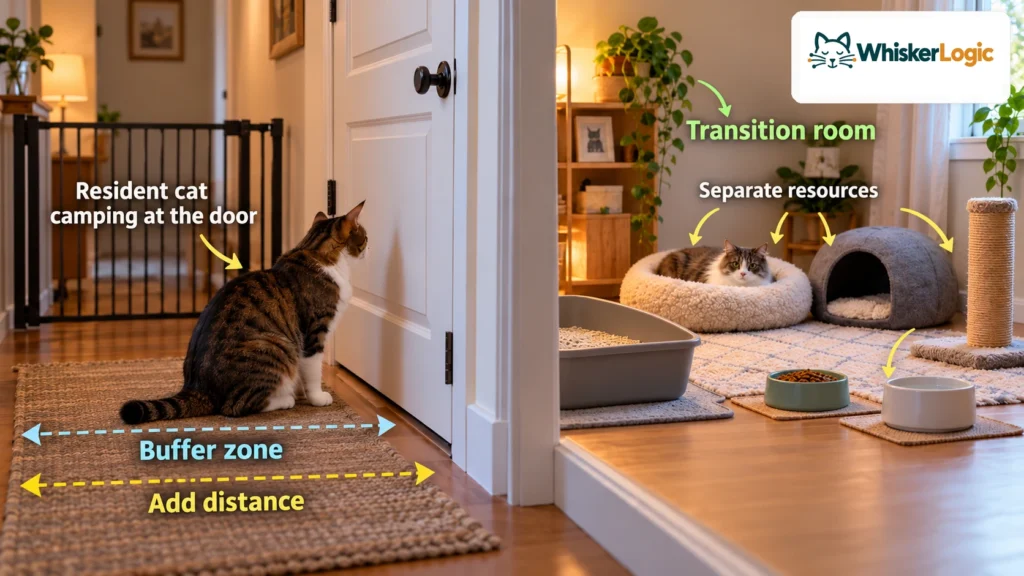
A brief visit to sniff the closed door is different from a resident cat spending long periods camped outside it.
Look for repeated pawing under the door, growling, rigid watching of the gap, or an inability to walk away. Constant close-range exposure can make the doorway a high-tension checkpoint.
Increase distance from the door. A secure second barrier or buffer zone can prevent the resident cat from repeatedly waiting right against it. Offer familiar activities and comfortable resting spots elsewhere, without punishing the cat for investigating.
Keep the transition room quiet, secure, and unavailable to the resident cat. The newcomer needs their own food, water, litter box, resting area, hiding places, scratching surface, toys, and suitable elevated options. This is a safe base—not punishment or social deprivation.
If your resident cat hisses at the new cat’s door and cannot disengage, don’t make close-door play the next required challenge. Re-establish comfort at a greater distance first.
If Your Cat Hisses at the New Cat’s Scent
Your resident cat sniffs a blanket used by the newcomer, hisses, and backs away. That is a reason to lower scent exposure, not to jump to a visual meeting.
Remove the item if it causes clear distress. Later, make it available farther away from essential resources or favorite resting places, and allow the cat to decide whether to investigate. Don’t push it toward the cat’s face or hold the cat beside it.
Watch for voluntary sniffing followed by normal activity rather than sustained vigilance, pacing, avoidance, or growling. The goal is a manageable experience with the scent, not a set number of repetitions.
If the Hissing Starts When They Can See Each Other
Sometimes the cats seem comfortable with scent and a closed door, but the first sight of each other triggers hissing. Comfort with smell does not automatically mean readiness for visual contact.
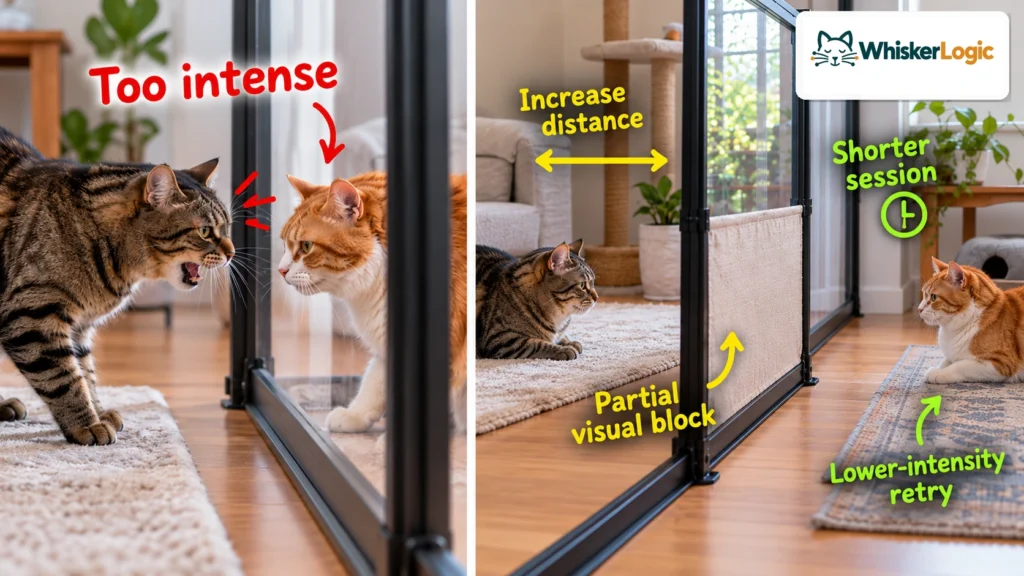
Use a secure screen, glass door, or other appropriate see-through barrier that neither cat can slip through or climb over. If either cat becomes tense:
- Increase the distance from the barrier.
- Make the session shorter.
- Cover part of the view so neither cat faces constant exposure.
- Return to closed-door interaction if a reduced view remains too difficult.
A useful change might be letting the cats notice each other briefly from across a room rather than placing them directly against a gate. Don’t keep them staring at each other just to make them “get used to it.”
Assess both cats. A quiet resident cat isn’t enough if the newcomer freezes, hides, or repeatedly tries to escape.
If Hissing Starts During Direct Contact
Hissing during supervised physical proximity calls for immediate reassessment, especially when combined with intense staring, growling, tail lashing, stalking, cornering, swatting, lunging, or chasing.
If tension escalates, end the interaction safely. Don’t reach between confronting cats, grab a highly aroused cat, force them together, or corner either one.
When safe to do so, place a large piece of cardboard, cushion, or another suitable barrier between their lines of sight while keeping your body away from them. Once they are calmer, guide them into separate secure areas without forced handling. If separation cannot be achieved safely, get assistance rather than risking injury.
Check for injuries when safe and seek veterinary care if needed. Resume later at a less intense stage; don’t immediately repeat the same direct-contact setup.
If contact develops into repeated pursuit, see Why Does My Cat Chase My Other Cat? for a closer look at chasing behavior.
Don’t Punish the Hissing
A hiss warns that the cat is uncomfortable. Yelling, spraying water, startling, restraining, or forcing face-to-face contact can add distress without resolving the situation.
Instead, listen to the signal: give the cat a way to leave, lower the exposure, and try again only at a level the cat can manage. Cat Friendly Homes’ hiding and hissing guidance specifically advises against punishment.
Don’t Let Them “Fight It Out”
Never allow cats to fight in the hope they will settle a hierarchy. A frightening confrontation can worsen later interactions and create injury risks.
The 2024 AAFP guidelines advise caregivers not to let cats “work it out themselves” or force them to get along. Prevent repeated confrontations and rebuild tolerable, positive experiences instead.
Give Each Cat Separate Resources and Escape Options
Poorly distributed resources can add pressure even when the first hissing was triggered by unfamiliarity rather than competition.
Make sure the cats have separate, accessible locations for food, water, litter boxes, resting, hiding, scratching, and elevated perches. A commonly recommended litter-box starting point is one per cat plus one extra, placed in different locations; several boxes lined up in a single room don’t offer the same choices.
Look for routes that can be controlled by one cat: hallways, doorways, stairs, litter-box entrances, and perches with a single way down. The cats should be able to retreat, move around each other, and reach essentials without being cornered or forced to pass closely.
Resource problems don’t cause every hiss, but removing bottlenecks makes the introduction less demanding. The FelineVMA behavior modification recommendations also emphasize safe spaces, separate exploration, and reward-based behavior change.
Let the Less-Comfortable Cat Set the Pace
One cat may approach eagerly while the other freezes, hides, hisses, turns away, or backs up. The approaching cat’s interest is not proof that the pair is ready.
Adjust the session for the cat showing less comfort, whether that’s the resident cat or the newcomer. Increase distance or restore a barrier so that leaving is possible without being followed.
Neither cat needs to behave identically. Both do need enough control and comfort to handle the current stage.
How Do You Know When to Move to the Next Step?
Look for a pattern of manageable encounters, rather than one successful treat or an arbitrary number of days.
Helpful signs include the ability to look away, relaxed or softening posture, voluntary exploration, comfortable movement, and normal interest in food, play, grooming, or rest. Neither cat should remain fixed on the other, block access, or repeatedly retreat in distress.
Change only one part of the next exposure at a time. For example, make a visual session slightly clearer while keeping distance and a secure barrier—not suddenly allowing unrestricted shared-room time.
If fixation, growling, repeated hissing, avoidance, or pursuit increases, step back. Behavior—not a calendar—sets the pace.
What Does “Comfortable Enough” Look Like?
It doesn’t mean that neither cat ever notices the other. It means each can handle the present level of exposure without sustained tension.
A comfortable-enough cat might glance over and then look away, investigate a toy, explore, rest, or leave without being followed. Eating a treat can be encouraging, but it is not sufficient on its own if the cat is stiff or watching the other cat continuously.
Both cats should have room to choose where to be. They do not need to cuddle, groom each other, or play together before progressing.
What If One Cat Wants Contact but the Other Keeps Backing Away?
Suppose the newcomer repeatedly approaches while your resident cat turns away, hisses, and tries to leave. If the newcomer keeps following, the interaction is still too demanding—even if the newcomer seems friendly.
Interrupt the approach before the retreating cat is cornered. Redirect the approaching cat to a separate activity when safe, increase space, and plan the next session with a stronger boundary. Don’t require the withdrawing cat to tolerate pursuit.
Repeated blocking or following deserves attention even without a physical fight.
Do Your Cats Have to Become Friends?
No. Some cats eventually sleep together, groom each other, or seek each other’s company. Others do best with separate routines and resting places.
Peaceful coexistence is a valid success: both cats can move around, use resources, rest, and avoid unwanted contact without persistent tension. Friendship cannot be promised or forced.
Can a Pheromone Diffuser Help?
Feline synthetic pheromones may be considered as an optional supporting tool. Their effects vary and may be subtle, particularly when a cat feels threatened.
A diffuser won’t replace gradual exposure, adequate distance, separate resources, safe escape options, or careful observation. Don’t treat its presence as permission to move the cats closer.
What to Try, in Order
- Find the first difficult stage: scent, door, separate exploration, visual access, direct contact, or shared space.
- Increase distance and lower the intensity of that exposure.
- Secure the transition room and prevent constant tension at its doorway.
- Separate core resources and check that neither cat can block the other’s access.
- Return to the last comfortable stage if the current one remains difficult.
- Allow voluntary approaches and exits without forcing either cat closer.
- Reward calm behavior when appropriate, using preferred treats or play without luring a distressed cat into proximity.
- Retry at lower intensity: farther away, with a shorter view, or for a shorter interaction.
- Progress when both cats show comfort, not after a predetermined wait.
- Avoid punishment and forced contact, including restraint and nose-to-nose introductions.
- Use a safe barrier if tension escalates; never reach between fighting cats or pick them up at peak arousal.
- Get veterinary or behavior help when health concerns, injuries, persistent tension, or unsafe aggression are present.
Not every single hiss requires restarting the entire introduction. What matters is the behavior around it and whether either cat remains distressed.
When to Get Veterinary or Behavior Help
Contact your veterinarian for possible pain or illness, injuries, appetite or litter-box changes, sudden severe behavior changes, or health questions about the new cat. Prompt intervention matters if a cat is injured, stops eating, or cannot urinate.
Ask for qualified behavior help if introductions repeatedly stall, one cat persistently stalks or blocks the other, serious aggression occurs, or either cat remains chronically stressed despite distance and environmental changes. Your veterinarian can help arrange a referral to a board-certified veterinary behaviorist when needed.
When your cats begin sharing space and you need help interpreting physical interaction, see Are My Cats Playing or Fighting?.
The main decision is simple: notice where the hissing starts, reduce exposure to a manageable level, protect both cats’ choices, and advance only when both are ready.
Frequently Asked Questions
Why is my resident cat hissing at my new cat?
An unfamiliar cat’s scent, presence, or approach may be uncomfortable. Look at the introduction stage, body language, distance, and whether your resident cat can retreat and recover. Hissing alone doesn’t reveal a single cause.
Is hissing normal when introducing cats?
Some hissing can occur, but it isn’t a reason to ignore tension. Brief hissing with easy disengagement differs from repeated growling, fixation, or escalating pursuit. Adjust the exposure accordingly.
Should I separate my cats again if one hisses?
If either cat remains distressed or tension escalates, end the session and separate them safely. Return to the last comfortable step. An isolated hiss followed by a relaxed departure doesn’t necessarily mean restarting from the beginning.
Should I punish my cat for hissing?
No. Give the cat space and adjust the introduction. Yelling, spray bottles, and forced handling can make the situation harder.
How long should I keep the new cat in a separate room?
There is no universal number of days. Keep the transition room available while the new cat settles and the cats move through stages based on their behavior.
When can my cats see each other?
After both are comfortable with earlier scent and closed-door stages, try brief visual access through a secure barrier at a manageable distance. Stop if either becomes distressed.
What if my cat hisses through the door?
Stop the close-door interaction, create more distance, and try a less intense session later. Don’t punish the hiss.
What if one cat keeps camping outside the new cat’s room?
Use a second barrier or buffer zone to prevent constant close-range exposure. Offer comfortable alternatives away from the doorway and watch whether the cat can disengage.
What if my cats start fighting?
Don’t put your hands between them or pick them up while highly aroused. Block sight lines with a suitable barrier if safe, separate them when possible, and check for injuries. Seek veterinary care and professional advice when needed.
Will my cats ever become friends?
Possibly, but that isn’t guaranteed. Comfortable coexistence without persistent tension is a worthwhile outcome.
Do I need separate litter boxes and feeding areas?
Yes. Give each cat accessible, well-spaced resources. One litter box per cat plus an extra is a common starting point, but location and clear access matter too.
Can pheromone diffusers help?
They may be a supportive addition, but effects vary and they won’t replace a gradual, behavior-based introduction.
When should I call my veterinarian?
Call for suspected illness or pain, injuries, appetite or litter-box changes, sudden severe behavior changes, or persistent distress. Urinary blockage signs need emergency care; ongoing unsafe conflict also warrants behavioral support.
Sources
- 2024 AAFP Intercat Tension Guidelines: Recognition, Prevention and Management
- FelineVMA — Step-by-Step Guide: How to Introduce a New Cat to Other Cats in Your Home (PDF)
- FelineVMA — Behavior Modification Recommendations for Multiple-Cat Households (PDF)
- Cat Friendly Homes — Introducing a New Cat Into Your Home
- Cat Friendly Homes — Hiding and Hissing in Cats
- Merck Veterinary Manual — Behavior Problems of Cats
- Cornell University College of Veterinary Medicine — Feline Lower Urinary Tract Disease
This article offers general educational guidance and does not replace individual veterinary or veterinary behavior care.