
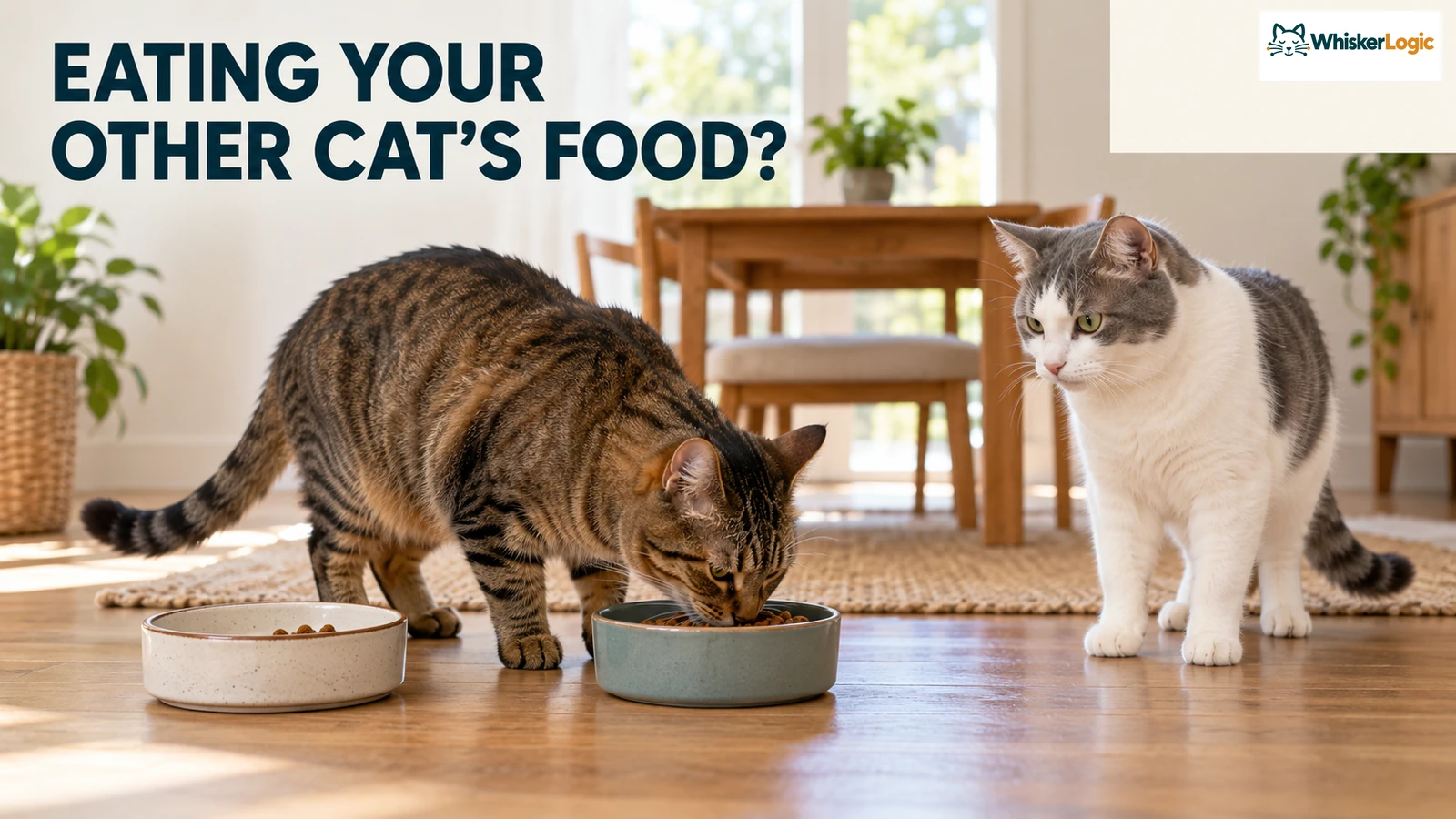
Is your cat eating your other cat’s food after you put down two separate portions? First check whether the other cat leaves freely or stops eating when approached. That difference matters before you assume bullying.
The goal is to make sure each cat can comfortably eat their own food—and to notice when a change in appetite needs veterinary attention.
Quick Answer
To stop your cat from eating your other cat’s food, first identify who actually consumes each portion. Taking voluntary leftovers is different from causing a cat to stop eating and retreat. Protect meals with distance and visual separation; use separate rooms or controlled access if swapping continues. Preserve slow eaters’ opportunities to finish. Do not automatically increase portions.
Vet Check: Has Appetite or Body Condition Changed?
Contact your veterinarian if food seeking has increased suddenly, particularly with weight loss, increased thirst or urination, vomiting, diarrhea, or unexplained changes in body condition. Include changes in either cat: the one taking food and the one leaving it.
Cornell lists increased appetite with weight loss, thirst, and urination among signs of hyperthyroidism. Feline diabetes can also cause weight loss despite a good or increased appetite, along with increased drinking and urination. These signs are reasons for an examination, not a diagnosis you can make from bowl stealing.
If a cat stops eating, seems weak, or appears unwell, seek prompt veterinary advice rather than waiting for a feeding experiment to work. Do not restrict food to punish stealing or change a prescribed diet yourself.
Table of Contents
Why Is Your Cat Eating Your Other Cat’s Food?
Start with the pattern you can see. A cat may finish first and move to food that remains available. Another may leave part of a meal to return later. Cats may also switch bowls without an obvious confrontation, or one cat may lose access when their housemate approaches.
Different foods add another question: is the cat repeatedly moving toward one particular diet? Record that preference without assuming it explains the entire interaction. A new increase in appetite deserves a separate health check.
Food stealing alone cannot tell you whether a cat is hungry, socially pressuring another cat, or ill. Your first useful question is: Can both cats eat the food intended for them, at their own pace?
Watch the Whole Meal Before You Decide What’s Happening
Follow the same sequence from food preparation through the last visit to the bowl:
- Meal begins: Where is each cat? Does either wait outside the feeding area?
- Each cat eats: Do both start, or does one watch without approaching?
- One finishes or approaches: Is the second bowl still occupied?
- The other responds: Do they keep eating, pause, move away, or return later?
- Who retains access? Can the original eater approach again without being followed or blocked?
- Who consumes each portion? Does the food you measured for one cat end up in the other cat?
A short video can help you review timing. Note “Milo approached; Luna stopped and left” rather than “Milo is dominant.” Do not leave a cat without food to collect more observations. If one repeatedly loses access, protect the next meal immediately.
Keep a simple meal log: the cat’s name, food and amount offered, amount left after a protected feeding opportunity, and whether another cat reached it. For example: “Luna: 40 g offered, 10 g left, no other cat had access.” That accounts for 30 g eaten if none was spilled or removed. These amounts illustrate the calculation only; they are not recommended meal portions. If cats swapped bowls while you were not watching, record individual intake as unknown rather than guessing.
Is Your Cat Taking Leftovers or Pushing the Other Cat Away?
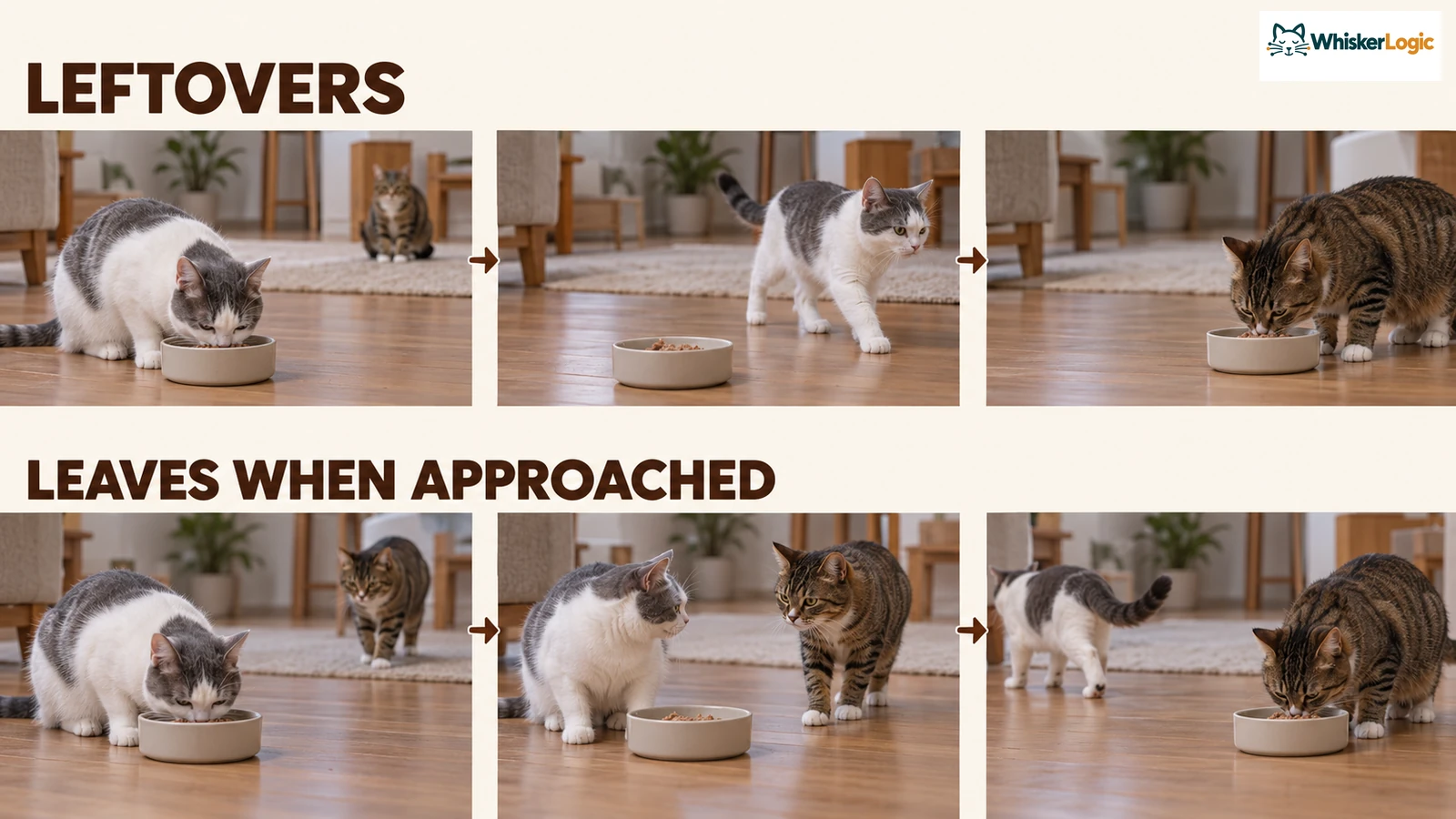
Voluntary leftovers: The first cat leaves before the other approaches. Check whether they were finished or intended to return; an unattended bowl is not necessarily an unwanted meal.
Displacement during eating: The first cat stops or leaves as the other approaches, and the approaching cat takes the bowl. Repeated loss of access matters even without hissing or a fight. This is an observable outcome, not proof of a particular motive.
Bowl switching without visible tension: Both cats move between bowls and keep eating. You may see no obvious social problem, but you still cannot reliably assign intake to each cat.
If waiting or retreating is the main pattern, see Why Does My Cat Wait for My Other Cat to Finish Eating?. Here, the practical task is to protect the portions after identifying who eats them.
Why Two Bowls Side by Side May Not Be Enough
Separate bowls identify portions; they do not necessarily protect access. If one cat can move directly from their own bowl to the other cat’s bowl, the second portion remains available to them.
Cat Friendly Homes recommends distance and visual separation between feeding stations. Start with locations where each cat already feels comfortable. A stable visual barrier can reduce face-to-face exposure, but it does not prevent a cat from walking around it.
The 2024 AAFP Intercat Tension Guidelines support separation during feeding, including visual barriers and microchip-activated feeders. Choose the arrangement by its outcome: both cats can eat, and each portion reaches its intended cat.
How to Give Each Cat a Protected Feeding Station
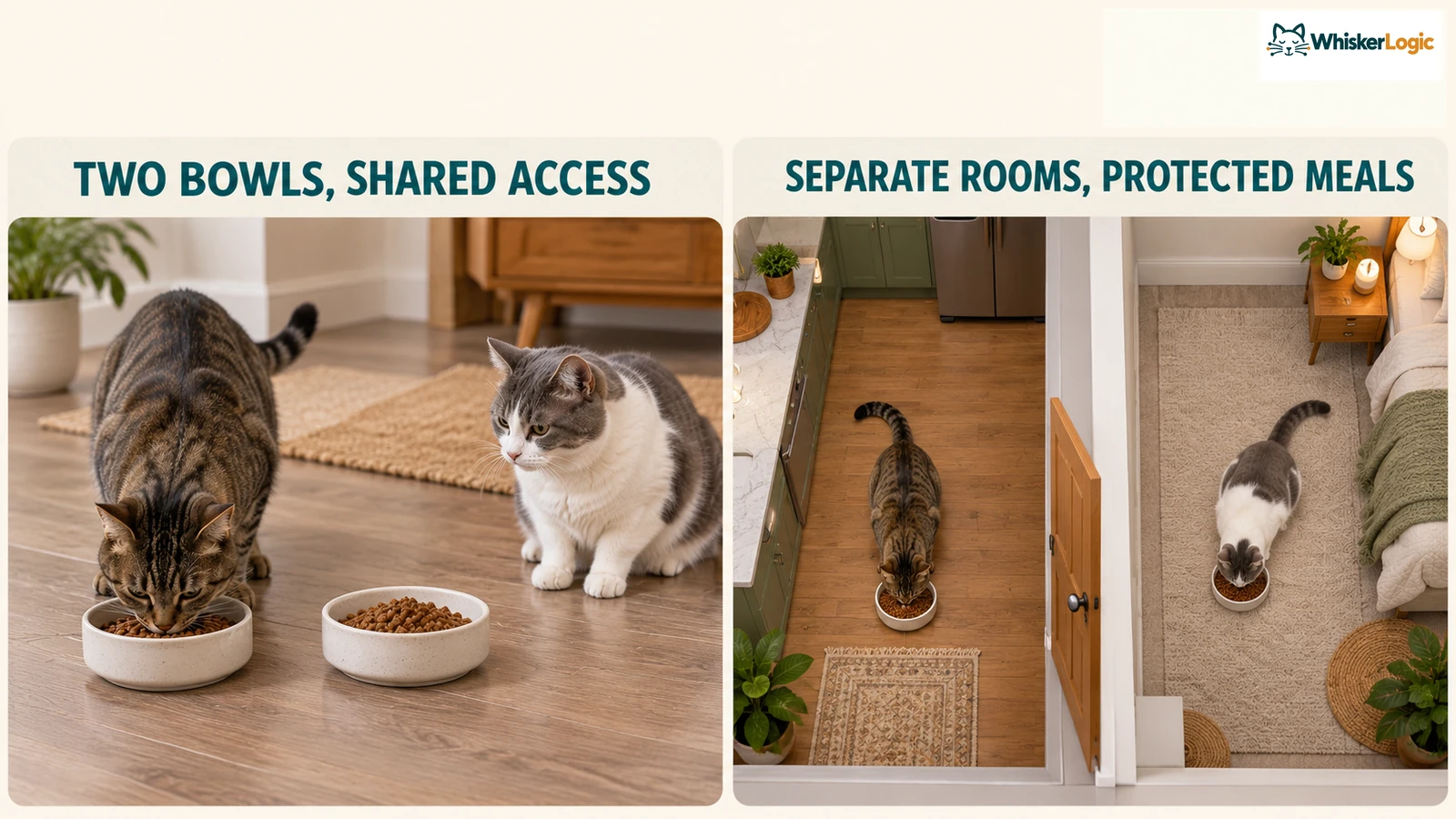
For the next meal, make the setup easy to supervise:
- Assign each cat a bowl and an individual measured portion.
- Put the stations farther apart and out of direct sight of each other.
- Watch whether either cat leaves their station to enter the other’s.
- If your cat still eats your other cat’s food despite distance and visual separation, feed in separate comfortable rooms with the doors closed during eating.
- Before restoring shared access, account for food left behind and plan how its intended eater will get another protected opportunity.
For example, if the fast eater finishes in the kitchen while the slower cat is still eating in a bedroom, keep access separated until the slower cat has finished that feeding opportunity. Do not open the door just because the first cat is done.
If a cat will not eat in the chosen room, reconsider the location and transition. Do not use hunger to force acceptance. Separation should make food accessible, not create a new obstacle.
What If One Cat Eats Fast and the Other Grazes?
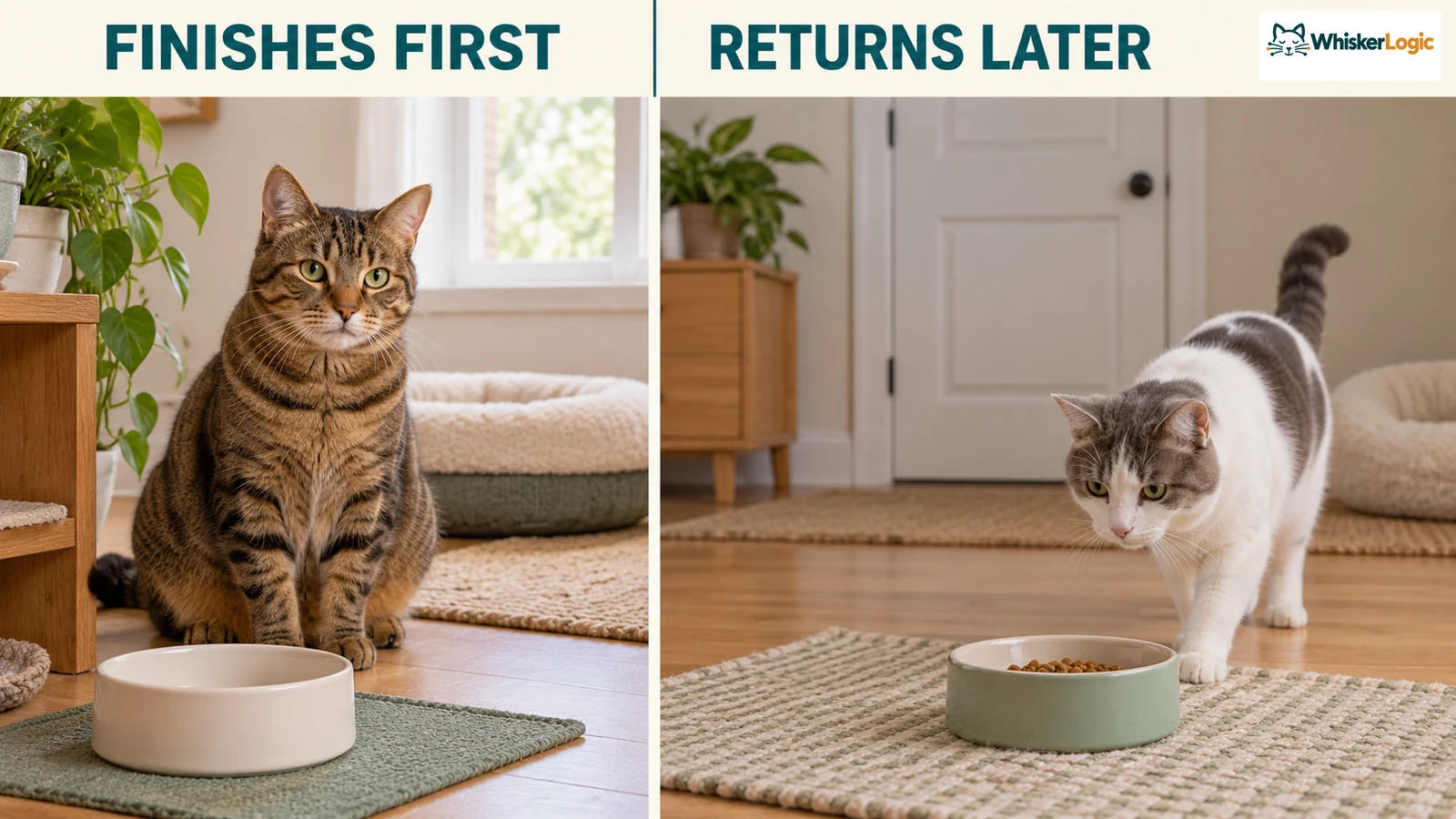
A grazer may take a few bites and leave with the intention of returning. Picking up every unfinished meal as soon as the faster cat finishes can leave the slower cat without enough opportunity to eat.
Instead, plan several protected feeding opportunities or a protected area the grazer can revisit while the other cat cannot enter. Selective-access equipment may help if managing repeated visits is impractical.
The 2018 Feline Feeding Programs Consensus Statement supports multiple small meals and feeding plans tailored to each cat’s needs. Ask your veterinary team how to divide the established daily allowance across those opportunities. More opportunities do not automatically mean more food.
Track what the grazer actually consumes. If the new arrangement results in less eating, adjust the plan and seek advice; a quiet bowl that goes untouched is not a successful solution.
What If Your Cats Need Different Diets?
When foods differ, preventing swapping becomes especially important. Record each cat’s food, assigned portion, and leftovers rather than relying on the combined amount disappearing.
VCA’s Feeding Multiple Pets guidance explains why individual portions and separate feeding areas matter, including when pets have different nutritional needs. Kittens and adults may need different foods; cats receiving therapeutic diets require the plan prescribed for them.
Do not switch both cats to one diet for convenience without veterinary approval. If either eats the other’s therapeutic food—or a cat on a prescribed diet eats outside it—tell the prescribing clinic what was eaten and how often. The significance depends on the treatment and the individual cat; an occasional swap is neither automatically harmless nor automatically an emergency.
When a Microchip Feeder May Help
A microchip feeder is an optional way to restrict access to a particular cat. It may be useful for a grazer, different diets, or repeated theft when room separation is difficult.
Before relying on it, observe several feeding opportunities. Does the intended cat approach, activate it, and eat comfortably? Can the other cat reach the food while it is open? Can they stand nearby and cause the intended eater to leave?
Introduce the device gradually and follow its instructions. A feeder that controls the lid still needs a suitable location. It cannot resolve every approach, waiting, or displacement problem around the meal. Separate rooms may remain the more workable choice.
Can a Puzzle Feeder Help?
A food puzzle may add activity or slow a fast eater, but it does not decide which cat gets access to the other bowl.
Begin with an easy puzzle and confirm that the cat can obtain food from it. Use part of their assigned allowance rather than adding an uncounted extra meal. Keep the slower cat’s food protected independently.
The useful distinction is simple: enrichment changes how a cat gets food; access control changes who can get it. A puzzle can support the plan, but it should not be the only safeguard for another cat’s portion.
Why Punishing Food Stealing Is Not the Answer
Do not yell, use spray bottles, or frighten a cat away from food. That does not establish a protected meal for the other cat.
Set up separation before bowls are served instead of repeatedly chasing a cat away afterward. For additional training, the FelineVMA behavior modification handout describes teaching cats to go to an assigned place using rewards. Practice that skill in calm moments; do not depend on a newly taught cue to protect an essential meal.
What If Food Stealing Started Suddenly?
Is your cat eating your other cat’s food more often than before? Check for changes in both appetite and feeding access. Did you move the bowls, change food or serving times, introduce a pet, or lose the ability to supervise meals? Has the other cat begun leaving more food?
Protect portions while you investigate, and use the early Vet Check to decide when veterinary advice is needed. Add the start date, changes in drinking or litter-box use, and any other symptoms to your meal log.
Do not respond by automatically increasing portions. Cat Friendly Homes’ obesity guidance recommends veterinary involvement in assessing weight and managing food intake, including food stealing in multi-cat homes.
What to Try, in Order
- Check health changes. Arrange veterinary advice promptly when the early warning signs apply.
- Identify who eats what. Observe the whole meal and account for leftovers.
- Improve station placement. Add distance and visual separation.
- Protect access if swapping persists. Use comfortable separate rooms or selective access.
- Preserve the slower cat’s opportunities. Plan protected return visits or smaller meals within the agreed allowance.
- Review the result. Compare actual intake and access before and after the change.
Look for two outcomes: each cat eats their intended food, and neither has to retreat or rush because the other approaches. Fewer visits to the wrong bowl are helpful, but do not establish success on their own.
When to Get Veterinary or Behavior Help
Contact your veterinarian for the health changes listed in the early Vet Check or if either cat is eating less. Ask the clinic to review each cat’s diet and amount if you cannot tell whether their needs are being met.
Seek a veterinarian’s guidance and, when appropriate, referral to a veterinary behaviorist or qualified feline behavior professional if one cat repeatedly loses access despite protected feeding, avoids the feeding area, or is followed, blocked, or chased around meals. Bring videos and your feeding log. Do not wait for a fight before asking for help.
FAQ
Does eating my other cat’s food mean my cat is dominant?
No. It does not establish social rank or motive. Watch the other cat’s response and whether both retain access to their intended meals.
Is it okay if my cats share the same food?
Even with the same suitable diet, swapping makes individual intake harder to track. Protect each allowance and confirm that both cats get enough opportunity to eat.
Should I feed the food-stealing cat more?
Not automatically. Check actual intake and consult your veterinarian about nutritional needs or new hunger. Taking extra food does not prove the current portion is too small.
Should I remove the slow cat’s bowl when the fast cat finishes?
Do not use the fast eater’s pace as the deadline. Protect the remaining food and arrange another opportunity if the slow cat normally returns later.
Will a microchip feeder stop all food stealing?
It may help control access, but observe its use in your home. The intended cat must eat comfortably, and the other cat must not gain access or drive them away.
Sources
Professional guidelines and consensus statement:
- 2024 AAFP Intercat Tension Guidelines: Recognition, Prevention, and Management. Also available from the journal publisher.
- Feline Feeding Programs: Addressing Behavioural Needs to Improve Feline Health and Wellbeing (2018).
Veterinary caregiver guidance: