
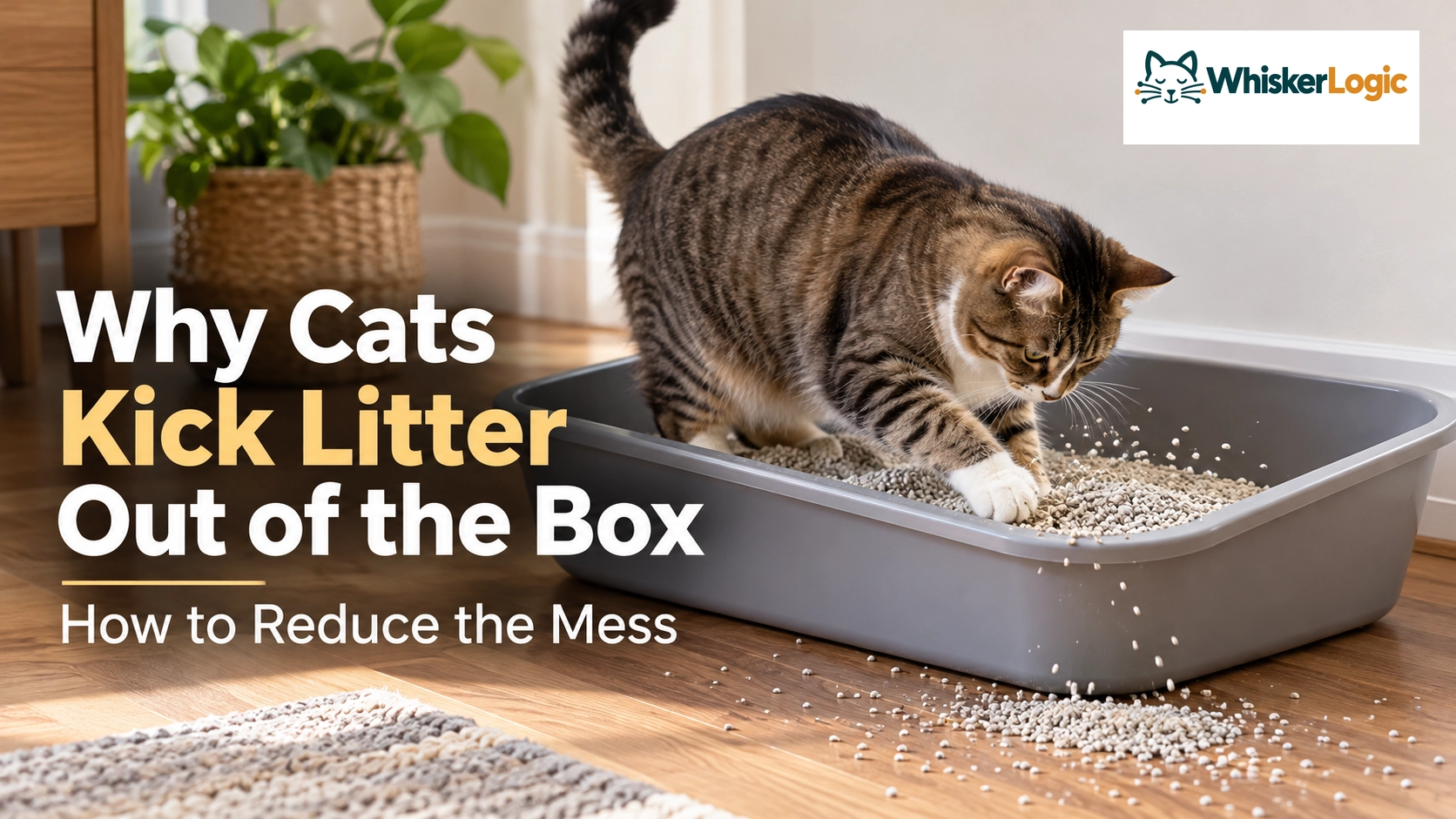
Your cat uses the litter box, digs, covers their waste, and walks away. But afterward, there’s a fan of litter scattered across the floor.
If you notice your cat kicking litter out of the box, don’t start by trying to stop the digging. Digging before elimination and covering afterward are normal feline behaviors.
Instead, find out exactly how the litter leaves the box. Is your cat throwing it over the sides while digging or covering? Pushing it out while turning or exiting? Or carrying loose granules away on their paws?
The solution depends on what you observe. A larger box, higher sides in the right places, an easier entrance, or a modest litter-depth adjustment may help. The goal is to reduce scatter without making the box cramped, uncomfortable, or difficult to use.
Quick Answer: How to Reduce Litter Outside the Box
If your cat uses the litter box normally but leaves litter on the floor, start with these checks:
- Keep normal digging comfortable. Digging and covering are natural behaviors, not something to punish.
- Identify when litter escapes. Digging scatter, exit scatter, and paw tracking need different approaches.
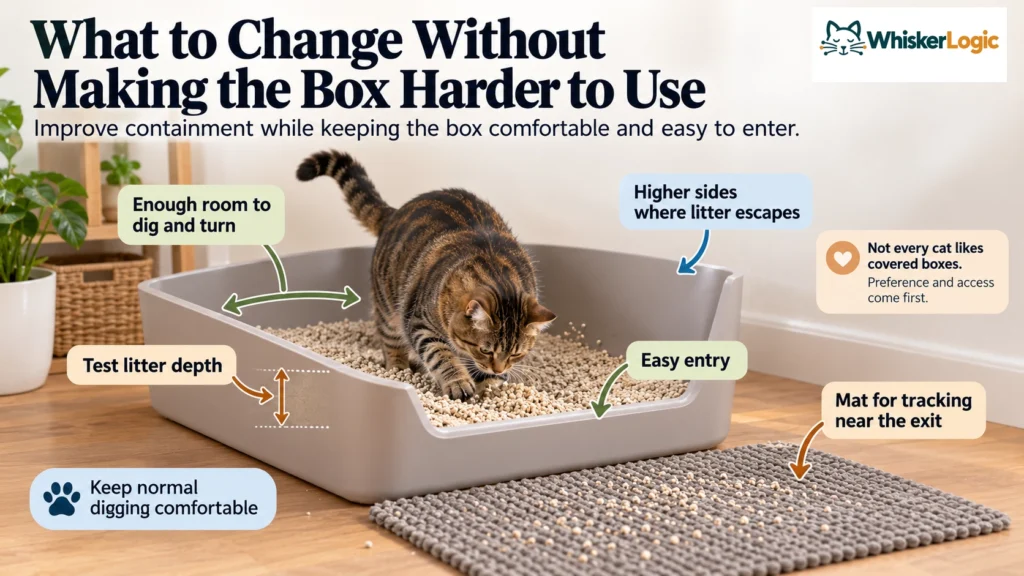
- Check the box size. Your cat needs enough room to dig, eliminate, turn, cover, and exit.
- Improve containment without blocking access. Higher sides may help, but the entrance must remain comfortable.
- Consider litter depth. Preferences vary, so test modest adjustments instead of assuming one ideal depth.
- Don’t automatically switch to a covered box. Any new design must still be spacious, accessible, and acceptable to your cat.
- Watch for sudden behavioral changes. New straining, pain, frequent visits, or abnormal urine or stool output may indicate a veterinary problem.
Vet Check: When Litter-Box Changes Need Medical Attention
Emergency: If your cat repeatedly tries to urinate but produces little or no urine, seek emergency veterinary care immediately.
A urinary obstruction can prevent a cat from passing urine and is life-threatening, particularly in male cats. Repeated unsuccessful attempts, straining, crying, and increasing distress are important warning signs.
Do not wait to see whether changing the litter box helps.
Also contact your veterinarian promptly if a change in litter-box behavior comes with frequent visits, blood in the urine, unusually small urine amounts, constipation, significant stool changes, sudden house-soiling, obvious pain, or difficulty entering or leaving the box.
Litter scattering alone does not indicate a urinary obstruction. The emergency concern comes from the urinary signs, not from normal digging.
Table of Contents
Why Does My Cat Kick Litter Out of the Litter Box?
Cats commonly dig before eliminating and cover their waste afterward. These actions are part of normal feline elimination behavior.
A cat can therefore use the litter box appropriately and still send litter over the edge.
Sometimes the box simply does not contain the movement well. The sides may be low, the usable floor area may be limited, or the entrance may allow a small pile of litter to spill out.
In other cases, the granules are not being thrown out at all. They leave on the cat’s paws and fall off afterward.
The 2025 study Litter Box Size and Litter Type Preference and Their Associated Behavioral Changes in Cats describes normal digging and covering behaviors and examines how litter-box size and substrate preferences relate to elimination behavior.
The study supports paying attention to the toileting environment. It does not establish a guaranteed method for preventing scattered litter.
The important distinction is that normal digging is not the problem to eliminate. The setup needs to accommodate it.
First Find Out How the Litter Is Getting Out
Before replacing the box or changing the litter, quietly observe one or more visits.
Use this sequence to identify when the litter escapes:
Approach → Dig → Eliminate → Cover → Turn → Exit → Walk Away
Cats do not always follow this exact order. For example, your cat may turn before eliminating or may not cover every time.
What matters is the point at which litter crosses the box boundary.
| Stage | What to watch | What to check |
|---|---|---|
| Approach | Hesitation or difficulty stepping in | Entry accessibility |
| Dig | Litter flying over a side | Digging space and wall height |
| Eliminate | Unusual posture or apparent discomfort | Changes that may need veterinary attention |
| Cover | Granules thrown over the rim | Covering direction and containment |
| Turn | Paws pushing litter against an edge | Usable floor space |
| Exit | Litter spilling through the doorway | Entrance design and litter buildup |
| Walk Away | Granules falling along the walking path | Paw tracking |
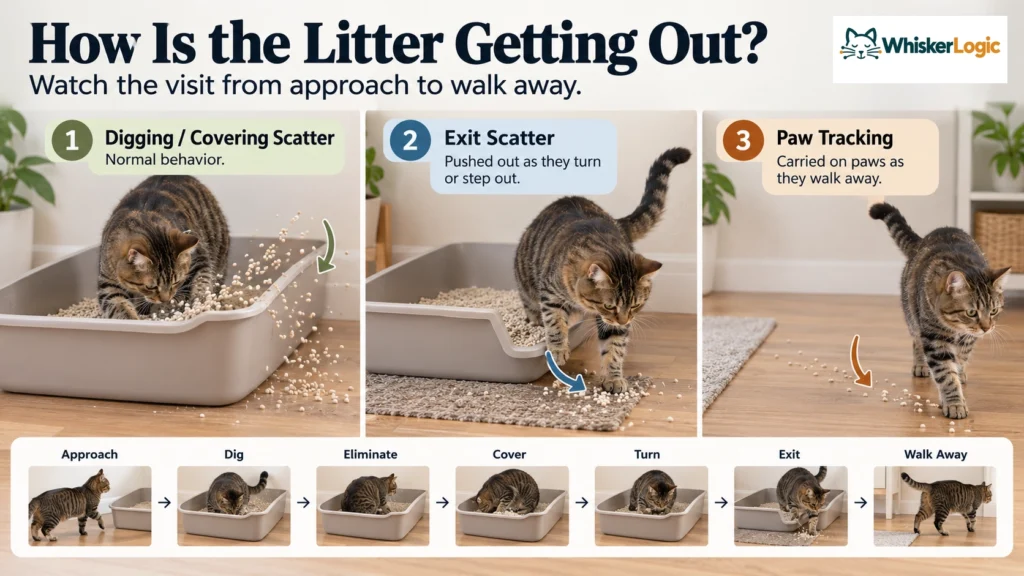
Cat Kicking Litter Out of the Box? Identify These Three Patterns
Digging or covering scatter: Your cat actively throws litter across the rim with paw movements.
Exit scatter: Your cat pushes or displaces litter while turning, stepping through the entrance, or leaving the box.
Paw tracking: Litter sticks to paws or fur and falls off after your cat walks away.
More than one pattern may happen during the same visit.
If you identify the main escape point, you can make a more targeted change instead of replacing everything at once.
Is Your Cat Throwing Litter Out While Digging or Covering?
Suppose your cat stands near the side of the box and digs backward with their front paws. Each movement sends granules over the opposite wall.
That is digging scatter.
The same thing may happen while your cat covers waste.
Look at four details:
- Where your cat digs: Does litter consistently escape over the same wall?
- Side height: Is that edge too low to contain the paw movements?
- Usable width: Does your cat have room to dig without staying close to the rim?
- Turning space: Can your cat reposition comfortably before and after elimination?
If the litter consistently crosses one low side, additional containment in that area may help.
But do not assume higher walls alone will solve the problem.
If the box is already cramped, raising its sides will not create more floor space. A larger box may be the more useful change.
Is the Litter Coming Out When Your Cat Turns or Exits?
Sometimes your cat digs and covers without throwing much litter over the walls.
The spill happens later.
You might notice a mound of litter near the doorway or see granules pushed outside as your cat turns toward the exit.
Check whether:
- Litter builds up directly in front of the entrance.
- Your cat has enough space to turn naturally.
- The entrance forces an awkward step or tight movement.
- Loose granules spill over the front edge as your cat leaves.
A larger usable floor area may help when turning space is limited.
If the box is already roomy, focus on how the entrance interacts with the litter buildup.
Avoid making the doorway unnecessarily high just to stop a small spill. Your cat should be able to enter and exit without struggling.
Or Is Your Cat Tracking Litter on Their Paws?
Not every trail of litter comes from digging.
Your cat may finish using the box without throwing much litter outside, then leave small granules along the floor as they walk away.
This is paw tracking.
The location of the litter can help you distinguish it from scatter.
Litter thrown during digging often collects beside the wall it crossed. Tracked litter may continue away from the entrance along your cat’s walking path.
Loose granules can cling temporarily to paws or fur before falling off.
If tracking is the main problem, a washable litter-catching mat may collect some of the granules near the exit.
But a mat will not correct inadequate turning space, an uncomfortable entrance, or changes in elimination behavior.
Check Whether the Litter Box Is Big Enough
A litter box may look large enough because your cat fits inside while standing.
But your cat needs room for more than standing.
Consider the full sequence:
Dig → Eliminate → Turn → Cover → Exit
The AAFP/ISFM House-Soiling Guidelines recommend a rectangular box approximately 1.5 times the cat’s body length from nose to base of tail.
This is a practical reference, not a universal requirement or a guarantee against scatter.
The 2025 Journal of Veterinary Medical Science study also found that the cats tested preferred larger boxes within the experimental conditions. Its specific experimental dimensions should not be turned into a fixed rule for every household.
At home, watch whether your cat can:
- Dig without repeatedly hitting the sides.
- Position their body comfortably.
- Turn around without being crowded.
- Cover waste without awkward movements.
- Leave without climbing over an uncomfortable barrier.
If the box restricts these movements, more usable floor space may help.
If your cat already has plenty of room and moves comfortably, look at containment, litter depth, or tracking instead.
Would Higher Sides Help?
Higher sides may help when litter is visibly flying over a low wall during digging or covering.
The most useful design is not necessarily one with high walls on every side.
Instead, look for higher containment where litter escapes and an entrance your cat can comfortably use.
For example, a spacious box with higher back and side walls and a lower entrance may provide a reasonable balance.
Before changing the box, check how easily your cat currently enters and exits.
Higher walls should not create a new access problem for a kitten, a senior cat, or a cat with limited mobility.
And remember that higher sides will not stop litter already being carried away on the paws.
Don’t Make the Entry Too Difficult
Accessibility matters as much as containment.
Kittens, senior cats, and cats with mobility limitations may have difficulty stepping over high entrances.
Look for signs such as:
- Hesitating before entering.
- Repeatedly lifting a paw without stepping in.
- Moving awkwardly across the edge.
- Appearing stiff when turning or exiting.
- Becoming reluctant to use a previously accepted box.
These signs do not identify a specific medical condition, but they deserve attention.
Cat Friendly Homes’ senior-care guidance discusses movement-related pain and recommends lower-entry litter boxes when needed.
A roomy box with adequate containment and a comfortable, lower entrance may work better than a uniformly high-sided box.
If your cat’s mobility changes suddenly, contact your veterinarian rather than treating the difficulty as a housekeeping issue.
Could the Litter Be Too Deep—or Too Shallow?
Litter depth is worth checking, especially if the mess changed after you started filling the box differently.
But there is no single ideal depth for every cat.
Professional guidance varies.
The AAFP’s Feline Behavior Guidelines state that many cats prefer approximately 1.5 inches of litter while acknowledging individual variation.
VCA’s Housetraining for Kittens and Cats describes a box with at least 3 inches of digging material.
These recommendations are not proof that one exact depth is right for your cat.
Instead, consider what changed.
If scattering became noticeably worse after you added much more litter, try a modest reduction and observe the next few visits.
If the litter layer became unusually shallow, consider whether your cat still has enough substrate to dig and cover comfortably.
With either adjustment:
- Avoid drastic changes.
- Preserve enough litter for normal digging and covering.
- Observe both the mess and your cat’s willingness to use the box.
- Keep the setup clean and comfortable.
Do not remove so much litter that normal digging becomes difficult simply to reduce cleanup.
Should You Switch to a Covered Box?
Not automatically.
A covered box may contain some of the litter thrown against its walls. However, it can also change your cat’s experience of the box.
Some cats accept covered designs, while others prefer open boxes.
The AAFP/ISFM guidelines emphasize size, easy access, cleaning, and individual preferences. They also note that small covered boxes can restrict normal positioning and that enclosed designs may retain odors.
Before choosing a covered box, ask whether it provides:
- Enough room for your cat to turn and dig.
- An entrance that is easy to use.
- Adequate interior space for comfortable movement.
- Acceptable odor conditions and visibility.
- A design your cat willingly uses.
If your cat already uses an open box comfortably, do not assume a cover will be an improvement.
For a closer look at enclosure-related problems, read Why Won’t My Cat Use a Covered Litter Box?.
What About a Top-Entry Box?
Top-entry litter boxes may contain some litter that would otherwise escape over a low wall.
But this possible containment advantage does not make them suitable for every cat.
A top-entry design requires the cat to climb into and out of the opening.
That can be inconvenient or inappropriate for:
- Kittens.
- Senior cats.
- Larger cats with limited room to maneuver.
- Cats experiencing pain or mobility limitations.
- Cats that hesitate at or reject the design.
Do not assume that a cat who can physically enter a top-entry box will necessarily prefer it.
If your cat needs easy access, a roomy open box with appropriate side containment and a lower entrance may be a better option.
Continued comfortable litter-box use matters more than reducing every stray granule.
Can a Litter Mat Help?
A washable litter-catching mat may help collect loose granules near the box.
It is most useful when litter falls from your cat’s paws or spills near the entrance.
Place it where your cat naturally steps after leaving, provided it does not obstruct access or create an unstable surface.
A mat can make cleanup easier, but it has limits.
It will not prevent litter from flying over a distant wall during digging. It also cannot compensate for a cramped box, an inaccessible entrance, or a medical problem.
Think of the mat as a collection tool, not the primary solution to every type of litter scatter.
Don’t Punish Normal Digging
Digging and covering are natural toileting behaviors.
Do not yell, spray water, grab your cat’s paws, or interrupt elimination in an attempt to reduce scatter.
Do not force your cat out of the box or make the litter unusably shallow.
Punishment can make the litter-box area frightening or unpredictable.
Veterinary behavior guidance recommends addressing the environment and using appropriate, nonpunitive management rather than punishing elimination-related behavior.
If your cat throws litter over the edge, check the box setup instead of trying to suppress natural digging.
The goal is to contain normal behavior, not stop it.
What If the Mess Started Suddenly?
A cat that has always scattered some litter while digging presents a different situation from a cat whose litter-box behavior changes abruptly.
First, consider recent environmental changes.
Did you:
- Replace the litter box?
- Change its location?
- Add more or less litter than usual?
- Introduce a different litter substrate?
If the setup changed, observe whether the timing matches the new scattering.
But if the environment stayed the same, pay closer attention to your cat’s behavior.
New changes in digging intensity, repeated visits, elimination posture, crying, time spent in the box, or difficulty entering and exiting may require veterinary assessment.
Also watch whether urine or stool output has changed.
A sudden behavior change does not prove a medical problem, but it should not automatically be dismissed as ordinary litter scatter.
Repeated attempts to urinate with little or no urine require emergency veterinary care.
What to Try, in Order
If your cat is eliminating normally and shows no signs of pain or illness, use this sequence to reduce litter scatter without making the box less comfortable.
- Watch one or more visits. Find the exact moment litter leaves the box. Do not interrupt your cat.
- Identify the scatter type. Determine whether the main problem is digging or covering scatter, exit scatter, or paw tracking.
- Check box size. Make sure there is enough usable floor space to dig, turn, eliminate, cover, and exit.
- Locate the escape point. See whether litter crosses one particular wall, spills at the doorway, or follows the walking path.
- Improve containment where appropriate. Consider higher sides when litter flies over an edge, without making entry difficult.
- Reassess accessibility. Pay special attention to kittens, senior cats, and cats with mobility limitations.
- Review litter depth. If the problem changed after a depth adjustment, try a modest change while preserving normal digging.
- Use a washable mat for tracking. Place it near the natural exit path to collect loose granules.
- Avoid automatic enclosure changes. Do not assume a covered or top-entry design will be comfortable or preferred.
- Maintain normal litter-box care. Scoop and clean regularly so your cat continues to find the box acceptable.
- Change one major variable at a time when practical. This makes it easier to identify what helps and whether your cat remains comfortable.
- Reassess both behavior and cleanup. A change is useful only if litter scatter improves without reducing normal box use. Seek veterinary help for new pain, straining, frequent attempts, abnormal output, or mobility changes.
You can keep a simple note of what you observed, what you changed, and whether the next few visits remained comfortable.
If a new setup makes your cat reluctant to use the box, reconsider the change rather than continuing solely because the floor is cleaner.
When to Call Your Veterinarian
Litter scattered during ordinary digging is not, by itself, a medical diagnosis.
However, contact your veterinarian promptly if you notice:
- A sudden change in digging, posture, or time spent in the box.
- Frequent litter-box visits.
- Straining or apparent discomfort while urinating or defecating.
- Crying during elimination.
- Blood in the urine.
- Unusually small urine amounts.
- Sudden urination or defecation outside the box.
- Constipation or significant stool changes.
- Obvious pain or new stiffness.
- Difficulty entering or exiting the box.
Seek emergency veterinary care immediately if your cat repeatedly attempts to urinate but produces little or no urine.
A urethral obstruction is life-threatening, particularly in male cats. Both Cornell’s feline urinary disease guidance and the Merck Veterinary Manual identify urinary obstruction as an emergency.
If you cannot tell whether your cat is passing urine, seek immediate veterinary advice rather than waiting to see whether the problem resolves.
Also, urine going over the edge of the litter box is different from dry litter being thrown out.
If your cat is urinating inside the box but urine is landing outside, see Why Is My Cat Peeing Over the Edge of the Litter Box?.
Frequently Asked Questions
Why does my cat throw litter everywhere?
Your cat may be digging or covering normally while the box fails to contain the movement. Litter can also spill during turning or exit, or stick to paws and fall off afterward. Identify when it escapes before choosing a solution.
Is digging in the litter box normal?
Yes. Digging before elimination and covering afterward are normal feline behaviors. Your cat should have enough room and litter to perform them comfortably.
How do I stop litter from flying out of the box?
Watch which side the litter crosses during digging or covering. Check the usable floor space and consider better containment along that side while keeping the entrance accessible. Avoid trying to stop the digging itself.
Is my litter box too small?
Possibly. A box can accommodate a standing cat while still restricting digging and turning. Approximately 1.5 times the cat’s body length from nose to tail base is a useful reference, but comfort and usable space matter more than a rigid measurement.
Are high-sided litter boxes better?
They may help when litter flies over low walls. However, high sides can create entry difficulties for kittens, seniors, or cats with mobility limitations. Containment and comfortable access should work together.
Should I get a covered litter box?
Not automatically. A cover may contain some scattered litter, but the interior must remain spacious, easy to enter, clean, and acceptable to your cat. Some cats prefer open designs.
Are top-entry litter boxes good for litter scatter?
They may reduce some escaping litter, but they require the cat to climb in and out. They may be unsuitable for kittens, senior cats, large cats, or cats with mobility difficulties.
How deep should cat litter be?
There is no universal depth for every cat. Veterinary guidance varies, and cats may have different preferences. Maintain enough substrate for digging and covering, and test modest changes if litter depth seems related to the problem.
Why does litter stick to my cat’s paws?
Loose granules can cling temporarily to paws or fur and fall off after your cat leaves the box. This is paw tracking, which is different from litter being kicked over the walls.
Can a litter mat help?
A washable litter-catching mat may collect loose granules near the exit, especially when tracking is the main issue. It will not fix an undersized box, difficult entrance, or litter flying over a distant wall.
Why did my cat suddenly start digging differently?
Check recent changes to the box, litter, and surrounding setup. If digging changes alongside frequent visits, unusual posture, straining, pain, abnormal output, or mobility problems, contact your veterinarian.
When is litter-box behavior a veterinary emergency?
Repeated attempts to urinate with little or no urine are an emergency because a urinary obstruction may be present, especially in male cats. Seek immediate veterinary care. Normal digging with scattered litter, without urinary warning signs, does not establish an obstruction.
The Bottom Line
If your cat keeps throwing litter out of the box, watch when and how it escapes before changing the setup.
Litter flying over a side during digging calls for a different approach than litter pushed out at the entrance or carried away on the paws.
Give your cat enough room to dig and turn, improve containment where it helps, and preserve a comfortable entrance. Treat litter depth and enclosed-box designs as options to evaluate, not automatic fixes.
The goal is less litter on the floor—not less natural digging.
And if your cat’s elimination behavior changes suddenly, particularly with straining or little to no urine, prioritize veterinary care.
Sources
- Iwabuchi-Inoue, Hattori & Kikusui (2025) — Litter Box Size and Litter Type Preference and Their Associated Behavioral Changes in Cats
- AAFP/ISFM — Guidelines for Diagnosing and Solving House-Soiling Behavior in Cats
- American Association of Feline Practitioners — Feline Behavior Guidelines
- Cat Friendly Homes — Providing Care for a Senior Cat
- VCA Animal Hospitals — Housetraining for Kittens and Cats
- Cornell Feline Health Center — Feline Lower Urinary Tract Disease
- Merck Veterinary Manual — Urethral Obstruction in Small Animals