
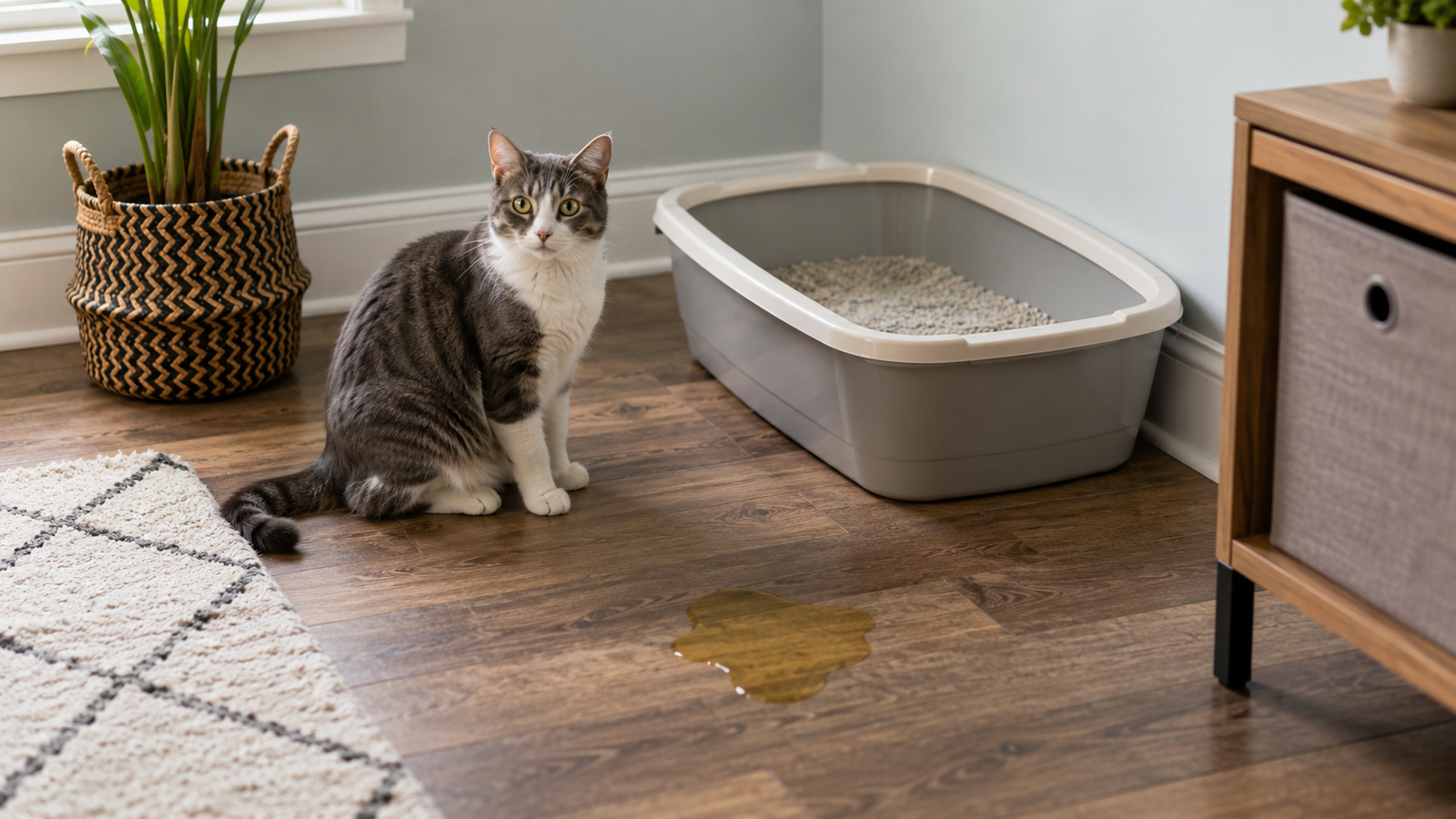
If your cat is peeing outside the litter box but still pooping in it, don’t assume the litter box is fine just because your cat continues to use it for bowel movements.
This pattern can happen for several different reasons. Urinary discomfort or urgency may contribute to accidents. A cat may dislike something about the litter box for urination, develop a preference for another surface or location, feel unsafe accessing the box, or urine-mark outside the box. More than one factor can also be involved.
The fact that your cat still poops in the box is useful information—but it doesn’t identify the cause by itself.
Quick answer: A cat can continue pooping in the litter box while peeing elsewhere because the factors affecting urination and defecation aren’t necessarily identical. Urinary discomfort or urgency, litter box preferences, learned surface or location preferences, social pressure, and urine marking can all affect where urination occurs. Continuing to poop in the box does not rule out a medical or litter box problem. Cornell University’s Feline Health Center recommends veterinary evaluation for cats that aren’t consistently using the litter box because medical conditions aren’t always accompanied by obvious signs of illness.
The best approach is to look at the pattern, address possible medical problems when appropriate, and troubleshoot the litter box and environment systematically rather than changing everything at once.
Emergency Vet Check: When Trouble Urinating Can’t Wait
Before changing litter or trying behavioral solutions, make sure your cat is actually able to urinate.
Repeated attempts to urinate that produce little or no urine can indicate a urethral obstruction, which is a veterinary emergency. Male cats are at greater risk because their urethra is longer and narrower.
If your cat repeatedly tries to urinate but produces little or no urine, seek veterinary care immediately rather than waiting to see whether a litter box change helps.
The Cornell Feline Health Center describes urethral obstruction as a potentially life-threatening condition requiring immediate veterinary treatment.
Table of Contents
Why a Cat May Pee Outside the Litter Box but Still Poop in It
It’s reasonable to wonder: if your cat is willing to enter the box to poop, why wouldn’t they pee there too?
There isn’t one explanation that applies to every cat.
The pattern doesn’t necessarily mean your cat has deliberately “chosen” one bathroom for poop and another for pee. Factors such as urinary urgency or discomfort, litter box setup, learned location or surface preferences, urine marking, and social access to the box can affect where urination happens.
Cornell notes that medical conditions affecting urination can increase pain, frequency, or urgency and contribute to elimination outside the litter box. Cats can also develop preferences for particular locations or surfaces.
The AAFP/ISFM house-soiling guidelines likewise describe feline house-soiling as a problem that can involve medical, environmental, social, and marking-related factors—and more than one factor may be involved.
So treat the fact that your cat still poops in the box as a clue, not a diagnosis.
It tells you that your cat will use that box under at least some circumstances. It does not rule out:
- urinary discomfort or urgency;
- a problem with some aspect of the litter box setup;
- a preference for another urination surface or location;
- social pressure around the box;
- urine marking;
- or overlapping causes.
First, Make Sure It’s Urination and Not Urine Marking
Before troubleshooting the litter box, try to determine what your cat is actually doing.
A larger puddle on a horizontal surface is more consistent with regular elimination, while smaller urine deposits—particularly on vertical surfaces with a standing, tail-up posture—are more typical of urine marking.
These are clues, not definitive rules.
The distinction matters because a cat can use the litter box normally and still urine-mark elsewhere.
Marking can be associated with social or territorial factors. Cornell notes that environmental changes, other animals, and the presence of cats outside the home can be associated with spraying.
If you’re unsure which pattern you’re seeing, observe your cat when possible. A home camera can also help you see what happens before the urine appears.
Look at the overall pattern:
- How much urine is there?
- Is it on a horizontal or vertical surface?
- Does your cat squat or remain standing?
- Does the tail rise or quiver?
- Is the same place repeatedly targeted?
Don’t diagnose the problem from one clue alone.
Look at Where Your Cat Is Peeing
The location of the urine can help you decide what to investigate next.
Right Beside the Litter Box
If your cat repeatedly pees immediately outside the box, inspect the setup closely.
Watch whether your cat enters but seems uncomfortable positioning inside, balances on the edge, leaves quickly, or keeps part of the body outside.
The box may be too small, difficult to enter, unpleasant underfoot, too dirty for that cat’s preference, or positioned somewhere the cat doesn’t feel comfortable remaining.
On Beds, Clothing, Rugs, or Other Soft Surfaces
Repeatedly choosing similar materials can point toward a surface preference.
Cornell notes that cats can develop preferences for particular substrates and may consistently choose surfaces such as clothing or carpet.
That still doesn’t tell you why the preference developed.
For example, an episode of uncomfortable or urgent urination may initially occur somewhere outside the box, after which a location or surface can become associated with toileting.
In One Particular Area
A consistent location may mean something about that spot has become preferable—or that something about the normal litter box location is less appealing.
Compare the two locations.
Is the chosen area:
- quieter?
- easier to reach?
- farther from another cat?
- more open?
- easier to leave?
Those differences can give you useful information about what to investigate.
On Vertical Surfaces
If you’re finding relatively small urine deposits on walls, doors, furniture, or other upright surfaces, revisit the possibility of urine marking instead of automatically treating the problem as litter box avoidance.
Could Urination Be Painful or Urgent?
A new change in litter box behavior deserves attention because urinary problems can alter when, where, and how a cat urinates.
According to the Cornell Feline Health Center, signs associated with feline lower urinary tract problems can include:
- painful or difficult urination;
- increased frequency of urination;
- blood in the urine;
- urination outside the litter box;
- crying during urination;
- excessive licking around the genital area.
These signs don’t identify one specific disease.
Lower urinary tract signs can occur with several conditions, including feline idiopathic cystitis (FIC), urinary stones, urethral obstruction, and other disorders. That’s why automatically labeling inappropriate urination as a “UTI” without veterinary evaluation can be misleading.
Medical problems outside the lower urinary tract can affect litter box use too. Cornell notes that conditions that increase urine production, including kidney disease, diabetes mellitus, and thyroid disease, may contribute to inappropriate elimination because a cat needs to urinate more frequently.
Pain or reduced mobility can also affect access to a litter box, particularly when the box has high sides or is difficult to reach.
If the change is new, persistent, or accompanied by urinary signs, veterinary evaluation should be part of the plan rather than treating the problem as purely behavioral.
Check What Changed Around the Litter Box
Once urgent medical concerns have been addressed, examine the litter box and its surroundings.
Start by asking what changed shortly before your cat started peeing outside the litter box.
Did You Change the Litter?
A change in texture or scent can matter to some cats.
The AAFP/ISFM house-soiling guidelines discuss litter preferences and recommend considering a soft, unscented, clumping litter when addressing elimination problems.
If the problem began after changing litter, consider offering the previous option again rather than repeatedly switching products.
Is the Box Large Enough?
Your cat needs room to enter, turn, dig, and posture comfortably.
The AAFP/ISFM guidelines recommend a rectangular litter box approximately 1.5 times the cat’s length from the nose to the base of the tail.
This can be particularly relevant for larger cats or cats that appear awkward when positioning to urinate.
Is Entry Difficult?
Older cats, kittens, and cats with mobility limitations may have difficulty with high-sided boxes.
A generously sized box with a lower entry can improve accessibility while still providing enough usable space.
Is the Box Clean Enough?
Remove urine clumps and feces at least daily.
Individual cats differ in how much soiling they tolerate, and a shared box can become unacceptable more quickly.
The AAFP/ISFM guidelines recommend regular cleaning and caution against strong-smelling cleaning products that may be unpleasant to cats.
Is the Location Working?
A suitable litter box can still be difficult to use if its location creates another problem.
Look for:
- loud appliances;
- heavy foot traffic;
- dogs or children disturbing the area;
- difficult access;
- another cat controlling the route;
- or a location where the cat can feel trapped.
The goal isn’t simply privacy. Your cat also needs reliable access and a reasonable way to leave the area.
Could Your Cat Prefer a Different Place or Surface for Peeing?
Sometimes a cat hasn’t completely rejected the litter box.
Instead, another location or surface may have become more attractive for urination.
If every accident occurs on the same rug, for example, don’t simply conclude that your cat is being stubborn. Compare the rug’s texture with the litter and consider what else is different about that location.
If accidents repeatedly occur in one room, compare that room with the litter box area.
You can also offer controlled choices rather than guessing.
For example, instead of abruptly replacing the only litter your cat has, provide an additional box with a different suitable unscented litter while keeping the familiar option available.
The same approach can be used to investigate box size or location.
When practical, change one meaningful variable at a time and observe what happens.
That makes your cat’s response more informative.
If You Have Multiple Cats, Check Access—Not Just Box Count
A litter box can be physically available without being socially easy to use.
This distinction matters in multi-cat homes.
Another cat doesn’t have to attack your cat beside the litter box for social pressure to matter. A cat may occupy a hallway, watch an entrance, chase another cat after elimination, or otherwise make access unpredictable.
The AAFP/ISFM house-soiling guidelines recommend providing litter boxes in multiple locations and considering the social relationships between cats when deciding where resources should be placed.
A commonly used starting point is one litter box per cat plus one additional box, but simply counting boxes isn’t enough.
Distribution matters too.
Several boxes grouped together in one location don’t provide the same choices as boxes placed in genuinely separate, accessible areas.
Ask:
- Are all the boxes concentrated in one room?
- Can one cat control access to them?
- Does a more timid cat have to pass another cat to reach a box?
- Can the cat leave the toileting area without being cornered?
- Does inappropriate urination happen more often when another cat is nearby?
These observations can reveal a social-access problem that adding another box beside the existing ones may not solve.
What to Do: A Step-by-Step Troubleshooting Plan
Instead of trying every litter box tip at once, work through the problem in order.
Step 1: Check for Urinary Warning Signs
Watch for straining, repeated attempts to urinate, pain, vocalization, blood in the urine, frequent genital licking, or changes in urinary frequency.
Repeated attempts with little or no urine require immediate veterinary attention.
Step 2: Determine Whether It’s Peeing or Marking
Look at posture, approximate urine quantity, the type of surface, and the circumstances surrounding each event.
Treat these observations as clues rather than attempting to diagnose the cause yourself.
Step 3: Record the Pattern
For several days, note:
- where the urine appears;
- when it happens;
- which surfaces are selected;
- whether your cat uses the litter box normally at other times;
- whether another cat is nearby;
- and anything that changed before the problem began.
Patterns are more informative than isolated accidents.
Step 4: Review Recent Changes
Think about the period just before the first incident.
Did you:
- change litter?
- move or replace the box?
- add a cover?
- bring home another pet?
- rearrange the home?
- change household routines?
- introduce a strongly scented cleaning product?
- restrict access to a room?
Timing doesn’t prove that a change caused the problem, but it can tell you what to investigate first.
Step 5: Improve the Basic Litter Box Setup
Provide a generously sized, accessible box.
Keep it clean.
Offer an appropriate unscented litter.
Place the box somewhere easy to reach where your cat isn’t vulnerable to being blocked or cornered.
In multi-cat homes, distribute boxes across separate locations.
Step 6: Test Preferences Instead of Guessing
If you suspect the litter, box design, or location, offer your cat a choice instead of repeatedly replacing the only available option.
An additional litter box can function as a simple preference test.
Change one factor at a time when practical.
Step 7: Reassess
Watch whether the frequency, location, or circumstances of the accidents change.
If inappropriate urination persists despite reasonable environmental changes—or if you’re uncertain whether illness or pain could be contributing—consult your veterinarian rather than continuing an endless series of home experiments.
What Not to Do
Don’t Punish Your Cat
Don’t yell, hit, spray your cat with water, rub your cat’s nose in urine, or force your cat into the litter box as punishment.
House-soiling isn’t evidence that your cat is angry with you or trying to get revenge.
The AAFP/ISFM information for cat owners emphasizes that house-soiling isn’t caused by spite or anger and recommends investigating the cat’s medical, environmental, and social needs instead.
Punishment doesn’t identify or solve the underlying problem.
Don’t Assume It’s “Just Behavioral”
A cat can appear otherwise normal while experiencing a medical problem.
Medical and behavioral explanations aren’t always separate. Physical discomfort can change behavior, and an episode that began with discomfort may be followed by a learned preference for another location or surface.
Don’t Make Multiple Random Changes at Once
Changing litter on Monday, moving the box Tuesday, adding a cover Wednesday, and switching cleaning products Thursday makes the results difficult to interpret.
Use what you observe to decide what to test next.
When to Call Your Veterinarian
Seek emergency veterinary care if your cat repeatedly attempts to urinate but produces little or no urine. Urethral obstruction can become life-threatening and requires immediate treatment.
Arrange veterinary evaluation for new or persistent inappropriate urination, particularly if you notice pain, increased urinary frequency, blood in the urine, vocalization, excessive genital licking, changes in urine volume, or other changes in your cat’s normal behavior.
Even without obvious illness, veterinary evaluation may still be appropriate when a cat suddenly begins urinating outside the litter box. Cornell notes that cats with medical causes of house-soiling don’t necessarily appear sick.
If medical causes have been appropriately investigated and the problem continues despite systematic environmental changes, ask your veterinarian whether help from a qualified feline behavior professional would be appropriate.
The Bottom Line
When your cat is peeing outside the litter box but still pooping in it, the continued use of the box for bowel movements is a useful clue—but it doesn’t prove that the litter box is fine or that the problem is behavioral.
First, make sure your cat is able to urinate normally and recognize signs that require urgent veterinary care.
Then determine whether you’re seeing ordinary urination or urine marking. Look at where the urine appears, what changed before the problem started, how the litter box is set up, whether your cat appears to prefer another surface or location, and whether other cats affect access.
Most importantly, troubleshoot systematically:
Observe → interpret → change one meaningful factor → reassess.
That approach gives you a better chance of understanding what is driving the problem than cycling through random litter box fixes.
Sources
- Cornell University College of Veterinary Medicine — Feline Behavior Problems: House Soiling
- Cornell University College of Veterinary Medicine — Feline Lower Urinary Tract Disease
- AAFP and ISFM Guidelines for Diagnosing and Solving House-Soiling Behavior in Cats
- AAFP/ISFM — Feline House-Soiling: Useful Information for Cat Owners