
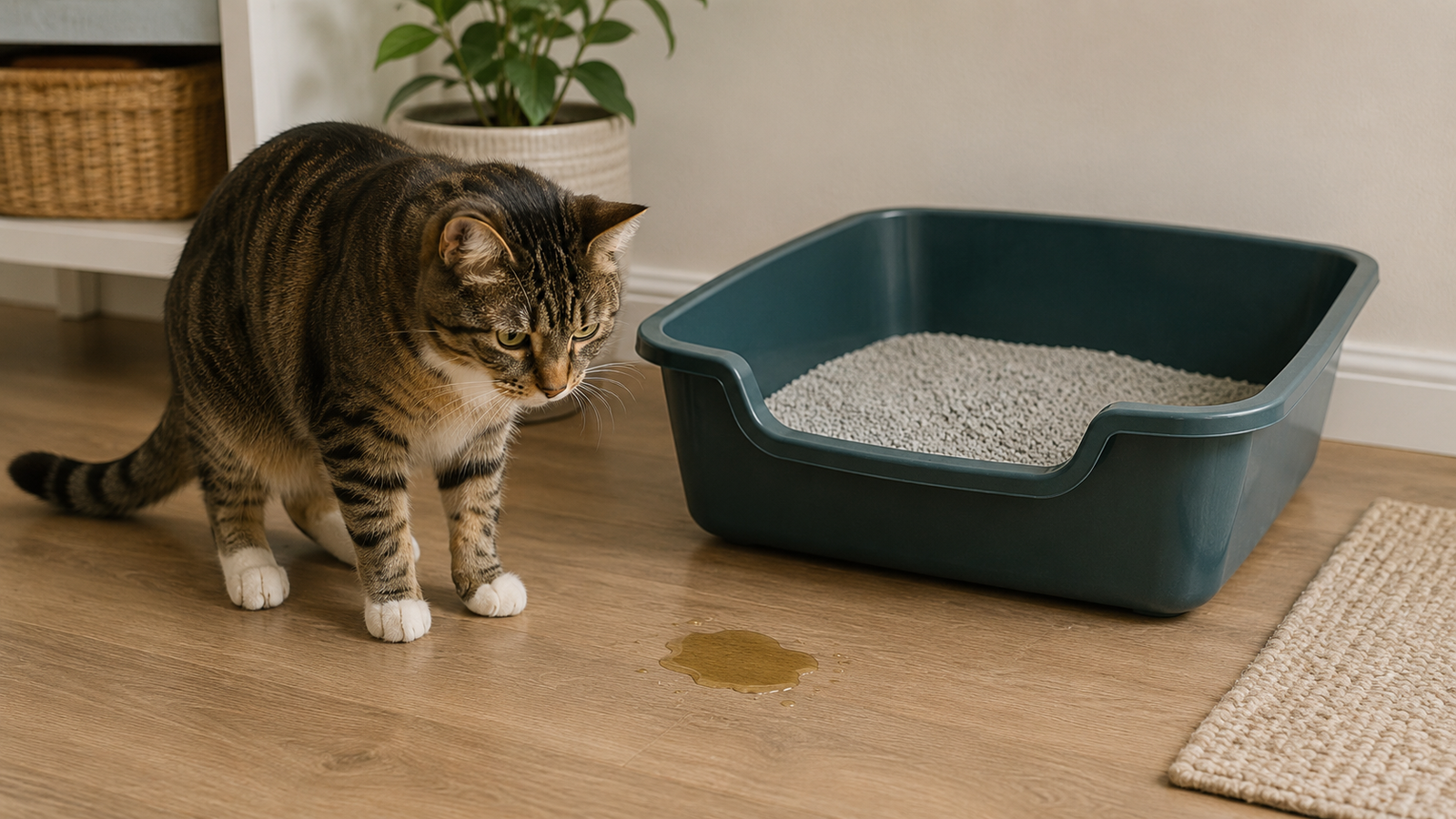
Finding urine right next to the litter box can be especially confusing. Your cat is getting to the right area, yet the urine still ends up outside the box. That can make it seem like your cat knows where to go but is deliberately refusing to use it.
But the location is better treated as a clue than an explanation. A cat peeing right next to the litter box may be avoiding something about the box or litter, having trouble getting fully inside or squatting comfortably, reacting to another cat, urine-marking, or experiencing urinary discomfort or urgency. The most useful first step is to look closely at how the accident happens.
Quick Answer
If your cat is peeing right next to the litter box, first determine whether your cat is squatting completely outside the box, getting partly inside, urinating over the edge, or standing and spraying a small amount. These patterns point to different things to investigate. Box size, accessibility, litter preference, cleanliness, social pressure, and medical problems can all contribute. A sudden change or signs of painful or difficult urination should be evaluated by a veterinarian.
Vet Check
Don’t assume that peeing beside the litter box is purely behavioral. Urinating outside the box can occur with lower urinary tract problems. Contact a veterinarian if the behavior is new or your cat shows signs such as frequent attempts to urinate, straining, crying while urinating, blood in the urine, or frequent licking around the genital area.
Repeated attempts to urinate with little or no urine coming out require immediate veterinary attention. A urethral obstruction is a medical emergency, and male cats are at greater risk.
Table of Contents
First, Look at Exactly How Your Cat Is Peeing Next to the Box
Before changing the litter, moving the box, or buying a new one, try to determine what is actually happening.
The puddle’s location alone doesn’t tell you whether your cat refused the box. Sometimes a cat attempts to use it, but urine ends up outside because of positioning, box dimensions, or difficulty maintaining a normal posture.
Your cat squats completely outside the box
If your cat approaches the litter area but squats on the floor beside the box, investigate both the litter-box setup and your cat’s health.
Check whether:
- the box is clean
- the litter type or scent recently changed
- the box is difficult to enter
- the location feels exposed or difficult to leave
- another cat can interfere with access
- your cat appears uncomfortable before, during, or after urinating
- there are signs of urinary pain or urgency
Don’t interpret this pattern as stubbornness. House-soiling can involve medical, environmental, social, and litter-box factors, and more than one factor may be involved.
Your cat gets in, but the rear end stays outside
This can look like litter-box avoidance when it may actually be a positioning problem.
Watch the next time your cat enters. Can your cat turn around and choose a comfortable position without being forced against the sides? Does the front half go inside while the rear remains near or beyond the entrance?
If so, box size deserves attention.
The AAFP/ISFM house-soiling guidelines recommend, as a general guide, a rectangular litter box about 1.5 times the cat’s length from the nose to the base of the tail.
If the current box is substantially smaller, offering a larger box can help you determine whether space is contributing to the problem.
Your cat is inside but pees over the edge
Urine beside the box doesn’t always mean your cat urinated on the floor.
Your cat may have been inside the litter box when the urine went over the edge.
If the cat enters normally but urine regularly goes over one side, observe posture and positioning. A larger box may provide more room to turn and squat, while appropriately higher sides may help contain urine for a cat that naturally urinates toward an edge.
But don’t automatically replace the box with one that has very high sides. A high entry can make access more difficult for kittens, senior cats, or cats with mobility problems.
If your cat has recently started standing unusually high while urinating, appears stiff, struggles to squat, or has difficulty entering or leaving the box, contact your veterinarian.
Your cat stands and sprays a small amount
Not every deposit of urine near a litter box is ordinary urination.
Urine marking—often called spraying—typically involves a cat standing rather than taking a normal squatting posture. The cat may back toward a vertical surface, raise the tail, and release a relatively small amount of urine. The tail may quiver.
This distinction matters because troubleshooting marking is different from troubleshooting a cat that needs to empty its bladder but isn’t using the box normally.
Don’t rely only on whether the urine is on a vertical surface, though. Cats can also urine-mark horizontal surfaces. Consider posture, urine quantity, location, frequency, and what was happening around the time of the behavior.
Why the Location Is Useful—but Doesn’t Give You the Diagnosis
Peeing immediately beside the litter box narrows what you should investigate, but it doesn’t prove that your cat simply dislikes the box.
A cat may approach the normal toileting area but dislike the litter surface, struggle to fit or squat comfortably, experience urinary urgency, feel unsafe entering when another cat is nearby, or associate the box with previous discomfort.
When possible, observing one actual bathroom attempt can therefore be more informative than examining the puddle afterward.
Check the Litter Box Setup
Once urgent medical concerns have been addressed, examine the litter-box setup systematically.
When there is no urgent medical concern, making targeted changes can make it easier to see what your cat responds to instead of replacing everything at once.
Is the box large enough?
A cat needs enough room to enter, turn, position the body, eliminate, and cover waste without being cramped.
The AAFP/ISFM house-soiling guidelines recommend a rectangular box approximately 1.5 times the cat’s nose-to-base-of-tail length.
If the current box is much smaller, offer a larger alternative rather than assuming your cat simply dislikes litter boxes.
A suitably adapted large storage container can sometimes provide more usable floor space than a conventional litter box. Make sure any alternative is safe, stable, and easy for your cat to enter.
Is getting in or squatting difficult?
Accessibility matters as well as floor space.
An entrance that was easy for a young, agile cat may become inconvenient for a senior cat or a cat experiencing mobility problems.
Watch for:
- hesitation before stepping inside
- putting only the front feet into the box
- stiffness while entering or leaving
- difficulty turning around
- an unusual urinating posture
- reluctance to climb over the entrance
AAHA/AAFP guidance notes that litter-box edges should not be too high for kittens or senior cats to enter and exit easily. Cats with mobility problems may also benefit from easier access to their litter boxes.
Is the litter itself part of the problem?
Cats can have individual preferences for litter type.
Ask what changed before the accidents began.
Did you:
- switch litter brands?
- introduce a scented litter?
- change from fine litter to larger pellets?
- substantially change litter depth?
- add a strongly scented product around the box?
If the problem started soon after a litter change, that timing is worth investigating.
AAHA/AAFP guidance notes that individual litter preferences have been documented and that some cats may find scented litter aversive. Offering alternatives in separate boxes can help reveal a cat’s preference.
Is the box clean enough for this cat?
Some cats appear more sensitive to a dirty litter box than others.
Scoop waste at least daily and clean the box regularly. AAHA/AAFP guidance recommends regular cleaning and daily scooping and advises avoiding strong cleaning chemicals in the box itself.
Pay attention to patterns.
If your cat reliably uses a freshly cleaned box but begins urinating beside it as waste accumulates, cleaning frequency may be contributing to the problem.
In a Multi-Cat Home, Check Access—Not Just Box Count
If you have multiple cats, don’t evaluate the litter box as if each cat uses it in isolation.
A cat doesn’t have to be physically attacked beside the box to have difficulty accessing it comfortably.
Another cat may:
- stare from nearby
- follow the cat toward the box
- wait near the exit
- chase the cat after it leaves
- occupy a narrow route leading to the box
- make a particular part of the home difficult to access
Some of these interactions can be subtle.
As a general rule of thumb, AAHA/AAFP guidance recommends one litter box per cat plus one additional box, or one per social group plus one additional box when the social groups are known.
But location matters too.
The boxes should be distributed in different, easily accessible locations when possible, particularly in multi-cat households. Multiple boxes clustered in one area may not give a cat a meaningful alternative if the problem is access to that location.
Look at the route to and from the litter box as well as the box itself. Ideally, a cat should be able to approach and leave the area without being trapped or intercepted by another cat.
What to Do Today
You don’t need to rebuild your cat’s entire environment in one afternoon. Start with the clues that best match what you’re seeing.
1. Observe a bathroom attempt if possible.
Determine whether your cat squats beside the box, gets partly inside, urinates over an edge, or stands and marks.
2. Check for urinary warning signs.
A new litter-box problem—especially with straining, frequent attempts, vocalization, blood in the urine, or very small amounts of urine—deserves veterinary attention.
3. Scoop and inspect the current box.
Remove waste and check whether the box is cramped, difficult to enter, damaged, or particularly dirty.
4. Offer a larger, accessible alternative if appropriate.
Rather than immediately removing the existing box, an additional box can let you observe which setup your cat chooses.
5. Review recent litter changes.
If the problem began after changing litter texture, scent, brand, or depth, consider whether the timing is meaningful.
6. Separate litter-box locations in a multi-cat home.
Give cats genuinely different toileting locations rather than placing every box together.
7. Clean the accident area thoroughly.
Use a product intended for cleaning pet urine and follow the manufacturer’s directions. The goal is to neutralize the remaining odor rather than simply cover it with fragrance.
8. Track what happens next.
Note where accidents occur, the time of day, the condition of the box, which cats are nearby, and what your cat does immediately before urinating. A repeated pattern can provide useful clues.
What Not to Do
Don’t punish your cat for peeing beside the litter box.
AAHA/AAFP guidance specifically advises against reprimanding cats for toileting in unwanted locations or taking them to the litter box as punishment.
Scolding or frightening your cat doesn’t identify whether the underlying problem is medical, environmental, social, or related to the litter-box setup.
Also avoid assuming that your cat is being lazy, angry, or deliberately taking revenge.
Instead, treat the accident as information and work through the clues systematically.
What If Your Cat Still Pees Next to the Box?
If you’ve improved the setup and the problem continues, reassess rather than endlessly repeating the same changes.
Ask:
- Has your cat had an appropriate veterinary evaluation?
- Is the problem becoming more frequent?
- Does your cat strain or produce unusually small amounts of urine?
- Is the urine always in exactly the same place?
- Does your cat actually enter the box?
- Has the urinating posture changed?
- Does the problem happen when another cat is nearby?
- Does it happen more often when the box contains waste?
- Did it begin after a change in litter, box, location, household routine, or another cat’s behavior?
Cornell notes that medical conditions can interfere with normal urination and that cats with medical problems may not always appear sick. Persistent house-soiling therefore shouldn’t automatically be labeled behavioral.
Peeing Next to the Box vs. Peeing Outside but Pooping Inside
If the defining pattern is location—your cat urinates immediately beside the litter box—focus on how your cat approaches, enters, positions in, and uses the box.
If your cat consistently poops in the litter box but urinates outside it, the difference between urine and stool is itself an important clue. For that situation, see our separate guide: Why Is My Cat Peeing Outside the Litter Box but Still Pooping in It?
The Bottom Line
A cat peeing right next to the litter box isn’t necessarily refusing to use it, and the location alone doesn’t tell you whether the cause is behavioral, environmental, or medical.
Start by watching how your cat urinates.
A cat squatting completely beside the box presents a different problem from a cat whose rear end hangs outside, a cat urinating over the edge, or a cat standing and spraying.
Then investigate the factors that fit what you’re seeing: health, box dimensions, accessibility, litter preference, cleanliness, location, and interactions with other cats.
Most importantly, don’t let the fact that the urine is close to the litter box create false reassurance. A sudden change in urination—particularly straining, repeated attempts, pain, blood in the urine, or producing little or no urine—needs veterinary attention.
Sources
AAFP & ISFM — Guidelines for Diagnosing and Solving House-Soiling Behavior in Cats
Cornell Feline Health Center — Feline Lower Urinary Tract Disease
Cornell Feline Health Center — Feline Behavior Problems: House Soiling
AAHA/AAFP — General Litter Box Considerations
AAHA/AAFP — 2021 Feline Life Stage Guidelines
VCA Animal Hospitals — Cat Behavior Problems: Marking and Spraying Behavior