
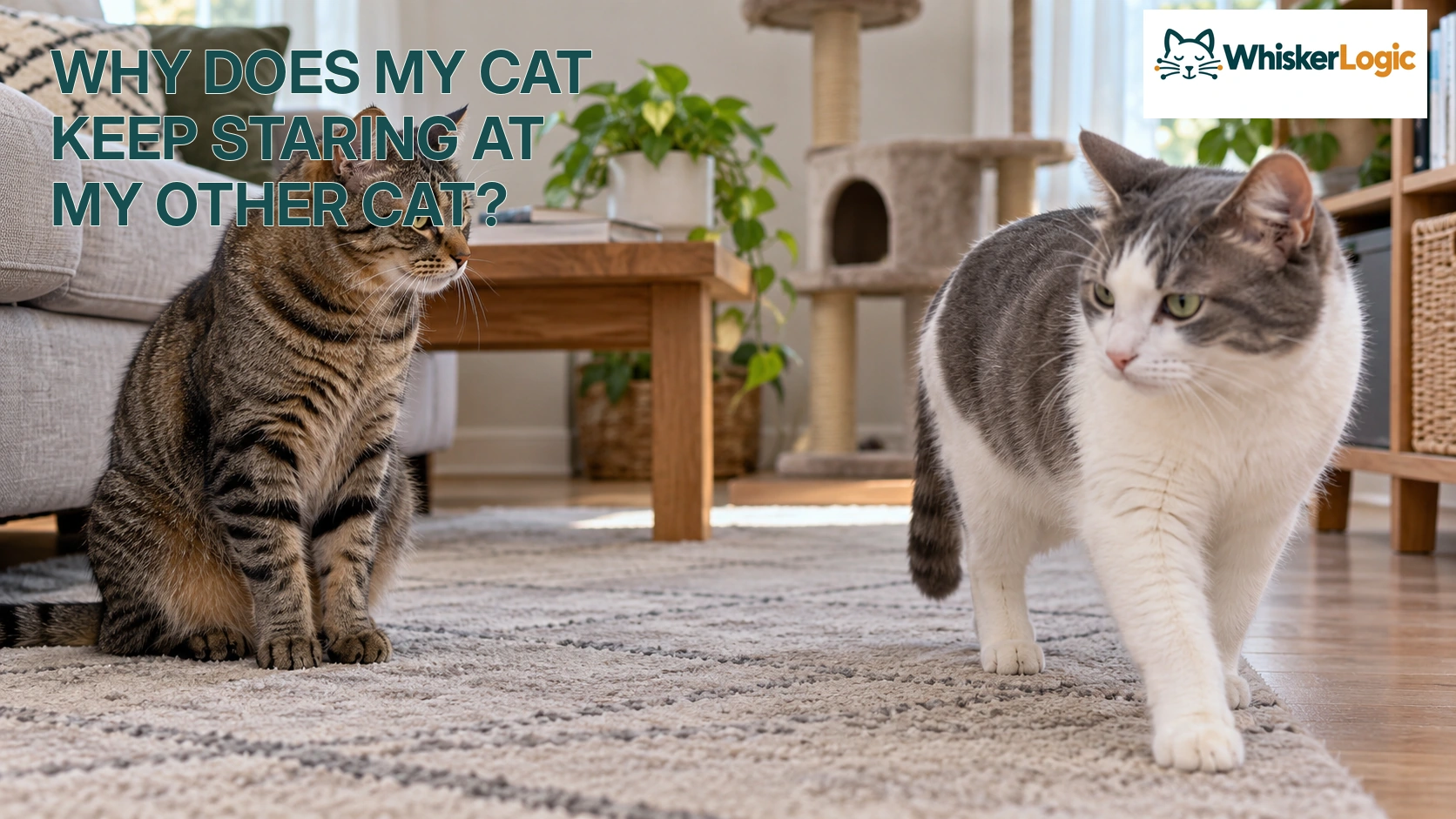
If you keep noticing your cat staring at your other cat, don’t judge the situation from the stare alone. The most useful clue is what the other cat repeatedly does next.
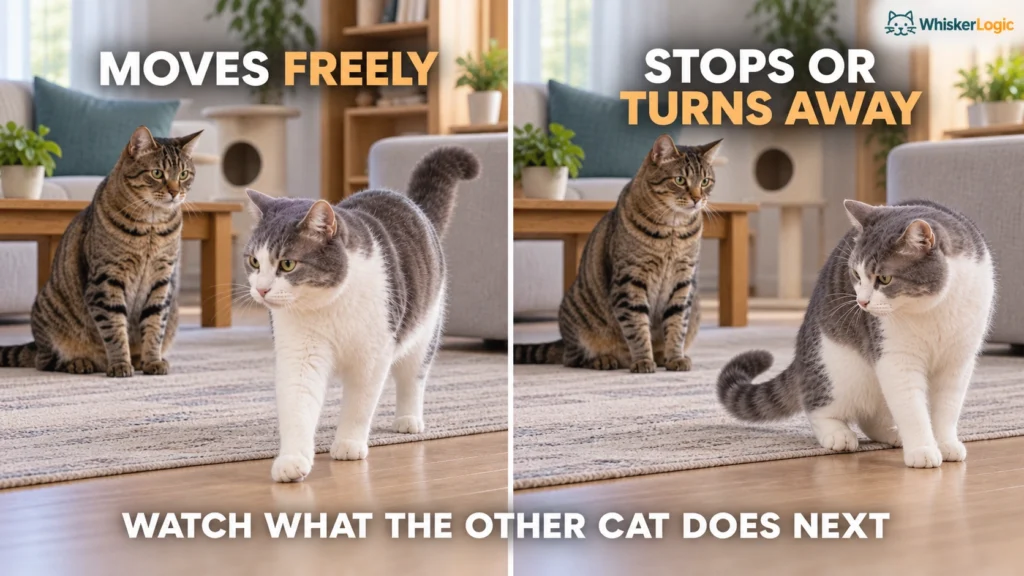
A cat that stays relaxed, moves freely, and continues eating, resting, and using resources normally gives you a very different picture from one that repeatedly freezes, walks away, waits, reroutes, or avoids an area when the staring begins.
The goal is not to decide which cat is “dominant.” It is to determine whether the repeated interaction is actually changing what one cat feels able to do.
Quick Answer
Staring alone is not proof of aggression, bullying, fear, or intercat tension.
Instead, watch the cat being stared at. Does that cat remain relaxed and continue what it was doing? Or does it repeatedly stop, retreat, hide, wait, take another route, or give up access to food, a litter box, a resting place, or another important area?
The 2024 AAFP Intercat Tension Guidelines include staring among the subtle behaviors that can occur with intercat tension. But one interaction does not establish an ongoing problem.
Look for a repeated pattern:
Stare → recipient response → location → effect on movement or access.
That pattern tells you much more than the stare itself. If the encounter escalates into chasing, cornering, or fighting, prioritize safe distance and separation rather than continuing to observe. Do not put your hands between fighting cats.
Vet Check
A sudden change in how your cats interact deserves extra attention, especially if they previously lived together without this pattern.
Contact your veterinarian if the change occurs alongside signs of pain, appetite changes, activity changes, grooming changes, mobility problems, injury, physical fights, hiding, or other new behavioral changes.
Medical problems and pain can affect social behavior, but staring alone cannot tell you that a cat is sick or in pain.
Table of Contents
Why Does My Cat Keep Staring at My Other Cat?
There is no single explanation for a cat staring at another cat. The useful distinction is between simply seeing a stare and seeing a repeated interaction that changes the other cat’s behavior.
Consider two situations.
In the first, one cat watches the other from across the room. The other cat remains relaxed, walks wherever it wants, rests normally, and later passes the watching cat without hesitation.
The stare alone gives you little evidence that the other cat’s behavior is being restricted.
Now consider a different pattern.
One cat sits near the entrance to a hallway and watches the other. The approaching cat stops, turns around, and takes another route. The next day, the same sequence happens again. Later, that cat waits outside the hallway until the staring cat leaves.
You still cannot determine the staring cat’s motivation from that observation alone.
But now you have something concrete to investigate:
The other cat’s movement repeatedly changes when the staring occurs.
The Most Important Clue Is What the Other Cat Does Next
When the staring happens, shift your attention to the recipient cat.
Less concerning from this observation alone
The other cat:
- remains physically relaxed;
- continues what it was doing;
- moves past or away without hesitation;
- approaches and leaves resources normally;
- rests in its usual locations;
- can disengage freely.
These behaviors do not prove that the cats have a perfect relationship. They simply provide less evidence, from this particular interaction, that the stare is interfering with the recipient cat.
Worth investigating
Pay closer attention when the staring repeatedly precedes behaviors such as:
- freezing;
- crouching;
- retreating;
- hiding;
- waiting;
- changing direction;
- refusing to pass through an area;
- interrupting eating;
- delaying approach to a litter box or another resource.
One occurrence is not enough.
But a sequence that keeps repeating — for example, stare → hesitation → retreat — gives you a specific pattern to investigate.
Watch the Whole Interaction, Not Just the Eyes
Eyes are only one part of a cat-to-cat interaction.
Look at both cats’ entire bodies and at what happens before and after the stare.
Consider whether you see a cluster involving:
- body stiffness or tension;
- changed ear position;
- a tense tail or posture;
- freezing or crouching;
- deliberate advancing;
- positioning that blocks a route;
- retreating or avoidance.
For example, a fixed stare accompanied by a stiff approach that repeatedly causes the other cat to move away provides more context than two relaxed cats occasionally watching each other from separate resting spots.
Do not diagnose aggression from pupil size, ear position, or any other single body-language signal.
Instead ask:
What is the whole interaction showing, and what happens next?
Where Does the Staring Happen?
Location can determine whether staring has any practical effect.
Pay particular attention when it happens near:
- hallways;
- doorways;
- stairs;
- narrow passages;
- feeding areas;
- litter-box routes;
- favorite resting areas;
- entrances and exits;
- important elevated locations.
An open room may give a cat several ways to move away or pass at a comfortable distance. A narrow hallway may offer only one practical route.
That difference matters.
The AAFP guidelines describe a case involving frequent staring and blocking in hallways and on stairs that interfered with another cat’s access to rooms containing litter boxes.
You do not need such an obvious example before investigating the layout of your own home.
Ask:
Does the staring repeatedly happen somewhere the other cat needs to pass?
If it does, observe the route before assuming anything about either cat’s personality.
Is the Same Cat Always the One That Walks Away?
Walking away once does not prove that a cat is intimidated.
Instead, observe several interactions.
Ask:
- Which cat approaches?
- Which cat stays?
- Which cat leaves?
- Does one cat repeatedly stop before passing?
- Does the same cat regularly take another route?
- Does it wait until the other cat moves?
- Does access to particular locations change?
Describe what you can actually see.
For example:
“Cat A sits in the hallway and watches Cat B. Cat B repeatedly turns around instead of passing.”
That description gives you a specific interaction to investigate.
Calling Cat A “dominant” and Cat B “submissive” does not.
The useful information is who repeatedly gives way, where it happens, and what changes afterward.
Can Staring Affect Access Without a Fight?
Yes. A practical access problem does not require hissing, chasing, swatting, or a physical fight.
Intercat tension can involve subtle avoidance or inhibition rather than obvious physical conflict.
Imagine one cat sitting near the hallway leading to a litter box while watching the other cat approach.
The approaching cat stops, waits, and eventually leaves.
There was no attack.
But if the same sequence repeatedly prevents or delays that cat from reaching the litter box, the practical issue is no longer simply that one cat likes to stare.
The route itself deserves attention.
If this is happening around litter boxes, see Can Another Cat Block Access to the Litter Box? for a closer look at routes, chokepoints, waiting, and subtle access problems.
Feeding areas deserve the same kind of observation. One cat may still eat but alter when or how it approaches food because another cat is nearby. If one cat consistently waits until the other leaves before approaching the food, see Why Does My Cat Wait for My Other Cat to Finish Eating?.
The important question is not simply:
“Did they fight?”
Ask:
“Can both cats still move through the home and use important resources normally?”
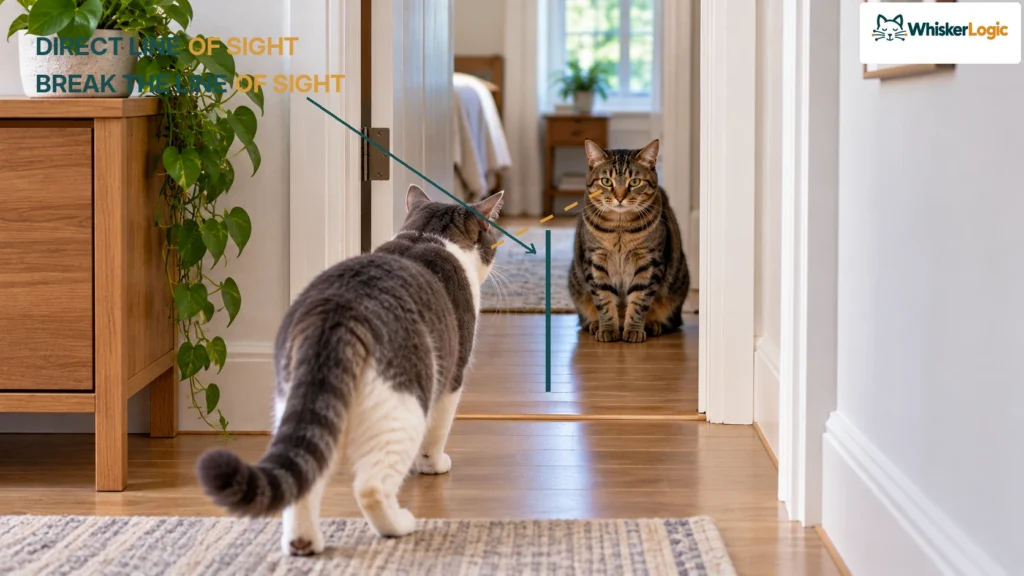
Try Breaking the Line of Sight
If staring repeatedly occurs at one location and the recipient cat hesitates, retreats, waits, or avoids passing there, changing the visual setup can provide useful contextual evidence.
This does not mean every pair of cats that looks at each other needs permanent visual separation.
Target the specific problem location instead.
Depending on the layout, you might:
- add a safe solid visual barrier;
- reposition appropriate furniture;
- create another practical route;
- provide suitable vertical space;
- change a setup that allows prolonged direct visual contact across a narrow passage.
Keep every route usable: a barrier should interrupt the direct view without trapping either cat, narrowing the only passage, or blocking access to food, water, litter boxes, or resting places. Check that any alternative route is practical for both cats, including a cat with reduced mobility.
Then observe what happens.
Does the recipient cat walk through more readily?
Does it approach the resource without waiting?
Does it use an area it previously avoided?
If behavior changes after the visual setup changes, that suggests the previous environment was relevant to the interaction.
It does not prove why the staring cat was staring, and it is not a diagnostic test.
You are testing a practical question:
Does changing the line of sight change what the other cat does?
Don’t Assume One Cat Is “Dominant”
It is tempting to describe the staring cat as the “alpha” or “dominant” cat and the cat that moves away as “submissive.”
That framing does not help you troubleshoot this situation.
The 2024 AAFP Intercat Tension Guidelines caution against interpreting household cat relationships as a simple dominance hierarchy. They also note that there is no evidence that intercat tension occurs because household cats are attempting to establish such a hierarchy.
Focus on observable behavior instead.
Rather than:
“My dominant cat controls my other cat.”
Record:
“When Cat A sits in this doorway and stares, Cat B usually stops and walks away.”
Or:
“Cat B waits to approach the food until Cat A leaves.”
Or:
“Both cats look at each other and then continue moving normally.”
Those descriptions help you identify what is happening, where it happens, and what you may be able to change.
What to Try, in Order
1. Watch the recipient cat
When the staring starts, watch what the other cat does immediately afterward.
2. Look for repetition
Do not draw a conclusion from one encounter. Look for the same sequence across multiple interactions.
3. Record where it happens
Note whether the cats are in an open room or near a doorway, hallway, stairway, feeding area, litter-box route, resting area, or another narrow or important location.
4. Check whether the same cat repeatedly gives way
Look for consistent waiting, retreating, rerouting, or hesitation without assigning dominance or submission labels.
5. Check movement and resource access
Make sure both cats can reach food, water, litter boxes, resting areas, safe places, and other important resources without repeatedly having to negotiate the same chokepoint.
6. Change the environment when there is a clear problem location
If you identify a repeated pattern at one location, consider a safe visual barrier, furniture adjustment, alternative route, or suitable vertical option.
Change the relevant feature rather than making several unrelated changes at once.
7. Reassess
Watch what happens after the environmental change.
Does the recipient cat move through the area more freely?
Does it approach the resource without waiting?
Does the repeated retreat continue?
Judge the intervention by the cats’ behavior afterward.
8. Avoid punishment and forced interaction
Do not yell, spray water, throw objects, force the cats together, force eye contact, punish the cat that retreats, or use “alpha” techniques.
Punishment can increase fear and stress without addressing the environmental or social situation causing the behavior.
If the problem is persistent, escalating, or difficult to manage safely, contact your veterinarian. More complex cases may benefit from referral to a qualified veterinary behavior professional.
When a Sudden Change Needs Veterinary Attention
Pay particular attention when this is a new behavior between cats that previously interacted differently.
If the change began after one cat returned from a veterinary appointment, especially if hissing, avoidance, or unfamiliar behavior appeared at the same time, see Why Is My Cat Hissing at My Other Cat After a Vet Visit?.
Pain, illness, or reduced mobility can affect how a cat behaves and responds socially. A cat that is uncomfortable may change where it rests, how it moves through the home, or how it reacts when another cat approaches.
That does not mean sudden staring proves a medical problem.
It means a new social change should not automatically be treated as purely behavioral.
Contact your veterinarian if the changed interaction occurs alongside:
- signs of pain;
- appetite changes;
- unusual inactivity;
- mobility changes;
- grooming changes;
- increased hiding or other marked behavioral changes;
- injury;
- physical fights;
- a sudden major change in the relationship between previously compatible cats.
A veterinarian can assess whether medical factors need to be ruled out while you also evaluate the cats’ environment and interactions.
Frequently Asked Questions
Why does my cat stare at my other cat?
There is no single explanation you can determine from staring alone.
Watch what happens next. If the other cat remains relaxed and moves freely, the observation alone gives you little evidence of a problem. If staring repeatedly precedes waiting, retreating, rerouting, hiding, or reduced access to important areas, investigate the pattern more closely.
Does staring mean my cat is aggressive toward my other cat?
No.
Staring can occur as part of intercat tension, but staring alone does not prove aggression or tell you the staring cat’s motivation.
Read the entire interaction and look for repeated patterns over time.
Should I stop my cats from staring at each other?
Not automatically.
If both cats remain relaxed and continue moving around the home and using resources normally, looking at each other is not enough reason to intervene.
Intervention becomes more relevant when the staring repeatedly changes the recipient cat’s behavior or access.
Why does my other cat always walk away when my cat stares?
Walking away once can happen for many reasons.
If the same cat repeatedly leaves when the staring occurs, look at where this happens and whether it affects movement, feeding, resting, litter-box access, or other routines.
The repeated pattern is more informative than labeling the cat “submissive.”
Can a cat block another cat just by staring?
Physical contact is not required for access to be affected.
If one cat repeatedly positions itself near a narrow route or resource while staring and the other consistently stops, waits, retreats, or takes another route, investigate whether the setup is creating a practical access problem.
What should I do if my cats stare at each other in a hallway?
Watch what happens after the stare.
If both cats continue through normally, that observation alone may not indicate a problem.
If the same cat repeatedly stops or retreats, examine the hallway as a possible chokepoint. A safe visual barrier, alternative route, furniture adjustment, or suitable vertical option may help. Then reassess how the cat uses the area.
Should I let my cats “work it out”?
Do not force cats into confrontation.
If you see repeated avoidance, blocking, escalating tension, or physical conflict, reduce the problematic interaction and improve the environment rather than forcing the cats together.
Is the cat doing the staring the dominant cat?
You cannot determine that from staring.
Instead of assigning dominance labels, record what happens: which cat remains, which cat retreats, where the interaction occurs, and whether movement or access changes.
Sources
2024 AAFP Intercat Tension Guidelines: Recognition, Prevention and Management