
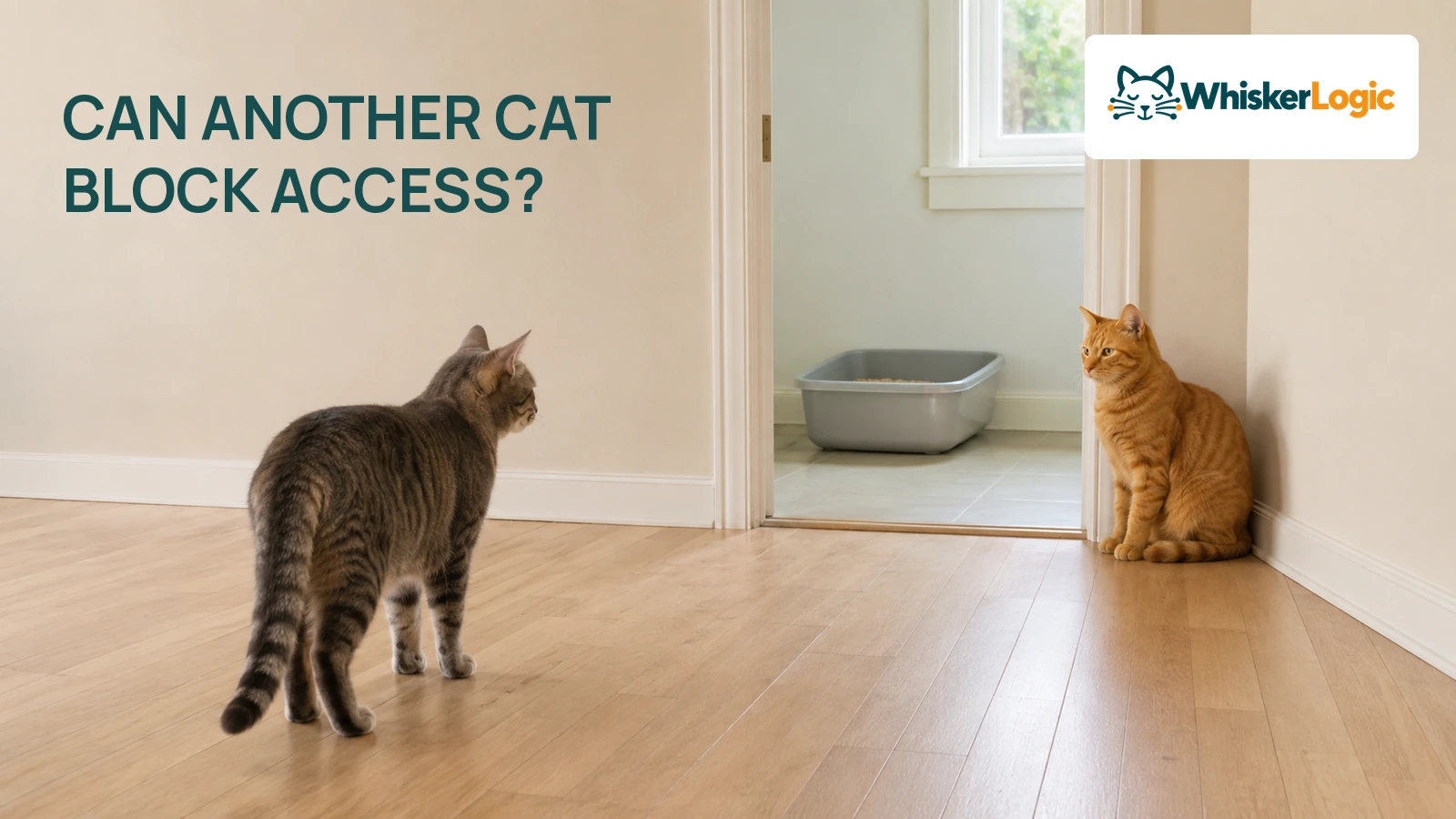
A cat blocking access to the litter box may never start an obvious fight. The box can be clean, appropriately sized, and physically available—and still feel difficult for another cat to reach. In a multi-cat home, subtle pressure may include staring, waiting near a doorway, following, blocking a narrow route, or chasing the other cat after it leaves.
If you suspect that a cat is blocking access to a litter box, do not judge the situation from one moment. Look for a repeatable relationship: when Cat A is present, Cat B pauses, reroutes, retreats, rushes, or avoids the box; when Cat A is absent, Cat B approaches or uses it more normally.
That pattern is useful evidence, but it is not a medical or behavioral diagnosis by itself.
Quick Answer
Yes. Another cat can make a litter box socially difficult to access without obvious fighting.
The important question is not simply whether the box exists, but whether each cat can approach it, use it, and leave it without being watched, blocked, followed, or chased.
Observe the entire route, distribute boxes in genuinely separate locations, reduce choke points, and reassess the pattern. Also rule out medical causes when elimination changes suddenly or warning signs are present.
Vet Check
Do not assume intercat tension explains a litter box change.
Straining, repeated attempts, passing little or no urine, blood, pain or vocalization, constipation, major stool changes, vomiting, lethargy, mobility problems, or any sudden change in elimination warrant veterinary attention.
Repeated attempts to urinate with little or no urine can signal a urethral obstruction, which is an emergency. Seek immediate veterinary care—especially if a male cat cannot pass urine or produces only tiny amounts while repeatedly trying.
Table of Contents
How Another Cat Can Block Access to the Litter Box Without a Fight
The 2024 AAFP Intercat Tension Guidelines describe intercat tension as a spectrum. Signs may be subtle—such as staring or blocking—or more overt.
This matters because many caregivers look only for noisy conflict. A quiet cat that repeatedly yields space can be affected even when the other cat never attacks.
The useful term here is intercat tension, not a simple story about an “alpha” or “dominant” cat owning the box. The relationship may change with location, time, available space, or access to a valued resource. One cat may pass through a room comfortably at one time and avoid it when another cat is positioned near the doorway.
This is why “available” is not the same as “accessible,” and neither automatically means “socially comfortable to use.”
A box can be open and unobstructed to a person while the cat perceives the approach or exit as risky.
Signs of a Cat Blocking Access to the Litter Box
Possible signs include one cat:
- Standing in a doorway
- Sitting at the end of a hallway
- Watching from a staircase
- Approaching when the other cat enters the box
- Following the cat after it leaves
- Chasing the other cat away
The affected cat may stop, wait, change direction, retreat, use the box only at quiet times, enter briefly, or eliminate elsewhere.
Owners sometimes call this “litter box bullying” or say that one cat is “guarding the litter box.” Those phrases can describe the concern, but they should not be treated as a diagnosis.
A cat resting near a box may simply prefer that location. A single stare or chase may be unrelated. The stronger clue is a repeated change in Cat B’s behavior that depends on Cat A’s presence.
Observation: Cat B approaches the hall, sees Cat A near the doorway, stops, and leaves. The same thing happens repeatedly.
Interpretation: Cat A’s position may be affecting access, but the observation does not establish motive or exclude a medical problem.
Action: Record when and where it happens, then change the route or resource layout and see whether Cat B’s behavior becomes easier and more consistent.
Watch What Happens Before Your Cat Reaches the Box
Start observing before the cat enters the litter-box room. The pressure point may be several feet—or an entire floor—away from the box.
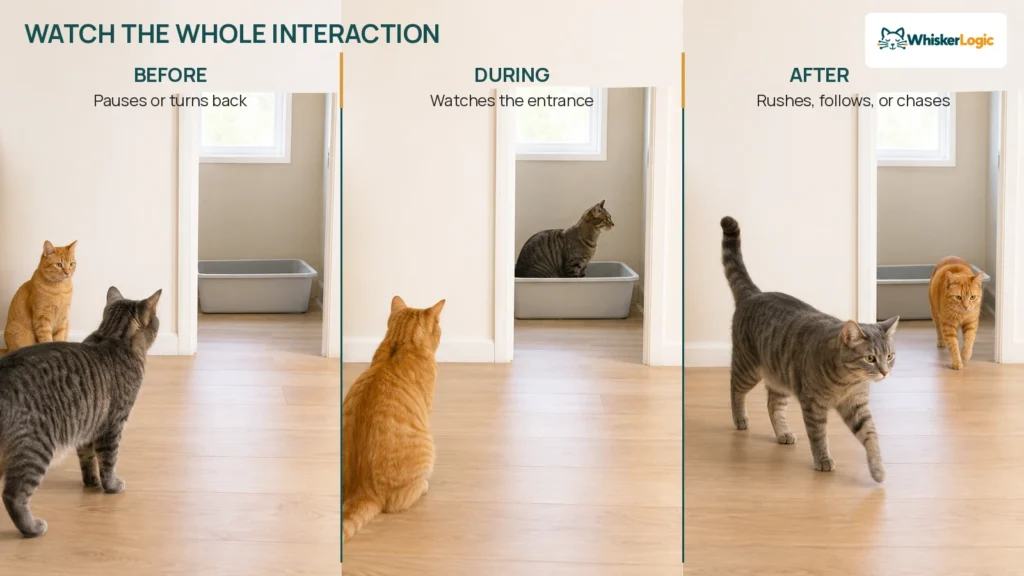
Ask:
- Does the cat pause in a hallway, at the bottom of the stairs, or outside a doorway?
- Does it wait until the other cat leaves?
- Does it look toward the other cat before moving forward?
- Does it take a longer route or approach only when the home is quiet?
- Does it turn back when the other cat appears?
Compare several occasions.
If the hesitation occurs whether or not the other cat is nearby, inspect other explanations too: box cleanliness, litter preference, noise, door movement, difficult entry, pain, or mobility limitations.
Watch What Happens While Your Cat Is Using the Box
A cat that reaches the box may still feel exposed while using it. Watch from a distance or use a camera only if doing so does not disturb the cats.
Look for the following:
- Does the cat keep looking toward the entrance instead of settling into normal elimination behavior?
- Does it enter and leave unusually quickly?
- Does the other cat approach, sit in view, or enter the room during use?
- Does the cat abandon the attempt when it hears or sees the other cat?
These observations are most useful when compared with the same cat using a box in another location.
A quick exit alone is not proof of social pressure; some cats simply spend little time in the box.
Watch What Happens When Your Cat Leaves
The exit can be as important as the approach. Elimination temporarily occupies the cat and may leave it with only one direction in which to leave.
Observe what happens next:
- Is the other cat waiting outside the box or room?
- Does staring begin as soon as the cat exits?
- Does one cat follow closely or chase the other?
- Does the exiting cat sprint away, flatten its body, hide, or avoid that route later?
Again, look for repetition and context.
Playful pursuit and tense following can look similar in a short clip. Consider body posture, whether roles reverse, whether both cats re-engage voluntarily, and whether one cat consistently tries to create distance.
Is the Problem the Litter Box or the Route to It?
A box problem and an access problem can produce similar outcomes: hesitation, short visits, accidents, or selective use.
The distinction comes from comparing contexts rather than guessing from the accident itself.
- If the cat avoids one box even when the other cat is absent, inspect the box, litter, location, cleanliness, entry height, noise, and possible pain.
- If the cat uses the same box more normally when the other cat is elsewhere, social access becomes a stronger possibility.
- If the cat uses a similar box in a different, independently accessible location, the route or social setting may matter more than the box design.
- If avoidance continues across boxes and locations, broaden the investigation rather than assuming another cat is responsible.
Changes in where urine or stool is deposited may need their own troubleshooting.
If your cat is peeing outside the box but still pooping in it, or pooping outside the box but still peeing in it, those guides address the elimination pattern in more detail.
The present question is narrower: whether another cat is affecting access.
Map Every Route to the Litter Boxes
Draw a simple map of the home or walk through it from each cat’s common resting areas.
Trace the full sequence:
Resting area → hallway, stairs, or doorway → litter box → exit route
Mark:
- Narrow passages
- Corners
- Dead ends
- Single entrances
- Direct sightlines
- Places where another cat regularly sits
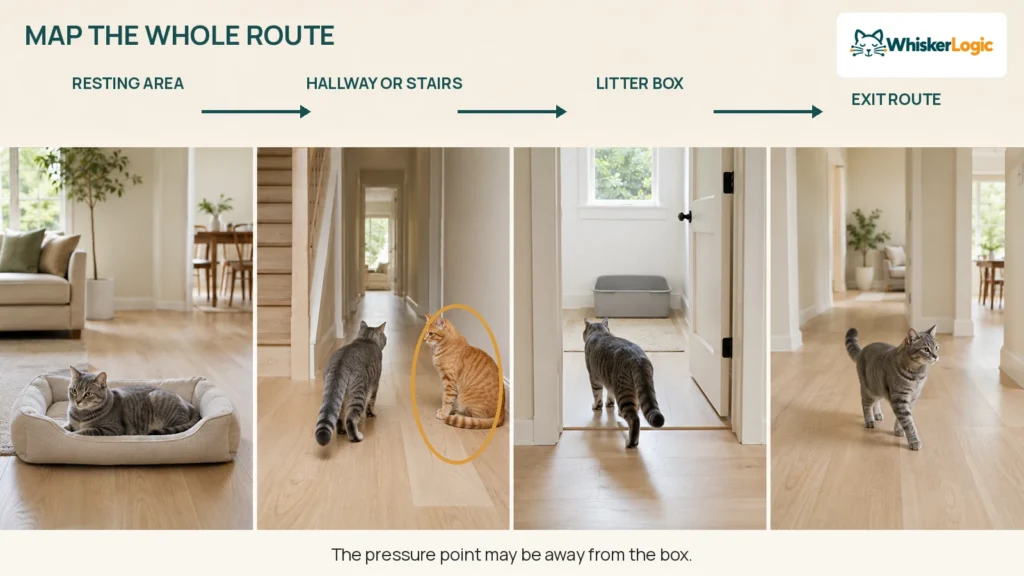
A choke point is any place where one cat’s position can strongly influence passage. Common examples are a narrow hallway, a staircase landing, a doorway into a utility room, or a covered enclosure with one opening.
The box itself may be several feet beyond the actual pressure point.
A case described in the 2024 AAFP guidelines illustrates why the route matters: one cat frequently stared at and blocked another cat in hallways and on stairways, interfering with access to rooms9 that contained litter boxes.
This does not mean every cat sitting on a staircase is blocking access. It shows why a repeated relationship between one cat’s position and the other cat’s movement is more informative than checking the box alone.
Map each box separately. Ask whether a cat can reach it from more than one direction and whether it can leave without moving toward the other cat.
Also note whether closed doors, baby gates, appliances, people, or dogs alter access at particular times.
Why More Litter Boxes May Not Help If They Are All Together
Adding boxes can help, but number alone does not describe access.
The AAHA/AAFP litter-box guidance recommends boxes in different, easily accessible locations in multi-cat homes and gives the familiar rule of thumb of one box per cat plus one extra.
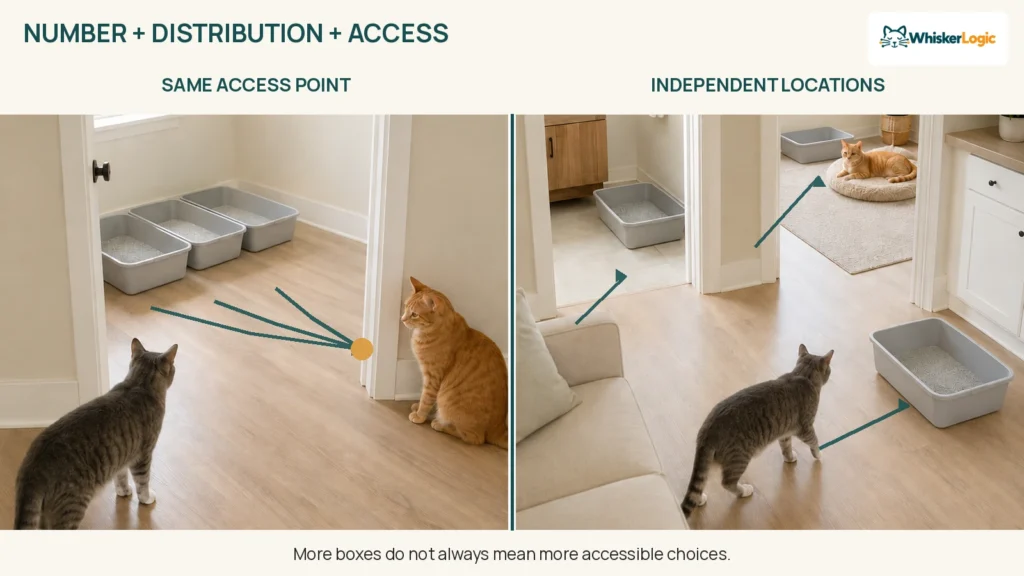
Three boxes lined up in one room may offer three substrates or clean spots, but they do not necessarily offer three independent routes.
If every trip passes through one doorway that another cat can watch or block, the whole room may function as a single access option.
That is a practical application of resource distribution, not a claim that side-by-side boxes always fail. If all cats use them comfortably, do not create a problem that is not there.
But when a pattern suggests access pressure, place at least some boxes far enough apart that one cat cannot control the approach to all of them from one position.
How to Make Litter Boxes Genuinely Accessible to Every Cat
Aim for a combination of adequate number, meaningful distribution, workable routes, and safe exits.
- Place boxes in separate areas rather than clustering every box behind one doorway.
- Where the home allows it, provide options on different floors or on opposite sides of a shared living area.
- Avoid making every route pass through the same narrow hall, staircase, or dead end.
- Give a cat room to approach and leave without squeezing past another cat.
- Use furniture or other safe visual separation to interrupt long, direct sightlines when needed, while preserving easy human access for cleaning.
- Keep each box clean and suitable; improved social access will not compensate for an aversive box.
- Check that older cats or cats with mobility limitations can reach the location and enter the box comfortably.
Do not punish the cat that waits, stares, follows, or chases.
AAHA’s summary of the 2024 AAFP guidelines explains that disciplining cats does not work, can cause fear and anxiety, and may harm the human–animal bond.
Do not yell, spray water, or force the cats together. Change the environment and access pattern while seeking professional guidance for persistent tension.
Look for Intercat Tension Away From the Litter Box
If access pressure is real, it may not be limited to elimination.
Observe routes to:
- Food
- Water
- Resting spots
- Scratching areas
- Windows
- Perches
- Preferred rooms
Does one cat consistently yield space, wait, hide, or take a long route when the other appears?
The Ohio State University Indoor Pet Initiative provides caregiver resources for both conflict between cats and litter-box problems. The 2024 AAFP guidelines place these concerns within a broader environmental framework by adapting the five pillars of a healthy feline environment for preventing and managing intercat tension.
Distribute other essential resources when tension appears around them too.
The goal is not to assign ownership or rank. It is to reduce situations in which one cat must pass close to another or rely on a single contested route to meet a basic need.
What to Try, in Order
- Check for medical warning signs. Seek veterinary care promptly for pain, straining, repeated attempts, little or no urine, blood, vomiting, lethargy, constipation, major stool changes, sudden elimination change, or mobility difficulty.
- Confirm the pattern. Observe multiple trips. Note the time, each cat’s position, what happened before and after use, and whether behavior changes when the other cat is absent.
- Map every route. Trace travel from resting areas to each box and back out. Mark doorways, halls, stairs, corners, dead ends, and direct sightlines.
- Identify the pressure point. Decide whether hesitation begins at the box, the room entrance, or somewhere earlier. Do not assume the box is the problem just because the outcome occurs there.
- Create independent access. Move or add boxes so at least some choices have different routes and exits. Avoid placing every option behind the same choke point.
- Reduce visual pressure. Where appropriate, adjust furniture or use safe visual separation so one cat cannot watch every approach, without creating a tighter trap or hidden dead end.
- Review other resources. If the same pattern occurs around food, water, beds, perches, or doorways, improve the distribution of those resources too.
- Reassess. After the change, compare the same behaviors: pausing, rerouting, rushing, retreating, following, chasing, and actual box use. Improvement supports the access hypothesis; no improvement means the investigation should broaden.
When to Get Veterinary or Behavior Help
Contact your veterinarian when elimination changes suddenly, medical signs are present, or the pattern persists despite environmental changes.
A physical examination and appropriate testing may be needed because pain, urinary disease, gastrointestinal problems, constipation, and mobility limitations can alter litter-box behavior.
The AAFP/ISFM house-soiling guidelines emphasize that house-soiling can reflect unmet physical, social, or medical needs and recommend both optimizing litter-box conditions and meeting feline environmental needs.
Social tension and medical disease can also coexist.
If a cat repeatedly tries to urinate but produces little or no urine, treat it as urgent. Cornell’s feline lower urinary tract disease guidance identifies urethral obstruction as a true medical emergency requiring immediate veterinary attention.
Seek help from a qualified veterinary behavior professional when:
- Tension is persistent
- One cat’s movement through the home is chronically restricted
- Chasing escalates
- Injuries occur
- The cats cannot safely share space
Video and a written route-and-timing log can help the veterinarian or behavior professional evaluate the pattern.
Frequently Asked Questions
Can a cat block access to the litter box without growling or fighting?
Yes. Intercat tension may involve subtle staring, waiting, following, or blocking. The key is a repeated effect on the other cat’s behavior, not the absence or presence of a dramatic fight.
How do I know whether my cat is guarding the litter box?
Do not label the behavior from one incident. Compare repeated trips.
If one cat’s presence reliably predicts that the other pauses, retreats, reroutes, rushes, or avoids the box—and access improves when the first cat is elsewhere—social pressure is more plausible.
Still consider box-related and medical causes.
Will adding another litter box stop one cat from blocking the other?
It may help only if the new box creates a genuinely different option.
A box beside the existing boxes may still share the same doorway, hallway, or exit. Consider number, distribution, routes, and exits together.
Should litter boxes be placed in different rooms?
In a home with suspected access pressure, separate locations are often more useful than a cluster because they reduce the chance that one position controls every route.
Choose quiet, clean, physically accessible locations that do not create another dead end.
Why does my cat use one box for pee and another for poop?
Social access can be one factor, but it is not the only explanation.
See the separate guide on why a cat uses one litter box to pee and another to poop for a focused explanation of that pattern.
Should I punish the cat that is blocking the litter box?
No. Do not yell, spray water, or force the cats together.
Punishment can increase fear and tension without fixing the route or resource problem. Improve access and seek veterinary or behavior help if the pattern continues.
Sources
- Rodan I, Ramos D, Carney H, et al. 2024 AAFP Intercat Tension Guidelines: Recognition, Prevention and Management. Journal of Feline Medicine and Surgery.
- AAHA/AAFP Feline Life Stage Guidelines: General Litter Box Considerations.
- Carney HC, Sadek TP, Curtis TM, et al. AAFP and ISFM Guidelines for Diagnosing and Solving House-Soiling Behavior in Cats.
- Cornell Feline Health Center: Feline Lower Urinary Tract Disease.
- The Ohio State University Indoor Pet Initiative: For Cat Owners.
- American Animal Hospital Association: What to Know About the 2024 AAFP Intercat Tension Guidelines.