
If your cat is chasing your other cat, the chase itself does not tell you whether the interaction is mutually chosen play or a problem.
Some cats willingly chase each other and switch roles. In other cases, one cat keeps pursuing after the other has tried to stop, hide, or move away. The most useful clues are not simply how fast they run or how dramatic the chase looks. Watch whether the cats take turns, what happens when one tries to disengage, whether the chased cat can still move freely around the home, and what both cats do after the chase ends.
Quick Answer
Chasing is more consistent with mutually chosen play when both cats participate, roles sometimes reverse, either cat can pause or leave, and both voluntarily re-engage at other times.
Pay closer attention when the same cat repeatedly pursues, the other cat consistently tries to get away, pursuit continues after those attempts to stop, or the chased cat begins hiding, rerouting, or avoiding parts of the home.
Do not judge from a single chase.
Watch the sequence:
Approach → chase → attempt to stop → response → what happens afterward
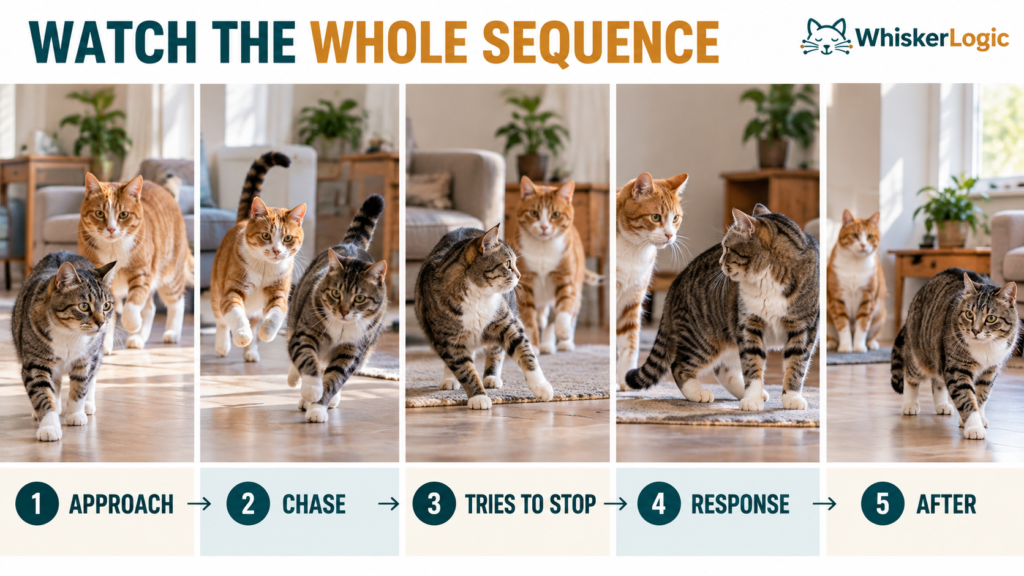
That sequence is usually more useful than the chase by itself.
Vet Check
A sudden change in how two cats interact deserves medical consideration, especially when they previously lived together without this pattern.
Pain, illness, reduced mobility, or another physical change can alter social behavior. Veterinary behavior guidance recommends considering medical causes when behavior changes suddenly or when frequent conflict, hiding, or other changes accompany the interaction.
Contact your veterinarian if the new or intensified chasing occurs alongside reduced appetite, unusual hiding, stiffness, limping, reluctance to jump, sensitivity to touch, reduced grooming, litter-box changes, vomiting, wounds, lethargy, or another noticeable change in health or activity.
Behavior alone cannot tell you whether pain or disease is present.
Table of Contents
Cat Chasing Other Cat? Look Beyond the Chase
Chasing can occur in more than one kind of cat-cat interaction.
The 2024 AAFP Intercat Tension Guidelines note that chasing can appear in social tension, but they also emphasize that behaviors such as chasing, wrestling, and mouthing may occur in both playful and more problematic interactions. The broader pattern matters.
A 2023 study that analyzed 105 close-contact interactions between cats also found that feline interactions do not always fit neatly into only “playing” or “fighting.” The researchers identified playful, agonistic, and intermediate interactions, reinforcing why a single behavior should not be used as a diagnosis.
Instead of asking only, “Why is my cat chasing my other cat?”, ask five more specific questions:
- Do the cats ever switch who chases whom?
- What happens when one cat tries to stop?
- Can the chased cat move away and use the home normally?
- What do both cats do after the chase?
- Does chasing repeatedly happen in particular locations or around important resources?
You are looking for a pattern over time, not trying to assign a permanent label to either cat.
Do the Cats Take Turns Chasing?
Role reversal is useful information.
Imagine one cat runs across the room and the other follows. Later, the second cat runs and the first follows back. There are pauses, either cat can leave, and one of them voluntarily approaches again later.
That is different from a pattern in which one cat repeatedly pursues while the other consistently tries to escape.
A review of feline social play emphasizes reciprocity as an important part of interpreting an interaction. An encounter may begin as mutual play and then change if one participant no longer wants to continue.
You do not need to see perfect 50/50 role switching. Cats differ in age, activity level, play style, and willingness to initiate.
Instead, look at the overall pattern:
- Does the chased cat sometimes become the chaser?
- Does it voluntarily approach the other cat later?
- Does it sometimes restart the interaction?
- Are there natural pauses?
- Can either cat simply leave?
If those things happen regularly, mutual participation becomes more plausible.
If the same cat is almost always fleeing and rarely chooses to re-engage, look more closely at what is happening.
If the interaction involves substantial body-to-body wrestling rather than primarily chasing, see Why Do My Cats Wrestle With Each Other? for that specific situation.
What Happens When One Cat Tries to Stop?
This is one of the most useful moments to watch.
Suppose the cats have been running through the house. One slows down, turns away, climbs onto a resting spot, retreats behind furniture, or otherwise stops participating.
Now watch the other cat.
In one pattern:
Chase → one cat stops → the other stops → both separate.
Or:
Chase → one cat stops → pause → that cat later approaches again → interaction restarts.
Choice is preserved.
In a different pattern:
Chase → one cat retreats → the other follows → retreat continues → pursuit continues.
Or:
Chase → one cat hides → the other remains nearby and repeatedly tries to reach it.
The second pattern deserves closer attention because the attempt to end the interaction is not ending the pursuit.
Research on feline social play specifically highlights this transition. An interaction can begin as mutual play, but if one cat tries to leave after a chase, the response of the other cat becomes important for interpreting what follows. The other cat may stop, try to restart the interaction, or continue in a way that produces further withdrawal or a defensive response.
A hiss, swat, or brief defensive reaction does not automatically mean the cats have a permanently bad relationship. The AAFP guidelines note that cats can use overt signals, including hissing and non-reciprocated chasing, to end a social encounter, and occasional short disagreements can occur without meaning the cats’ entire relationship is dysfunctional.
The important question is:
When one cat asks for distance, does the interaction actually stop?
Can the Chased Cat Actually Get Away?
Do not judge freedom of movement only by whether the chased cat is physically fast enough to escape.
Watch how that cat uses the home.
A cat may be able to outrun another cat and still begin changing its routine to avoid being pursued.
Look for repeated patterns such as waiting before entering a hallway, hesitating at stairs or doorways, taking longer routes, leaving when the other cat appears, remaining in one room, avoiding a favorite resting place, delaying access to food or water, hesitating near a litter box, or hiding after being chased.
The AAFP guidelines recognize subtle behaviors such as walking away, hiding, staring, and blocking as possible signs of intercat tension. They also describe a case in which repeated staring and blocking in hallways and stairways interfered with another cat’s access to rooms containing litter boxes.
So the better question is not:
“Can this cat escape?”
It is:
“Can this cat move through the home and reach important resources without repeatedly having to avoid or escape the other cat?”
If the pattern specifically affects the route to a litter box, see Can Another Cat Block Access to the Litter Box? for focused troubleshooting.
Watch What Happens After the Chase
The minutes after a chase can provide useful context.
After a mutually chosen interaction, both cats may quickly return to ordinary activities. They might groom, explore, rest, eat, or later approach each other again.
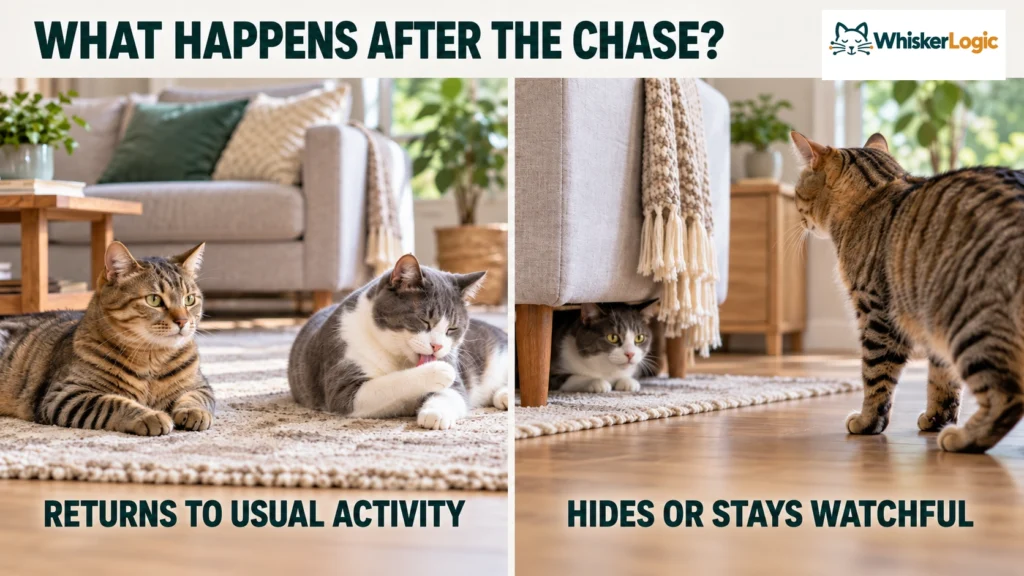
That does not prove every chase was playful. It simply adds useful evidence to the larger pattern.
Look more closely when the same cat repeatedly:
- hides after being chased
- remains crouched or unusually watchful
- avoids the area where the chase happened
- waits for the other cat to leave before moving
- gives up a resting place or route
- checks where the other cat is before passing
- changes normal eating, resting, toileting, or movement patterns
One retreat does not establish an ongoing problem. The AAFP guidelines specifically caution that a single encounter does not necessarily reflect the cats’ overall relationship; interactions need to be observed over time.
If your question is broader than chasing and you need to evaluate the whole interaction, use Are My Cats Playing or Fighting? instead.
Notice Where the Chasing Happens
Location can reveal a pattern that is easy to miss when you focus only on the cats.
Pay particular attention to chasing that repeatedly starts around narrow hallways, stairs, doorways, entrances to litter-box areas, food or water stations, preferred resting areas, cat trees, or other places where one cat has limited options for moving around another.
A chase across an open room during an otherwise reciprocal interaction is different from repeated pursuit whenever one cat tries to pass through the same narrow doorway.
The AAFP/ISFM environmental guidelines recommend multiple, separated key resources in multi-cat homes so cats can access feeding, drinking, toileting, resting, scratching, and play areas with less competition.
The 2024 intercat tension guidelines also recommend safe places, visual separation, vertical space, and hiding options with more than one route of entry and exit where possible, helping reduce opportunities for another cat to block access.
Run a Simple Location Check
For several days, record:
Where did the chase start? → Who initiated it? → Where did the chased cat go? → Did pursuit continue? → What happened afterward?
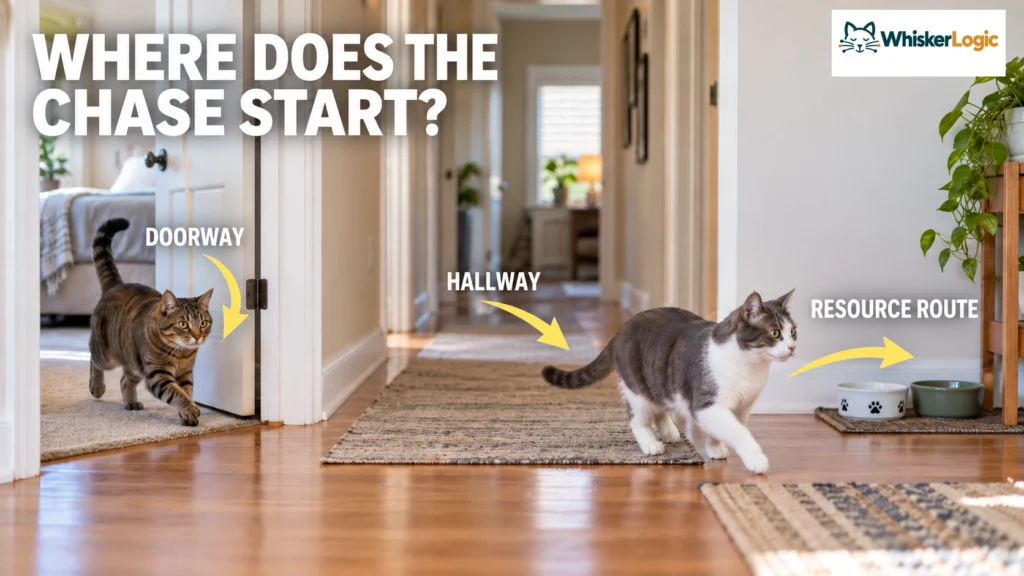
You may discover that chasing occurs in many different locations during active periods and ends easily.
Or you may find a repeated sequence such as:
Cat A enters hallway → Cat B chases → Cat A returns to bedroom.
If that sequence keeps repeating, investigate the route and environment rather than assigning a personality label to either cat.
When Chasing May Be Mutually Chosen Play
No single sign proves that a chase is play.
The overall interaction is more consistent with mutual participation when several clues occur together: both cats sometimes initiate, roles sometimes reverse, either cat can stop, pauses occur naturally, attempts to leave are respected, both cats voluntarily re-engage later, neither cat consistently loses access to parts of the home, and both return to normal behavior afterward.
The 2023 observational study found differences in the patterns associated with playful and agonistic interactions, while also identifying an intermediate category. That is another reason to interpret the whole sequence rather than treat chasing itself as a yes-or-no test.
Occasional disagreement does not automatically mean the cats’ relationship has failed. The AAFP guidelines note that companion cats can have brief periods of not getting along without this necessarily indicating a dysfunctional relationship.
When Chasing Is Becoming One-Sided
Pay closer attention when several of these patterns repeatedly occur together:
- the same cat almost always pursues
- the other cat consistently tries to leave
- pursuit continues after retreat
- the chased cat rarely re-engages voluntarily
- hiding regularly follows the chase
- movement through the home becomes restricted
- incidents cluster around doorways, stairs, or important resources
- hissing, growling, or defensive behavior repeatedly accompanies the pursuit
- normal eating, resting, toileting, or social routines change
These observations can show that the interaction deserves intervention, but they still do not prove why it is happening.
Avoid turning the pattern into a personality diagnosis such as “alpha,” “dominant cat,” or “bully.”
The AAFP guidelines specifically state that there is no evidence that household intercat tension occurs because cats are trying to establish a dominance hierarchy. Factors such as resource competition, changes in the household, social relationships, pain, illness, and environmental conditions are more useful to investigate.
Describe what the cats actually do.
Then change the conditions contributing to the repeated pattern.
What to Do About Repeated One-Sided Chasing
Protect the Chased Cat’s Ability to Leave
Look for dead ends, narrow routes, and places where one cat can easily intercept the other.
Where practical, create alternative paths into or out of important areas.
Safe places are especially useful when they provide more than one route of entry and exit. Vertical space such as cat trees, shelves, or furniture can also give cats more control over movement and distance.
The goal is not simply to provide a place to hide.
The goal is to make it easier for a cat to choose distance without becoming trapped.
Separate Important Resources
Do not make every cat use the same narrow location to reach all important resources.
Provide appropriately separated options for food, water, litter boxes, resting areas, scratching areas, and play.
The AAFP/ISFM environmental guidelines recommend multiple and separated key resources, particularly in multi-cat households where different cats or social groups may need independent access.
Give the Persistent Chaser Appropriate Play Opportunities
A cat with a strong play drive may repeatedly direct stalking, chasing, or pouncing toward another cat that does not want the same level of interaction.
The AAFP guidelines recommend adequate interactive and self-directed play opportunities and specifically discuss preventing persistent predatory-style play toward housemates by meeting play needs in other ways.
Use interactive toys that allow stalking, chasing, pouncing, and capture of an appropriate target.
This is not about punishing or exhausting the cat. It is about providing additional outlets that do not depend on another cat being willing to participate.
If the cats are clearly interacting but one repeatedly ignores the other’s attempts to pause, see Cat Plays Too Rough With Other Cats? When to Step In.
Interrupt Escalating Situations Without Punishment
Do not yell, spray water, chase either cat, or put your hands between highly aroused cats.
If tension is escalating, the AAFP guidelines recommend safely reducing visual contact with an inanimate barrier such as a cushion, pillow, cardboard, or another solid object, then redirecting or separating the cats as appropriate.
Punishment can add fear and stress to an already difficult interaction. Merck Veterinary Manual guidance similarly recommends environmental management and avoiding punishment-based approaches when managing feline behavior problems.
Change Predictable Chase Locations
If your observations show that most incidents begin in one hallway, doorway, stairway, or near one resource, focus on that specific location.
Depending on the home, that might mean moving a resource, creating another route, adding vertical access, breaking a long sightline, adding another resting area, or changing how a narrow passage is used.
A repeated location pattern gives you something concrete to test.
Reassess What Changes
After changing the environment, watch the same questions again:
Does the chased cat move more freely?
Does pursuit stop sooner?
Is there less hiding or hesitation?
Can both cats reach important resources without repeating the same chase sequence?
Improvement after an environmental change does not prove why the chasing originally started.
It does tell you whether that change made daily life easier for the cats.
When to Get Professional Help
Contact your veterinarian or an appropriately qualified feline behavior professional if chasing suddenly begins between cats that previously interacted comfortably, one cat is increasingly hiding or restricting its movement, access to food, water, resting areas, or litter boxes is affected, physical conflict or injury occurs, or the pattern continues despite reasonable environmental changes.
Medical evaluation is particularly important when the behavior change is sudden or accompanied by changes in mobility, appetite, elimination, grooming, activity, or other signs of illness.
Merck Veterinary Manual guidance emphasizes that behavioral problems can have multiple contributing factors and that underlying medical conditions should be considered rather than assuming a behavior has a purely behavioral cause.
Videos can help a veterinarian or behavior professional understand what happens before, during, and after an interaction, but only record when you can do so safely.
Never provoke a chase to obtain footage.
Frequently Asked Questions
Why does my cat chase my other cat for no reason?
The reason may not be obvious from the chase itself.
Possible contexts include mutually chosen play, one cat attempting to initiate interaction when the other does not want it, differences in play drive, environmental or resource-related tension, or arousal caused by another stimulus.
Instead of guessing the cause, watch what happens immediately before the chase, whether roles reverse, how attempts to leave are handled, and what both cats do afterward.
Is a cat chasing another cat always playing?
No.
Chasing can occur in both playful and tense interactions, so it should not be interpreted by itself. Reciprocity, attempts to disengage, vocalization, other body language, freedom of movement, and what happens afterward provide more useful context.
Is It Okay if One Cat Always Does the Chasing?
Not necessarily, but unequal role switching alone does not prove there is a problem.
Look at the chased cat.
If that cat voluntarily returns, sometimes initiates interaction, moves normally around the home, and can end encounters without continued pursuit, the imbalance may be less concerning.
If it repeatedly escapes, hides, changes routes, gives up spaces, or cannot successfully end the interaction, take the pattern more seriously.
Why Does My Cat Chase the Other Cat After the Other Cat Walks Away?
That moment is especially useful to watch.
If walking away was an attempt to end the interaction and the other cat immediately continues pursuing, the interaction has become less reciprocal at that point.
Research on feline social play specifically highlights the response after one cat attempts to terminate an interaction as important for understanding what happens next.
Why Does My Cat Chase My Other Cat Near the Litter Box?
Repeated chasing near a litter box can matter even when no fight occurs beside the box.
Watch the entire route into and out of the litter-box area. If one cat repeatedly waits, follows, blocks, or chases at a doorway or hallway and the other cat begins hesitating or changing its toileting routine, investigate access to the resource.
The problem may involve the route to the box rather than the box itself.
Should I Let My Cats Work It Out?
Do not deliberately force repeated unwanted encounters in the hope that the cats will settle the issue themselves.
The 2024 AAFP guidelines specifically advise against making cats “work it out” or forcing them to get along. Instead, examine the cats’ environment, access to resources, and the situations in which tension repeatedly occurs.
Sources
2024 AAFP Intercat Tension Guidelines: Recognition, Prevention and Management