
Two cats can chase each other down a hallway, wrestle on the floor, bite, swat, pounce, and then get up as if nothing happened. That can make a normal social interaction look much more alarming than it is.
So if you are asking, “Are my cats playing or fighting?”, do not judge the interaction by its most dramatic moment. A bite does not automatically mean fighting, and wrestling does not automatically mean play.
Instead, watch both cats across the whole interaction.
Do both cats keep participating? Can either cat pause or leave? Does chasing go both ways? Most importantly, what happens when one cat tries to stop?
That question is often more useful than asking whether you saw teeth, claws, wrestling, or a hiss.
Quick Answer
Cat play can look rough. Chasing, wrestling, pouncing, swatting, and biting can all occur during social play.
The more useful question is whether both cats continue choosing the interaction.
Watch for the overall pattern:
- Do both cats repeatedly participate?
- Do their roles sometimes change naturally?
- Are there pauses or releases?
- Can either cat leave?
- If one cat tries to leave, does the other allow it?
- Is chasing reciprocal or persistently one-sided?
- Are vocalizations brief, or do they become repeated and more intense?
- What happens immediately afterward?
For example, one cat running away does not automatically mean a fight. If the other cat pauses and the first cat soon comes back voluntarily, the interaction may still be mutual.
More concerning is a repeated pattern in which one cat tries to disengage while the other keeps pursuing, cornering, or following the cat into hiding.
How rough the interaction looks matters less than whether both cats can stop participating when they want to.
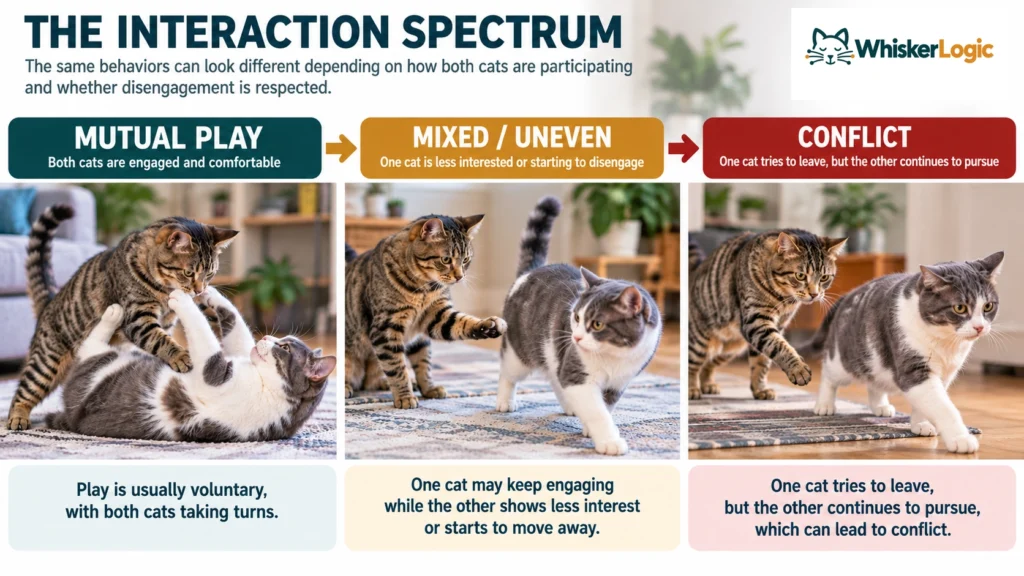
Think of the interaction as a spectrum:
Mutual Play → Mixed or Uneven Interaction → Conflict
You do not always need to force what you see into an immediate “play” or “fight” label.
Vet Check
If cats that previously interacted normally suddenly start fighting or behaving very differently toward each other, consider a veterinary check, especially if either cat also has an injury or shows changes in:
- movement, jumping, or mobility
- appetite
- hiding
- grooming
- litter-box behavior
- normal routines
- other physical or behavioral patterns
Pain or illness can contribute to behavioral changes, but behavior alone cannot tell you the medical cause.
The 2024 AAFP Intercat Tension Guidelines recommend considering medical problems when behavior changes, because physical and social problems can overlap.
If either cat is injured during an interaction, contact your veterinarian for guidance.
Table of Contents
Are My Cats Playing or Fighting? Start With Both Cats, Not One Move
A common mistake is trying to classify the entire interaction from one behavior.
Biting = fighting.
Wrestling = fighting.
Ears back = fighting.
No noise = playing.
Those rules are too simple.
The 2023 Scientific Reports study “An ethological analysis of close-contact inter-cat interactions determining if cats are playing, fighting, or something in between” found that cat-cat interactions are better interpreted as behavioral patterns rather than from one isolated action.
For example, wrestling appeared prominently in playful interactions, while chasing and vocalization were more associated with agonistic interactions. But the researchers also cautioned against using a single behavior as a complete classification rule.
So instead of asking:
“Did one cat bite the other?”
Ask:
“What were both cats doing before, during, and after that bite?”
One cat may bite during wrestling and then release. The cats may pause, separate, and voluntarily begin another bout.
That tells you something very different from a bite occurring while the other cat repeatedly attempts to escape.
Pattern and context matter more than one dramatic movement.
There May Be a Middle Ground Between Play and Fighting
Not every interaction fits neatly into “play” or “fight.”
The 2023 Scientific Reports study classified close-contact interactions into three useful categories:
- playful
- intermediate
- agonistic
The intermediate interactions included features associated with both playful and agonistic behavior.
That matters because an interaction can begin as mutual play and later become uncomfortable or one-sided. One cat may still want to continue after the other has had enough.
The researchers specifically discussed situations in which one cat appears to want to end an interaction while the other continues.
So if you cannot immediately decide whether an interaction is normal play or conflict, you may not be missing one obvious sign. You may be watching an interaction that is genuinely mixed.
Your job is not to assign a label as quickly as possible.
Your job is to watch how the interaction develops.
First, Watch Whether Both Cats Keep Choosing the Interaction
Mutual participation is one of the most useful things to observe.
Suppose your cats wrestle for several seconds. One breaks away and walks across the room.
Watch what happens next.
Does that cat turn around and approach again?
Does it initiate another chase?
Does it pounce back toward the other cat?
Does it remain nearby even though it could easily leave?
Voluntary re-engagement is useful evidence because the cat had an opportunity to end the interaction and chose to participate again.
Also watch for pauses. Cats may briefly stop, reposition, look around, or separate before another bout begins.
Roles may change naturally too. The cat chasing during one part of the interaction may later be chased, or the cat on top during wrestling may later be underneath.
But role reversal is not mandatory and does not prove play.
The broader Frontiers in Veterinary Science review of feline social play also emphasizes the importance of reciprocity and of watching what happens when social play stops being mutual.
A simpler question is often more useful:
Do both cats repeatedly have opportunities to disengage, yet both continue participating?
Now compare that with a different pattern:
One cat repeatedly retreats.
The other repeatedly advances.
One hides.
The other follows.
One tries to leave the room.
The other immediately pursues.
That deserves closer attention, even if the physical contact itself does not look especially dramatic.
Watch What Happens When One Cat Tries to Stop
This is one of the most useful questions you can apply in real time:
What happens when one cat says “enough”?
Cats cannot tell you verbally that they want a play session to end, so watch what happens around disengagement.
Consider these two sequences.
Pattern A
Cat A runs away.
Cat B stops.
There is a pause.
Cat A remains free to leave but voluntarily comes back and approaches Cat B.
The interaction begins again.
Pattern B
Cat A runs away.
Cat B immediately pursues.
Cat A tries to create more distance.
Cat B continues following.
Cat A hides behind furniture or reaches an area with limited escape options.
Cat B continues approaching or waiting nearby.
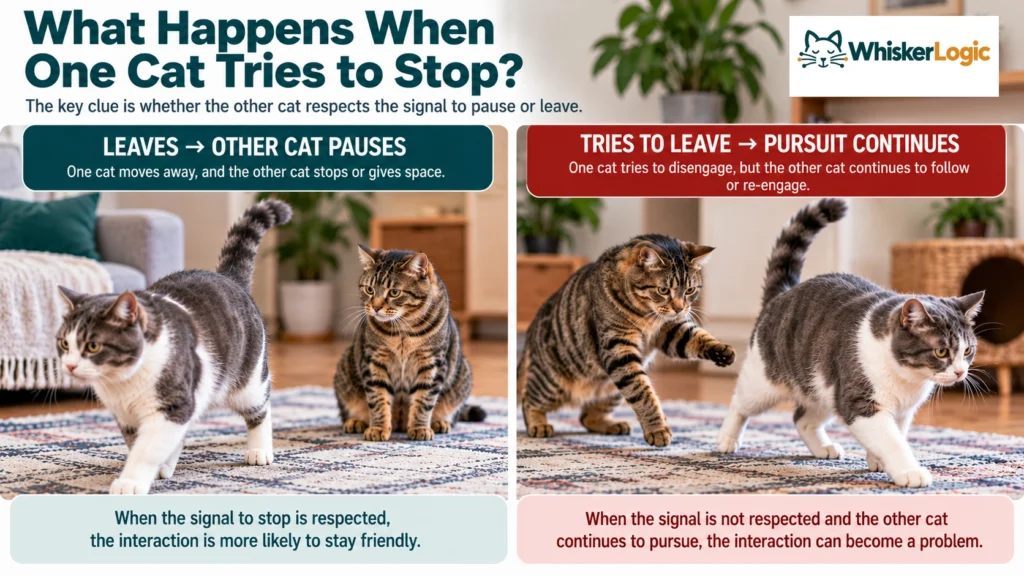
The second sequence is more concerning because the important issue is no longer simply how rough the wrestling looked. One cat is repeatedly attempting to end or avoid the interaction, while the other is not allowing that disengagement to happen easily.
The AAFP guidelines describe behaviors such as walking away, hiding, blocking, and preventing access to space or resources as useful context when evaluating intercat tension.
So when you are uncertain about a chase, bite, or wrestling match, stop concentrating only on the most dramatic movement.
Watch the attempted exit.
Is the Chasing Mutual or Mostly One-Sided?
Chasing can occur during both play and conflict.
The Scientific Reports study found chasing more associated with agonistic interactions, but it also noted that chasing can occur during social play, particularly when it is extensively reciprocated.
That means the existence of a chase is not enough.
Watch its structure.
A sequence such as:
Cat A chases Cat B → pause → Cat B approaches → later Cat B chases Cat A
provides different information from:
Cat A chases Cat B → Cat B retreats → Cat A continues → Cat B hides → Cat A follows
You do not need perfectly equal turn-taking.
Instead, ask whether both cats appear able and willing to participate, or whether one cat is repeatedly placed in the recipient role while trying to create distance.
Persistent one-sided pursuit becomes more concerning when it is combined with escape attempts, hiding, cornering, or tension afterward.
Wrestling, Biting, and Swatting Can Still Be Play
Physical contact can look dramatic without automatically being a fight.
Cats may wrestle, grab, bite, pounce, and swat during social play.
The Scientific Reports research found substantial wrestling in playful cat-cat interactions, but wrestling alone should not be used as proof that cats are playing.
Again, look at what surrounds the contact.
Does one cat release the other?
Are there pauses?
Can the cat underneath get away?
Does the interaction resume voluntarily?
Or is one cat repeatedly attempting to escape while the other restrains, pursues, or immediately re-engages?
If wrestling itself is the behavior you are trying to interpret, see our more focused guide: Why Do My Cats Wrestle With Each Other?
The important point here is simple:
Rough-looking contact does not classify the interaction by itself.
What Do Hissing, Growling, and Yowling Tell You?
Sound matters, but it also needs context.
A single hiss should not automatically turn a complex interaction into “a fight.”
Treat it as information about that moment.
Suppose one cat hisses.
The other backs off.
The interaction stops or becomes less intense.
Both cats regain space.
That sequence is different from repeated or escalating hissing, growling, yowling, or screaming while one cat is being pursued and cannot disengage.
In the 2023 Scientific Reports study, vocalization was particularly associated with agonistic interactions.
But that does not create a rule that every vocalization means fighting.
Likewise, silence does not prove that cats are playing.
Intercat tension can also be subtle. The AAFP guidelines describe behaviors including staring, walking away, hiding, and blocking as possible signs of tension.
Treat sound as one part of the pattern.
Read Body Language as a Pattern, Not a Scorecard
Ears, tails, posture, and fur can help you interpret an interaction, but there is no reliable point system where three “play signs” automatically outweigh two “fight signs.”
Watch both cats for combinations and changes in:
- ear position
- body tension
- crouching
- piloerection or raised fur
- tail position and movement
- staring
- retreat
- attempts to create distance
The question is not simply whether one cat flattened its ears for a moment.
Ask what happened around that posture.
Did the interaction pause?
Did the cat relax and voluntarily return?
Did the other cat allow space?
Or did the posture occur alongside persistent pursuit, retreat, hiding, or inability to get away?
Staring deserves particular attention when it continues outside the immediate play bout.
Persistent staring can be part of intercat tension, especially when the other cat responds by freezing, retreating, hiding, or changing where it goes.
If that is the pattern you are seeing, read Why Does My Cat Keep Staring at My Other Cat?
What Happens Afterward Can Change the Interpretation
Do not stop observing the moment the chasing or wrestling ends.
What happens afterward can provide important context.
An interaction is more consistent with comfortable social behavior when:
- normal activity resumes
- the cats remain comfortable moving around each other
- voluntary re-engagement occurs
- neither cat begins avoiding important areas or resources
More concerning patterns include:
- one cat hiding after interactions
- repeated avoidance of the other cat
- persistent staring
- blocking hallways, doorways, stairs, or other routes
- reluctance to pass through areas where the other cat waits
- avoiding food, water, resting places, or litter boxes
- continuing tension after the physical interaction has ended
The AAFP guidelines emphasize that intercat tension can be subtle and does not need to look like an obvious fight.
For example, if one cat begins controlling access to an important route or resource, the problem has moved beyond whether the wrestling itself looked playful.
If litter-box access is involved, see Can Another Cat Block Access to the Litter Box?
Think beyond the event itself.
What did the interaction change for the other cat?
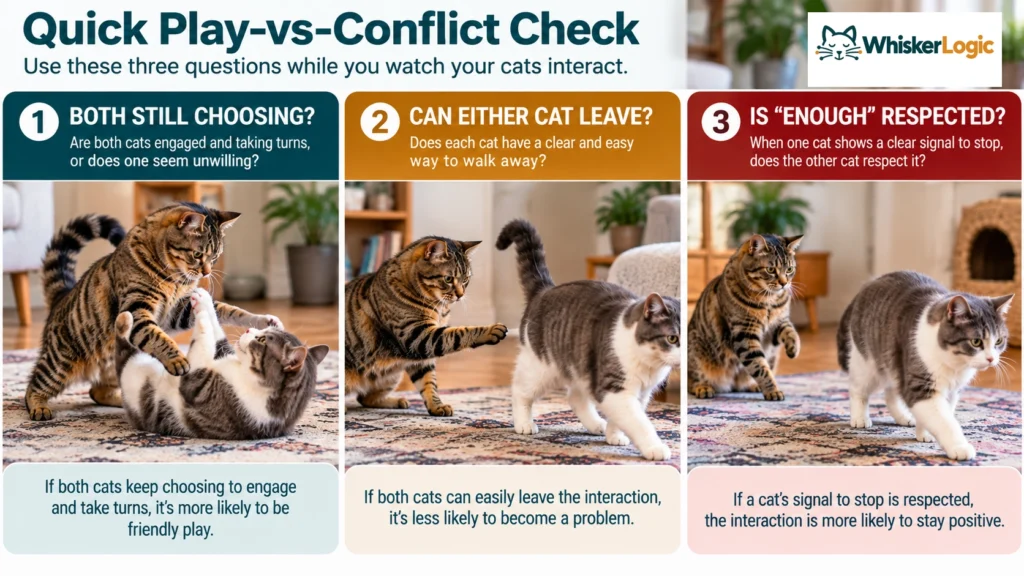
A Quick Play-vs-Conflict Check
Use this table to organize what you observe rather than relying on one dramatic sign.
| What to watch | More consistent with mutual play | More concerning for conflict or an uneven interaction |
|---|---|---|
| Participation | Both cats repeatedly participate | One repeatedly tries to avoid the interaction |
| Roles | Roles may change naturally | Mostly fixed pursuer-recipient pattern |
| Chasing | Reciprocal or willingly resumed | Persistent one-sided pursuit |
| Wrestling | Releases and pauses occur | One cat cannot disengage |
| Vocalization | None or limited; interaction changes after a boundary signal | Repeated or escalating growling, yowling, or screaming |
| Leaving | Either cat can leave without being forced back into the interaction | Leaving repeatedly triggers pursuit or cornering |
| Afterward | Normal behavior resumes | Hiding, avoidance, blocking, or persistent tension |
| Injury | No injury observed; interpret this with the other rows | Wounds, blood, or other injury |
No single row proves that cats are playing or fighting. Use the overall pattern.
If the columns seem mixed, that is useful information too.
You may be watching an uneven interaction rather than clear mutual play or an unmistakable fight.
When You Can Usually Keep Watching
You can usually continue observing rather than immediately intervening when the interaction remains broadly reciprocal and:
- both cats repeatedly participate
- pauses and releases occur
- either cat can leave
- attempts to disengage are respected
- no injury occurs
- normal behavior returns afterward
You are looking for continued evidence that both cats still have choices.
Do not assume, however, that every rough interaction should simply be left for the cats to “work out.”
Persistent tension deserves attention, especially when one cat cannot successfully create distance.
If the pattern changes, reassess.
When You Should Interrupt the Interaction
Intervention becomes more appropriate when you see a cluster of concerning behaviors rather than one ambiguous movement.
Pay particular attention when:
- one cat repeatedly tries to escape
- the other repeatedly prevents disengagement
- one cat becomes cornered
- pursuit remains sustained and one-sided
- vocalization becomes repeated or escalates
- the interaction does not pause when one cat tries to stop
- tension continues after the physical interaction ends
You do not need to wait for blood or an obvious injury before taking persistent distress or inability to disengage seriously.
If you need to interrupt, do not reach between the cats. Use a safer method of creating distance or separation, as described below.
How to Separate Cats Safely if It Becomes a Real Fight
If the interaction has escalated into a serious fight, do not put your hands between the cats or try to grab them with your bare hands.
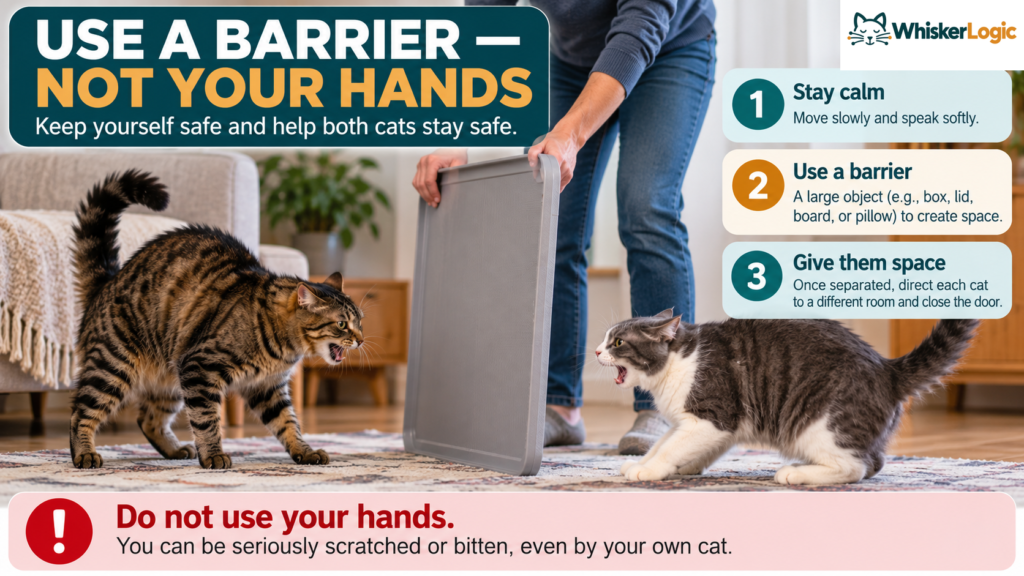
A highly aroused cat can redirect a bite or scratch toward a nearby person.
When feasible, create separation from a safer distance.
A solid visual or physical barrier can help block the cats’ access to each other without requiring you to reach between them. The AAFP guidelines describe using visual barriers or other objects to create separation while reducing the risk of injury to people.
Once separated, place the cats in secure, separate areas and allow them time to calm down.
Do not immediately force another face-to-face interaction simply because the physical fight has stopped.
If fighting is severe, recurrent, causes injury, or the cats cannot safely share the home, contact your veterinarian or a board-certified veterinary behaviorist.
If Your Cats Suddenly Started Fighting After Getting Along
A sudden change between cats that previously interacted normally deserves a different level of attention.
Possible categories to investigate include:
- medical or pain-related changes
- environmental changes
- stressful events
- redirected aggression
- changes involving space or important resources
- changes in the cats’ social relationship
For example, redirected aggression can occur when a cat becomes highly aroused by something it cannot reach—such as another cat outside—and redirects that response toward a nearby household cat.
But do not assume redirected aggression is the explanation simply because a fight seemed sudden.
First, separate the cats safely if necessary and consider veterinary evaluation, particularly if either cat has other behavioral or physical changes.
A sudden breakdown in a previously stable relationship is its own problem to investigate rather than simply another version of rough play.
If You Are Still Asking “Are My Cats Playing or Fighting?”, Watch the Exit
If you remember only one rule from this guide, make it this:
Do not classify the interaction from its most dramatic movement.
A chase can occur during play.
Wrestling can occur during play.
Biting and swatting can occur during play.
A brief vocal boundary does not automatically prove a fight.
Instead, watch the sequence.
One cat leaves. What does the other do?
One cat pauses. Is the pause respected?
One cat creates distance. Can it keep that distance?
After separating, does the cat voluntarily return?
And when the interaction ends, do both cats return to normal—or does one hide, avoid routes or resources, or remain tense around the other?
Those observations help you place the interaction somewhere more useful than a simple yes-or-no label:
Mutual Play → Mixed or Uneven Interaction → Conflict
The goal is not to become certain from one movement.
The goal is to determine whether both cats still have a meaningful choice about participating.
Frequently Asked Questions
Do cats bite each other when they play?
Yes. Biting can occur during cat play, including during wrestling.
Do not use the presence of a bite alone to classify the interaction.
Watch whether the cats release each other, pause, remain able to leave, and voluntarily continue interacting.
A bite occurring within a reciprocal interaction is different from biting combined with repeated escape attempts, cornering, sustained pursuit, or injury.
Can cats hiss and still be playing?
A brief hiss does not automatically prove that the entire interaction is a fight.
Treat it as information about that moment.
If one cat hisses and the other gives it space, the interaction may simply have reached a boundary.
Repeated or escalating vocalization combined with pursuit, inability to disengage, or continued tension is more concerning.
Should I stop my cats when they wrestle?
Not necessarily.
Wrestling can be part of social play.
If both cats continue participating voluntarily, releases and pauses occur, either cat can leave, and normal behavior resumes afterward, you may simply continue watching.
Interrupt if the interaction becomes persistently one-sided, one cat repeatedly tries to escape, disengagement is not respected, or the cats become injured or unable to separate safely.
How do I know when cat play has gone too far?
Watch for a shift in participation.
Play has become more concerning when one cat repeatedly tries to stop while the other continues—especially when this develops into sustained pursuit, hiding, cornering, escalating vocalization, inability to disengage, or tension that continues afterward.
Instead of asking whether the cats became “too rough,” ask:
Did both cats still want to participate?
Sources
2024 AAFP Intercat Tension Guidelines: Recognition, Prevention and Management
VCA Animal Hospitals — Redirected Aggression in Cats