
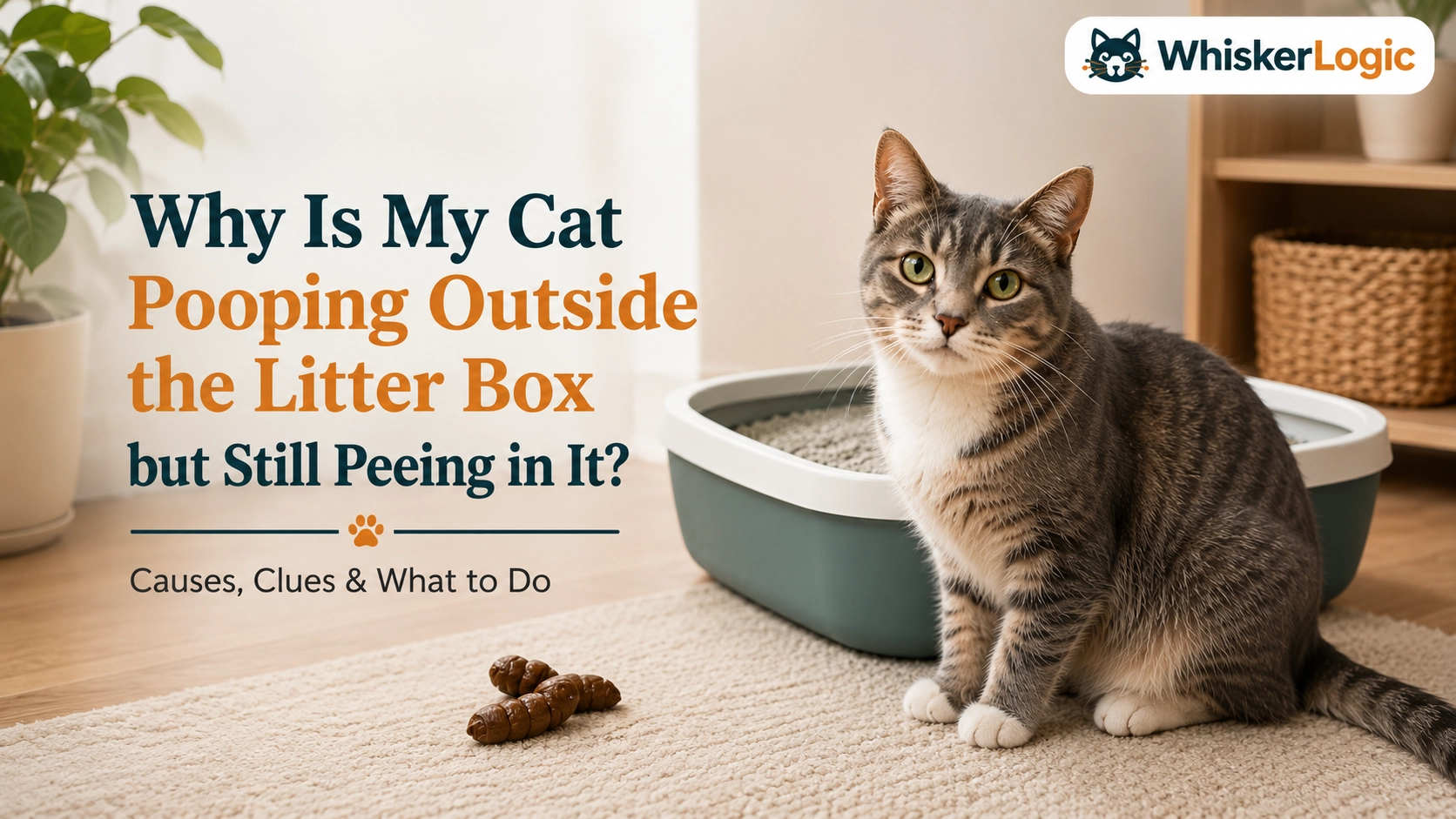
If you have a cat pooping outside litter box but peeing in it, that split is an important clue. Your cat is still using the box for urination, but something may be making defecation different.
The reason could involve the bowel movement itself—such as discomfort, straining, or urgency—or something about using the box to poop, including its size, entry height, litter, cleanliness, location, or accessibility. Some cats may also develop a preference for another surface or location, while cats in multi-cat homes may have trouble accessing a box without tension from another cat.
The key is not to assume that this is simply a behavioral problem. Start with what your cat is passing, then watch what happens at the litter box, and use those observations to decide what to check next.
Quick Answer
When a cat pees in the litter box but poops outside it, first check whether anything about the stool or the act of defecating has changed.
Look for hard or unusually dry stool, diarrhea, straining, repeated attempts, urgency, or signs of discomfort. If those are absent, watch an actual litter-box visit if possible. Does your cat enter and leave? Perch on the edge? Struggle to turn around? Keep the rear end outside the box? Defecate immediately beside it?
Those details can help you decide whether to investigate a medical issue, the physical litter-box setup, a litter or location preference, or access problems involving another cat.
The pee/poop split is a clue—not a diagnosis.
Vet Check
Litter-box changes can have medical causes, even when a cat still uses the box for urination.
Contact your veterinarian if your cat repeatedly strains, repeatedly tries to defecate without producing stool, appears painful or distressed, or develops hard or unusually dry stool, persistent diarrhea, vomiting, reduced appetite, lethargy, or a significant change in normal stool or behavior.
One additional safety point matters: owners cannot always tell whether a cat in the litter box is straining to urinate or defecate. If your cat is repeatedly straining and you are unsure which is happening—especially if little or no urine is being produced—seek veterinary care promptly.
Do not give your cat human laxatives or other medications unless your veterinarian specifically directs you to do so.
Table of Contents
Cat Pooping Outside Litter Box but Peeing in It: What the Split Tells You
If your cat still pees in the litter box, you know the box is still being used for urination.
What you don’t know is why defecation is happening elsewhere.
The pattern does not prove that the problem is behavioral. It does not rule out digestive discomfort, and it does not prove that the litter-box setup works equally well for a bowel movement.
The Cornell Feline Health Center explains that medical problems can interfere with normal elimination. Digestive tract problems, for example, can make defecation painful, increase frequency or urgency, or decrease a cat’s control over defecation. Cornell also identifies litter-box aversion and preferences for particular surfaces or locations as possible contributors to house-soiling.
A cat with an aversion to some aspect of the box may still use it inconsistently. That makes continued urination in the box useful information, but not evidence that everything about the box is acceptable.
If your cat has the opposite pattern—pooping in the box but urinating elsewhere—see Why Is My Cat Peeing Outside the Litter Box but Still Pooping in It?.
First, Look at the Poop
Before changing the litter-box setup, look at the bowel movement itself.
You are not trying to diagnose your cat from the stool. You are looking for observations that tell you whether veterinary evaluation should come before environmental troubleshooting.
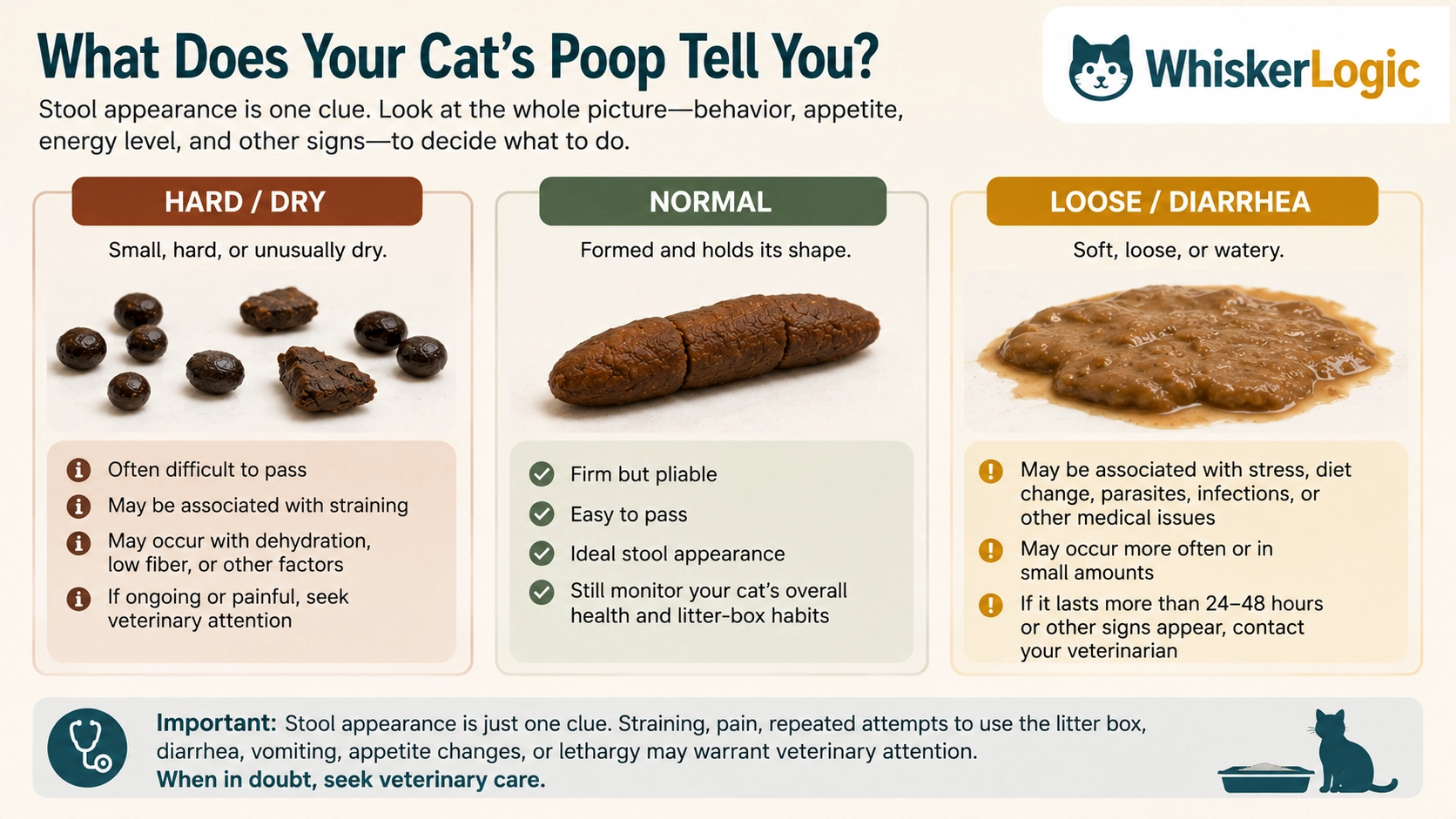
Hard or unusually dry stool
Hard, dry stool—especially when accompanied by straining or difficulty passing it—makes discomfort during defecation more important to investigate.
Watch for repeated attempts, unusually small amounts of stool, obvious discomfort, changes in appetite, vomiting, lethargy, or other changes from your cat’s normal behavior.
Do not assume that pooping outside the box proves constipation, and do not try to treat suspected constipation with human laxatives.
Loose stool, diarrhea, or urgency
Loose stool or diarrhea changes the situation in a different way.
Digestive problems can increase the frequency or urgency of defecation and may reduce a cat’s ability to reach the usual elimination area in time.
A sudden or significant stool change, persistent diarrhea, or diarrhea accompanied by other signs of illness deserves veterinary attention rather than repeated experimentation with litter boxes.
Normal-looking stool
If the stool looks normal and your cat otherwise appears comfortable, move to the next clue:
Don’t just look at where the poop ends up. Watch the attempt that comes before it.
Watch What Happens at the Litter Box
This is one of the most useful steps when troubleshooting a cat pooping outside the litter box but peeing in it.
If possible, quietly observe more than one litter-box visit without interrupting your cat.
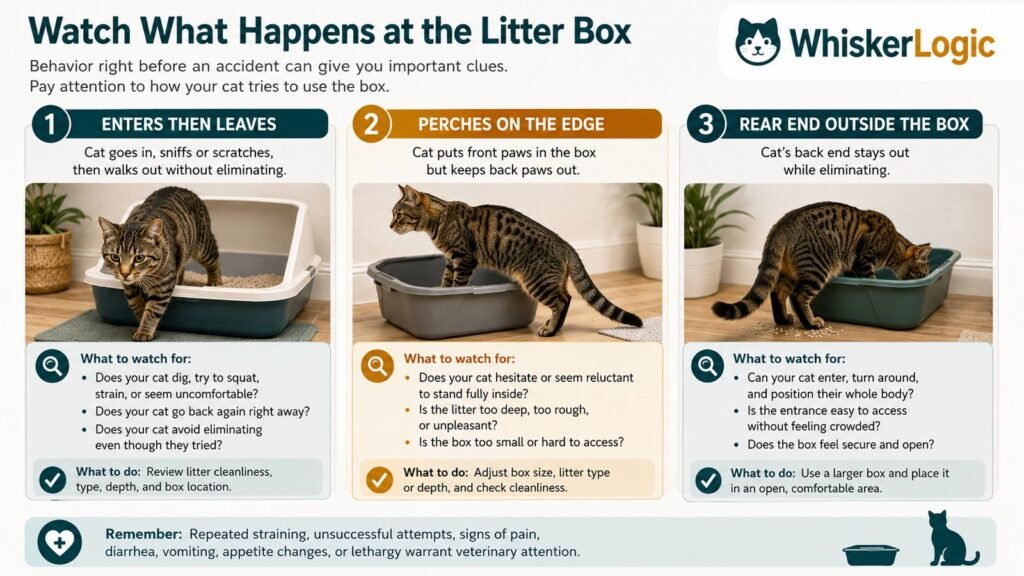
Your cat enters, then leaves without pooping
Watch the sequence rather than just the outcome.
Does your cat:
- enter and sniff?
- dig and then stop?
- try to squat?
- leave suddenly?
- return repeatedly?
- strain without producing stool?
Repeated unsuccessful attempts or signs of pain shift the priority toward veterinary evaluation.
If your cat enters comfortably but repeatedly chooses not to defecate there, look more closely at the box and litter.
Your cat perches on the edge
Cornell specifically recommends paying attention when a cat perches on the edge without touching the litter, refuses to bury waste, cries while using the box, or eliminates right near it.
Perching does not diagnose the problem. Instead, it gives you useful questions.
Is the litter unpleasant underfoot?
Is the box dirty?
Does the cat appear cramped?
Was the litter recently changed?
Does the cat seem reluctant to put all four paws inside?
Your cat’s rear end stays outside the box
Sometimes the cat appears to be making a genuine attempt to use the litter box, but the feces land outside because the body is not fully positioned inside.
Watch whether your cat can comfortably enter, turn, dig, and position the entire body.
If the box looks cramped during these movements, testing a larger box is reasonable.
Your cat poops right beside the box
Reaching the litter-box area but defecating beside it is useful information.
Look at what happened immediately before the accident.
Did your cat enter the box first?
Did it put only the front paws inside?
Did it sniff the litter and leave?
Did it seem reluctant to climb over the edge?
Did another cat approach?
The fact that the poop is beside the box cannot identify the cause by itself. But the behavior leading up to it can help narrow down what to check next.
Check Whether the Box Works for Pooping
Once you have looked for medical warning signs and observed your cat’s behavior, inspect the litter-box setup itself.
Check the box size
Your cat should have enough room to stand and turn around comfortably.
The Ohio State University Indoor Pet Initiative notes that larger boxes provide more room for movement and recommends a box large enough for a cat to stand on all four feet and turn around.
Instead of judging the box only by its dimensions, watch your cat use it.
Can your cat enter easily?
Can it turn without repeatedly hitting the sides?
Can it dig and position its body comfortably?
Does the rear end remain inside?
If not, a larger box is a sensible variable to test.
Check entry height and accessibility
The box that worked when your cat was younger may become harder to use with age or reduced mobility.
Low-sided boxes can make entry and exit easier for older cats or cats that have difficulty climbing over a high edge.
Also inspect the entire route.
Does your cat need to climb stairs, jump over something, squeeze through a tight space, or pass another animal to reach the box?
Accessibility means more than simply having a litter box somewhere in the house.
Check the litter
Litter texture and scent can influence whether a cat wants to use a box.
Ohio State notes that many cats prefer fine-grained, unscented litter and that scented or deodorizing litters can be off-putting to some cats.
Timing can provide a useful clue.
If the problem began shortly after switching litter brands, textures, scents, or formulas, consider whether the change coincided with the new behavior.
When practical, avoid changing every litter box abruptly. Offering an alternative makes it easier to see whether your cat actually prefers the different substrate.
Check cleanliness
A box can be acceptable at one point in the day and less attractive after it has already been used.
Cornell notes that some cats refuse to use a box containing urine or feces, while Ohio State recommends daily scooping.
This becomes especially relevant if your cat urinates in the box earlier and then defecates elsewhere later.
Ask a simple question:
What condition is the box actually in when my cat needs to poop?
In a multi-cat home, check more frequently because several cats can soil the available boxes quickly.
Check covered versus uncovered boxes
A covered box is not automatically wrong.
Some cats may prefer the additional privacy. Others may prefer an uncovered setup.
Covered boxes also concentrate odors more than uncovered boxes, according to Ohio State, which makes cleanliness particularly important.
If your cat seems reluctant to enter a covered box or uncomfortable once inside, offering a large, clean, uncovered alternative can help you test whether the box style matters.
Could Your Cat Prefer a Different Place to Poop?
The next clue is not just that your cat is pooping outside the box, but where it keeps happening.
Look for a repeated surface
Does your cat repeatedly choose the same type of surface?
Examples might include:
- carpet
- a bath mat
- clothing
- bedding
- a smooth floor
Cornell notes that cats can develop preferences for particular elimination surfaces and may repeatedly choose the same type.
A repeated surface is therefore information.
Compare it with the litter currently available. Is the chosen surface softer? Smoother? More stable underfoot?
The goal is not to immediately redesign every box. It is to identify a pattern that can guide your next test.
Look for a repeated location
A cat can also develop a preference for a particular location.
If the poop repeatedly appears in the same area, examine what that place offers.
Is it quieter than the litter-box area?
Is it easier to reach?
Is there more room?
Can your cat see what is approaching?
Does the current litter-box location contain noise, foot traffic, or another pet?
Cornell notes that placing a litter box in a cat’s preferred elimination location can sometimes help address an established location preference.
This can also function as a useful test: if the cat begins using a box when it is placed at the chosen location, the location itself may be an important part of the problem.
Don’t treat it as revenge
A cat pooping outside the litter box is not good evidence that the cat is angry with you or deliberately trying to punish you.
Punishment does not identify or correct the underlying reason.
Cornell advises against hitting, kicking, screaming at, or rubbing a cat’s face in waste. Fear and anxiety can make house-soiling problems worse.
Treat the accident as evidence to investigate, not misconduct to punish.
What Changes in a Multi-Cat Home
When several cats live together, there is another question to ask:
Can this cat use the litter box comfortably without interference from another cat?
Do not look only for fights.
The 2024 AAFP Intercat Tension Guidelines emphasize that tension between household cats can be subtle and may not be recognized by owners.
Observe what happens around litter-box routes and exits.
For example, does another cat frequently:
- occupy the route to the box?
- stare from nearby?
- follow the cat toward or away from the area?
- wait near the exit?
- chase the cat afterward?
These observations do not prove that intercat tension is causing the pooping problem. They tell you whether safe access deserves closer investigation.
Cornell specifically recommends considering whether another animal threatens a cat while it is in the litter box or as it exits. It also recommends providing boxes in locations with more than one way out.
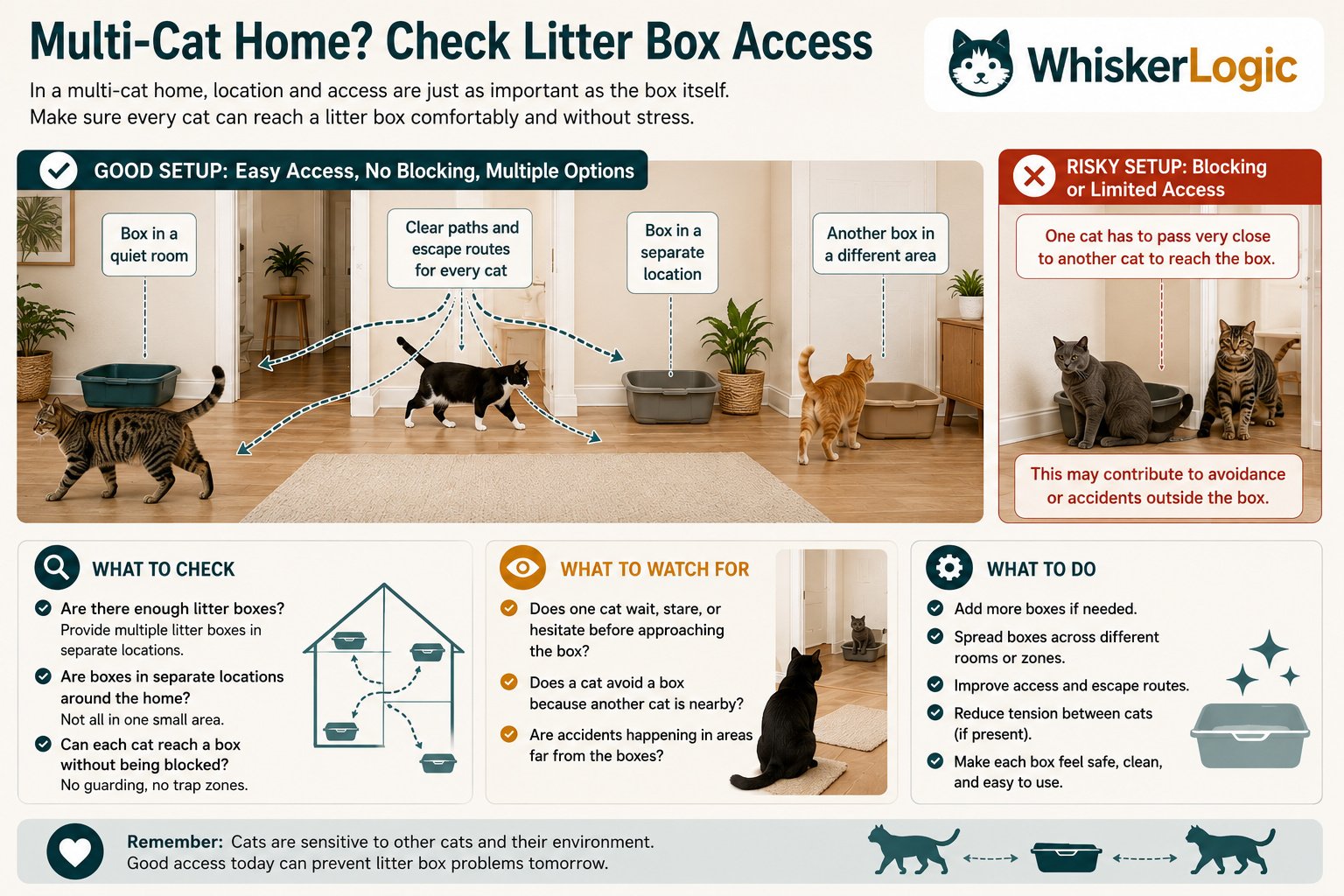
Distribute litter boxes instead of clustering them
A common starting recommendation is one litter box per cat, plus one extra.
But the number alone is not the whole solution.
Cornell recommends multiple boxes in multiple locations.
If several boxes are lined up together in one room, a cat that feels uncomfortable entering that area still has few meaningful alternatives.
Spread boxes across accessible locations when possible so one cat cannot easily interfere with access to every option.
What to Try, in Order
If your cat is pooping outside the litter box but peeing in it, avoid changing everything at once.
Use what you have observed to make targeted changes.
1. Rule out warning signs first
If you notice straining, repeated unsuccessful attempts, pain, significant stool changes, vomiting, reduced appetite, lethargy, or uncertainty about whether your cat can urinate normally, contact your veterinarian.
2. Observe the litter-box attempt
If your cat appears comfortable, watch what actually happens at the box.
The difference between refusing to enter, entering and leaving, perching, hanging over the edge, and being interrupted by another cat can point you toward different things to investigate.
3. Fix obvious physical problems
If the box is cramped, try a larger one.
If entry is difficult, offer a lower entrance.
If the route is obstructed or difficult, improve accessibility.
4. Keep the box consistently clean
Scoop at least daily and check boxes more frequently when several cats use them.
Pay particular attention to whether the box is already soiled when your cat typically needs to defecate.
5. Test litter or location clues
If your cat repeatedly chooses a specific surface or location, use that pattern rather than guessing.
Change one major variable at a time when practical so you can tell whether the change helps.
6. Improve options in a multi-cat home
Provide boxes in multiple accessible locations and watch for subtle interference around them.
The goal is not merely to increase the number of boxes. It is to provide genuinely usable alternatives.
7. Reassess
After a targeted change, observe the pattern again.
Is your cat now pooping inside the box?
Is it entering more readily?
Is the poop still landing immediately outside?
Has the preferred accident location changed?
Are there new stool changes?
If the problem persists despite an appropriate setup—or you remain concerned about discomfort—consult your veterinarian.
When to Call Your Veterinarian
A new or persistent change in where your cat defecates deserves veterinary consideration because medical and behavioral/environmental factors can overlap.
Contact your veterinarian if you notice repeated straining, difficulty passing stool, repeated unsuccessful attempts to defecate, persistent diarrhea, hard or unusually dry stool, obvious pain, vomiting, reduced appetite, lethargy, or another significant change from your cat’s normal condition.
Cornell recommends veterinary examination when a cat develops house-soiling because medical conditions can interfere with normal elimination, and affected cats may not always appear obviously sick.
If your cat repeatedly strains in the litter box and you cannot tell whether the problem is urination or defecation, do not assume it is constipation. Little or no urine production—particularly with repeated attempts—requires prompt veterinary attention.
A veterinarian can use your observations, your cat’s history, a physical examination, and appropriate diagnostic testing to investigate the underlying cause.
Frequently Asked Questions
Why is my cat pooping outside the litter box but peeing in it?
The pattern can occur when something affects defecation specifically or when some aspect of the litter-box setup works for urination but not consistently for bowel movements.
Possible contributors include digestive discomfort or urgency, difficulty positioning or entering the box, litter or cleanliness issues, surface or location preferences, reduced mobility, and interference from another cat.
The pattern itself cannot tell you which explanation is correct. Start with stool and warning signs, then observe what your cat actually does at the box.
Why does my cat poop right next to the litter box?
Pooping right beside the box can happen even when a cat reaches the correct area.
Watch whether your cat enters first, perches on the edge, has difficulty positioning the whole body inside, avoids stepping into the litter, or is interrupted around the box.
Then check size, entry height, litter, cleanliness, accessibility, and the surrounding environment.
If the problem is specifically urinating beside the box, see Why Is My Cat Peeing Right Next to the Litter Box?.
Should I get a bigger litter box?
A larger box is worth testing if your cat appears cramped, has trouble turning, frequently perches on the edge, or positions the rear of the body outside.
The box should allow your cat to stand and turn around comfortably.
Should I change the litter?
Consider it if your cat appears reluctant to stand or dig in the current litter, repeatedly chooses another type of surface, or the problem began after a litter change.
Many cats prefer fine-grained, unscented litter.
Rather than changing everything simultaneously, testing an alternative can make your cat’s preference easier to interpret.
Can constipation cause a cat to poop outside the litter box?
Difficulty or discomfort during defecation can contribute to litter-box problems, but pooping outside the box alone does not diagnose constipation.
Hard or unusually dry stool, straining, repeated attempts, or other changes should be discussed with your veterinarian.
Do not give human laxatives without veterinary direction.
Can another cat cause litter-box problems without fighting?
Yes. Intercat tension can be subtle.
Watch for patterns around litter boxes such as blocking access, staring, following, waiting nearby, or chasing after another cat leaves the area.
Those behaviors do not automatically prove the cause, but they are reasons to examine whether your cat has safe access to boxes in multiple locations.
Should I punish my cat for pooping outside the litter box?
No.
Punishment does not address medical discomfort, box aversion, access problems, or surface and location preferences. It can also increase fear or anxiety.
Instead, use the accident as a clue: check the stool, observe the next litter-box attempt, inspect the setup, and seek veterinary evaluation when appropriate.
sources
Cornell University College of Veterinary Medicine — Feline Behavior Problems: House Soiling
Ohio State University College of Veterinary Medicine — Indoor Pet Initiative: Litter Boxes
Merck Veterinary Manual — Disorders of the Stomach and Intestines in Cats
Merck Veterinary Manual — Providing a Litter Box for a Cat
Feline Veterinary Medical Association — 2024 AAFP Intercat Tension Guidelines
AAFP and ISFM Guidelines for Diagnosing and Solving House-Soiling Behavior in Cats