
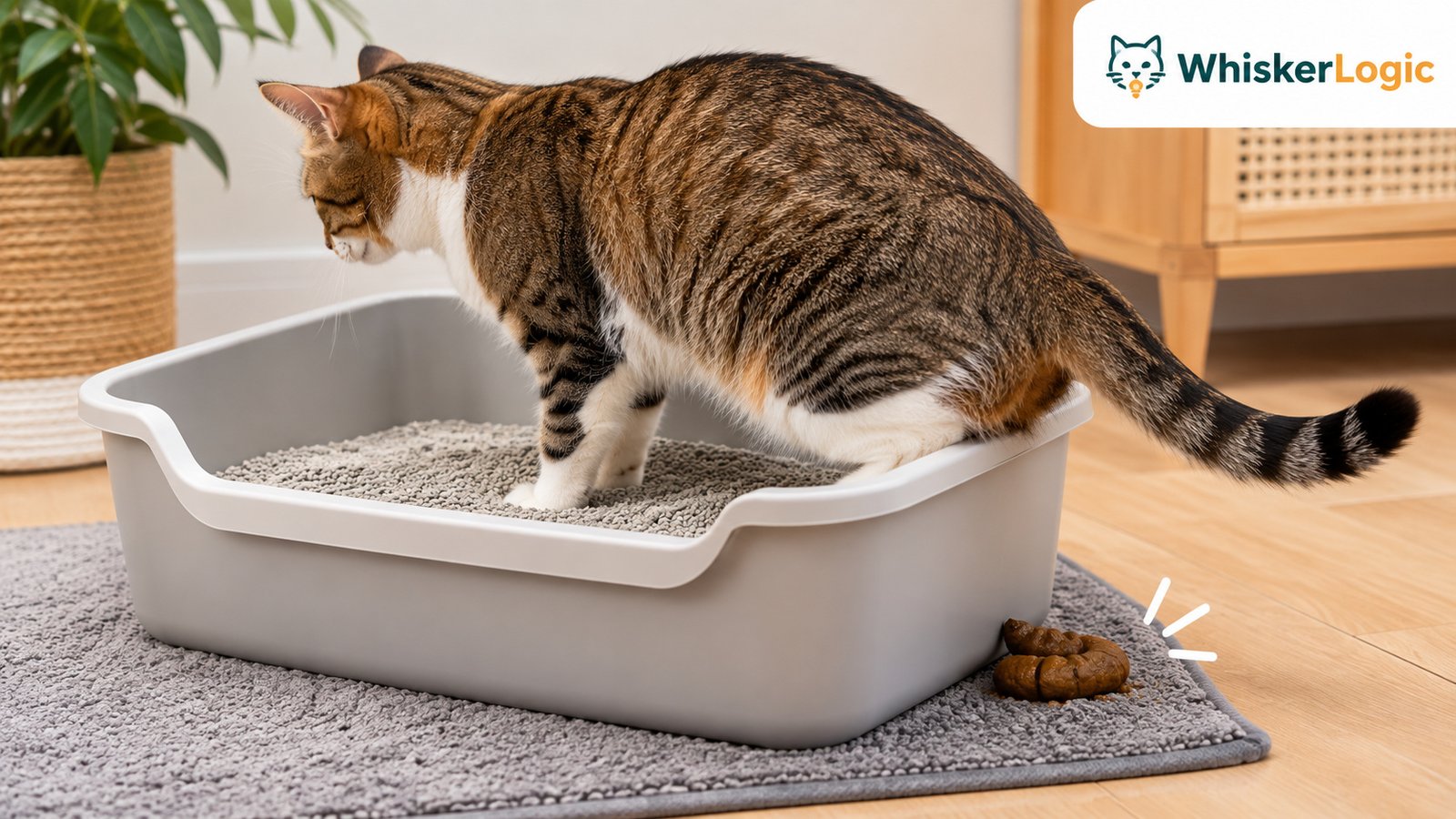
Cat pooping right next to the litter box? The location itself is useful information. Your cat reached the litter-box area, so the most useful question is not simply, “Why is my cat pooping outside the box?” It is what happened when your cat got there.
A cat that gets inside but positions its rear end over the edge presents a different troubleshooting problem from a cat that approaches the box and refuses to enter. Watching that sequence can help you decide what to check first.
Quick Answer
If your cat is pooping right next to the litter box, watch exactly what happens before the stool lands there.
- Gets inside but misses the box: Check box size, entry, positioning, and mobility.
- Approaches but won’t enter: Check cleanliness, litter, box design, and accessibility.
- Enters but quickly leaves: Watch for difficulty positioning, discomfort, or something disturbing the cat.
- Hesitates or gets interrupted near the box: Check the location, escape routes, and whether another cat affects access.
- Strains or has changed stool or bowel habits: Put veterinary evaluation ahead of litter-box experiments.
The fact that the poop is beside the box is a clue, not a diagnosis.
Vet Check
Do not automatically assume that pooping beside the litter box is behavioral.
Contact your veterinarian if you notice repeated straining, hard or unusually dry stool, diarrhea, unusual urgency, obvious pain or distress, repeated unsuccessful attempts to defecate, vomiting, reduced appetite, lethargy, significant or persistent stool changes, sudden onset of the behavior, or difficulty walking, climbing, or getting into the box.
Medical problems can affect the comfort, frequency, urgency, or control of defecation, while mobility problems can make normal litter-box use more difficult.
Do not give your cat human laxatives, medications, or other treatments unless your veterinarian specifically instructs you to do so.
Table of Contents
Cat Pooping Right Next to the Litter Box: Why Location Is a Useful Clue
Finding poop immediately beside the litter box does not prove that the box itself is the problem. But it narrows the situation enough to ask better questions.
The Merck Veterinary Manual includes details about elimination and the litter-box setup when evaluating feline house-soiling, including factors such as box size, location, cleaning, substrate, and the home environment.
Cornell Feline Health Center describes several broad contributors to house-soiling, including medical problems, aversion to some aspect of the litter box, and preferences involving location or substrate.
That means the exact location of the poop becomes useful when you combine it with what your cat actually does:
- Fully enters but misses: Focus first on positioning, space, entry, and mobility.
- Enters and leaves before pooping: Watch what interrupts the normal sequence.
- Approaches but refuses to enter: Examine the box, litter, cleanliness, accessibility, and immediate environment.
- Hesitates or seems rushed: Look for disturbances or social interference around the box.
- Shows changes in stool or defecation: Move medical evaluation higher on the list.
The location tells you where to start investigating. It does not tell you the cause by itself.
First, Watch What Your Cat Actually Does
Before changing several things at once, observe one or more litter-box visits if you can do so without disturbing your cat.
You are looking for the sequence immediately before the accident.
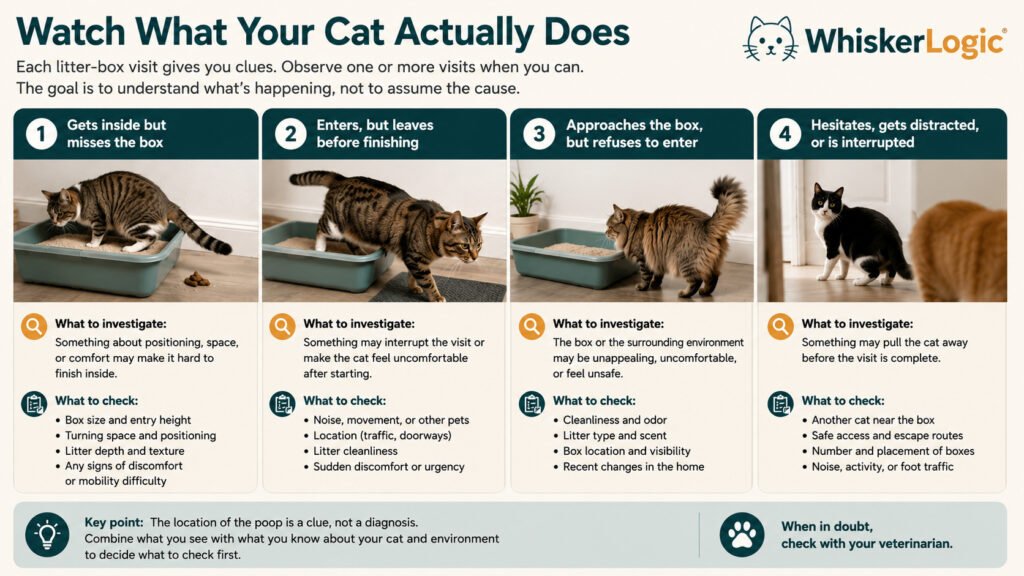
Your cat enters the box, but the poop lands outside
Check where your cat’s body is when it starts to squat.
Some cats get into a box but position themselves close enough to an edge that the rear of the body remains over or beyond it.
Watch whether your cat:
- has enough room to turn and reposition;
- repeatedly uses the same edge;
- keeps its rear end near or beyond a side;
- appears cramped while squatting;
- has difficulty moving farther into the box.
If this happens consistently, testing a larger, easy-to-enter box is more useful than assuming your cat has deliberately stopped using the litter box.
Your cat enters, then leaves before pooping
Ask one question:
What happens while your cat is inside?
Does your cat step in and immediately turn around? Dig and then leave? Repeatedly try to position itself? Appear uncomfortable?
Do not assign a cause from one behavior alone.
Instead, look for a pattern and note whether it occurs alongside stool changes, straining, a dirty box, a recent litter change, difficulty positioning, or a disturbance around the box.
Your cat approaches the box but refuses to enter
Now the box itself becomes a stronger troubleshooting target.
Check:
- Is it clean?
- Has the litter changed?
- Is the litter strongly scented?
- Is the entrance difficult to step over?
- Is the box covered or enclosed?
- Has the box recently been moved?
- Is something noisy or unpredictable nearby?
- Does another pet frequently occupy or pass through the area?
The Ohio State University Indoor Pet Initiative emphasizes litter-box characteristics such as size, accessibility, cleanliness, litter, and location when creating an appropriate toileting setup.
When practical, avoid changing every variable simultaneously. A controlled change gives you more information about what actually helps.
Your cat hesitates or seems rushed around the box
Look beyond the container itself.
Watch what happens as your cat approaches and leaves.
Does another cat follow?
Does another cat wait nearby or occupy a narrow route?
Does your cat repeatedly look around instead of settling?
Does it rush out?
Is there only one practical way into or out of the area?
These observations are especially important in a multi-cat home.
Check the Box Size and Entry
If your cat actually gets into the litter box before the accident, look carefully at the usable space.
A cat needs enough room not only to stand in the box but also to enter, turn, position, squat, and leave comfortably.
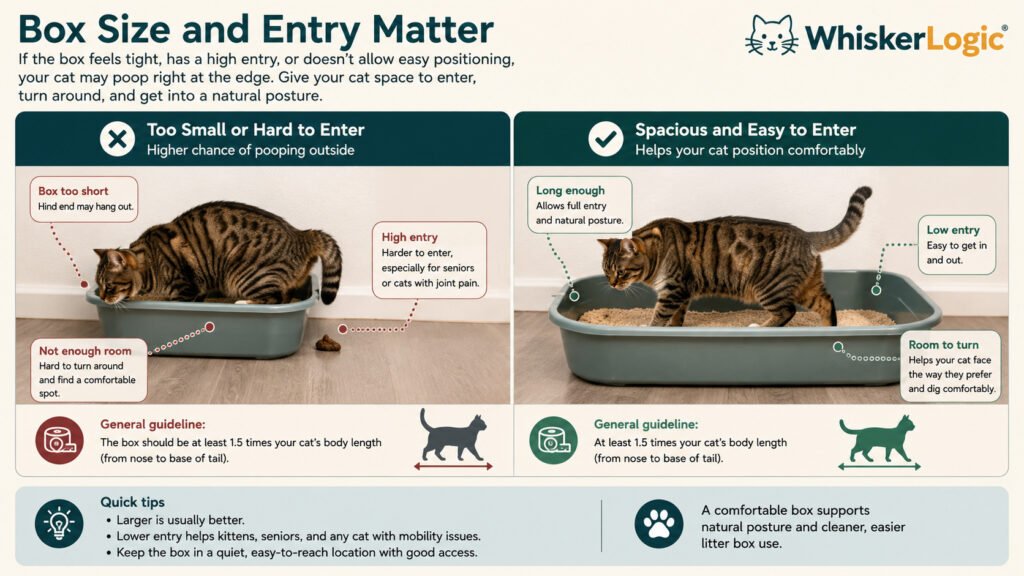
Litter-box guidance from Ohio State University’s Indoor Pet Initiative emphasizes adequate size and accessibility. Professional feline guidance also commonly uses a box roughly 1.5 times the cat’s length from the nose to the base of the tail as a practical starting point for sizing.
Treat that as a guideline, not a magic measurement. Your cat’s actual movement inside the box matters more than whether the box technically meets a number.
If your cat consistently enters willingly but leaves its rear end over an edge, test a substantially larger box and see whether its positioning changes.
If the cat appears reluctant or physically unable to step over the entrance, easier access may matter more than higher sides.
This creates an important distinction:
Rear end over the edge + easy entry → test more usable space.
Difficulty getting into the box → test easier access and consider whether mobility has changed.
Check the Litter and Cleanliness
If your cat reaches the box but seems reluctant to stand or remain in it, examine the surface and condition of the box.
Cats can develop preferences or aversions involving litter characteristics, and keeping litter boxes clean is an important part of appropriate litter-box management.
Start by asking:
What changed?
Look for recent changes involving:
- litter brand or texture;
- scented litter;
- liners;
- deodorizers;
- cleaning products;
- box style;
- litter depth;
- box location.
Then check cleanliness.
Scoop regularly and keep the box clean and dry. But do not assume that finding a dirty box after an accident proves that cleanliness caused the problem.
Instead, clean it consistently and observe what happens.
If normal use returns and remains stable, that result is useful troubleshooting evidence.
If nothing changes, move to the next clue rather than repeatedly cleaning or replacing products without a reason.
Could Pooping Be Uncomfortable?
This is where litter-box troubleshooting must stop short of diagnosis.
Problems that affect the digestive tract, defecation, or mobility can contribute to house-soiling. Cornell notes that medical problems may make elimination painful, increase urgency or frequency, or interfere with a cat’s ability to reach or use a litter box normally.
VCA’s guidance on feline house-soiling also emphasizes considering general health, mobility, stool consistency, stool frequency, and what happens during elimination.
The important clue is change.
Pay attention if your cat begins to:
- strain;
- make repeated attempts;
- produce noticeably harder, drier, looser, or otherwise changed stool;
- defecate much more or less frequently;
- appear urgent or uncomfortable;
- have difficulty entering, turning, or squatting.
None of those observations lets you diagnose constipation, colitis, arthritis, gastrointestinal disease, or another condition at home.
They tell you that the problem should not be treated as a simple litter preference issue.
A sudden change in a cat that previously used the box reliably deserves particular attention, especially when it occurs alongside changes in stool, appetite, activity, comfort, or mobility.
Does the Box Location Feel Safe?
A convenient location for people is not necessarily an easy toileting location for a cat.
The cat needs reliable access and a reasonable opportunity to use and leave the box without repeated disturbance.
Cornell Feline Health Center recommends considering accessible locations and whether other animals may bother a cat while it uses or leaves the litter box.
Look at the area from your cat’s perspective.
Is the box:
- beside a loud appliance?
- hidden in a dead-end space?
- behind a difficult door or barrier?
- reached by stairs that have become harder to use?
- in a busy pathway?
- somewhere another pet frequently approaches?
Then compare those environmental details with your cat’s behavior.
A cat that confidently enters the box but consistently misses the edge presents a different problem from a cat that stops approaching whenever another cat appears.
What Changes in a Multi-Cat Home
In a multi-cat household, litter-box access means more than simply counting boxes.
Ask:
Can this particular cat reach, enter, use, and leave a litter box without another cat interfering?
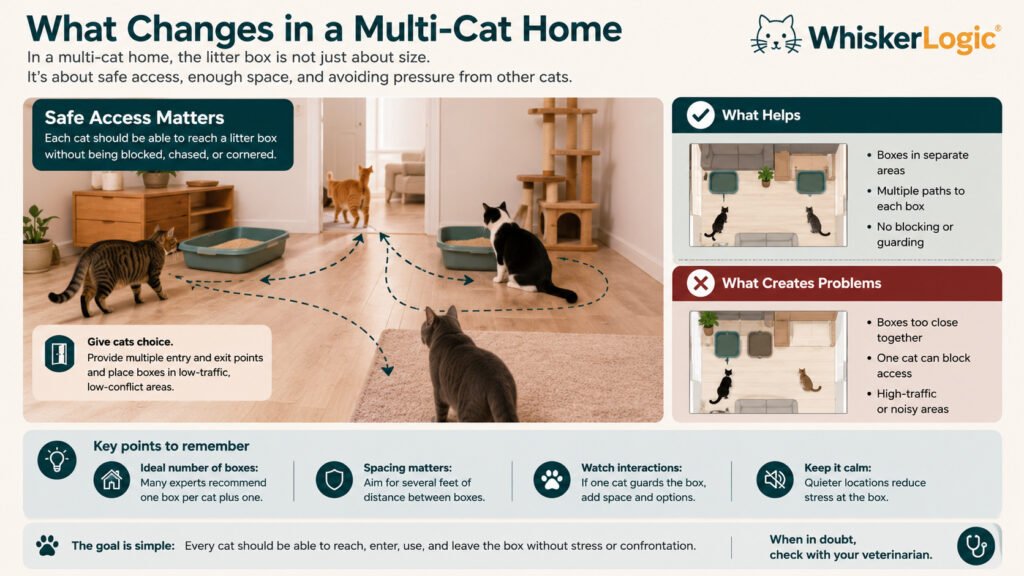
Intercat tension does not always look like a fight.
The 2024 AAFP Intercat Tension Guidelines address the recognition and management of tension between cats sharing a home. Cornell also notes that another animal can interfere with a cat around litter-box use.
Watch for:
- following another cat toward the box;
- waiting near the litter-box area;
- blocking a doorway or narrow route;
- staring or approaching while another cat is eliminating;
- chasing after the cat exits;
- one cat avoiding the area while another is present.
Also consider distribution, not only the total number of boxes.
Several boxes placed together may not provide the same practical choice as boxes in separate, accessible locations.
The AAFP/ISFM House-Soiling Guidelines emphasize addressing both litter-box arrangements and environmental factors when managing house-soiling.
If another cat appears to affect access, provide genuinely separate toileting options rather than simply adding another box beside the existing one.
What to Try, in Order
Do not work through a generic list of litter-box fixes. Start with the branch that matches what you actually observed.
Path 1: Stool or defecation has changed
You observe: Straining, repeated attempts, abnormal stool, urgency, apparent discomfort, sudden onset, or other signs of illness.
What it may mean: A medical contributor needs to be considered.
Next step: Contact your veterinarian rather than beginning with a series of litter or box experiments.
Do not diagnose the cause or treat it with human medications at home.
Path 2: Your cat gets inside but the poop misses the box
You observe: The cat enters willingly, but its rear end remains close to or beyond an edge.
Check: Usable floor space, turning room, entry height, positioning, and whether movement appears normal.
Next step: Test a larger, accessible box and observe whether the cat positions differently.
If the cat seems physically unable to enter, turn, or squat normally, veterinary evaluation becomes more important.
Path 3: Your cat approaches but refuses to enter
You observe: The cat reaches the litter-box area but stops, investigates, or chooses the floor beside it.
Check: Cleanliness, litter, fragrance, box design, entry, recent changes, and anything unpleasant around the box.
Next step: Correct obvious problems and, when practical, offer an alternative setup while keeping the familiar option available.
Then watch which setup the cat chooses.
Path 4: Your cat enters but quickly leaves
You observe: The cat steps inside but does not settle into normal elimination.
Check: Positioning attempts, possible discomfort, litter condition, disturbances, and whether another animal approaches.
Next step: Let the observation determine whether to test the physical setup, investigate the environment, or contact your veterinarian.
Do not assume that entering the box proves the box is comfortable to use.
Path 5: Your cat hesitates or gets interrupted near the box
You observe: Looking around repeatedly, retreating, rushing, waiting for another cat to leave, or being approached during litter-box visits.
Check: Location, noise, escape routes, household traffic, and other animals.
Next step: Provide a quiet, accessible toileting option with less opportunity for interruption. In multi-cat homes, separate resources physically rather than clustering every box together.
Then: Change, observe, reassess
Once medical concerns have been addressed, change one major variable at a time when practical.
For example:
Current box → larger accessible box
or
Current litter → second box offering an appropriate alternative
or
Current location → additional box in a quieter, accessible location
Then observe what happens.
If your cat chooses the alternative consistently or the accidents stop, you have gained useful evidence.
If appropriate box, litter, cleanliness, accessibility, and environmental changes do not resolve the problem, stop cycling through random fixes and discuss the persistent behavior with your veterinarian.
And if your cat still pees normally inside the box but consistently poops outside it, location is no longer your only important clue. Read Why Is My Cat Pooping Outside the Litter Box but Still Peeing in It? for troubleshooting focused specifically on the pee/poop split.
When to Call Your Veterinarian
Contact your veterinarian when pooping beside the box is sudden, persistent, unexplained, or accompanied by changes in defecation, stool, appetite, activity, comfort, or mobility.
Repeated straining, unsuccessful attempts to defecate, obvious distress, vomiting, reduced appetite, lethargy, or significant stool changes should not be treated as ordinary litter-box behavior.
The goal is not to assume that every accident has a medical cause. It is to avoid assuming that a potentially medical problem is behavioral.
When you call, useful information includes:
- when the problem started;
- what the stool looks like;
- how often your cat is defecating;
- whether there is straining or repeated attempts;
- whether appetite or activity has changed;
- exactly what your cat does when approaching and using the box.
Those observations can be much more useful than simply reporting that your cat “won’t use the litter box.”
Frequently Asked Questions
Why does my cat poop right beside the litter box instead of somewhere else?
It suggests your cat is still reaching the litter-box area, but the location alone does not reveal the cause. Watch whether your cat enters, partially enters, refuses to enter, leaves early, or appears interrupted. That sequence tells you what to investigate first.
My cat gets into the litter box, but the poop lands outside. What should I check?
Watch your cat’s positioning. If the rear end consistently extends over an edge, test a larger, accessible box with more room to turn and squat. If your cat appears to have difficulty moving or positioning, especially if this is new, contact your veterinarian.
Why does my cat poop beside the box but still pee inside it?
The pee/poop split is a separate troubleshooting clue. See Why Is My Cat Pooping Outside the Litter Box but Still Peeing in It? for the guide focused specifically on that pattern.
What if my cat also pees right next to the litter box?
Urination beside the box introduces different medical and behavioral considerations. See Why Is My Cat Peeing Right Next to the Litter Box? for the urine-specific situation.
Should I get a bigger litter box?
A larger box is a useful test when your cat willingly enters but appears cramped or repeatedly positions its rear end over an edge. It is not a substitute for veterinary evaluation if your cat is straining, showing abnormal stool, or having difficulty moving.
Should I punish my cat?
No. Punishment does not identify why normal litter-box use has broken down and may add fear or stress.
Focus instead on the evidence: What does your cat do at the box, what has changed, and which physical, environmental, or social factor should you check next?
Sources
- Cornell Feline Health Center — Feline Behavior Problems: House Soiling
- Merck Veterinary Manual — Behavior Problems of Cats
- Merck Veterinary Manual — Providing a Litter Box for a Cat
- Merck Veterinary Manual — Disorders of the Stomach and Intestines in Cats
- Ohio State University Indoor Pet Initiative — Litter Boxes
- VCA Animal Hospitals — Cat Behavior Problems: House Soiling
- FelineVMA — AAFP/ISFM House-Soiling Guidelines
- FelineVMA — 2024 AAFP Intercat Tension Guidelines