
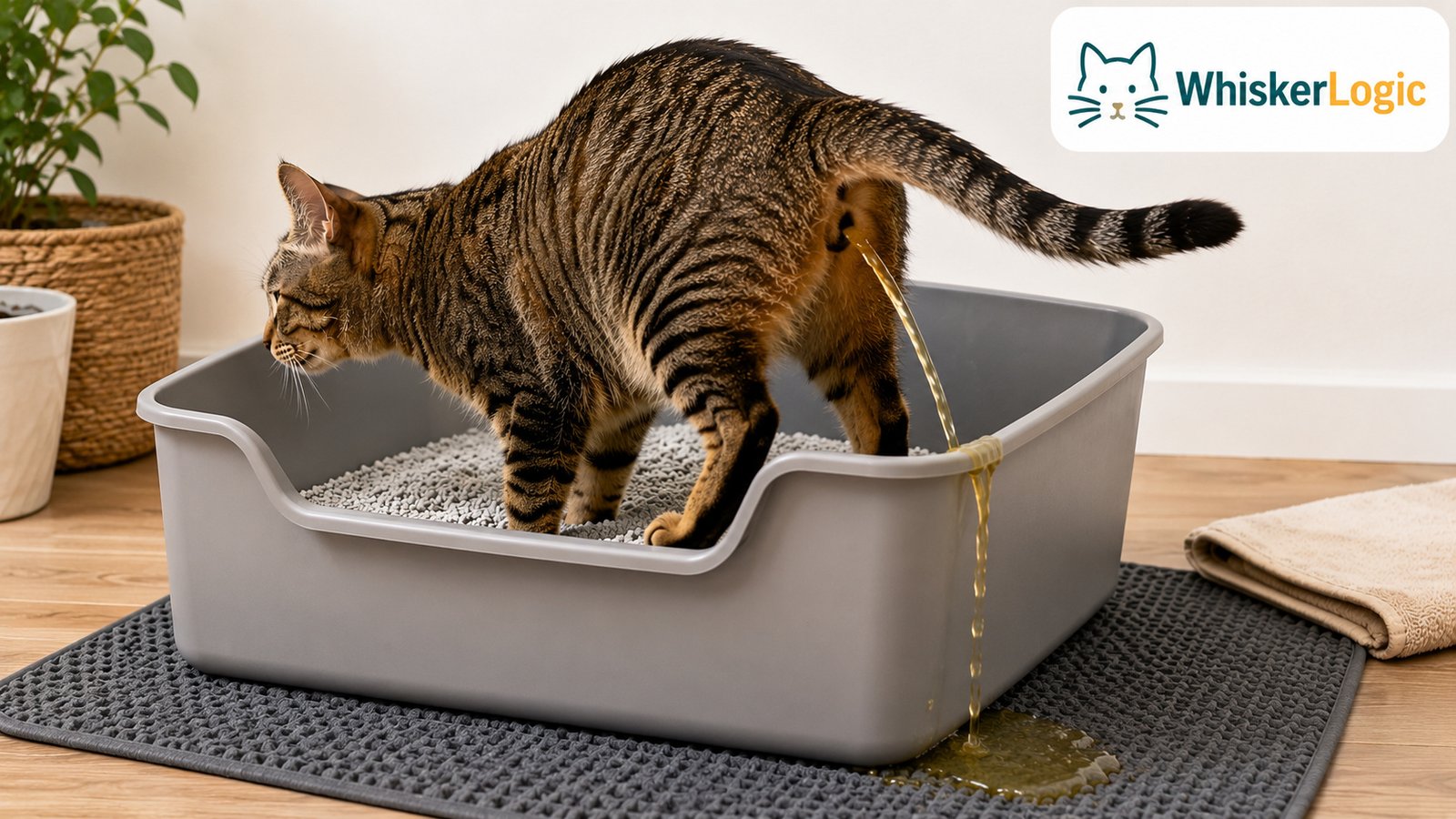
If you’re dealing with a cat peeing over the edge of the litter box, the first question is not simply why the urine is ending up outside. It is how the urine is getting there.
A cat may be fully inside the box but urinate high enough to clear a low wall. Another may position their rear against the edge, enter only partway, or start in a squat and gradually raise their rear. In other cases, what looks like a litter-box miss may actually be urine marking. Watching the position and posture can help you decide what to check next.
Quick Answer: If your cat is using the litter box but urine goes over the edge, first watch one complete urination if possible. Check whether the cat fits comfortably inside the box, where the rear is positioned, whether the cat squats or stands, and whether the posture changes during urination. A larger box may help when space is tight; higher sides may help when the cat fits comfortably but urinates high. A new change in posture, difficulty squatting or entering, or urinary warning signs should shift the priority toward veterinary evaluation rather than simply changing the box.
Vet Check: A change in urination should not automatically be treated as a litter-box design problem. Contact your veterinarian promptly if your cat develops painful or difficult urination, blood in the urine, frequent trips to the box, vocalizing while urinating, excessive genital licking, or a sudden change in urinary behavior or positioning. Repeated attempts or straining with little or no urine require immediate veterinary attention. Urinary obstruction is an emergency, and male cats are at greater risk. As obstruction progresses, cats can become increasingly distressed and may develop systemic signs such as vomiting, lethargy, or loss of appetite. The Cornell Feline Health Center explains the major signs of lower urinary tract disease and the emergency posed by urethral obstruction; the 2025 iCatCare consensus guidelines on lower urinary tract diseases in cats provide additional clinical guidance on urethral obstruction.
Table of Contents
First, Watch How the Urine Gets Over the Edge
Where you find the urine afterward tells you less than seeing what happens while your cat urinates.
If possible, quietly observe one complete litter-box visit without interrupting your cat. A camera pointed toward the box can also help if the problem happens when you are not nearby.
Look for these patterns:
| What you observe | What to check first |
|---|---|
| Cat is fully inside, but urine clears the wall | Urination height, posture, and wall height |
| Rear is pressed against or extends over the edge | Usable floor space and positioning |
| Cat enters only partway | Entry, box size, litter, cleanliness, and willingness to move farther inside |
| Cat begins squatting but raises the rear | Whether this is longstanding or a recent posture change |
| Cat stands and directs a small amount toward a vertical surface | Whether the overall pattern is consistent with urine marking |
| Problem happens mainly with one box | That box’s size, entry, wall height, location, and litter |
| Problem started after replacing the box | Differences between the old and new box |
These are troubleshooting clues, not diagnoses. One observation can have more than one explanation.
This distinction also helps prevent confusion with related litter-box problems. If you are simply finding urine right next to the litter box but have not seen it physically go over the edge, that situation needs a somewhat different investigation.
Is the Litter Box Too Small?
For a cat peeing over edge of litter box walls, one of the first physical factors to check is whether the box provides enough usable space. A cat can technically get inside a litter box without having enough room to use it comfortably.
Pay attention to what happens after your cat enters. Can the cat turn around without squeezing against the walls? Is there room to choose a position and squat without the rear being forced against an edge? Does a large cat appear to occupy nearly the entire floor of the box?
The AAFP/ISFM house-soiling guidelines use a practical recommendation of a rectangular litter box approximately 1.5 times the cat’s length from the nose to the base of the tail.
Treat that measurement as a useful reference point, not a magic cutoff or guarantee. The important question in this situation is whether the box provides enough usable floor space for your cat to enter, turn, position, dig, squat, and eliminate without being pushed toward an edge.
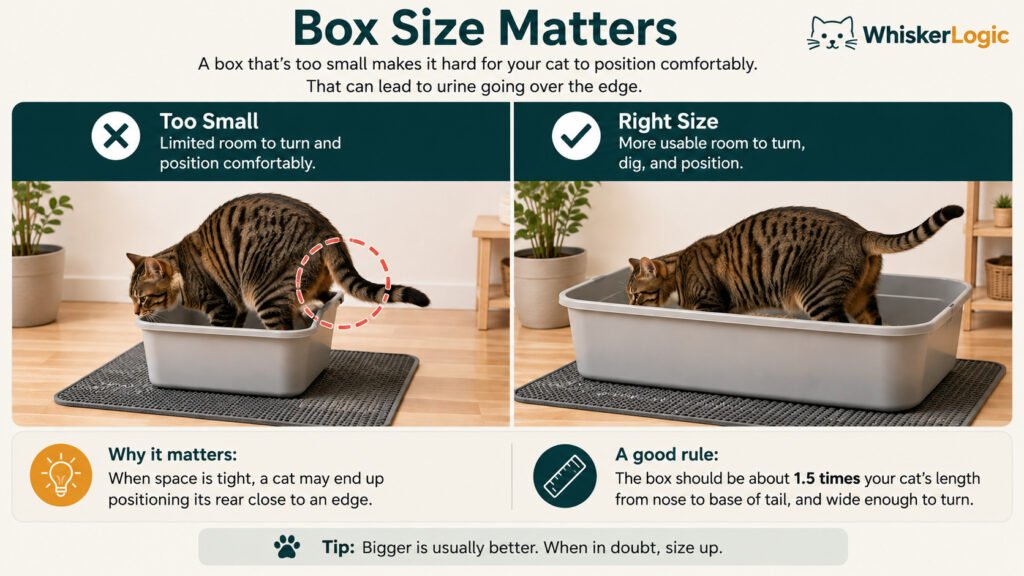
If the rear repeatedly ends up against the wall because the cat has little room to reposition, trying a larger box makes more sense than simply adding taller walls.
Box Size and Wall Height Solve Different Problems
A large box can still have walls too low to contain urine from a cat that urinates high.
A high-sided box can still be too small for the cat to position comfortably.
That distinction matters:
A taller box does not fix an undersized box.
First make sure the cat has adequate usable space. Then decide whether additional containment is actually needed.
Would Higher Sides Help?
Higher sides can be useful when your cat fits comfortably inside the box and uses it reliably, but the urine stream simply clears a low side or back wall.
In that situation, the problem may be less about convincing the cat to use the box and more about matching the box’s containment to the cat’s normal position.
Before switching, check which edge the urine usually crosses. If your cat consistently faces the same direction and urinates toward the back or side, higher walls in those areas may be enough.
But “use a high-sided litter box” is not a universal solution.
A tall wall can create a new problem if the cat has to climb over a high entrance. Kittens, older cats, and cats with mobility limitations may need easier access. Cornell’s house-soiling guidance notes that kittens, older cats, and cats with mobility problems may need boxes that are easier to enter.
In veterinary settings, the 2022 ISFM/AAFP Cat Friendly Veterinary Environment Guidelines describe litter boxes with higher walls and a low entry as one way to combine containment with easier access for unwell cats. The same design principle can be useful to consider at home when a cat needs both urine containment and an easier entrance.
That leads to a useful design concept for some cats:
higher sides and back + a lower entry point.
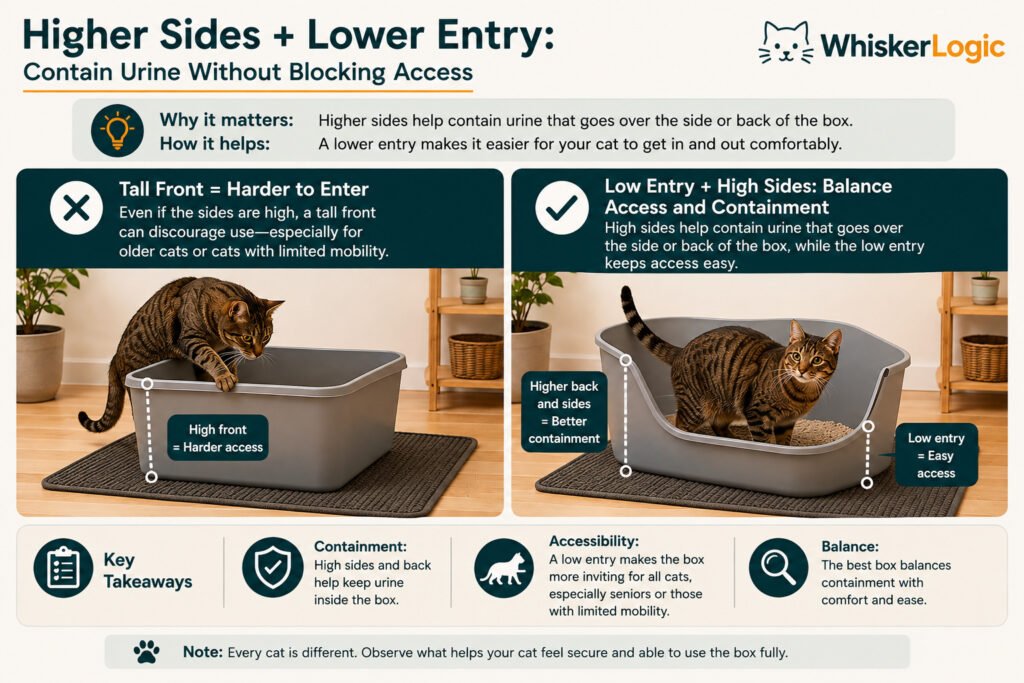
The goal is not simply to build the tallest possible barrier. It is to contain the urine without making the box harder for the cat to enter and use.
Is This Peeing or Urine Spraying?
A cat standing while urinating is not automatically spraying.
Instead, look at the whole pattern.
Ordinary elimination more typically involves a squat and a fuller void directed toward the litter or another horizontal surface. Urine marking more typically involves a smaller amount of urine and is often directed toward a vertical surface.
According to the Cornell Feline Health Center, a typical spraying cat stands with the tail raised and may quiver the tail while depositing a relatively small amount of urine on a vertical surface.
The distinction is useful, but real behavior is not always perfectly textbook. The AAFP/ISFM house-soiling guidelines also note that urine marking can occur on horizontal surfaces.
So do not decide based on posture alone.
Consider several clues together:
- Is the cat squatting or standing?
- Is the tail upright or quivering?
- Is the urine directed toward a vertical surface?
- Does it appear to be a small amount or a normal bladder-emptying volume?
- Does the cat also perform normal urination in the litter box at other times?
- Is the behavior occurring repeatedly in particular locations?
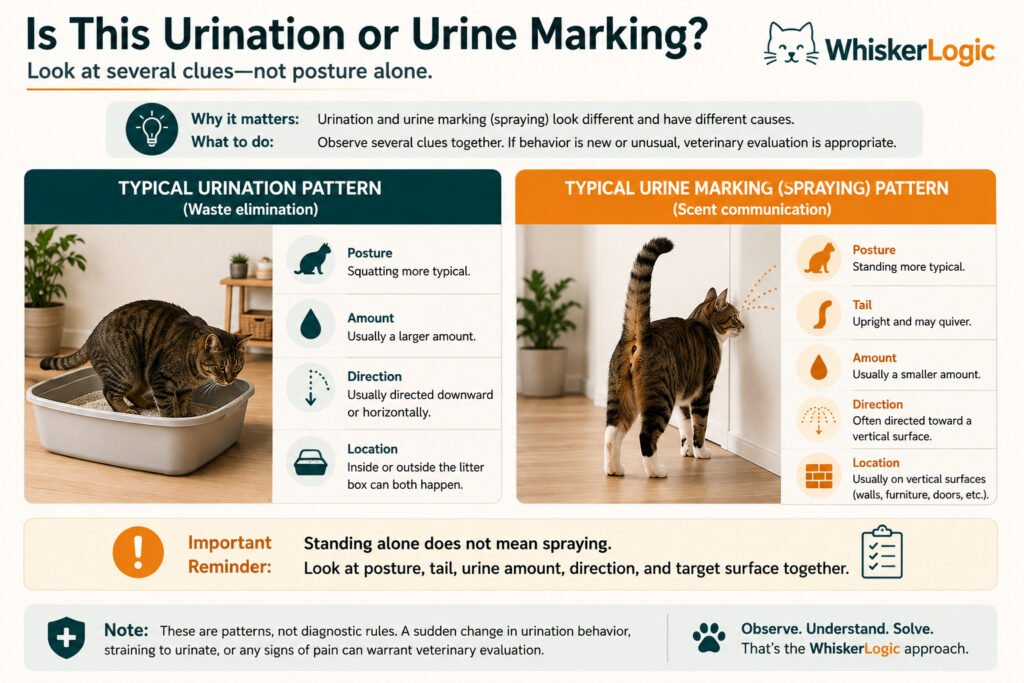
If your cat simply stands relatively high inside the litter box and empties a normal amount of urine over a low wall, that does not by itself establish that the cat is spraying.
Could Pain or Mobility Be Changing the Position?
The most useful question here is often not “Does my cat stand while peeing?” but “Is this different from how my cat used to pee?”
A cat that has always urinated with a relatively high rear may simply need a box that accommodates that posture.
A recent change deserves more attention.
Watch for difficulty:
- stepping over the entrance
- turning around inside the box
- lowering into a squat
- holding a squat
- repositioning the hind end
- climbing into a box that was previously easy to use
Medical problems can interfere with normal elimination or mobility, and cats with medical conditions do not necessarily appear obviously sick. Cornell recommends veterinary evaluation when litter-box problems may have an underlying medical component.
That does not mean an unusual posture proves arthritis, urinary disease, pain, or any other diagnosis. Posture is an observation. A veterinarian is needed to determine whether a medical problem is responsible.
If your cat’s posture or ability to use the box has changed recently, especially alongside other urinary or mobility changes, discuss it with your veterinarian rather than assuming that taller walls will solve the problem.
Check the Litter, Cleanliness, and Box Setup
Not every cat peeing over the edge needs a different type of litter.
This part of the setup becomes more relevant when the cat seems reluctant to put the whole body inside, perches at the entrance, rushes out, or strongly prefers one box over another.
Check whether:
- the problem began after changing the litter or box
- the box contains urine or feces when the cat tries to use it
- the cat puts only the front feet inside
- the cat seems reluctant to step onto the litter
- the problem happens with one box but not another
- a cover or other design feature reduces usable space
- the entrance makes positioning difficult
Cornell notes that the box itself, litter, cleanliness, and location can all affect litter-box use, and that sudden litter changes can contribute to aversion.
Use those factors as clues rather than changing everything at once.
If you replace the box, change the litter, move the box, and alter the litter depth simultaneously, you may fix the problem—but you will have little idea which change mattered.
When there is no urgent medical concern, controlled changes are easier to evaluate.
What to Try, in Order
The fastest route to a useful solution is usually to work from what your cat actually does rather than trying random litter-box changes.
1. Watch One Complete Urination
Determine exactly how the urine crosses the edge.
Is the cat fully inside? Where is the rear? Does the cat squat, stand, or change height? Which wall does the urine cross?
If you have only found a puddle after the fact, avoid assuming that it came over the wall.
2. Check the Usable Size of the Box
Look at the space available after your cat is inside—not just the dimensions printed on the package.
If your cat has little room to turn or repeatedly ends up with the rear pressed against an edge, test a larger box. The professional 1.5-times-body-length recommendation provides a useful starting reference.
3. Check Entry and Positioning
If your cat enters only partially, find out what may be stopping the cat from moving farther in.
Consider the entrance height, interior space, cleanliness, litter, and whether the behavior occurs with every available box.
A cat that comfortably walks all the way into another box is giving you useful comparative information.
4. Decide Whether Containment Is Actually the Missing Piece
If the box is roomy, your cat enters normally, and the urine simply travels over a low side, higher walls become a logical next test.
If your cat needs easier access, consider the combination of a low entry with higher sides or a higher back rather than raising every wall.
5. Check for a Marking Pattern
If the cat stands with the tail raised or quivering, directs a small amount of urine toward a vertical surface, and shows other marking-type behavior, the problem may not be simple litter-box containment.
Do not classify it as spraying just because the cat stands.
6. Compare the Behavior With the Past
A longstanding high urination posture and a sudden inability to squat are not the same situation.
If the posture is new, or your cat now hesitates to enter, turn, squat, or reposition, make veterinary evaluation part of the next step.
7. Stop Troubleshooting the Box if Warning Signs Appear
Do not keep experimenting with box dimensions while a cat is repeatedly straining or attempting to urinate with little or no urine.
That situation needs immediate veterinary attention, not another litter-box modification.
And if observation shows that your cat is actually leaving the box and urinating elsewhere rather than sending urine over the edge, see the separate guide to a cat peeing outside the litter box but still pooping in it.
When to Call Your Veterinarian
Use what you observed to decide whether this still looks primarily like a containment problem or whether veterinary evaluation should move higher on the list.
If your cat has always urinated with a high rear, still produces a normal amount of urine, moves comfortably, and otherwise uses the box normally, adjusting the box size or wall height may be a reasonable next step.
If the posture is new, or your cat now struggles to enter, turn, squat, hold a squat, or reposition, arrange veterinary evaluation rather than assuming the box is the only issue. The same applies if the change occurs alongside blood in the urine, painful urination, increased urinary frequency, vocalization, or excessive genital licking.
There is an important difference between arranging an evaluation and dealing with an emergency:
If your cat repeatedly strains or tries to urinate but produces little or no urine, seek immediate veterinary care.
Do not wait to see whether a new litter box solves that pattern.
Frequently Asked Questions
Why Does My Cat Pee Over the Side of the Litter Box?
The answer depends on how it happens. Some cats fit inside the box but urinate high enough to clear a low wall. Others position their rear against the edge because usable space is limited, enter only partway, or change posture while urinating. A new posture change can also justify veterinary evaluation. Watch one complete urination before deciding which explanation fits best.
Will a High-Sided Litter Box Stop My Cat From Peeing Over the Edge?
It may help if your cat fits comfortably inside the box, enters normally, and simply urinates above a low wall. It is less likely to solve the problem if the box is too small or the cat does not fully enter. If easier access is also important, a lower entrance combined with higher sides or a higher back may be more practical than simply making every wall taller.
How Big Should a Litter Box Be?
AAFP/ISFM guidelines recommend a rectangular litter box approximately 1.5 times the cat’s length from the nose to the base of the tail. Use that as a practical guideline rather than an exact cutoff. Your cat should have enough usable room to enter, turn, position, and eliminate comfortably.
Why Does My Cat Stand Up While Peeing in the Litter Box?
Some cats may urinate from a relatively high position, and standing alone does not prove urine spraying. Look at urine volume, direction, tail position, target surface, and whether the posture is new. If your cat recently stopped squatting normally or seems uncomfortable repositioning, veterinary evaluation is appropriate.
How Can I Tell if My Cat Is Peeing or Spraying?
Typical urine spraying often involves standing with an upright or quivering tail and depositing a smaller amount of urine toward a vertical surface. Normal urination more commonly involves squatting and a fuller void. These are patterns rather than absolute rules, so use several observations together rather than one sign.
Should I See a Vet if My Cat Suddenly Starts Peeing Over the Edge?
A sudden change in urination posture or litter-box behavior is worth discussing with your veterinarian, particularly if your cat also has painful or difficult urination, frequent trips to the box, blood in the urine, vocalization, genital licking, or new difficulty moving or squatting. Repeated straining or attempts to urinate with little or no urine require immediate veterinary attention.
Sources
- Cornell Feline Health Center — Feline Behavior Problems: House Soiling
- Cornell Feline Health Center — Feline Lower Urinary Tract Disease
- AAFP/ISFM — Guidelines for Diagnosing and Solving House-Soiling Behavior in Cats
- ISFM/AAFP — 2022 Cat Friendly Veterinary Environment Guidelines
- iCatCare — 2025 Consensus Guidelines on the Diagnosis and Management of Lower Urinary Tract Diseases in Cats