
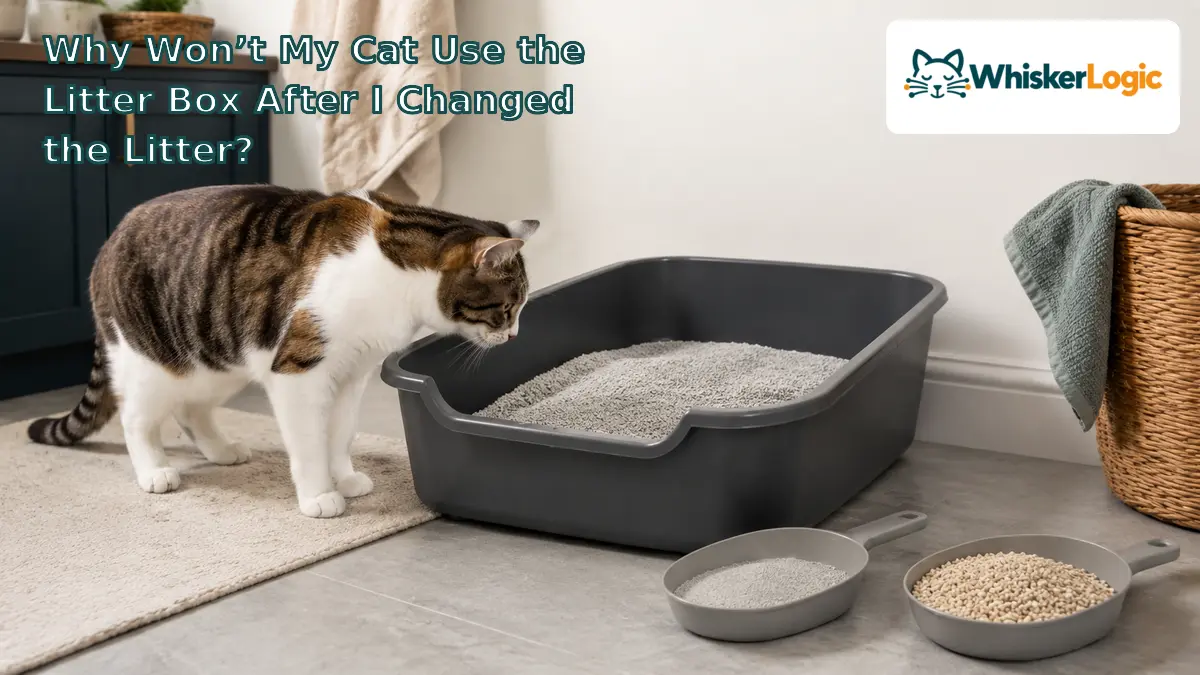
If your cat won’t use the litter box after changing litter, the timing makes the new litter an obvious place to investigate—but it does not prove the litter caused the problem. Your cat may be reacting to a different texture, scent, material, depth, or paw feel. It is also possible that another change happened at the same time, or that pain, access, cleanliness, or social pressure is involved.
The most useful response is not to guess what cats supposedly like. Give your cat access to a familiar option when practical, watch how they interact with each setup, and compare the old and new litter while keeping the other important variables as stable as you can.
Quick Answer
A sudden litter change can matter. Professional guidance identifies substrate characteristics—including texture, scent, particle type, clumping properties, and depth—as factors that may affect litter-box use. Individual cats can still have different preferences.
Start by checking for urinary or other medical warning signs. Then list everything that changed, not just the litter brand. If the previously accepted litter is still safe and available, offer it in a comparable box alongside the new litter. Repeatedly choosing the old litter makes the substrate difference more plausible. Avoiding both tells you to broaden the investigation rather than continuing to blame the new litter.
Vet Check: Do Not Assume It Is Only the New Litter
A behavioral change that follows a litter switch can still coincide with a medical problem. Cats do not always look obviously sick when pain or illness begins affecting litter-box use. The Cornell Feline Health Center’s house-soiling guidance recommends veterinary evaluation because medical conditions can contribute to elimination outside the box.
Contact your veterinarian promptly if your cat shows signs such as:
- Straining or repeated attempts to urinate
- Passing small amounts of urine more often than usual
- Blood in the urine
- Crying, restlessness, or apparent pain around urination
- Vomiting, reduced appetite, unusual hiding, or lethargy
- A sudden, persistent change in litter-box behavior
If your cat repeatedly tries to urinate but produces little or no urine, seek immediate veterinary care. A urethral obstruction is a medical emergency, and male cats are at greater risk. See Cornell’s guidance on feline lower urinary tract disease.
Table of Contents
Cat Won’t Use the Litter Box After Changing Litter: What It Means
The new litter may be relevant because the substrate is the surface your cat must step on, dig in, balance on, and use while eliminating. A change that looks minor to a person may alter the way the box smells, feels under the paws, shifts under the cat’s weight, absorbs moisture, or clumps.
However, the sequence “new litter, then avoidance” shows correlation—not proof of cause. The same behavior can also occur because the box is dirty, difficult to enter, poorly located, associated with discomfort, or inaccessible because of another cat. Sometimes the owner changes the litter, box, liner, depth, cleaning product, and location together without realizing that several variables are now different.
Treat the timing as a clue that tells you where to start testing. Do not treat it as a diagnosis.
First, Figure Out What Actually Changed
Compare the previous and current setups carefully. “A different brand” can involve several changes at once:
- Material: Clay, silica, paper, wood, corn, wheat, or another substrate
- Particle texture and size: Fine and sand-like, coarse granules, crystals, or pellets
- Scent: Unscented, fragranced, or deodorizing additives
- Clumping behavior: Clumping versus non-clumping, or a different type of clump
- Dust and tracking: How much material becomes airborne or sticks to the paws
- Depth: How much litter is in the box
- Movement underfoot: Whether the substrate feels stable or shifts when stepped on
Then ask what else changed during the same period:
- Did you replace the box or add a liner?
- Did you add or remove a cover?
- Did you move the box?
- Did you change cleaning products or deodorizer?
- Did access to the room change?
- Is the new bag being poured to a different depth?
- Did another pet, visitor, construction project, or household disruption appear?
If a cover was added at the same time, you are not testing litter alone. The cover can change usable space, entry, airflow, and visibility. Use the separate guide on why a cat won’t use a covered litter box to distinguish those variables.
Watch How Your Cat Responds to the New Litter
Whenever practical, observe a normal interaction without hovering, placing the cat in the box, or forcing contact. One action alone does not prove the cause, but repeated patterns can help you decide what to test.
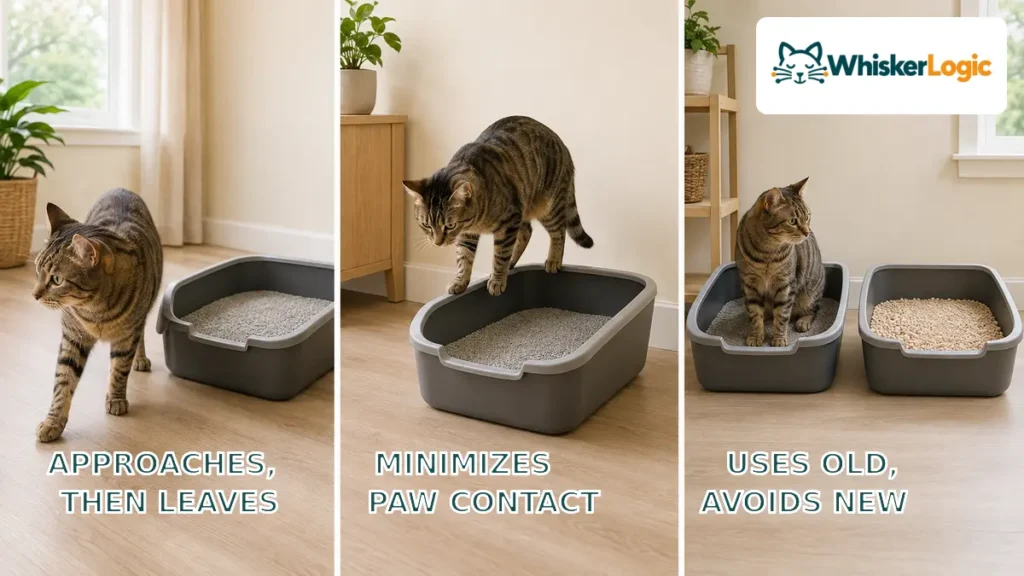
Your cat approaches, sniffs, and walks away
Something about the box, litter, odor, access, or location may be discouraging use. Offer familiar litter in a comparable setup.
Your cat balances on the edge or minimizes paw contact
Discomfort with the substrate becomes more plausible, although dirtiness or physical discomfort can look similar. Compare texture, depth, and cleanliness while retaining a familiar option.
Your cat enters but scratches the side, wall, or air
The substrate may not support the cat’s normal digging or covering behavior, but this sign is not diagnostic. Compare litter types while keeping the box and location stable.
Your cat repeatedly uses the old-litter box and avoids the new-litter box
A substrate difference becomes a stronger working explanation. Identify which characteristic differs and change one variable at a time.
Your cat avoids both old and new litter
The new substrate alone becomes a weaker explanation. Investigate medical, box, access, cleanliness, location, and social factors.
Professional AAFP/ISFM house-soiling guidelines discuss litter preference evaluations and behaviors such as balancing on the box edge. These observations are useful clues, not stand-alone diagnoses.
If the specific pattern is urination immediately beside the box, see why a cat pees right next to the litter box. That location can provide additional clues, but it still does not identify one cause by itself.
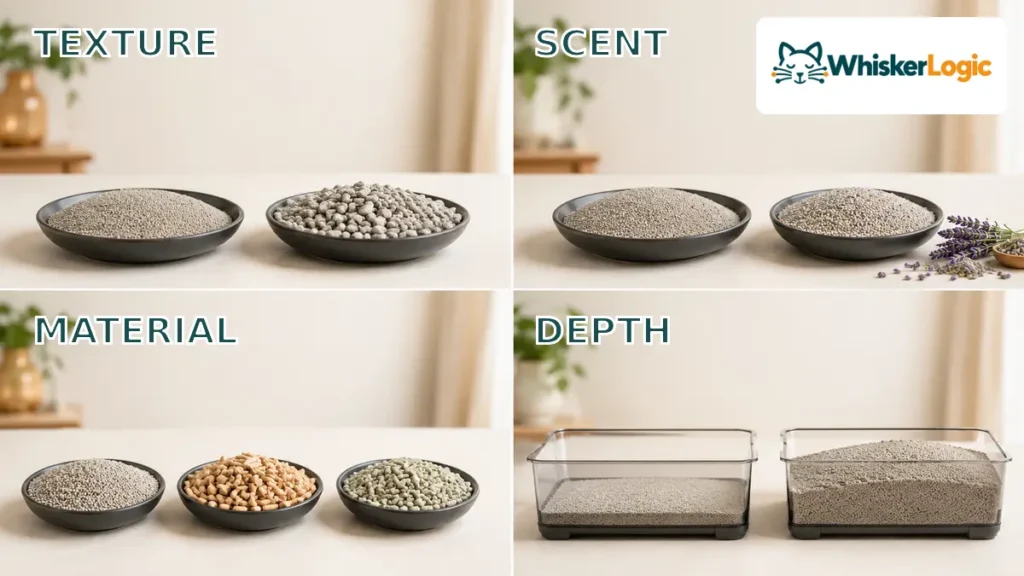
Does Texture, Scent, Material, or Litter Depth Matter?
It can—but individual preference matters more than a slogan printed on a package.
Veterinary guidance commonly identifies fine-textured, unscented, clumping litter as acceptable to many cats. The Merck Veterinary Manual notes that many cats prefer small clumping particles and that unscented litter is generally advised, while also recognizing that preferences vary.
A 2025 study comparing the tested clumping clay, wood, and paper litters found more elimination events in the clay-filled boxes in its study population. But that result does not establish a universal rule.
The experiment involved particular products and cats in Japanese cat cafés, lasted a limited period, and did not isolate texture, scent, and clumping characteristics as separate variables. The paper also disclosed that its lead author was employed by a pet-products company.
The responsible conclusion is that litter type can affect box choice in a studied population—not that every cat prefers every clay litter.
Depth deserves separate attention. If you changed the product and began pouring much more or much less of it, you changed two variables. Professional recommendations can provide a useful starting point, but cats can differ in preferred depth. During a comparison, try to keep depth similar unless depth itself is the feature you are testing.
Give Your Cat a Familiar Litter Option
If the old litter was previously accepted, remains safe to use, and is available, restoring access to it is often the clearest first practical step. This is not “giving in” to the cat. It reduces the immediate conflict and gives you information.
Interpret the result carefully:
- The cat resumes reliable box use with the old litter: Something about the new substrate becomes more plausible as a contributor.
- The cat sometimes uses both: The new litter alone may not explain the pattern. Look at cleanliness, access, location, and timing.
- The cat avoids both: Stop treating the substrate change as the complete explanation and broaden the investigation.
Resuming use of the old litter does not rule out a medical problem. It only tells you that the familiar setup is currently easier or more acceptable for the cat to use.
How to Compare Old vs. New Litter
A side-by-side preference test can help separate a litter preference from other changes. It will not be a perfect laboratory experiment, but it can be far more informative than switching products repeatedly.
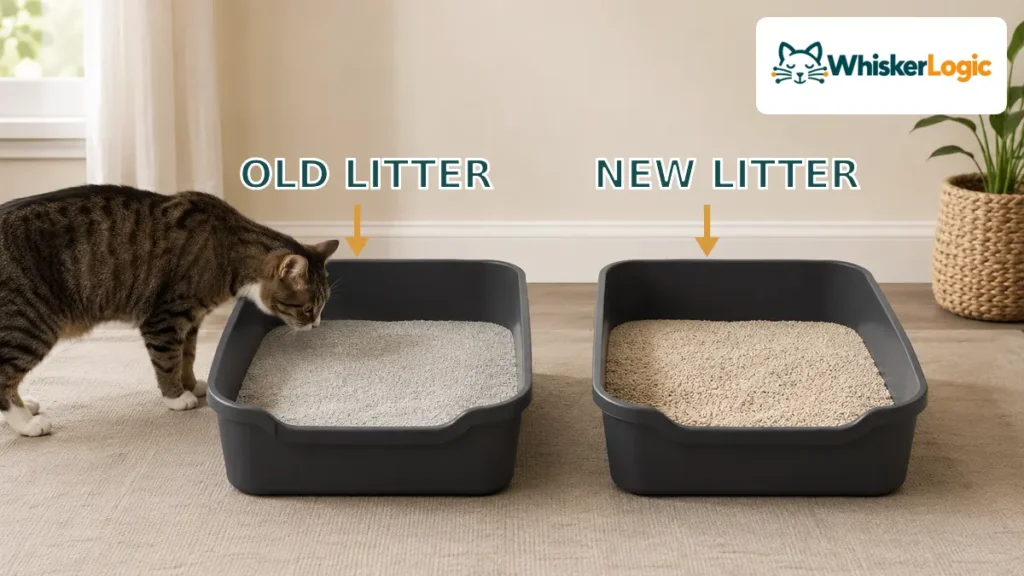
- Use two comparable boxes. Keep design, usable size, entry height, and cover status as similar as practical.
- Put the old litter in one and the new litter in the other. Label them for yourself if they look similar.
- Keep the depth comparable. Do not test product and depth simultaneously unless that is intentional.
- Keep both boxes clean. A dirty old-litter box beside a freshly cleaned new-litter box is not a fair comparison.
- Use comparable access and location conditions. One box should not be hidden, blocked, noisy, or easy for another cat to guard while the other is not.
- Observe repeated choices. One use or one refusal can be accidental. Look for a consistent pattern over multiple opportunities.
- Change one important variable at a time. Once a difference appears, do not immediately alter the box, location, depth, and litter again.
If the only practical placement puts the boxes in different conditions, acknowledge that limitation. The result may still guide you, but it will be harder to know whether litter or location drove the choice.
Never force your cat into either box. Forced placement can add stress and create another negative association.
How to Transition to a New Litter Gradually
If you must use the new litter—for example, because the old product is unavailable—avoid making another abrupt switch if your cat is currently using the familiar substrate.
Cornell advises making a necessary brand change gradually by adding small amounts of the new litter to the old. There is no need to pretend that one fixed percentage schedule suits every cat. The appropriate pace depends on whether your cat continues entering, digging, eliminating, and covering comfortably.
A practical evidence-conscious approach is:
- Begin with the familiar litter your cat is reliably using.
- Add a small amount of the new product.
- Keep the box, location, cleaning routine, and depth as stable as practical.
- Watch for hesitation, edge-balancing, reduced digging, or accidents.
- Increase the new litter only while box use remains comfortable and consistent.
- If avoidance returns, pause or step back rather than pushing ahead on a calendar.
Gradual mixing may be less useful when the products have very different particle sizes or when the cat refuses even a small amount. In that case, maintaining separate old- and new-litter options may produce clearer information than repeatedly remixing the same box.
What If You Changed More Than Just the Litter?
Return to the last setup your cat used reliably, then separate the changes.
For example, suppose you bought a covered box, moved it to the laundry room, added a liner, and filled it with scented litter on the same day. A refusal cannot tell you which of those changes matters. Restore the most important familiar features you can, and reintroduce necessary changes one at a time.
Prioritize variables that directly affect use:
- Safe, easy access
- Adequate usable space and comfortable entry
- A clean box
- A familiar substrate
- A quiet location where the cat cannot be trapped or blocked
This controlled approach is slower than guessing, but each result is easier to interpret.
What Changes in a Multi-Cat Home?
Do not treat all cats as a single test subject.
One cat may accept the new litter while another avoids it. That does not mean the second cat is being difficult; individual preferences and physical comfort can differ. Track which cat uses which box if you can do so without disrupting them.
Also check whether the familiar-litter box has become a resource another cat can guard. Boxes placed side by side may function like one resource rather than providing meaningful separation. Distribute litter-box resources in different accessible locations so one cat cannot control the only acceptable option.
Ask:
- Do all cats avoid the new litter, or only one?
- Does each cat have access to a preferred substrate?
- Can one cat block the path to or exit from a box?
- Is the old-litter box receiving more traffic and becoming dirty faster?
Social access can distort a preference test. A cat cannot choose the preferred litter if another cat controls the route to it.
What to Try, in Order
- Check for medical warning signs. Treat repeated unproductive urination as an emergency.
- Confirm the timeline. Did avoidance begin immediately after the change, or had subtle problems started earlier?
- List every simultaneous change. Include the box, cover, liner, location, cleaner, depth, and access.
- Compare the two litters. Note material, texture, particle size, scent, clumping, dust, and depth.
- Observe an interaction. Look for repeated hesitation or attempts to avoid paw contact without treating any one behavior as proof.
- Restore a familiar option. Use the old litter when it is safe and available.
- Compare old and new in similar conditions. Keep the main non-litter variables stable.
- Change one important variable at a time. Preserve what works while you isolate what does not.
- Transition gradually if a new product is necessary. Follow the cat’s continued comfortable use rather than an arbitrary deadline.
- Broaden the investigation if both are rejected. Review medical, box, cleanliness, access, location, mobility, and social factors.
- Seek veterinary or qualified behavioral help when needed. Escalate when signs are concerning or the problem persists despite sensible environmental changes.
What If Your Cat Rejects Both Old and New Litter?
That result is useful: it weakens the idea that the new substrate is the only problem.
Check the following next:
- Medical discomfort: Urinary, digestive, joint, or other pain can affect where and how a cat eliminates.
- Cleanliness: The box may not be scooped often enough for the cat’s current tolerance, especially in a multi-cat home.
- Box size or entry: A cat may struggle to turn, posture, or step over a high side.
- Location: Noise, household traffic, appliances, dogs, or a dead-end position may discourage use.
- Learned aversion: A painful or frightening event in the box can affect later behavior.
- Mobility: Older cats or cats in pain may need a lower entry and easier route.
- Social pressure: Another cat may guard the box or ambush the user on exit.
If the cat still urinates in the box but defecates elsewhere, that split pattern deserves its own investigation; see why a cat poops outside the litter box but still pees in it.
If the opposite pattern is happening, use the guide on peeing outside the litter box while still pooping in it.
When to Call Your Veterinarian
Call promptly when the behavior is sudden, persistent, or accompanied by pain, blood, repeated attempts, appetite changes, vomiting, lethargy, or other changes in health.
Veterinary assessment is also appropriate when a previously reliable cat continues avoiding the box after access to a familiar, clean, comfortable setup has been restored.
If the medical evaluation does not identify a cause and the problem continues, ask your veterinarian about referral to a qualified feline behavior professional.
Bring a simple record of:
- When the litter changed
- When avoidance began
- Urination and defecation patterns
- Which boxes and substrates each cat used
- Any straining, vocalizing, or changes in urine or stool
- All environmental changes made before and after the problem began
That history can be more useful than a general statement that the cat “doesn’t like” the new litter.
Frequently Asked Questions
Why won’t my cat use the litter box after changing litter?
The new litter may feel or smell different, move differently under the paws, or have a different depth or clumping behavior. But timing alone does not prove causation. Offer a familiar option, compare old and new under similar conditions, and investigate medical or environmental factors if your cat rejects both.
Should I switch back to the old litter immediately?
If the old litter was used reliably, remains safe, and is available, restoring it is a reasonable first step. It can reduce accidents and help test whether the substrate change matters. A return to box use strengthens that explanation but does not rule out illness.
How long should a gradual litter transition take?
There is no well-supported universal schedule that fits every cat. Add the new litter in small amounts and progress only while your cat continues to use the box comfortably. If hesitation or avoidance appears, pause or return to the last accepted mixture.
Is unscented litter always better?
Unscented litter is commonly recommended, and many cats may avoid strong fragrances. It is still not a guarantee that every cat will prefer a particular unscented product. Texture, particle size, depth, cleanliness, and individual history also matter.
Do cats always prefer clay litter?
No. Some research populations have used tested clay substrates more often than tested wood or paper alternatives, but individual preferences vary, and product characteristics overlap. Use population findings as a starting point, then observe the cat in front of you.
Can I just put my cat in the new litter box to show them where it is?
Do not force or repeatedly place your cat in the box. That does not resolve the reason for avoidance and may add stress. Make the setup accessible, offer a familiar choice, and let normal behavior provide information.
Sources
- Cornell Feline Health Center — Feline Behavior Problems: House Soiling
- Cornell Feline Health Center — Feline Lower Urinary Tract Disease
- Merck Veterinary Manual — Providing a Litter Box for a Cat
- Merck Veterinary Manual — Behavior Problems of Cats
- Ellis et al. — AAFP and ISFM Guidelines for Diagnosing and Solving House-Soiling Behavior in Cats
- Iwabuchi-Inoue, Hattori, and Kikusui (2025) — Litter Box Size and Litter Type Preference and Their Associated Behavioral Changes in Cats