
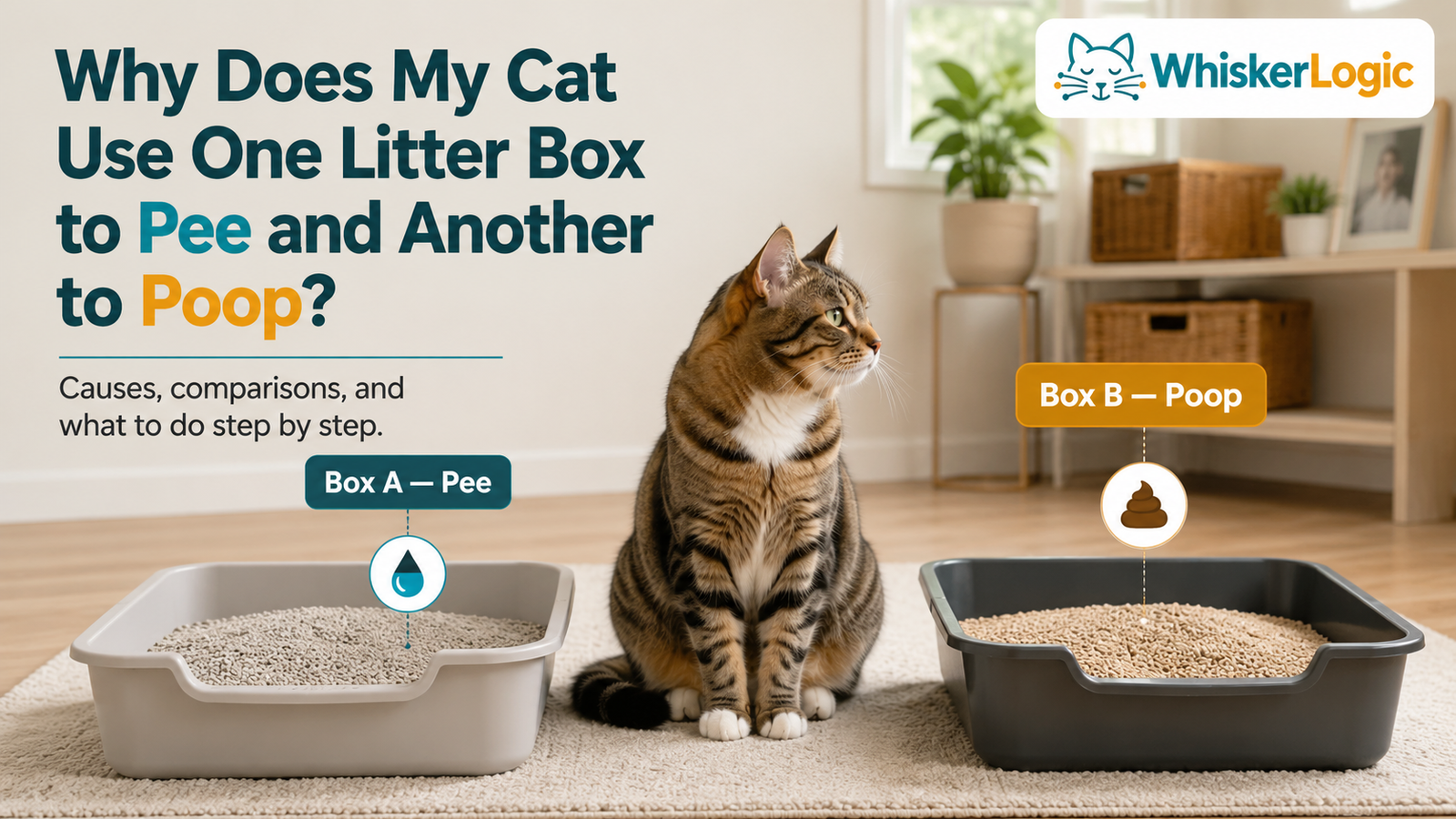
If your cat uses one litter box to pee and another to poop, the first question is not necessarily how to stop the behavior. It is whether anything is actually wrong.
A cat that reliably urinates in one box and defecates in another may simply be showing an individual preference. The two setups may differ in litter depth, substrate, size, cleanliness, location, accessibility, or another detail that matters to that cat. In other cases, a new split between the boxes can be a clue that something has changed.
The useful approach is to look at whether the pattern is comfortable and stable, compare what is different between the two boxes, and investigate only when there is a reason to do so.
Quick Answer
If your cat pees in one litter box and poops in another but comfortably and reliably uses both, has no accidents elsewhere, and shows no signs of pain or difficulty eliminating, the pattern may not need to be changed.
Cats can have individual litter-box preferences. Those preferences may involve the litter, depth, box characteristics, cleanliness, location, accessibility, or other features of the setup. That does not mean cats universally need separate boxes for urine and stool.
A sudden new pattern is different. If one box is becoming avoided or your cat develops straining, repeated attempts, pain, urinary changes, stool changes, or other signs of illness, investigate the change rather than assuming it is simply a preference.
Vet Check: Pay Attention to a New or Uncomfortable Change
A long-standing two-box routine is different from a sudden change in elimination behavior.
Contact your veterinarian if your cat develops repeated straining, repeated litter-box trips, painful or difficult urination, blood in the urine, vocalizing while eliminating, constipation, persistent diarrhea or another substantial stool change, vomiting, reduced appetite, lethargy, new mobility difficulty, or a significant unexplained change in normal elimination behavior.
According to the Cornell Feline Health Center’s guidance on feline lower urinary tract disease, a cat with a urethral obstruction may repeatedly attempt to urinate while producing little or no urine.
If your cat repeatedly tries to urinate but produces little or no urine, seek immediate veterinary care. Urethral obstruction is an emergency, and male cats are at increased risk.
Do not try to diagnose a urinary, digestive, or mobility problem from the pee/poop split alone. The pattern can tell you that something changed; it cannot tell you the medical cause.
Table of Contents
Why Your Cat Uses One Litter Box to Pee and Another to Poop
There is no single explanation that applies to every cat, and this pattern does not prove that cats naturally need separate boxes for urine and stool.
What professional guidance does support is that cats can have individual litter-box preferences.
The 2021 AAHA/AAFP Feline Life Stage Guidelines discuss individual litter preferences and recommend offering choices when evaluating different litters. The guidelines also identify factors such as location, cleanliness, box size, accessibility, and box design as potentially relevant to litter-box use.
The AAFP/ISFM guidelines for diagnosing and solving house-soiling behavior in cats likewise emphasize evaluating the cat’s litter-box environment and individual preferences rather than assuming that one setup works for every cat.
This gives us a more useful way to interpret a cat that uses different litter boxes:
Do not assume your cat is deliberately separating urine from stool. First compare the two setups.
For example, the box used for urine might contain shallower litter. The poop box might provide more usable space. One location might be quieter or easier to access. One box may also be cleaner at the time your cat needs to eliminate.
Each difference is a clue to investigate—not proof of causation.
First, Is This Actually a Problem?
Before troubleshooting, look at whether the current arrangement is working.
If your cat:
- consistently urinates in Box A;
- consistently defecates in Box B;
- enters and leaves both boxes comfortably;
- does not strain or make repeated unsuccessful attempts;
- produces apparently normal urine and stool;
- has no accidents outside the boxes;
- and has followed the same pattern for a long time,
there may be no practical litter-box problem to solve.
The important distinction is between a stable preference that works and a change that signals a problem.
A new pattern deserves more investigation, especially if one box is becoming avoided, elimination begins occurring outside the boxes, or your cat appears uncomfortable.
If everything is working, you do not need to create a troubleshooting project simply because using one box for both functions would be more convenient.
Compare What’s Different Between the Two Boxes
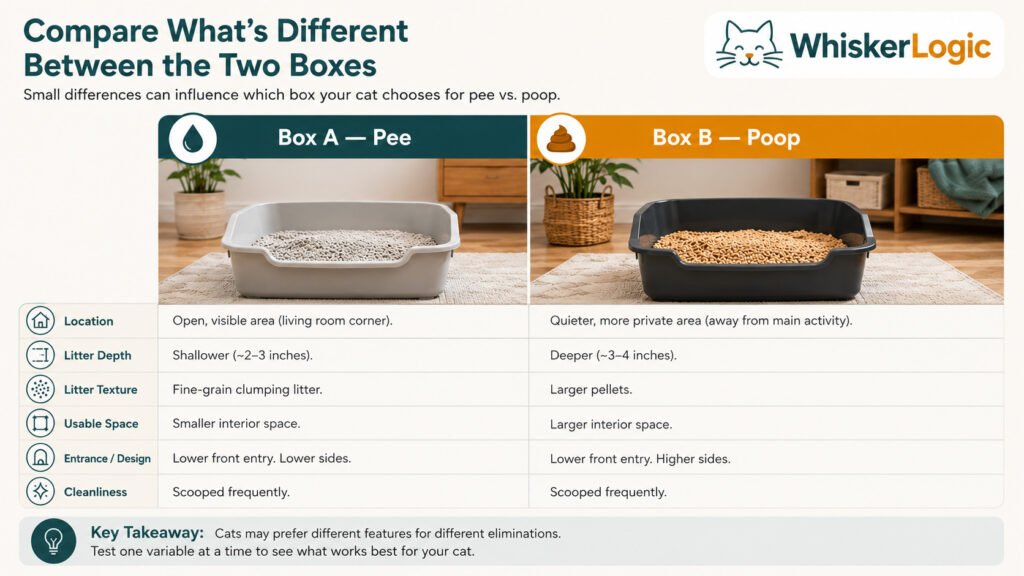
If there is a reason to investigate, compare Box A and Box B before changing anything.
Do not assume the elimination type itself is the only meaningful difference.
Compare Box A and Box B
Look at the two setups side by side. Write down what is different rather than assuming the pee/poop split itself explains your cat’s choice.
- Location: Is one box in a quieter, easier-to-reach, or less busy area?
- Usable interior space: Does one give your cat more room to enter, turn, dig, and position comfortably?
- Entrance height: Is one box easier to step into or out of?
- Covered or uncovered: Does the design change usable space, visibility, access, or the way your cat enters and exits?
- Litter material and texture: Do the boxes contain different substrates or feel different under the paws?
- Litter depth: Is the litter noticeably deeper in one box?
- Scent or additives: Is one litter scented or otherwise different?
- Cleanliness: Is one box usually cleaner when your cat needs to use it?
- Waste already present: Does your cat’s choice change after one box has already been used?
- Scooping frequency: Is one box cleaned more often than the other?
- Noise and activity: Is one location exposed to appliances, people, children, or other household activity?
- Accessibility: Do stairs, doors, obstacles, or mobility requirements make one box easier to reach?
- Approach and exit: Can your cat enter and leave both locations easily?
- Other cats: Does another cat spend time near, approach, watch, or interfere with access to one box?
You are not looking for differences just to find something to change. You are looking for a repeatable difference that matches your cat’s behavior.
For example, if the poop box consistently contains deeper litter, depth becomes worth considering. If the boxes are physically similar but located in very different places, location becomes more interesting. If the preference changes depending on which box has already been used, cleanliness may deserve closer attention.
None of these observations proves the cause on its own.
Watch the Cat, Not Just What Is Left in the Box
If possible, quietly observe several normal litter-box visits.
Does your cat enter directly? Dig before eliminating? Turn around repeatedly? Position comfortably? Keep its paws on the edge? Cover the waste? Leave normally?
Compare the behavior at both boxes.
A single behavior does not diagnose a preference, but repeated differences can help identify which variable is worth examining.
Does Litter Depth or Texture Differ?
Litter depth is worth comparing if the two boxes are filled differently.
VCA’s professional guidance on litter-box preference testing notes that some cats may prefer shallow litter for urination and deeper litter for defecation.
The important phrase is some cats.
This does not mean cats generally need a shallow pee box and a deep poop box. It also does not justify assigning a specific “correct” depth for each elimination type.
Instead, treat depth as one possible individual variable.
If your cat consistently urinates in a shallower box and defecates in a deeper one, the difference may be worth investigating when troubleshooting is actually necessary.
The Litter Itself May Matter Too
Compare:
- litter material;
- particle size;
- fine versus coarse texture;
- clumping versus non-clumping litter;
- scent or deodorizing additives;
- and how the substrate moves under the paws.
Professional feline guidelines recognize individual substrate preferences and support offering choices rather than assuming every cat prefers the same litter.
If the pee/poop split began after you replaced the litter in one box, the litter change itself deserves closer attention. See our guide to why a cat won’t use the litter box after changing litter.
If you decide to compare litter depth or substrate, avoid changing the box and its location at the same time. Otherwise, you will not know which change influenced the result.
Does the Location Matter More Than the Box?
Two physically identical boxes can provide very different experiences when they are placed in different locations.
One may be in a quiet room while another is beside a washing machine. One may be immediately accessible while reaching another requires stairs. One may have an open approach and exit, while another sits in a narrow area where another animal or household activity can interfere.
The AAHA/AAFP litter-box guidelines recommend providing boxes in appropriate, accessible locations and emphasize the importance of placement, particularly when multiple cats share a home.
Location preference is also considered in VCA’s litter-box troubleshooting guidance.
If the physical boxes are similar but your cat uses them differently, ask:
- Is one area quieter?
- Does one have more foot traffic?
- Is one beside a noisy appliance?
- Does reaching one require stairs?
- Can a door block access?
- Does a dog or child regularly pass nearby?
- Is one box easier to approach and leave?
- Does another cat tend to spend time near one location?
These observations do not prove that location caused the pee/poop split. They tell you whether location deserves more attention than the physical box.
Does Cleanliness Affect Which Box Your Cat Chooses?
Cleanliness can affect litter-box acceptance.
The AAHA/AAFP guidelines recommend regular cleaning and daily scooping and note that some cats appear particularly sensitive to dirty boxes.
Research also provides a useful warning against oversimplifying why this matters.
In a controlled study of litter-box appeal, Ellis, McGowan, and Martin examined whether previous use affected which box cats chose. Their findings support paying attention to whether a box already contains waste, but they do not justify the simple claim that cats separate pee and poop because they dislike having the two smells mixed together.
That distinction matters.
Rather than guessing what your cat thinks about urine and feces odors, observe what is actually happening.
For example, suppose Box A is often used first and contains waste by the time your cat later chooses Box B. If that sequence repeats, you can observe whether the choice changes when both boxes are maintained to a similar standard of cleanliness.
Look for repeatable patterns:
- Does your cat switch boxes mainly after one has already been used?
- Does the pattern change after scooping?
- Is one box routinely cleaner?
- Does one accumulate waste faster?
- Are the boxes scooped on different schedules?
If cleanliness is the variable you want to examine, start by keeping the boxes comparably clean.
Do not simultaneously change the litter, move the boxes, and alter their design.
How to Tell Whether Your Cat Prefers the Box or the Location
Sometimes the two setups differ in so many ways that the current pattern cannot tell you what matters.
Imagine this:
Box A is large, uncovered, filled with shallow litter, and downstairs.
Box B is smaller, covered, filled more deeply, and upstairs.
If your cat pees in A and poops in B, you cannot tell from that observation alone whether the important variable is size, cover, litter depth, location, or something else.
This is where a controlled comparison can help—but only when there is a reason to troubleshoot.
First Rule: Do Not Disrupt a Successful Setup Just to Find Out What Happens
If both boxes are being used comfortably and reliably, leave them where they are.
A box-versus-location comparison is useful when you are trying to solve a real problem, such as one box becoming increasingly avoided.
Change One Important Variable at a Time
If you want to investigate litter depth, keep the other important conditions as comparable as practical.
If you want to investigate substrate, use comparable boxes and avoid moving them at the same time.
VCA uses the same general principle in preference testing: different litter substrates can be compared in similar boxes, and other characteristics can be evaluated separately.
What If Location Is the Suspected Variable?
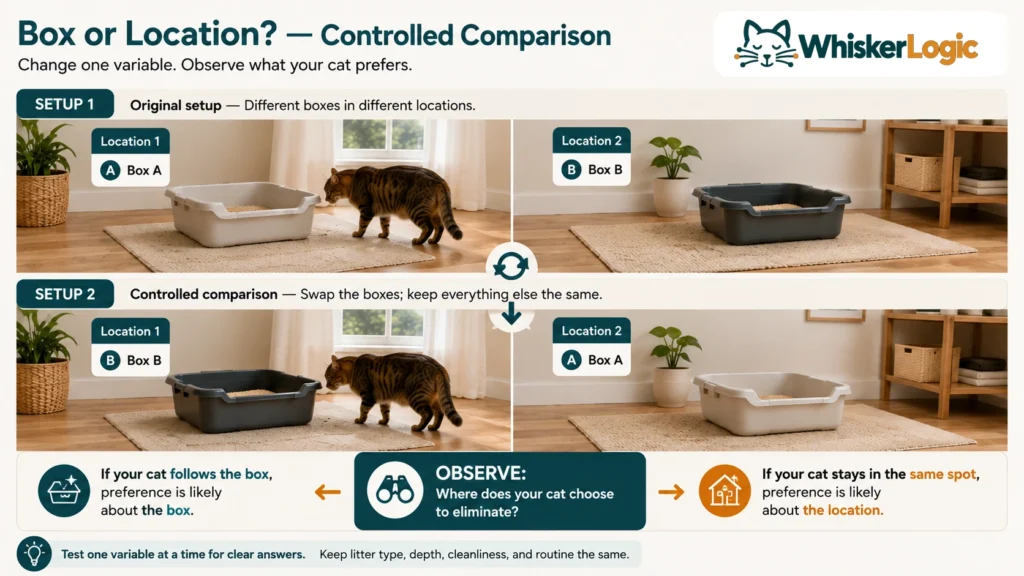
When there is a practical reason to troubleshoot and the physical boxes differ, a carefully planned comparison may help determine whether the preference appears to follow the box or its location.
If the behavior follows the physical box despite a location change, characteristics of that box become more interesting.
If the behavior remains associated with a location despite a box change, characteristics of that location become more plausible.
But do not treat one visit as proof.
Do not repeatedly move litter boxes around searching for an answer. Moving a familiar resource can itself affect use.
The goal is simple:
Change one important variable, observe the pattern, and avoid drawing conclusions stronger than the observation allows.
This is a practical home comparison, not a scientific experiment or a diagnosis.
What Changes in a Multi-Cat Home?
In a multi-cat home, a litter box can be physically available without being equally easy for every cat to access.
The AAHA/AAFP guidelines recommend multiple litter boxes in appropriate locations and emphasize access and placement in multi-cat households.
VCA’s house-soiling guidance also recommends considering interactions with other animals when evaluating litter-box access.
You do not need to see an obvious fight before paying attention to the social environment.
Observe whether another cat:
- sits near one box;
- stares when your cat approaches;
- follows your cat toward the box;
- waits outside;
- occupies a narrow access route;
- approaches while your cat is eliminating;
- or chases or ambushes your cat after it leaves.
Then watch your cat.
Does your cat pause before approaching one box? Wait until another cat leaves the area? Use a particular box only at quieter times?
Those observations can make social access worth investigating.
But do not reverse the logic:
Using one litter box to pee and another to poop does not, by itself, mean there is conflict between your cats.
When You Should Leave the Pattern Alone
You do not need to correct a litter-box arrangement simply because it looks unusual.
If:
- both boxes are appropriate;
- both are reliably used;
- your cat eliminates comfortably;
- urine and stool appear normal;
- there are no outside-the-box accidents;
- there are no relevant medical warning signs;
- and the pattern is stable,
there may be little practical benefit in trying to make your cat use one box for both functions.
Keep the successful boxes available, maintain them properly, and watch for meaningful changes.
Preserve what is working unless there is evidence of a problem.
What to Try If One Box Is Becoming Less Acceptable
If one box is being avoided or the pattern has changed, work through the situation in order.
1. Check for Medical Warning Signs
Pain, straining, repeated attempts, urinary changes, substantial stool changes, vomiting, reduced appetite, lethargy, mobility difficulty, or another sudden behavioral change should move veterinary evaluation higher on the list.
2. Determine Whether the Pattern Is Stable or New
A cat that has comfortably used separate boxes for years presents a different situation from a cat that abruptly stopped using one previously accepted box.
3. Confirm Where Both Elimination Types Are Occurring
This article applies when urine remains inside an appropriate litter box and stool remains inside another appropriate litter box.
If your cat starts peeing outside the litter box while still pooping in it, follow the urine-specific troubleshooting path instead.
If your cat begins pooping outside the litter box while still peeing in it, that is a different situation that requires defecation-specific troubleshooting.
4. Compare Box A With Box B
Look for differences in location, usable space, entrance, design, litter, depth, cleanliness, accessibility, and social access.
5. Observe Your Cat Using Both Boxes
How your cat approaches, enters, positions, eliminates, digs, covers, and leaves can reveal more than simply finding urine or stool afterward.
6. Equalize Obvious Confounders
If one box is consistently dirtier, start by maintaining comparable cleanliness.
If you are comparing litter, avoid moving the boxes at the same time.
If you are comparing depth, keep the litter material consistent.
7. Change One Important Variable at a Time
Do not replace the boxes, move them, change the litter, add or remove covers, and alter the cleaning routine simultaneously.
8. Investigate Box Versus Location Only When Necessary
If location is a genuine candidate and one box is becoming unacceptable, a careful comparison may help determine whether the pattern follows the physical box or the place where it sits.
9. Check Social Access in Multi-Cat Homes
Look beyond the number of boxes. Observe whether your cat can approach, use, and leave each box without interference.
10. Stop Troubleshooting When the Setup Is Working
If both boxes are comfortably and reliably used, keeping the two-box arrangement may be the most practical answer.
When a New Pee/Poop Split Deserves Veterinary Attention
A sudden new split deserves more attention than a long-standing stable preference.
The Cornell Feline Health Center’s house-soiling guidance explains that medical conditions can interfere with normal urination or defecation. Urinary problems may cause pain or changes in frequency, while gastrointestinal problems can alter defecation and cause discomfort.
Mobility problems can also change how easily a cat reaches or enters particular boxes.
None of these possibilities means that a new pee/poop split proves illness. It means a sudden change should not automatically be labeled a harmless preference.
Contact your veterinarian when the change is accompanied by:
- repeated straining;
- repeated unsuccessful attempts to urinate or defecate;
- increased urinary frequency;
- little or no urine;
- blood in the urine;
- crying or obvious discomfort during elimination;
- difficult defecation or constipation;
- persistent diarrhea or a substantial stool change;
- vomiting;
- reduced appetite;
- lethargy;
- new mobility difficulty;
- or another significant change in normal behavior.
Also pay attention when your cat suddenly refuses a box that was previously used comfortably, even if the other box is still being used.
Instead of asking:
“Which disease makes a cat use separate pee and poop boxes?”
ask:
“What changed at the same time as my cat’s normal elimination pattern?”
That question helps you investigate the box, litter, location, cleanliness, social environment, and medical context without treating the two-box pattern itself as a diagnosis.
Frequently Asked Questions
Why Does My Cat Use One Litter Box to Pee and Another to Poop?
There may not be one universal reason. Your cat may have an individual preference related to litter depth, substrate, box characteristics, cleanliness, location, accessibility, or another difference between the two setups. If both boxes are used comfortably and reliably, the pattern itself may not need correcting.
Is It Normal for Cats to Use Separate Litter Boxes for Pee and Poop?
Some cats do use different boxes for urination and defecation, but evidence does not support treating separate pee and poop boxes as a universal feline requirement. What matters most is whether your individual cat is comfortable, consistent, and free of medical warning signs.
Should I Stop My Cat From Using Separate Litter Boxes?
Usually there is little reason to force a change if both boxes are appropriate, reliably used, and your cat appears comfortable. Removing or changing a successfully used box could disrupt a setup that is already working.
Do Cats Prefer Different Litter Depths for Peeing and Pooping?
Some cats may. VCA notes that some individuals may prefer shallower litter for urination and deeper litter for defecation. That is a possible individual preference, not a rule for all cats. If your boxes differ in depth, treat depth as one variable to compare rather than assuming it explains the pattern.
Should I Keep Both Litter Boxes?
If your cat reliably uses both, keeping both preserves an arrangement your cat already accepts. There is usually little benefit in removing a successfully used box simply to encourage one-box use.
Why Did My Cat Suddenly Start Using Separate Boxes?
Start by identifying what changed. Compare the boxes, litter, depth, cleanliness, locations, accessibility, household routine, and interactions with other pets.
Because pain and medical problems can also change urination or defecation behavior, a sudden change accompanied by straining, pain, urinary or stool changes, vomiting, reduced appetite, lethargy, mobility difficulty, or other concerning signs deserves veterinary attention.
Sources
AAFP/ISFM Guidelines for Diagnosing and Solving House-Soiling Behavior in Cats
2021 AAHA/AAFP Feline Life Stage Guidelines — General Litter Box Considerations
Cornell Feline Health Center — Feline Behavior Problems: House Soiling
Cornell Feline Health Center — Feline Lower Urinary Tract Disease
VCA Animal Hospitals — Cat Behavior Problems: House Soiling
Ellis, McGowan, and Martin — Does Previous Use Affect Litter Box Appeal in Multi-Cat Households?