
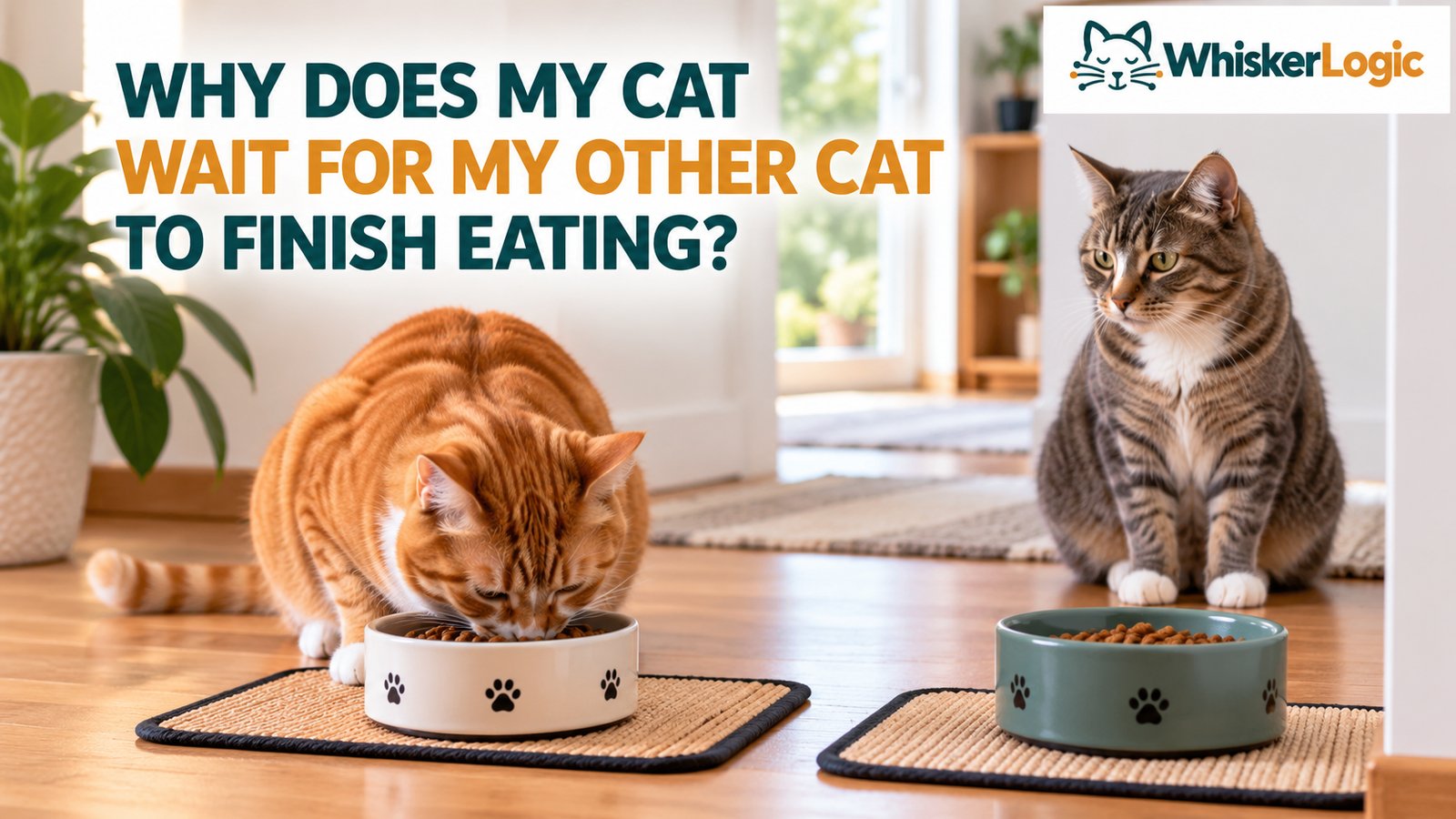
If your cat waits for another cat to finish eating, the feeding order alone does not tell you whether something is wrong. Some cats wait and then eat calmly, get an appropriate amount of food, and show no obvious difficulty around the other cat.
But waiting can also be a clue that one cat is less comfortable approaching food while the other cat is nearby. The useful question is not simply which cat eats first? It is whether the waiting cat has comfortable, reliable access to food.
Quick Answer
If your cat waits for another cat to finish eating, it may simply be a workable feeding routine. If the cat waits calmly, approaches once the other cat leaves, eats comfortably, and consistently gets an appropriate amount of food, the sequence itself may not indicate a problem.
Pay closer attention if your cat approaches and retreats, watches the other cat closely, stays away until the other cat leaves, abandons the bowl when approached, eats tensely, or consistently gets less food.
Research on feline feeding behavior notes that some cats may avoid conflict around a shared feeding station by waiting until another cat has finished eating. Feeding Cats for Optimal Mental and Behavioral Well-Being
A useful next step is to feed the cats out of sight of each other while keeping their food, bowls, and meal timing as consistent as practical. Then compare whether the waiting cat approaches sooner, stays at the bowl more comfortably, and eats its normal amount.
Vet Check
Waiting for another cat to finish is different from not eating enough overall.
Do not assume another cat is responsible for a reduced appetite. Appetite changes can have behavioral, environmental, dental, or medical causes, and waiting behavior alone cannot identify the cause.
Contact your veterinarian if your cat is eating meaningfully less than usual, stops eating, loses weight, has vomiting or lethargy, appears painful, has difficulty chewing, or develops a sudden or otherwise unexplained change in appetite or feeding behavior.
The Cornell Feline Health Center emphasizes that appetite loss is a clinical sign rather than a diagnosis and can have many underlying causes. A cat that is not eating warrants prompt veterinary attention.
Table of Contents
Why Your Cat Waits for Your Other Cat to Finish Eating
When a cat waits for another cat to finish eating, there is no single explanation for the behavior.
If your cat waits quietly, then approaches and eats an appropriate amount without signs of avoidance or vigilance, the feeding order alone is not evidence of bullying, fear, submission, or a social hierarchy.
Another possibility is that the cat finds it more comfortable to approach the feeding area when the other cat is no longer there.
A review of feline feeding behavior by Delgado and Dantas describes how cats sharing a feeding station may respond differently to competition. Some may have conflict around the food, while others may avoid conflict by waiting until another cat has finished eating. The authors recommend giving each cat the option to eat alone because eating near another cat does not necessarily mean that the arrangement is comfortable for every cat.
Professional feline guidance points in the same practical direction. The AAFP consensus statement on feline feeding programs recommends multiple feeding stations in multi-cat homes and emphasizes arrangements that allow cats to eat where they feel safe.
The important point is to treat waiting as an observation to investigate, not a diagnosis.
Waiting Calmly Is Different From Being Kept Away From Food
The distinction becomes clearer when you look at what the waiting cat actually does.
A cat that waits calmly may rest elsewhere, show little interest in what the other cat is doing, and then walk to its food and eat normally when the other cat leaves. It consistently gets an appropriate amount of food, and you do not see a broader pattern of avoidance around the home.
A potentially more concerning pattern looks different.
The waiting cat may:
- start toward the food and then stop;
- approach and retreat repeatedly;
- remain at a distance while watching the other cat;
- wait where it can monitor the feeding area;
- hesitate when the other cat looks toward it;
- leave its own bowl when the other cat approaches;
- eat unusually quickly once it gets access;
- remain visibly alert instead of settling into the meal; or
- consistently fail to eat its normal portion.
None of these observations, by itself, proves that one cat is bullying, dominating, or frightening the other.
What they do tell you is that social access to food deserves a closer look.
Repeated patterns across several meals are much more informative than one unusual feeding event.
Watch What Happens Before, During, and After the Meal
Instead of focusing only on which cat reaches the bowl first, watch the entire sequence.
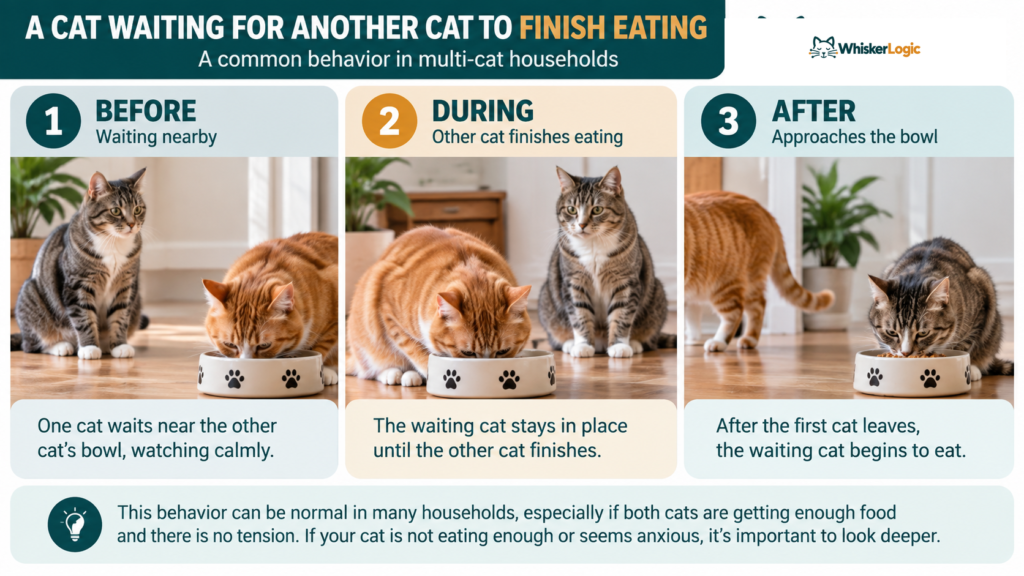
Before the Other Cat Eats
Notice what happens as food becomes available.
Does the waiting cat walk toward its feeding area normally?
Or does it stop when it sees the other cat?
Watch for approaching and retreating, waiting at a particular doorway or location, or remaining unusually far from the food.
Also look at the physical layout. Is the other cat sitting or standing between the waiting cat and the food? Does reaching the bowl require one cat to pass closely by the other?
Staring matters too. The 2024 AAFP Intercat Tension Guidelines describe subtle behaviors including staring and blocking in the context of intercat tension. These behaviors can be easier to miss than hissing, chasing, or fighting.
One instance of staring does not establish a social problem. Look for a repeated pattern and for what the other cat does in response.
While the Other Cat Is Eating
Look at both cats.
Is the waiting cat relaxed somewhere else, or is it monitoring the feeding cat closely?
Does it try to approach?
If it reaches its own bowl, can it stay there and eat comfortably?
Now watch the cat that is already eating. Does that cat remain focused on its own meal, or does it repeatedly look toward the waiting cat, move toward the other bowl, follow the other cat, or otherwise affect its access?
The goal is not to decide which cat is “dominant” or “submissive.” It is to determine whether both cats can access and use their feeding stations without needing to monitor or avoid each other.
After the Other Cat Leaves
What happens when the first cat finishes and walks away?
If the waiting cat approaches immediately, settles at its bowl, and eats an appropriate amount, the other cat’s presence may be one variable affecting when it feels comfortable eating.
If the cat remains hesitant even after the other cat has gone, broaden the investigation rather than assuming the explanation is social.
Also check what the cat actually consumes. A cat that eats later but reliably gets an appropriate amount of food presents a different situation from a cat whose overall intake is falling.
Are the Food Bowls Too Close Together?
Two bowls do not automatically function as two independent feeding stations.
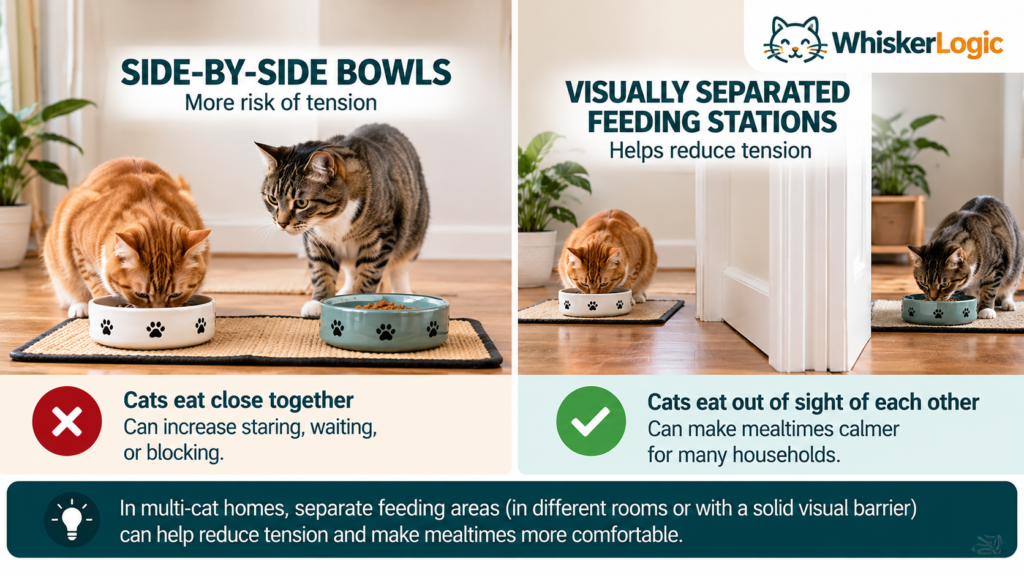
If they are side by side, both cats still occupy essentially the same feeding area. They may be able to watch each other continuously, move easily between bowls, or influence each other’s access.
The 2024 AAFP Intercat Tension Guidelines recommend multiple visually separated feeding stations and discuss separation during feeding to reduce competition. Visual barriers can also be useful when arranging resources for cats living together.
The AAFP feline feeding consensus similarly supports multiple feeding stations and visual separation in multi-cat homes.
There is no useful universal rule such as moving bowls an exact number of feet apart. Homes, room layouts, individual cats, mobility, and social relationships differ.
Instead, ask a functional question:
Can each cat reach, use, and leave its feeding station without having to pass, face, or closely monitor the other cat?
Simply moving two bowls a little farther apart in the same open area may not provide meaningful separation if the cats can still closely monitor or approach each other.
Try Feeding Your Cats Out of Sight of Each Other
One useful way to learn more about the behavior is to compare what happens when the cats cannot see each other while eating.
For several meals, keep the setup as stable as practical:
- use the same food;
- use the same bowls;
- feed at roughly the same usual time; and
- avoid making several unrelated feeding changes at once.
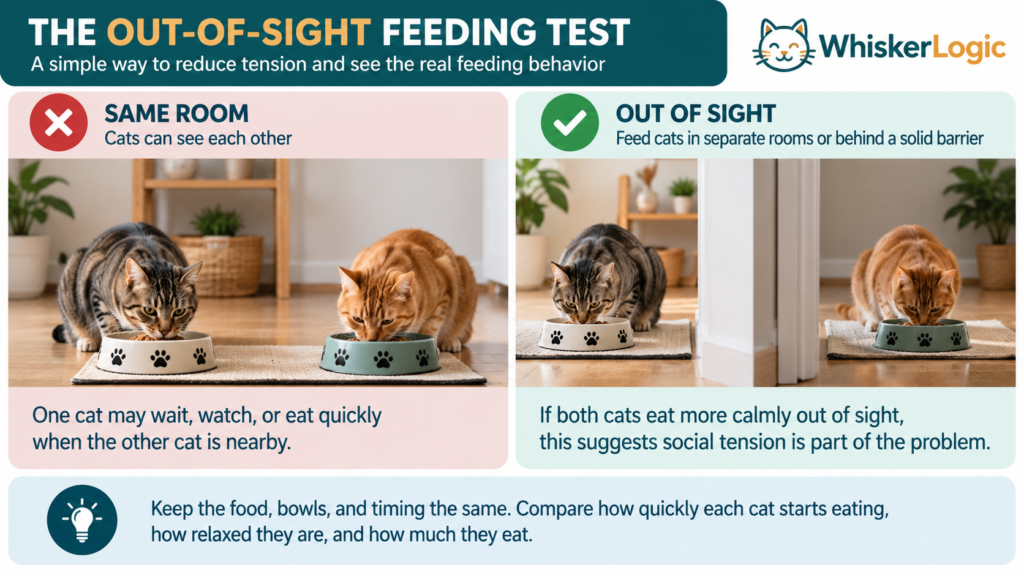
Change primarily the visual/social access between the cats.
Depending on your home, that may mean feeding them in different rooms or using an effective visual barrier.
Then watch the cat that normally waits.
Does it:
- approach its food sooner?
- stay at the bowl rather than leaving?
- spend less time scanning or monitoring the surroundings?
- appear more settled while eating?
- consume its normal portion more reliably?
This is a practical comparison, not a diagnostic test. It can help you see whether the other cat’s presence or the original feeding arrangement is one variable affecting the behavior.
If the cat eats more readily when the other cat is out of sight, that is useful information, but it does not by itself diagnose intercat tension.
If little changes, broaden the investigation. Consider appetite, food preference, the feeding location, the bowl or setup, changes in routine, and possible medical causes rather than forcing a social explanation.
What If One Cat Is Taking the Other Cat’s Food?
This gives you more direct evidence of a food-access problem.
Suppose Cat A finishes its meal, walks toward Cat B’s bowl, and Cat B repeatedly retreats before finishing. In that situation, Cat B may not reliably receive the portion intended for it.
Separate feeding areas can make individual intake easier to monitor and protect.
If one cat needs a particular diet, eats much faster, or repeatedly gains access to another cat’s food, physical separation during meals may be necessary.
In some households, a microchip-activated feeder can be a useful management tool when reliable individual food access cannot otherwise be maintained. Feline feeding and intercat-tension guidance discusses these feeders as one possible way to control individual access to food.
It is a conditional tool, not a diagnosis or a requirement for multi-cat homes.
First determine what is actually happening at mealtimes.
Do not punish the cat that approaches another bowl. Yelling, spraying water, or other punishment does not solve the feeding setup and can add stress to the situation.
Look for Intercat Tension Away From Mealtimes
If the feeding pattern appears to be influenced by the cats’ interactions, do not limit your observations to food.
Look at what happens around:
- hallways and narrow routes;
- doorways;
- favorite resting places;
- water stations;
- litter boxes;
- play areas; and
- interactions with people.
Does one cat regularly wait for the other to leave before moving through a doorway?
Does one cat stare while the other changes direction?
Does a cat abandon a resting place or another resource when the other approaches?
Do you repeatedly see following, blocking, retreating, or avoidance even without obvious fights?
The 2024 AAFP guidelines emphasize that intercat tension can be subtle. This matters because the absence of overt fighting does not automatically mean that both cats have equally comfortable access to important resources.
The same access-based reasoning can apply elsewhere in the home. For example, WhiskerLogic’s guide Can Another Cat Block Access to the Litter Box? explains how subtle interactions around routes and resources can influence whether another cat uses a litter box comfortably.
A repeated pattern involving several resources is more informative than one isolated “first cat eats, second cat waits” sequence.
What to Try, in Order
- Confirm that the waiting cat is actually eating enough.
Eating later is not the same as eating less. Pay attention to how much food the cat actually consumes and monitor body weight over time. - Observe several meals before assigning a cause.
Watch approach, retreat, staring, positioning, leaving the bowl, and what happens immediately after the other cat walks away. - Look at the feeding layout.
Two adjacent bowls may function more like one shared feeding area than two independent stations. - Feed the cats out of sight of each other.
Keep the food, bowls, and meal timing as stable as practical so that the major change is the cats’ visual/social access to one another. - Compare the waiting cat’s behavior.
Does it approach sooner, stay at the bowl, appear less vigilant, and consume its normal amount when the other cat is not visible? - Protect individual food access if necessary.
If one cat repeatedly takes another cat’s food, use separate feeding areas or another practical way to ensure each cat can consume its intended portion. - Check the rest of the home.
Look for repeated staring, blocking, following, retreating, or avoidance around other resources and routes. - Do not punish or force either cat.
Avoid yelling, spraying water, or forcing the cats to eat beside each other. - Broaden the investigation if the pattern persists.
If separation does not improve the behavior, or if the cat’s actual food intake is reduced, consider other environmental and medical explanations rather than assuming the other cat is responsible. - Get veterinary help when appetite or health is changing.
Waiting behavior does not rule out an underlying medical problem.
When Waiting to Eat Needs Veterinary Attention
The key safety distinction is between a cat that waits but ultimately eats an appropriate amount and a cat whose overall food intake has fallen.
A sudden or unexplained change in eating behavior deserves attention even if another cat appears to be involved.
Contact your veterinarian if you notice:
- a meaningful reduction in food intake;
- complete refusal to eat;
- unexplained weight loss;
- vomiting;
- lethargy;
- signs of pain;
- difficulty chewing or eating;
- a sudden appetite change; or
- another unexplained change in normal feeding behavior.
Cornell notes that anorexia can accompany many different health problems and that dental pain is among the possible reasons a cat may refuse food. The cause cannot be determined simply by watching the order in which two cats eat.
If your cat is not eating, do not spend days testing different bowl arrangements while waiting to see whether the other cat is the problem. Seek veterinary guidance promptly.
Frequently Asked Questions
Why does my cat wait until my other cat is done eating?
There are several possibilities. Your cat may simply have a workable feeding routine and eat normally afterward, or the other cat’s presence may make approaching the feeding area less comfortable. Some cats may avoid conflict around a feeding station by waiting until another cat has finished. Look at your cat’s behavior and actual food intake rather than assuming the feeding order explains the relationship.
Does eating second mean my cat is submissive?
No. Feeding order alone does not establish a dominance or submissive hierarchy. Watch what actually happens around the food, including approaching and retreating, staring, blocking, leaving the bowl when the other cat approaches, and whether both cats receive an appropriate amount of food.
Should I feed my cats separately?
Providing separate feeding stations is supported by professional feline feeding guidance. If one cat consistently waits for the other, a particularly useful comparison is to feed the cats out of sight of each other and see whether the waiting cat approaches and eats more comfortably.
Is it okay if my cats’ food bowls are next to each other?
Side-by-side bowls may not function as genuinely separate feeding stations because the cats still share the same immediate space and can closely monitor or approach each other. Visual separation may be more useful than simply having two bowls. There is no universal bowl-distance rule that applies to every multi-cat home.
What if my cat waits but eats normally afterward?
If your cat remains relaxed, consistently eats an appropriate amount, and shows no broader pattern of avoidance or resource-access problems, waiting itself may not indicate a problem. Continue monitoring food intake and body weight over time and pay attention to any change in the pattern.
Why does my cat leave the bowl when my other cat approaches?
That pattern gives you more information than feeding order alone. The approaching cat may be affecting the other cat’s willingness or ability to remain at the feeding station. Try feeding the cats out of sight of each other and compare the behavior. If reduced appetite continues even when they are separated, do not assume the cause is social; discuss the change with your veterinarian.
Will a microchip feeder stop my other cat from stealing food?
A microchip-activated feeder can help control individual food access in some households, especially when cats need different diets or one repeatedly accesses another cat’s food. It is not necessary for every multi-cat home and does not replace investigating whether the feeding setup or the cats’ interactions are contributing to the problem.
Sources
- Rodan I, Ramos D, et al. 2024 AAFP Intercat Tension Guidelines: Recognition, Prevention and Management. Journal of Feline Medicine and Surgery.
- Sadek T, Hamper B, Horwitz D, et al. Feline Feeding Programs: Addressing Behavioral Needs to Improve Feline Health and Wellbeing. AAFP Consensus Statement.
- Delgado M, Dantas LMS. Feeding Cats for Optimal Mental and Behavioral Well-Being. Veterinary Clinics of North America: Small Animal Practice.
- Cornell Feline Health Center — Anorexia.