
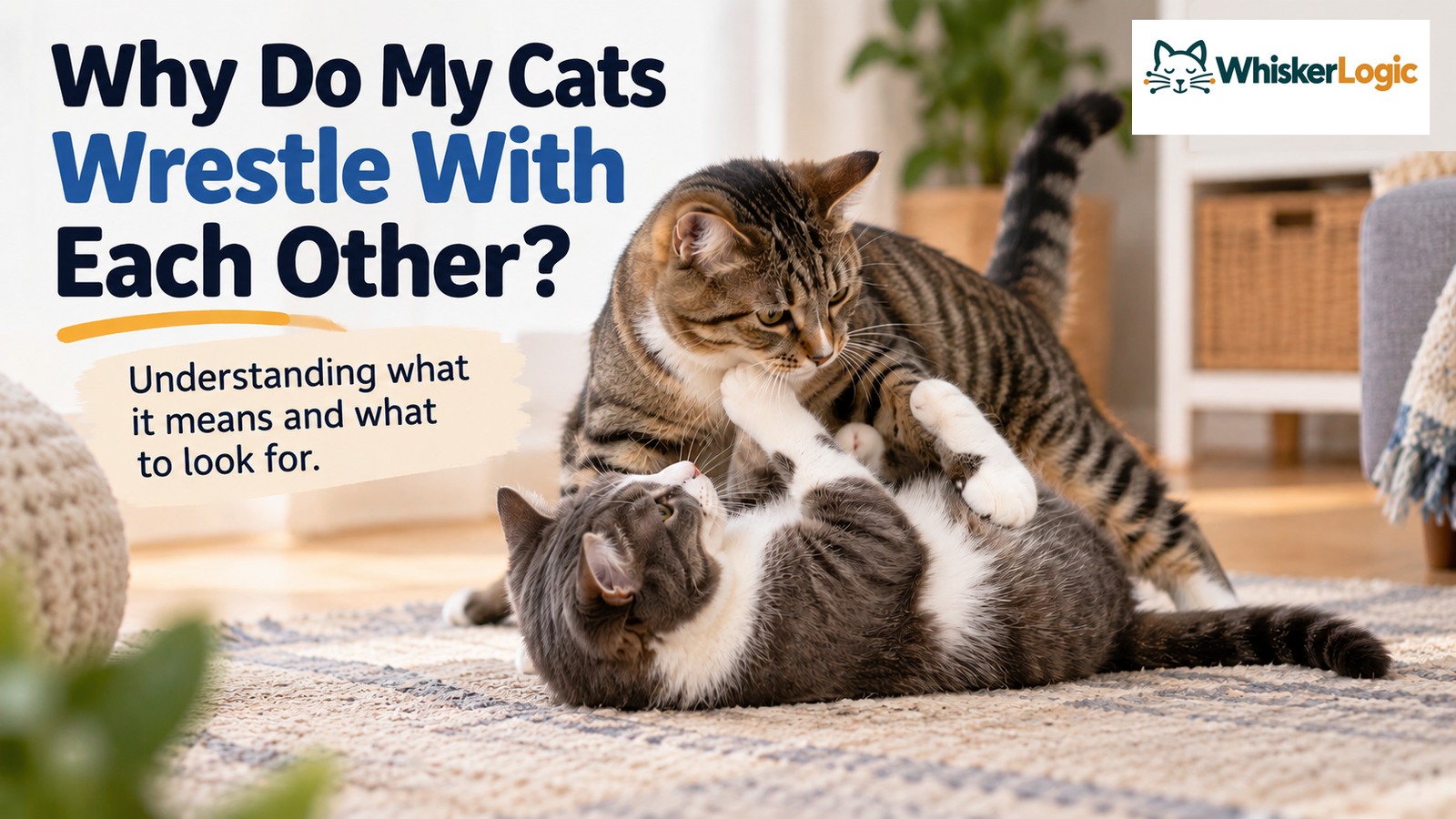
Cats can wrestle in ways that look surprisingly intense. They may grab each other, roll across the floor, pin one another, bite, kick with their back feet, break apart, and then start all over again.
If your cats wrestle with each other, the wrestling itself does not tell you whether there is a problem. Many of the same movements can appear in social play and in less comfortable interactions.
The more useful question is: Do both cats keep choosing to participate?
Watch the entire exchange. Look for role changes, pauses, opportunities to leave, voluntary re-engagement, vocalization in context, and especially what happens when one cat tries to stop. Then watch what both cats do afterward.
Quick Answer
Wrestling between cats is often part of mutual social play, particularly when the interaction is reciprocal: both cats participate, roles may change, pauses occur, either cat can disengage, and both voluntarily come back for more.
But wrestling can also become uneven. One cat may still want the interaction while the other is trying to end it. Research on close-contact interactions between cats supports a more useful framework than a simple play-or-fight rule: interactions can be playful, intermediate, or agonistic, and the character of an interaction can change as the cats’ motivations change.
So do not judge the interaction from a bite, pin, kick, hiss, or belly-up position by itself. Ask what each cat does next.
Vet Check
A familiar wrestling pattern that changes suddenly deserves attention, especially if the change occurs alongside signs that one cat may be uncomfortable or unwell.
Pain, illness, or reduced mobility can affect how a cat responds to physical contact and social interaction. A cat that previously tolerated wrestling, for example, may react differently if being grabbed, jumped on, or moving quickly has become uncomfortable.
Contact your veterinarian if the change is sudden or wrestling is accompanied by an injury, limping, apparent pain, unusual sensitivity to touch, reduced activity, hiding, appetite changes, or a broader change in one cat’s normal behavior.
If the cats are in a highly aroused physical conflict, do not put your hands between them. The 2024 AAFP Intercat Tension Guidelines warn about the risk of human injury when people physically intervene with highly aroused cats. Create separation without reaching into the interaction.
Table of Contents
Wrestling Is Part of Feline Social Play—But It Doesn’t Tell the Whole Story
Wrestling is part of the behavioral repertoire seen in feline social play. It can include grabbing with the forelegs, rolling onto the side or back, physical struggling, biting, and kicking or raking movements with the hind legs.
That is one reason normal cat play can look alarming to people.
A review of feline social play in Frontiers in Veterinary Science describes social play as involving behavioral elements that can resemble actions used in other contexts. A bite, pounce, belly-up posture, or wrestling movement therefore should not be interpreted in isolation.
A 2023 Scientific Reports study by Gajdoš-Kmecová and colleagues analyzed 105 close-contact interactions involving 210 cats. Reciprocal wrestling was most closely associated with the group classified as playful, but the authors cautioned against using wrestling alone as evidence that an interaction is play.
That distinction matters.
Two cats can perform similar wrestling movements while the larger interaction unfolds very differently. Instead of asking only what movement occurred, watch how both cats participate across the sequence.
When Cats Wrestle With Each Other, Watch for Reciprocity
Reciprocity means that the interaction is not continuously being imposed by one cat on the other.
During mutual wrestling, you may see one cat tackle the other and end up on top. Later, their positions may reverse. One cat may move away briefly and then initiate the next contact. A pause may occur, followed by both cats moving toward each other again.
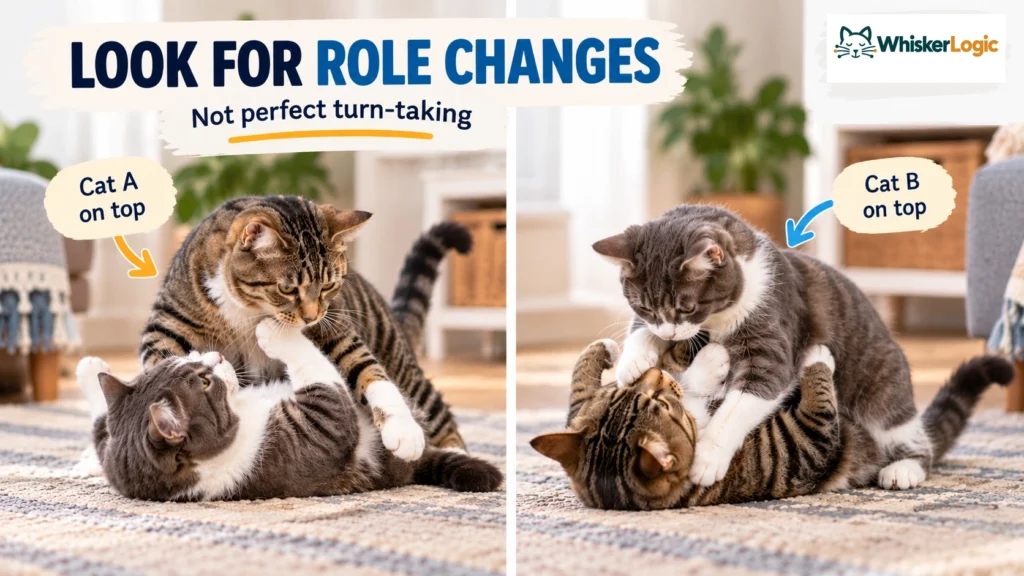
The Scientific Reports study found role reversal during reciprocal wrestling and reported that greater reciprocity, together with fewer agonistic behaviors, characterized interactions more consistent with play.
This does not mean the cats must divide every move exactly 50/50.
One cat may be more energetic, larger, faster, or more likely to initiate. A short interaction may not contain an obvious role reversal at all.
Instead, look across the whole interaction—and preferably across several interactions—and ask:
- Does each cat sometimes approach or re-engage?
- Can either cat stop without immediately being forced back into contact?
- Do the cats sometimes change roles?
- When they separate, does the cat that was underneath or being pursued ever voluntarily return?
- Does one cat repeatedly seek distance while the other repeatedly removes that distance?
The last two questions are especially useful because they focus on choice rather than appearance.
Watch What Happens When One Cat Tries to Stop
A wrestling bout can begin as mutual play and become less mutual.
That is one reason a binary label can be misleading.
The feline social-play review discusses the importance of sequences and changing motivation during social interaction rather than treating individual actions as having one fixed meaning.
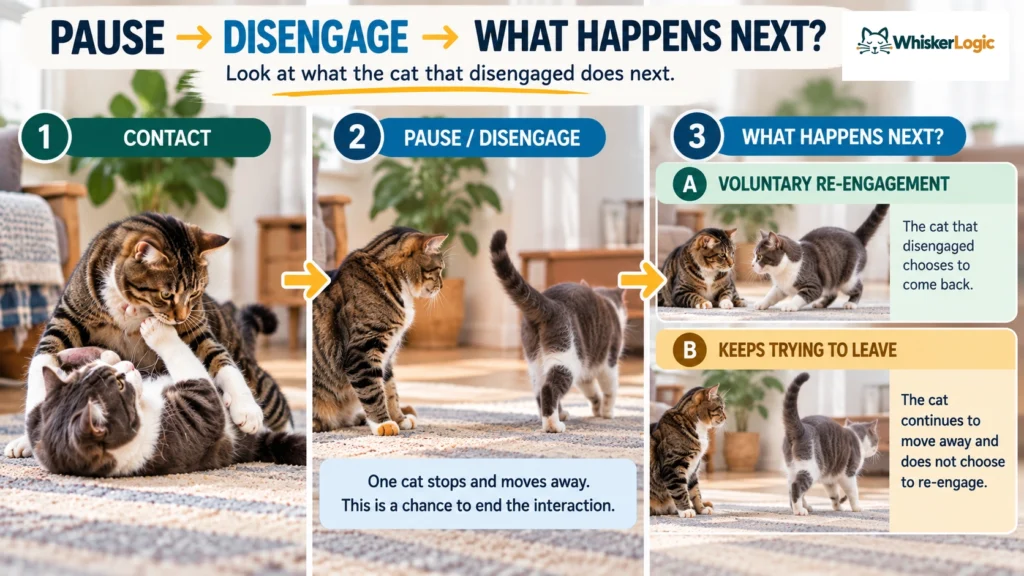
Imagine two cats rolling and grabbing each other. They separate. Cat A walks several feet away.
Now watch Cat A.
If Cat B approaches again and Cat A turns, pounces, or otherwise willingly re-engages, that supports an interpretation of continued mutual participation.
If Cat A keeps walking away, retreats again, hides, becomes defensive, or repeatedly tries to create distance while Cat B keeps pursuing, the interaction is becoming less reciprocal.
That does not automatically prove a serious fight. It tells you that “they were wrestling” is no longer enough information.
The recipient cat’s response matters.
Pauses Can Tell You More Than the Roughest Moment
Do not watch only the dramatic middle of a wrestling bout.
Watch the transitions.
Suppose one cat pins the other for three seconds. That image may look worrying. But if they release, sit apart briefly, and the previously pinned cat walks back and initiates another round, the sequence means something very different from a cat that escapes the pin and runs under furniture while the other immediately pursues it.
A useful observation sequence is:
Before → Contact → Pause → Disengagement → What happens next?
Voluntary re-engagement is useful evidence because a cat that had an opportunity to leave is choosing further interaction.
It still should not be treated as a single foolproof test. Look for a repeated pattern across the entire interaction.
Being on the Bottom Does Not Automatically Mean a Cat Is Losing
A cat rolling onto its back during wrestling can look vulnerable, especially when the other cat stands over it.
Do not classify the interaction from that position alone.
The feline social-play literature includes belly-up positions, holding, biting, paw contact, and hind-leg movements among behaviors that can occur during play. During reciprocal wrestling, the cat underneath at one moment may be on top later.
Ask what the bottom cat actually does.
Does it remain actively engaged, grab the other cat, kick, roll, get up normally, and later return?
Or does it repeatedly attempt to escape, remain defensive after release, or seek a location where the other cat cannot reach it?
Position is an observation. The cat’s response helps you interpret it.
For the same reason, the cat on top should not automatically be labeled “dominant.” A wrestling position by itself does not establish that one household cat occupies an alpha rank over the other.
Biting and Kicking Do Not Automatically Turn Wrestling Into Fighting
Seeing teeth or rapid hind-leg kicks can make an interaction look severe.
But biting can occur within feline social play, and wrestling can include hind-leg kicking or raking movements.
That means:
“One cat bit the other” is not enough to classify the interaction.
Add context.
Was the bite part of an otherwise reciprocal wrestling exchange? Did the other cat continue participating? Could it disengage? Did the cats release each other? Did one cat become increasingly defensive or repeatedly attempt to escape?
And check for injury.
The fact that biting or kicking can occur during play does not mean every bite or kick is harmless. Physical contact that causes injury requires a different response from rough-looking contact that both cats repeatedly choose to continue.
Vocalization Matters—But It Still Needs Context
Growling, hissing, snarling, spitting, or yowling deserves attention, particularly when vocalization occurs repeatedly alongside pursuit, defensive behavior, or attempts to escape.
In the 2023 close-contact interaction study, vocalization was more closely associated with agonistic interactions, while frequent and prolonged wrestling characterized the playful group. The 2024 AAFP guidelines likewise emphasize evaluating whether rough physical interaction is reciprocal and considering agonistic signals in context.
But this does not mean one hiss equals a fight.
A cat may vocalize when setting a boundary or when it no longer wants the interaction to continue. What the other cat does in response can be especially informative.
If one cat hisses, the other stops, and both disengage, you have observed a different sequence from repeated growling or hissing while one cat tries to flee and the other continues pursuing.
Treat vocalization as part of the evidence—not as a standalone verdict.
Not Every Wrestling Match Is Simply “Play” or “Fight”
One of the most useful findings from the 2023 research is that close-contact interactions did not fall neatly into only two categories.
The researchers identified three broad groups:
Playful → Intermediate → Agonistic
The intermediate interactions contained characteristics of both and were more similar overall to the playful group than to the agonistic group.
For a cat owner watching wrestling at home, a practical way to think about the interaction is:
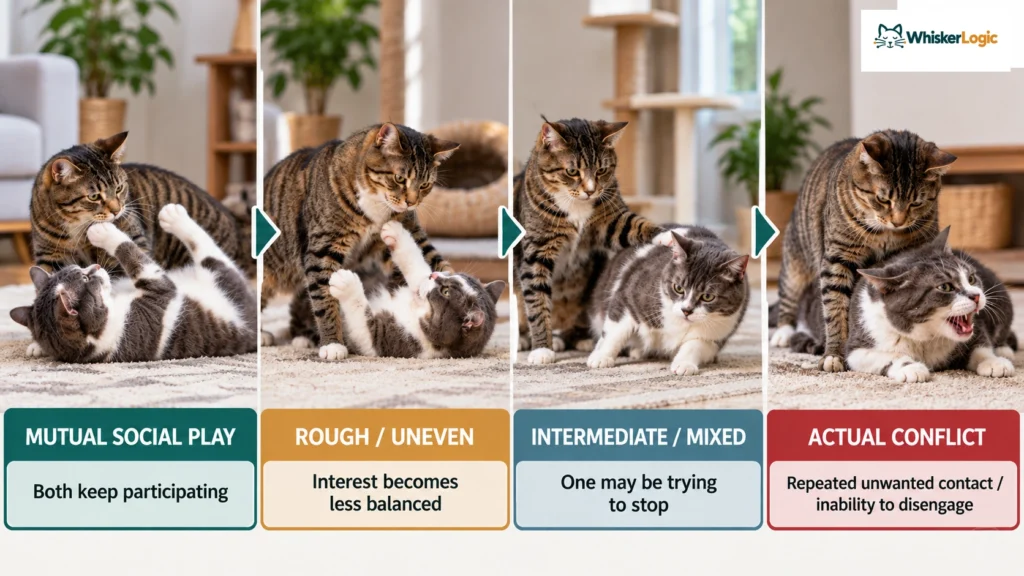
Mutual social play
Both cats appear to participate willingly. Wrestling is reciprocal, roles may change, pauses occur, disengagement is possible, and both cats may voluntarily restart the interaction.
Rough or uneven play
The interaction may still largely resemble play, but the cats are not equally interested at every moment. One may become more persistent while the other takes more breaks or becomes less enthusiastic.
That is a reason to observe more carefully—not automatically evidence that the cats have a serious relationship problem.
Intermediate or mixed interaction
Playful and agonistic elements may appear in the same exchange. One cat may still want to continue after the other’s motivation has changed.
The Scientific Reports authors note that intermediate interactions may reflect a short-term disagreement in social priorities and do not necessarily mean the cats’ overall relationship has broken down.
Actual conflict
The interaction increasingly appears directed toward creating or maintaining distance rather than continuing mutual engagement. Persistent defensive behavior, repeated unwanted pursuit, injury, or an inability to disengage safely makes intervention more important.
These descriptions are more useful as a continuum than as four rigid boxes.
A wrestling bout can change while it is happening.
Look at the Cat Receiving the Rougher Behavior
When cats wrestle with each other, the cat receiving the rougher-looking behavior can sometimes tell you more than the cat doing the tackling, pinning, biting, or kicking.
Shift your attention to the recipient.
What does that cat do?
A cat that gets pinned, breaks free, pauses briefly, and then jumps back onto its housemate is giving you useful information about its continued participation.
A cat that gets pinned, escapes, runs away, and repeatedly tries to avoid renewed contact is giving you different information.
This same principle is useful elsewhere in a multi-cat home. A behavior becomes easier to interpret when you watch its repeated effect on the other cat rather than assigning meaning to the first cat’s action alone.
For example, WhiskerLogic’s guide to a cat blocking another cat’s access to the litter box applies the same reasoning: the important clue is not simply where one cat sits, but whether the other cat repeatedly changes its movement or access in response.
Observe the action. Then observe its effect.
What Happens After the Wrestling?
Do not stop observing when physical contact ends.
The aftermath can provide information that the most dramatic moment cannot.
After separating, do both cats return to ordinary activity? Does the cat that was pinned remain comfortably in the area? Do they later approach each other normally?
Or does one cat disappear into a hiding place, avoid the other, remain unusually vigilant, alter its route through the home, or hesitate around resources?
The 2024 AAFP Intercat Tension Guidelines emphasize assessing the cats’ broader relationship and looking for patterns of affiliative behavior, tolerance, and tension rather than relying on one isolated encounter.
The 2023 study also cautions against using one interaction to define the cats’ overall relationship. Cats can have occasional disagreements even when their broader relationship contains affiliative behavior.
That means the minutes after wrestling—and patterns you notice later—can matter as much as the roughest moment itself.
If one cat repeatedly watches the other and the watched cat changes where it goes or what it does, WhiskerLogic’s guide to why one cat keeps staring at another cat examines that situation separately.
When Wrestling Starts Looking One-Sided
The strongest reason to become concerned is not simply that the wrestling looks rough.
It is that one cat repeatedly stops choosing it.
Pay closer attention when you see a recurring pattern in which:
- one cat initiates nearly every bout;
- one cat repeatedly tries to leave;
- the other cat keeps restarting contact despite those attempts;
- role changes become rare or absent across repeated interactions;
- one cat hides or seeks inaccessible locations afterward;
- vocalization accompanies attempts to create distance;
- the interaction repeatedly ends with unwanted pursuit rather than voluntary re-engagement;
- injuries occur; or
- the recipient’s normal movement or access to important parts of the home begins to change.
None of these observations alone diagnoses the cats’ relationship.
Together, however, they can show that the question has changed from “Why are my cats wrestling?” to “Is one cat repeatedly unable to end this interaction?”
That is the more important welfare question.
What to Do When Your Cats Wrestle
If the interaction appears reciprocal and both cats repeatedly choose to continue, you generally do not need to interrupt every wrestling bout simply because it looks rough.
Instead, observe enough interactions to learn their normal pattern.
1. Watch the whole sequence
Do not judge from the pin, bite, kick, or roll that caught your attention.
Notice who initiated, how each cat responded, whether they paused, who moved away, and what happened next.
2. Give special attention to disengagement
When one cat leaves, see whether the other respects the pause.
Then see whether the cat that left chooses to return.
3. Compare roles across multiple bouts
Do not demand perfect turn-taking, but look for evidence that both cats can influence the interaction.
A single pin tells you little. A repeated pattern in which the same cat tries to escape every time tells you much more.
4. Watch the aftermath
Check whether both cats return to normal activities and normal use of the home.
If one cat’s behavior changes consistently after wrestling, broaden your observation beyond the wrestling itself.
5. Make disengagement possible
Cats should not have to remain in close contact because the environment gives them no practical alternative.
Provide usable vertical space, resting and hiding options, and routes that allow cats to move away from one another. The AAFP guidelines emphasize adequate, separated resources and environmental arrangements that allow cats to avoid unwanted interactions.
6. Provide appropriate individual play opportunities
Interactive play with a caregiver can give each cat an outlet for play and predatory behavior. This can be particularly useful when household cats differ substantially in age, energy, or interest in physical interaction.
Do not assume additional play automatically solves a social problem, however. Continue watching whether both cats choose their direct interactions.
7. Do not punish the cats
Do not yell, spray them with water, or physically punish them for wrestling or conflict.
Punishment can increase fear or stress without addressing why an interaction is becoming difficult.
8. Intervene safely if the interaction becomes dangerous
If the cats enter a highly aroused physical conflict, do not reach between them or grab them with bare hands.
Create distance safely and allow them to calm down separately. Persistent or escalating conflict warrants veterinary assessment and, when appropriate, help from a qualified feline behavior professional or board-certified veterinary behaviorist.
When Wrestling Is Part of a Bigger Multi-Cat Pattern
Sometimes the most useful information is outside the wrestling bout.
Ask whether the same cat that repeatedly tries to end wrestling also yields space elsewhere.
Does it hesitate at doorways? Wait for the other cat to leave before approaching food? Change routes through the house? Retreat when stared at? Avoid a preferred resting area when the other cat is nearby?
The AAFP Intercat Tension Guidelines emphasize that intercat tension can be subtle and may involve behaviors such as staring and blocking rather than obvious physical fights.
WhiskerLogic covers those situations separately because they answer different questions. If one cat consistently waits until the other has finished eating, see why one cat may wait for another cat to finish eating.
The goal is not to reinterpret every household behavior as part of the wrestling. It is to notice when wrestling may be one piece of a broader repeated pattern affecting one cat’s choices.
When to Get Veterinary or Behavior Help
Seek veterinary care when the wrestling pattern changes suddenly, injuries occur, or either cat shows possible signs of pain, illness, reduced mobility, or a significant change in normal behavior.
Behavioral help is appropriate when one cat repeatedly cannot disengage, interactions are escalating, the cats cannot safely share space, or one cat’s normal access to food, water, litter boxes, resting places, or areas of the home is being affected.
Videos can be useful when professional assessment is needed.
The 2024 AAFP guidelines discuss using caregiver photos and videos as part of evaluating intercat interactions. If it is safe to do so, record several interactions from a distance rather than relying only on your memory of the most dramatic moment.
A short observation log can also help:
Who initiated → What happened → Who disengaged → Whether pursuit continued → Whether either cat re-engaged → What both cats did afterward
Patterns become easier to recognize when you compare several interactions instead of one.
Frequently Asked Questions
Why do my cats wrestle with each other every day?
Frequent wrestling can be part of normal social play if both cats repeatedly choose to participate. Frequency alone does not tell you whether there is a problem. Watch reciprocity, attempts to disengage, voluntary re-engagement, injuries, and what each cat does afterward.
Is it normal for cats to bite each other while wrestling?
Biting can occur within feline social play, so a bite does not automatically mean the cats are fighting. Look at the whole interaction: whether both cats participate, whether either cat is trying to escape, whether disengagement is possible, and whether injuries occur.
Why does one cat always end up on top?
Being on top is not reliable evidence that a cat is “dominant.” Role reversal can occur during reciprocal social play, but roles do not have to alternate perfectly in every bout. Pay more attention to whether the cat underneath can disengage and whether it voluntarily returns to the interaction.
Is belly-up behavior a sign that my cat is playing?
Not by itself. Belly-up positions can occur during feline social play, but a single posture should not be used to classify the entire interaction. Watch what the cat does before, during, and after that position.
Should I stop my cats whenever they wrestle?
Not simply because they wrestle. If both cats remain willing participants, can disengage, and repeatedly choose to re-engage, automatically interrupting every bout may be unnecessary. Intervene safely when the interaction becomes persistently one-sided, injuries occur, a cat cannot disengage, or the encounter escalates into dangerous conflict.
Can cats play and then suddenly stop enjoying it?
Yes. The motivation of either cat can change during an interaction. Research supports an intermediate category between clearly playful and agonistic close-contact interactions. One cat may want to stop before the other does, which is why attempts to disengage and the other cat’s response are so useful to watch.
Does wrestling mean my cats are trying to establish dominance?
Do not assume so. Wrestling is not reliable evidence that one household cat is establishing an alpha position over another. Evaluate how both cats participate and whether either can disengage rather than assigning social rank from who pins whom.
The Bottom Line
When your cats grab, roll, pin, bite, or kick each other, do not classify the relationship from the roughest-looking movement.
Wrestling can be part of mutual social play. It can become rough or uneven, move through an intermediate or mixed interaction, or occur as part of genuine conflict.
Watch the sequence instead:
Do roles change?
Can either cat leave?
What happens when one tries to stop?
Does the cat that disengaged voluntarily come back?
What happens afterward?
The central question is not whether the wrestling looks rough.
It is whether both cats keep choosing the interaction.
Sources
2024 AAFP Intercat Tension Guidelines: Recognition, Prevention and Management