

When a cat plays too rough with other cats, the interaction can still be play—but that doesn’t mean both cats want the same intensity or want the play to continue for the same amount of time.
Don’t judge the interaction only by wrestling, chasing, pouncing, swatting, mouthing, or one hiss. Instead, watch what happens when the other cat tries to stop.
If one cat pauses or leaves and the other lets the interaction end, the roughness may still be part of mutually chosen play. If the same cat repeatedly tries to disengage while the other pursues, pounces again, or immediately restarts the interaction, the play may be becoming too one-sided for that cat.
The goal isn’t to stop all rough play. It’s to protect each cat’s ability to participate, disengage, and move through the home normally.
Quick Answer
Cats can wrestle, chase, pounce, swat, grab, and use their mouths during social play. Some of the same behaviors can also occur in less friendly interactions, so one dramatic behavior doesn’t tell you whether play has become too rough.
The more useful clues are whether both cats continue participating voluntarily, whether either cat can pause or leave, and what the other cat does when that happens.
Ask:
What happens when the other cat tries to stop?
A cat that pauses when its playmate leaves gives you a very different pattern from a cat that repeatedly follows and restarts contact after the other cat tries to disengage.
If you’re not sure whether the interaction is play at all, start with Are My Cats Playing or Fighting?. This article addresses the narrower situation where the interaction appears to be play, but one cat seems to play harder or longer than the other wants.
Vet Check
A sudden change in play tolerance or social interaction deserves veterinary consideration, particularly if you also notice pain or tenderness, limping, changes in jumping or mobility, appetite changes, grooming changes, litter-box changes, unusual hiding, activity changes, wounds or bite injuries, or a major sudden change between cats that previously interacted comfortably.
Changes in behavior, movement, appetite, grooming, activity, or social interaction can occur with pain or other medical problems and deserve appropriate veterinary assessment.
Pain or illness can affect how a cat participates in or responds to social interaction, but rough play alone cannot diagnose a medical problem.
Table of Contents
Why a Cat Plays Too Rough With Other Cats
If your cat plays too rough with other cats, don’t start by asking how dramatic the interaction looks.
This article assumes the interaction appears to be play. The more specific question is whether one cat can successfully pause or end the interaction when it wants to.
Start with:
Does the other cat still get a choice?
Consider two interactions.
In the first:
Wrestling → one cat gets up and leaves → the other stays behind.
In the second:
Wrestling → one cat gets up and leaves → the other follows → pounces again → the first cat tries to leave again.
Both interactions may have started as play.
The important difference is what happened when one cat wanted a pause.
If wrestling itself is the behavior you’re trying to understand, see Why Do My Cats Wrestle With Each Other?.
Don’t start with “How rough does this look?” Start with “Does the other cat still get a choice?”
The Best Clue Is What Happens When the Other Cat Tries to Stop
This is the part of the interaction worth watching most closely.
One sequence may look like:
Play → one cat pauses or leaves → the other pauses → interaction ends.
Sometimes the cats separate and one voluntarily returns later:
Play → pause → separation → voluntary re-engagement.
Compare that with:
Play → one cat leaves → immediate pursuit → another attempt to escape → pursuit continues.
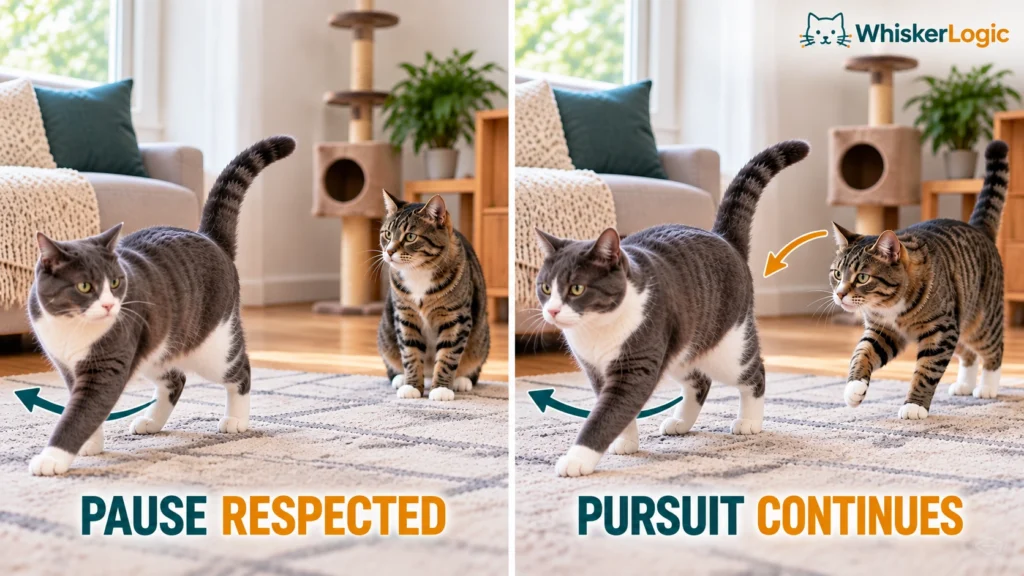
The second sequence does not automatically prove aggression. It also doesn’t prove that the interaction wasn’t play when it began.
Instead, it tells you something more specific: the interaction is becoming less mutually controlled because one cat’s attempt to reduce or end contact isn’t successfully doing so.
Research on feline social play specifically describes how an interaction may begin as mutual play and then change when one cat wants to terminate it. What the other cat does next—stopping, attempting to restart play, or continuing the interaction—helps provide context for what follows.
So don’t watch only the pounce.
Watch what happens afterward.
Don’t watch only the chase.
Watch what happens when the chased cat stops participating.
And don’t assume that because both cats wanted to play 30 seconds ago, both still want to continue now.
Is the Other Cat Still Choosing to Participate?
No single sign proves that rough play is mutually enjoyable or that it has become a problem.
Look for a repeated pattern across multiple interactions.
Potentially reassuring clues include:
- The other cat voluntarily approaches.
- Either cat can pause or walk away.
- The recipient sometimes initiates interactions.
- A cat that leaves isn’t consistently pursued.
- The cats sometimes voluntarily re-engage after a break.
- Both return to normal activities afterward.
- The interaction doesn’t repeatedly interfere with rest or normal movement through the home.
Clues worth investigating include:
- The same cat repeatedly tries to leave.
- One cat repeatedly seeks distance or hiding places.
- Pursuit repeatedly continues after disengagement.
- The same cat repeatedly has its rest interrupted.
- One cat has difficulty ending contact.
- The recipient begins avoiding places where rough interactions commonly occur.
- One cat repeatedly escapes while the other continues trying to reach it.
No single sign on either list proves that the play is fine or that it is too rough.
For example, one cat running away once doesn’t tell you much by itself.
But if the same cat repeatedly leaves, tries to settle elsewhere, and is immediately followed each time, you have a more useful pattern to investigate.
The important question isn’t whether every action is perfectly balanced.
It’s whether both cats retain a meaningful ability to participate—and to stop participating.
Why Does One Cat Play Rougher Than the Other?
There may not be one simple explanation.
Two cats sharing a home can differ in play drive, age, preferred play style, physical ability, and how long they want an interaction to continue.
These are possibilities to investigate, not diagnoses.
Different Play Drives
One cat may seek physical play frequently while the other is satisfied after shorter bouts.
The mismatch matters more than deciding which cat has the “correct” amount of play.
If one cat wants another wrestling bout while the other wants to rest, focus on whether the cat trying to rest can successfully end the interaction.
You don’t need to label one cat dominant, aggressive, or a bully to recognize that their preferred stopping points differ.
Age Differences
Age can contribute to different play needs.
Feline environmental guidelines note that kittens generally have a greater need for intercat play and greater intensity and duration of play, while older cats still need play but may need different types or intensities.
That doesn’t mean young cats always bother older cats, or that a younger cat is automatically bullying an older housemate.
Watch the individual cats.
Can the older or lower-play-drive cat leave and rest when it wants to?
Can the younger or more persistent cat redirect its play elsewhere?
A sudden change in an older cat’s tolerance, especially alongside changes in movement, jumping, grooming, appetite, activity, or other behavior, deserves veterinary consideration rather than being dismissed as “just getting older.”
Different Play Styles
Two cats may also prefer different types of play.
One may frequently initiate brief chases. Another may prefer close-contact wrestling. Another may show more interest in toys than prolonged physical interaction with another cat.
Different styles aren’t automatically a problem.
They become practically important when one cat’s preferred style repeatedly continues after the other cat tries to disengage.
Not Enough Appropriate Play Opportunities
Appropriate play opportunities are part of recommended feline environmental care, and multi-cat guidance supports individual play opportunities when appropriate.
If one cat persistently directs playful activity toward another cat, providing additional individual interactive play is a reasonable change to test.
But don’t jump from:
“My cat keeps pursuing the other cat”
to:
“My cat definitely isn’t getting enough play.”
You haven’t established that cause.
And the goal isn’t simply to exhaust the cat.
Instead, give the more persistent cat an appropriate alternative and observe whether the pattern between the cats changes.
Social Experience May Matter
Early experience can influence aspects of feline social behavior and play, but that doesn’t allow you to reconstruct an adult cat’s developmental history from one current behavior.
A cat’s background may provide context.
Rough play alone cannot tell you that a cat “wasn’t socialized properly” or establish a specific developmental cause.
Focus first on the interaction you can observe now.
A Hiss Can Be a Boundary, Not Proof of a Fight
A hiss during rough play matters, but it shouldn’t be interpreted in isolation.
A hiss can function as a distance-increasing signal, but it does not by itself tell you whether the entire interaction is play or conflict.
That makes what happens next especially useful.
Listen to what happens after the hiss, not just the hiss itself.
Compare:
Hiss → other cat pauses → separation → normal behavior resumes.
with:
Hiss → continued pursuit → another attempt to escape → cornering → increasing vocal or physical intensity.
In the first sequence, the signal was followed by increased distance.
In the second, the cat trying to create distance isn’t successfully getting it.
A hiss alone doesn’t prove a fight.
But repeated hissing followed by continued pursuit or escalation gives you more reason to investigate whether the cat can actually end the interaction.
When Should You Interrupt Rough Play?
You don’t need to interrupt every wrestling bout simply because it looks intense.
Watching may be reasonable when both cats can participate, pause, disengage, leave, and return voluntarily.
Intervention becomes more relevant when you repeatedly see:
- escape attempts followed by immediate pursuit
- continued physical contact after one cat tries to disengage
- cornering or blocked exits
- escalating vocal or physical intensity
- inability to leave safely
- repeated avoidance after interactions
- wounds or injuries
The goal isn’t to wait until you can confidently label the encounter a fight.
Interrupt the pattern before it has to become a full fight.
You don’t need to diagnose aggression, dominance, fear, or anxiety to recognize that one cat is trying to create distance and isn’t succeeding.
How to Interrupt Without Punishing Either Cat
When the interaction is still manageable, use calm redirection and distance rather than punishment.
You may be able to redirect the more persistent cat toward an appropriate toy or call it away if it already responds reliably to you.
You can also use the environment to help create distance.
Avoid:
- yelling
- spraying water
- hitting
- throwing objects at the cats
- alpha or dominance techniques
- forcing the cats together
- punishing a cat for communicating
- reaching between highly aroused cats with your bare hands
Veterinary behavioral guidance recommends avoiding punishment-based methods, and the AAFP intercat tension guidelines specifically caution against threatening or unpleasant actions.
If the interaction escalates into a real fight, ordinary rough-play management no longer applies.
Don’t put your hands between fighting or highly aroused cats.
A solid visual barrier, such as a suitable piece of cardboard or another safe barrier, can help block visual contact and assist separation without requiring you to grab either cat.
Once safely separated, give the cats time and space to settle rather than immediately forcing another interaction.
Repeated serious fights require assessment of the larger intercat problem.
Give the More Persistent Cat Another Way to Play
If one cat consistently wants more play than the other appears willing to provide, give that cat an appropriate alternative.
Individual interactive play can provide opportunities to stalk, chase, pounce, and capture without requiring the other cat to participate.
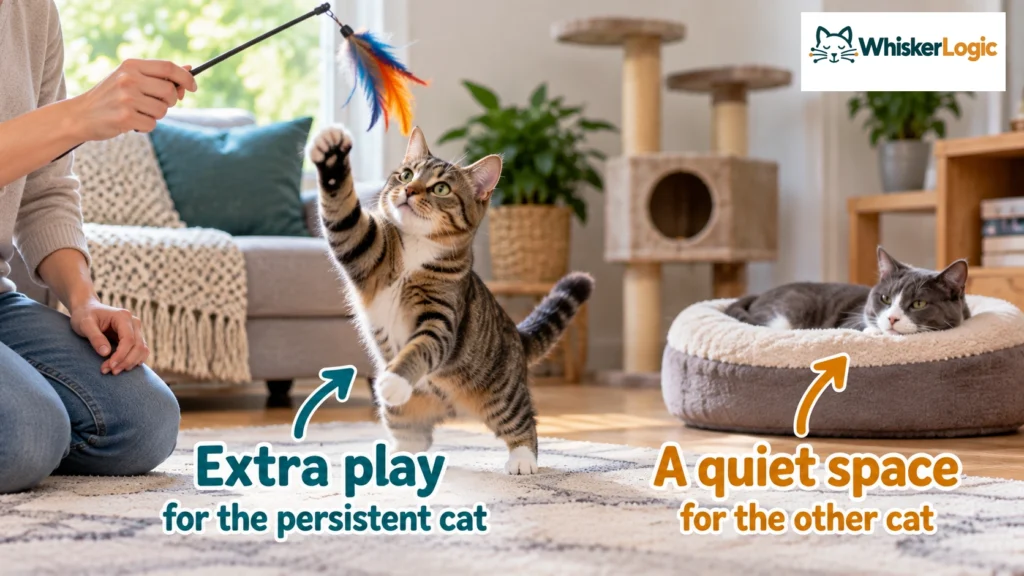
The 2024 AAFP intercat tension guidelines specifically recommend caregiver-initiated play for cats with high play drives that bother senior or more timid housemates.
But don’t turn that recommendation into a guarantee.
Providing more play does not prove that “excess energy” caused the problem, and the goal isn’t simply to tire the cat out.
Instead, run a small practical test.
Suppose rough interactions commonly happen in the evening.
Before the usual rough-play period, provide the more persistent cat with a separate interactive play session.
Then watch the next interactions.
Does persistent pursuit happen less often?
Does the other cat get more uninterrupted rest?
When the recipient leaves, does disengagement become easier?
If nothing changes, that’s useful information too.
It means you should keep investigating rather than assuming lack of play was the explanation.
Make It Easier for the Other Cat to Leave
A cat technically being able to run away doesn’t necessarily mean it has a useful way to disengage.
Look at where the rough interactions happen.
Do they repeatedly occur in:
- a narrow hallway
- a doorway
- a staircase
- a space between large furniture
- a resting location with one practical exit
- another area where one cat can easily intercept the other
Ask:
If this cat wants the interaction to end right now, where can it go?
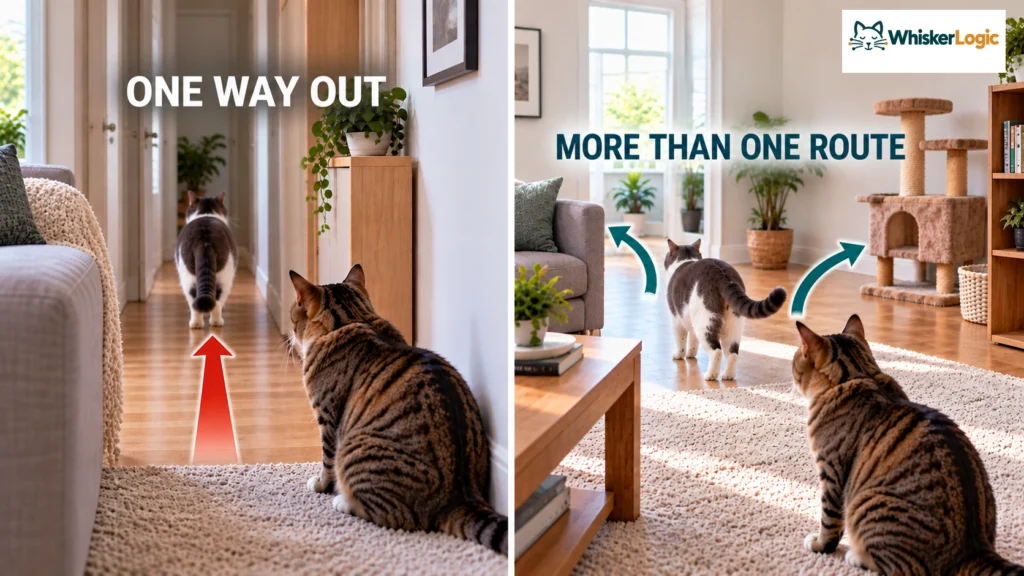
Depending on your home, useful changes may include creating alternative paths, reducing chokepoints, providing appropriate resting locations, using suitable vertical space where it actually improves movement, and distributing important resources so one cat doesn’t have to repeatedly pass the other to reach them.
Environmental guidelines for multi-cat homes emphasize safe places, separated resources, and appropriate play opportunities.
In a multi-cat home, a safe place is more useful when another cat cannot easily control its only entrance or exit.
But apply those principles to the specific problem.
Don’t simply buy a cat tree because someone says cats need vertical space.
A perch may not help if it has one practical route down and the other cat waits underneath.
A hiding place may not solve the problem if the persistent cat can follow the recipient into it or wait at its only exit.
An escape route is useful only if it actually lets the cat disengage.
Try a 7-Day Rough-Play Observation Test
This is a WhiskerLogic observation exercise, not a diagnostic test or scientific protocol.
For seven days, stop trying to classify each encounter simply as “fine” or “too rough.”
Track the sequence instead.
For each relevant interaction, record:
- Which cat initiates?
- Does the other cat participate willingly?
- Which cat pauses or stops first?
- Does the other cat respect that pause?
- Does pursuit continue after disengagement?
- Does the recipient voluntarily re-engage later?
- Where does the interaction happen?
- When does it usually happen?
- What do both cats do afterward?
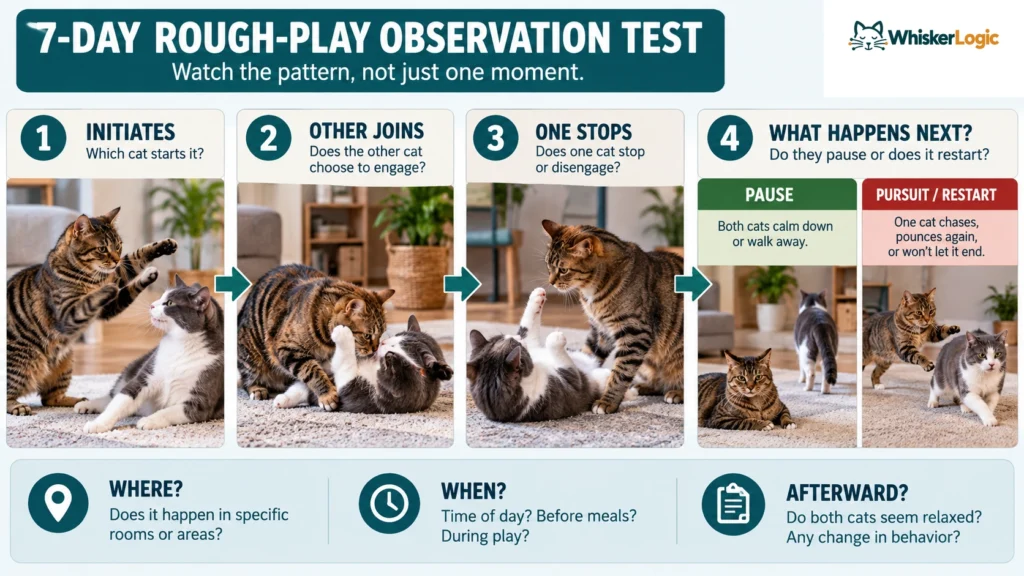
You’re looking for repetition.
You may discover that the cats wrestle intensely but reliably stop when either cat walks away.
Or you may find that the same cat tries to end most bouts and is repeatedly pursued.
You might notice that the problem occurs mainly in one hallway.
Or while one cat is resting.
Or at roughly the same time each evening.
Once you identify a pattern, test one relevant change.
For example, if rough interactions predictably happen in the evening, provide a separate interactive play session for the more persistent cat before that usual period.
Then keep observing.
Don’t simultaneously rearrange the home, change feeding schedules, introduce multiple new play sessions, move every resource, and separate the cats after every interaction.
If you change many things at once, it becomes harder to know what mattered.
The purpose isn’t to diagnose either cat.
It’s to turn:
“My cat plays too rough with other cats.”
into a more useful observation:
“When Cat A leaves the evening play bout, Cat B usually follows and restarts physical contact.”
Now you have a specific pattern you can work with.
When Rough Play May Be Becoming a Bigger Intercat Problem
Don’t assess the cats’ relationship only during play.
Look at what happens during the rest of the day.
Repeated rough play deserves broader attention if the same cat also begins:
- persistently avoiding the other cat
- hiding more often
- changing normal routes through the home
- hesitating to enter certain areas
- having difficulty reaching food, water, resting areas, or litter boxes
- being repeatedly stared at or blocked
- remaining tense after play ends
- becoming involved in recurrent conflict
- having difficulty moving normally through shared areas
The 2024 AAFP intercat tension guidelines emphasize that tension between household cats can be subtle and may involve behaviors such as staring, blocking, hiding, and avoidance rather than obvious fighting alone.
If staring or blocking is becoming part of the relationship outside play, Why Does My Cat Keep Staring at My Other Cat? addresses that pattern specifically.
If another cat’s presence is interfering with litter-box access, Can Another Cat Block Access to the Litter Box? explains how to examine the route and access problem.
This distinction matters.
A mismatch in play intensity is one problem.
A cat that cannot comfortably move through its home or reach important resources may be experiencing a broader intercat problem that requires more than adjusting play.
When You Need More Than a Rough-Play Fix
Seek veterinary assessment when there are wounds or bite injuries, a sudden major change in social behavior, or signs that pain or illness may be contributing.
More extensive behavioral help becomes appropriate when you see:
- repeated serious fights
- persistent avoidance or hiding
- escalating conflict
- inability to coexist safely
- one cat repeatedly unable to reach important areas or resources
- substantial changes in normal daily behavior
- reasonable environmental and play-management changes failing to improve the situation
A veterinarian can assess whether a medical problem may be contributing to a behavioral change.
Persistent or complex intercat problems may also warrant help from a veterinarian with behavioral expertise or another appropriately qualified veterinary behavior professional.
You don’t need to wait for rough play to become a serious fight before responding.
But you also don’t need to stop every physical game.
Keep returning to the question that gives you the most useful information:
What happens when the other cat tries to stop?
If one cat can pause, leave, and later return voluntarily, that’s very different from repeatedly trying to disengage while the other keeps pursuing.
Protecting each cat’s ability to participate—and its ability to stop participating—is more useful than judging the relationship from how dramatic one play bout looks.
FAQ
Can cats play too rough without actually fighting?
Yes. Cats can wrestle, chase, pounce, swat, grab, and use their mouths during social play. Rough-looking behavior alone doesn’t prove that the interaction is a fight.
Watch what happens when one cat tries to stop. If the other cat allows the pause or separation, that’s different from repeated pursuit after one cat is trying to disengage.
Should I stop my cats when they play too rough?
Not automatically.
Watching may be reasonable when both cats can pause, disengage, leave, and voluntarily return. Consider stepping in when one cat repeatedly tries to stop but is pursued, becomes cornered, cannot leave safely, the interaction keeps escalating, or injury occurs.
Why does my younger cat play so rough with my older cat?
Younger and older cats may differ in play intensity, duration, activity, and physical ability. Feline environmental guidelines note that kittens generally need more intercat play and greater play intensity and duration, while play for older cats may need to be adjusted.
That doesn’t mean the younger cat is automatically bullying the older cat.
Watch whether the older cat can rest and disengage when it wants to. If its tolerance changes suddenly or you notice mobility, appetite, grooming, activity, or other behavioral changes, consider veterinary assessment.
Is hissing during rough play always bad?
No. A hiss can function as a distance-increasing signal and doesn’t by itself prove that the cats are fighting.
Watch what follows. A hiss followed by a pause and separation gives you different information from a hiss followed by continued pursuit, cornering, and escalating vocal or physical behavior.
What should I do if my cat plays too rough with other cats?
Start by identifying exactly when the interaction becomes one-sided.
Give the more persistent cat appropriate individual play opportunities, make it easier for the other cat to leave, reduce environmental chokepoints, provide separated resources and resting options, and calmly interrupt persistent pursuit when the other cat is trying to disengage.
Change one relevant factor at a time and observe what changes rather than assuming one intervention will solve every case.
If the pattern causes injuries, develops into serious fights, changes suddenly, or affects one cat’s ability to move through the home or access resources normally, involve your veterinarian.
Sources
2024 AAFP Intercat Tension Guidelines: Recognition, Prevention and Management