
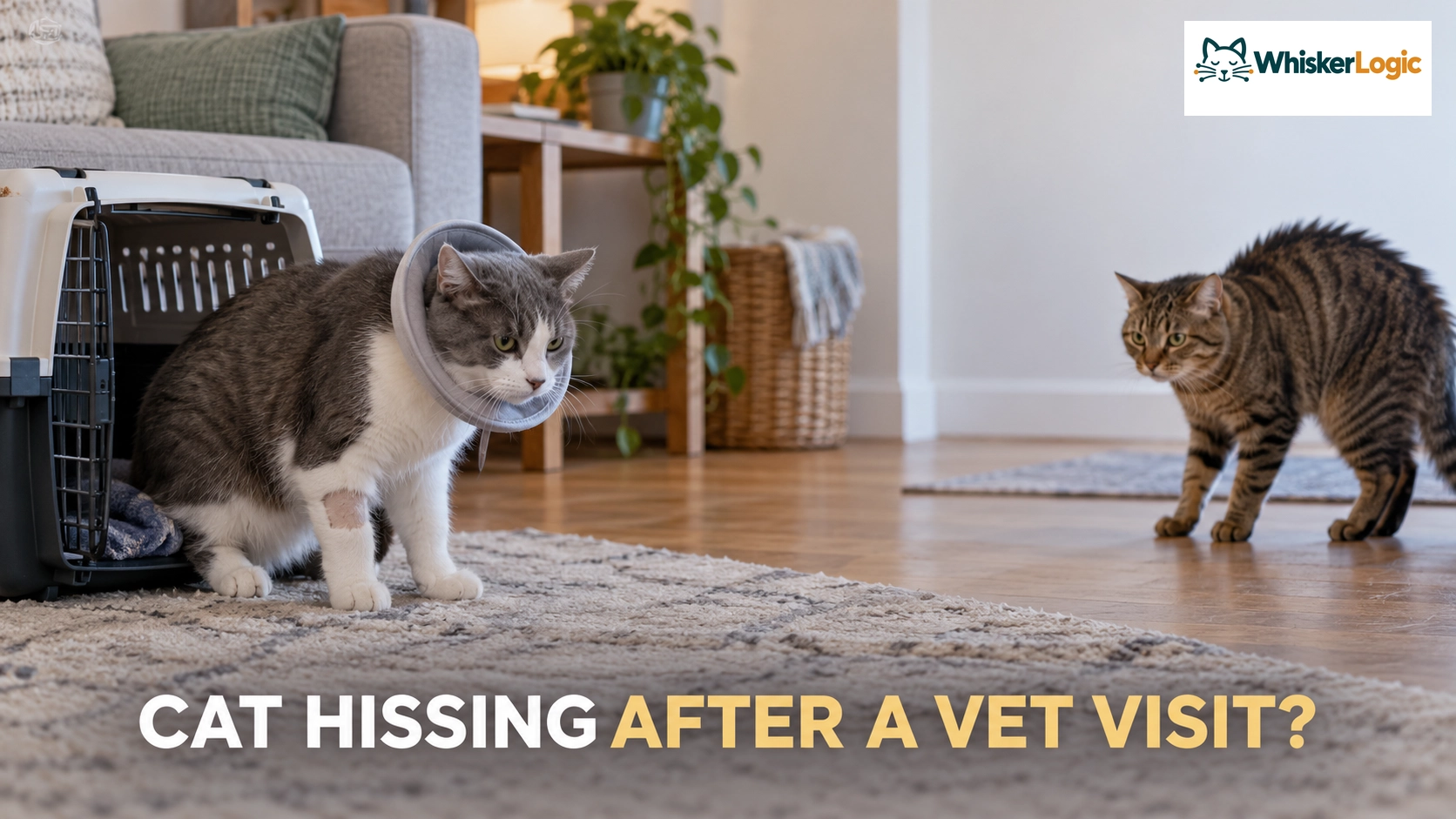
If one cat came home from the veterinarian and your other cat suddenly started hissing, growling, avoiding, staring at, or swatting them, do not force a reunion.
If your cat is hissing at your other cat after a vet visit, several temporary changes may be involved. The returning cat may smell different, move differently, behave differently, feel stressed or painful, be recovering from anesthesia, or look unfamiliar because of shaved fur, a bandage, or a recovery collar.
That does not automatically mean their relationship has broken down, and it does not prove that one cat has simply “forgotten” or failed to recognize the other.
Start with the returning cat’s medical recovery. Then watch what happens when the cats create distance.
A brief hiss followed by one cat backing away and both cats settling is very different from repeated staring, following, chasing, blocking, cornering, or physical conflict.
Quick Answer
Do not force the cats to greet each other after a vet visit.
First, follow the veterinarian’s recovery instructions and make sure the returning cat can rest safely.
Then watch whether the cats can create and respect distance.
If one cat hisses, the other backs away, and both settle, extra space and supervision may be enough.
If hissing continues, one cat will not leave the other alone, or you see staring, pursuit, blocking, cornering, or physical conflict, temporarily separate them.
If tension persists, rebuild contact gradually. Do not decide that they are ready simply because a certain number of hours or days has passed.
Vet Check: Recovery Comes Before Reunion
Before treating this as only a cat-to-cat relationship problem, think about what happened during the veterinary visit.
Was the returning cat:
- sick or injured?
- sedated or anesthetized?
- recovering from surgery?
- treated for a painful condition?
- given new medication?
- shaved or bandaged?
- wearing a recovery collar or other medical equipment?
- given restrictions on running, jumping, or activity?
Pain, illness, stress, medication effects, and recovery from anesthesia can change how a cat moves and behaves.
The 2024 AAFP Intercat Tension Guidelines identify pain or disease, as well as changes in a cat’s odor or behavior after a veterinary visit, as possible triggers for tension between cats that previously lived together.
The 2022 ISFM Consensus Guidelines on Acute Pain in Cats also emphasize that pain-related changes can be subtle and may involve posture, activity, behavior, interaction, movement, and appetite.
Follow the discharge instructions from your veterinary team.
Contact your veterinarian promptly if the returning cat develops concerning or worsening signs such as:
- unusual or worsening lethargy;
- obvious or increasing discomfort;
- reluctance or difficulty moving;
- difficulty walking;
- refusal to eat;
- repeated vomiting;
- abnormal breathing;
- difficulty urinating or inability to urinate;
- significant changes in defecation;
- major litter-box changes;
- unusual sensitivity or distress when moving;
- worsening redness, swelling, discharge, bleeding, or other concerns around a surgical site;
- any change that conflicts with the recovery instructions you were given.
Difficulty breathing, inability to urinate, collapse, severe bleeding, or rapid deterioration should not be treated as a behavioral problem. Seek urgent veterinary care.
If the veterinarian has prescribed restricted activity or protected rest, those medical instructions take priority even if the cats appear ready to interact socially.
Table of Contents
Cat Hissing at Other Cat After Vet Visit: What May Have Changed?
There may not be one single explanation.
The Returning Cat May Smell Different
A veterinary visit can expose a cat to unfamiliar smells from the clinic, disinfectants, medications, equipment, people, other animals, and bedding.
Cats rely heavily on sensory information, including scent, so those changes may affect how another household cat responds.
The 2022 ISFM/AAFP Cat Friendly Veterinary Environment Guidelines emphasize the importance of feline senses and familiar odors and recognize that veterinary environments contain unfamiliar sensory stimuli that can contribute to distress.
But scent should not be treated as the complete explanation.
The Returning Cat May Behave or Move Differently
The cat may come home:
- quieter than usual;
- restless;
- sleepy;
- unsteady;
- stiff;
- hesitant to jump;
- slower to move;
- less interested in social contact;
- more defensive about being approached.
Those changes may reflect medication, anesthesia recovery, stress, pain, illness, or the procedure itself.
The cat who stayed home is therefore not responding only to a different smell. Their familiar housemate may temporarily smell, look, move, and behave differently.
Appearance May Also Be Different
A shaved patch, bandage, recovery suit, cone, or other equipment can add another unfamiliar feature.
Again, this does not prove that the other cat has literally stopped recognizing them.
What About “Non-Recognition Aggression”?
You may see this post-vet reaction described online as non-recognition aggression.
The term can be useful as a description of the pattern, but it should not be treated as a proven diagnosis of what is happening inside the cat’s mind.
Seeing one cat react negatively when another returns home does not prove that recognition has been completely lost.
A more useful approach is to ask:
What changed after the veterinary visit, and what happens when these cats encounter each other now?
First Check the Cat Who Came Home From the Vet
Recovery comes before reunion.
A cat recovering from illness, surgery, anesthesia, injury, or a painful procedure may need a quiet area where another cat cannot repeatedly approach, chase, or invite them to play.
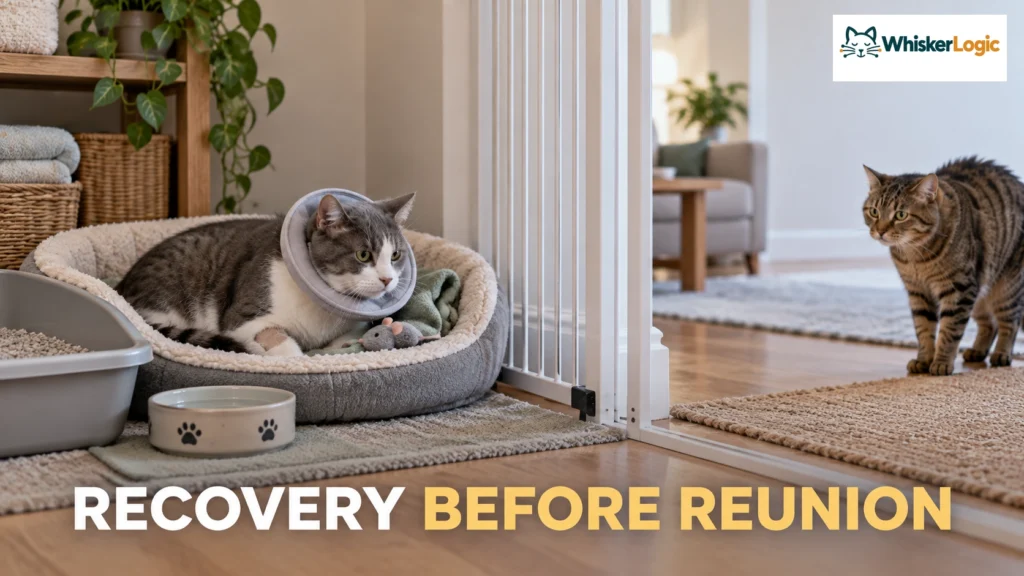
Set up the recovery area according to your veterinarian’s instructions.
Depending on the cat’s medical needs, that may include:
- food and water within easy reach;
- an appropriate litter box;
- comfortable bedding;
- a quiet resting area;
- a safe hiding option;
- medication given as directed;
- protection from unwanted play;
- restricted jumping or climbing if required.
A recovering cat may also be less able to respond to social pressure in their usual way.
A cat who normally walks away from an unwanted interaction may move more slowly after surgery. A cat who is uncomfortable may hiss or swat sooner when approached.
Do not diagnose pain from hissing alone.
Instead, consider the entire situation and follow the veterinarian’s recovery guidance.
Also remember that the cat who stayed home can have a medical problem too. If that cat develops a sudden broader behavior change that does not fit the post-vet situation, veterinary assessment may also be appropriate.
A Hiss Often Means “Give Me Space”—Watch What Happens Next
A hiss is important, but the hiss by itself does not tell you whether the cats have a serious relationship problem.
Hissing commonly functions as a distance-increasing signal. The cat is uncomfortable with what is happening and is trying to increase space without immediately escalating to physical contact.
The most useful information comes from what happens next.
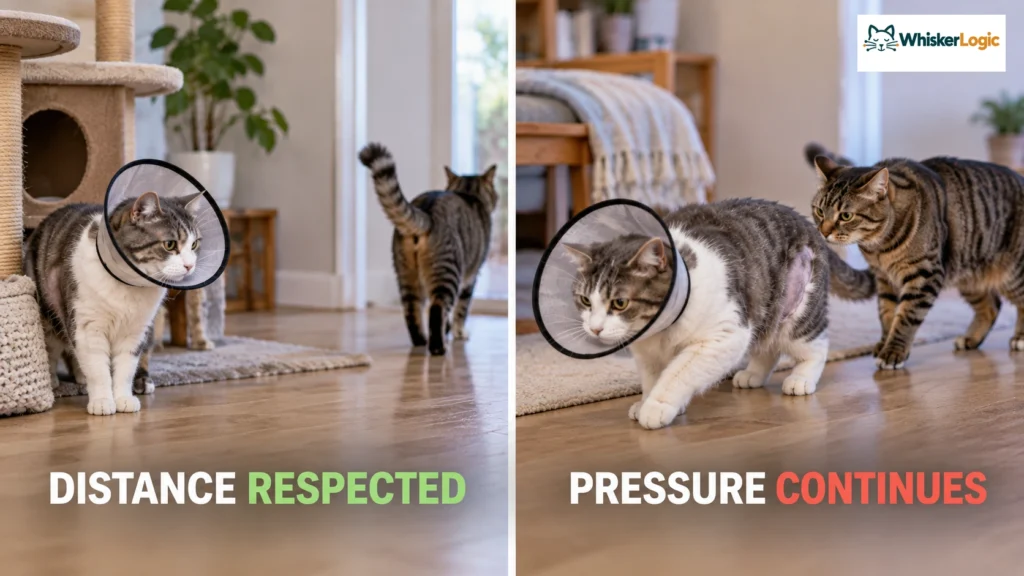
Observation: The Other Cat Backs Away
Cat A hisses when Cat B approaches.
Cat B stops, looks away, changes direction, or walks away.
Cat A does not pursue.
A short time later, both cats settle and return to normal activities.
Interpretation
The interaction contained tension, but the cats successfully created distance.
That does not guarantee that every later interaction will be comfortable, but it is very different from an encounter in which one cat cannot disengage.
Action
Give them space and continue supervising.
Do not pick them up and place them together to see whether they are “over it.”
Let the cats choose whether to approach again.
Now compare that with another sequence.
Observation: The Hiss Does Not End the Interaction
Cat A hisses.
Cat B continues approaching.
Cat A moves away.
Cat B follows.
You then see staring, repeated approaches, stalking, chasing, doorway blocking, cornering, or Cat A hiding while Cat B continues monitoring the area.
Interpretation
The important problem is no longer the hiss itself.
One cat is having difficulty ending the interaction or moving freely.
The 2024 AAFP guidelines identify staring and blocking as potentially subtle signs of intercat tension, while hissing, growling, swatting, chasing, and physical conflict are more obvious signs.
Action
Increase distance.
If the pattern continues, temporarily separate the cats rather than repeatedly exposing them to the same interaction.
If pursuit has become part of the problem, see Why Does My Cat Chase My Other Cat?.
If repeated watching is the main concern, Why Does My Cat Keep Staring at My Other Cat? explains why what the other cat does in response matters.
When You Can Give Them Space Without Starting a Full Reintroduction
Not every hiss after a veterinary visit means you need to restart the cats’ relationship from the beginning.
You may be able to give them more room and supervise if the overall pattern looks like this:
- the hissing is brief;
- one cat moves away;
- the other allows that retreat;
- neither cat follows or corners the other;
- prolonged staring does not continue;
- both cats settle afterward;
- they can move through normal parts of the home;
- access to food, water, litter boxes, and resting areas remains normal;
- normal routines begin returning.
The question is not simply:
Did one cat hiss?
Ask instead:
Could the cats disengage afterward?
Even if the answer is yes, the returning cat may still need protection from play, chasing, jumping, or social contact because of medical recovery instructions.
Social comfort does not override medical restrictions.
When to Separate the Cats After a Vet Visit
Temporary separation is appropriate when contact prevents either cat from settling safely.
Consider separating them if you see:
- repeated hissing or growling during encounters;
- prolonged or repeated staring;
- stalking or following;
- chasing;
- blocking doorways, hallways, stairs, or other routes;
- guarding access to food, water, litter boxes, resting areas, or people;
- cornering;
- repeated swatting;
- physical fighting;
- one cat repeatedly hiding because the other remains nearby;
- one cat becoming unable to move normally through the home;
- either cat remaining highly aroused after encounters;
- the returning cat repeatedly being disturbed despite needing medical rest.
Separation is management, not punishment.
Each cat should have access to the resources needed to eat, drink, rest, hide, and use a litter box comfortably.
Important: If the Cats Are Already Fighting
Do not put your hands between fighting or highly aroused cats.
Do not pick one up while the other is still focused on them.
When intervention is necessary and safe, use distance and an inanimate visual barrier, such as a large piece of cardboard or a cushion, to break visual contact and help the cats separate.
Then give them time apart to settle.
If you are unsure whether a physical interaction was play or actual conflict, see Are My Cats Playing or Fighting?.
How to Reintroduce Your Cats After a Vet Visit
If giving them ordinary space is not enough, use a gradual reintroduction.
The exact pace should be based on the cats’ behavior.
1. Start With Separate Safe Spaces
Place the cats in separate areas behind a closed door.
The recovering cat’s area must also meet their medical needs.
Each cat should be able to rest without continuously listening for, watching, or avoiding the other.
Provide appropriate access to:
- food;
- water;
- litter boxes;
- comfortable resting places;
- hiding options.
Do not repeatedly open the door to test them while they are still highly alert or reactive.
2. Wait for Both Cats to Settle
Before increasing contact, look for ordinary behavior returning.
Depending on the individual cat, that may include:
- resting;
- grooming;
- eating normally;
- playing;
- exploring;
- using the litter box normally;
- spending time away from the separating door.
A cat who remains fixed on the door, repeatedly growls or hisses there, or cannot return to normal activities is giving you information that the current distance may still be necessary.
3. Reintroduce Familiar Scent Without Forcing It
When both cats are calmer, you can move familiar bedding or another soft household item between their areas.
Let each cat investigate—or ignore—the item voluntarily.
You do not need to push the item toward the cat’s face.
You also do not need to rub the cats together or apply a substance to make them smell alike.
The goal is simply to let familiar household scent become part of the environment again without creating another stressful interaction.
4. Use Calm, Positive Activity on Opposite Sides of the Door
When the cats are comfortable in their separate spaces, you can offer an activity each cat already enjoys on opposite sides of the closed door.
Depending on the cats, that might be:
- treats;
- food;
- individual interactive play.
Do not force either cat to remain near the door.
Start far enough away that both cats can remain relaxed.
If one cat stops eating, freezes, stares at the door, repeatedly growls, or cannot engage in the activity, increase the distance.
5. Add Controlled Visual Access
Once the cats can remain comfortable with the closed-door stage, introduce brief visual contact through a secure barrier.
This might be a properly secured screen, tall gate arrangement, or another setup that prevents either cat from rushing directly at the other.
Both cats should still have the ability to move away.
Watch what they do rather than trying to keep them looking at each other.
A glance followed by looking away is different from prolonged fixation.
If you see:
- sustained staring;
- repeated hissing or growling;
- attempts to rush the barrier;
- stalking;
- retreat followed by continued monitoring;
- inability to settle afterward,
end the session and increase distance again.
6. Try Brief Supervised Time Together
When visual contact is consistently calm, try brief periods in the same area.
Choose a space with:
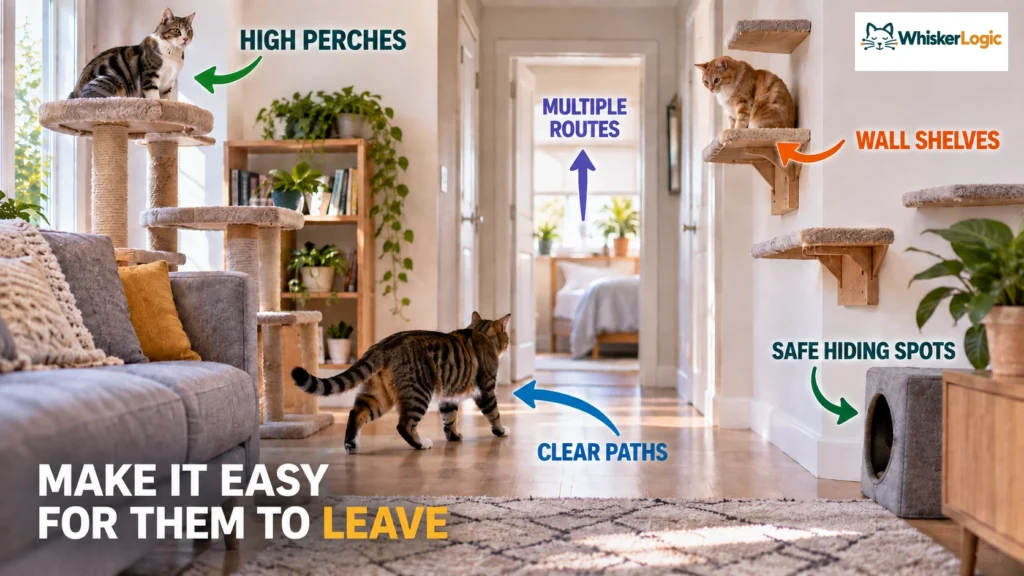
- room to move;
- more than one route away;
- no obvious dead-end corner;
- easy access to safe places.
Do not position the cats nose-to-nose.
Do not hold either cat in place.
Do not block an exit to force interaction.
They do not need to greet each other.
A successful early session may simply consist of both cats noticing each other and then doing something else.
7. Gradually Restore Normal Access
Increase shared time only while both cats continue showing that they can:
- disengage;
- look away;
- leave;
- relax;
- move through the space;
- use resources;
- return to ordinary activities.
If tension returns, go back to the previous successful step.
Do not continue forward simply because time has passed.
Let Their Behavior Decide When to Move to the Next Step
Do not use a rule such as:
“Separate them for exactly 24 hours.”
or:
“They should be fine after 48 hours.”
The amount of time needed can vary.
A cat returning from a routine appointment may behave differently from a cat returning after surgery, hospitalization, severe illness, sedation, or a painful procedure.
Previous relationships also matter.
Instead of watching the clock, watch what the cats are able to do.
Useful Signs of Progress
Look for:
- loose rather than rigid posture;
- voluntary approach without rushing;
- the ability to look away;
- the ability to turn and leave;
- eating or playing calmly when the other cat is nearby;
- moving through the room without being followed;
- resting without constantly monitoring the other cat;
- normal access to resources;
- normal household routines returning.
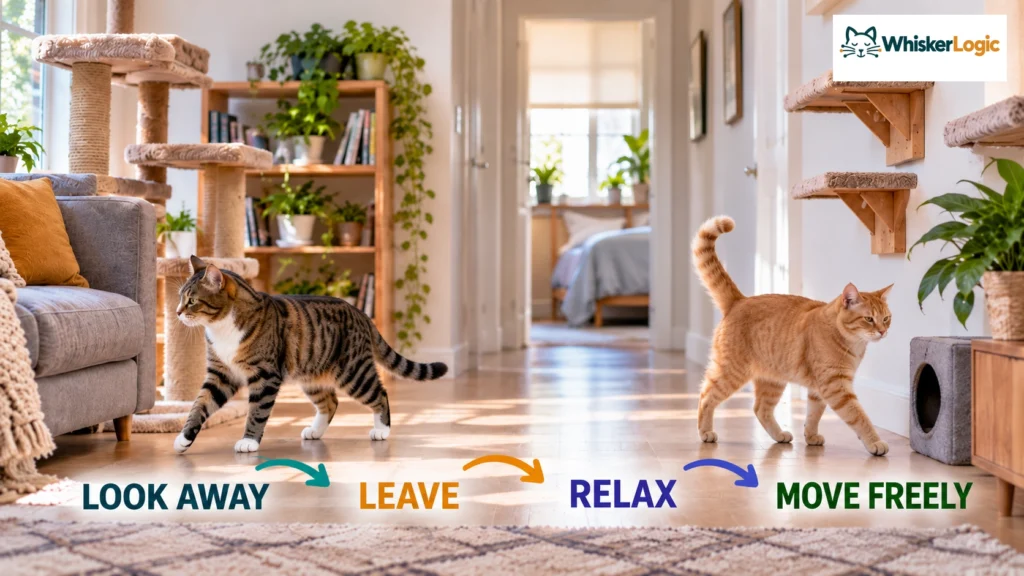
The cats do not need to cuddle.
They do not need to groom each other.
They do not even need to choose close physical proximity.
Being able to coexist peacefully and move freely through the home is meaningful progress.
Signs That You Should Slow Down
Be more cautious if you repeatedly see:
- fixation on the other cat;
- freezing;
- hiding;
- stalking;
- repeated retreat;
- pursuit;
- blocking;
- one cat waiting for the other to leave before using a resource;
- difficulty settling after an encounter.
If tension begins affecting litter-box access or normal movement through the home, see Can Another Cat Block Access to the Litter Box?.
What Not to Do When One Cat Hisses at the Other After a Vet Visit
Some attempts to make the cats “get over it” can add more pressure.
Do Not Punish Hissing or Growling
Hissing and growling provide useful information that the cat is uncomfortable.
Punishment can add fear or stress without resolving the reason the cat wanted more distance.
Do Not Force Nose-to-Nose Greetings
The cats do not need to inspect each other at close range.
Let them choose whether to approach.
Do Not Hold the Cats Together
Holding a cat removes their ability to retreat and can increase pressure.
Do Not Let Them “Fight It Out”
Cats do not need to settle a disagreement through physical combat.
Repeated conflict can cause injuries and may make future encounters more difficult.
Do Not Carry an Aroused Cat Toward the Other Cat
If a cat is staring, hissing, growling, swatting, or highly aroused, give them distance.
Do not pick them up and move them toward the other cat.
Do Not Use Perfume or Vanilla Tricks
Do not apply perfume, vanilla extract, or other strong substances to both cats in an attempt to make them smell the same.
These methods do not address the full situation and may introduce yet another unfamiliar odor.
Do Not Force Scent Transfer
Familiar bedding and soft household items can be offered for voluntary investigation.
There is no need to physically force one cat’s scent onto the other.
Do Not Ignore Medical Recovery
Even if the cats are socially comfortable, rough play, chasing, jumping, or physical contact may violate post-surgical or medical restrictions.
Do Not Treat Pheromones as the Main Solution
Synthetic feline pheromone products may be used as an optional addition to environmental and behavioral management.
They should not replace separation, environmental management, or gradual reintroduction when those steps are needed.
How to Reduce the Chance of This Happening After the Next Vet Visit
You cannot guarantee that a post-vet reaction will never happen again, but you can make future veterinary trips and homecomings easier to manage.
Make the Carrier Part of Normal Life
Do not let the carrier appear only when something unpleasant is about to happen.
When practical, leave it accessible in the home with the door open.
Add comfortable familiar bedding and allow your cat to enter voluntarily.
Use Familiar Bedding
Place familiar bedding in the carrier when appropriate.
Familiar smells may make the carrier and veterinary experience less unfamiliar.
Reduce Travel Stress Where Possible
Keep the carrier stable during transportation and reduce unnecessary noise and visual stimulation.
Discuss severe travel anxiety or previous difficult veterinary visits with your veterinarian before the next appointment.
Depending on the individual cat, the veterinary team may be able to suggest additional preparation.
Tell the Veterinary Team About Previous Post-Vet Tension
If one cat has reacted strongly after another cat returned from previous appointments, tell your veterinarian.
This helps them understand that the visit affects not only the patient but also the multi-cat household after the cat returns home.
Allow a Calm Homecoming
Do not immediately place the returning cat in the middle of the household and force interaction.
Give them an opportunity to settle.
How much separation is appropriate depends on:
- what happened at the veterinary visit;
- the returning cat’s recovery needs;
- the cats’ previous relationship;
- what the cats actually do when they encounter each other.
Do Both Cats Need to Go to the Vet Together?
You may encounter advice suggesting that both cats should always travel to the veterinarian together so they return with similar smells.
That should not be treated as a universal rule.
Taking an additional cat can create extra travel and veterinary stress for that cat and may not be necessary.
If your cats repeatedly have significant post-vet tension, discuss the pattern with your veterinarian and develop a plan appropriate for those individual cats.
When the Problem Is No Longer Just a Temporary Post-Vet Reaction
The veterinary visit may explain why the first unusual encounter occurred.
It does not necessarily explain every behavior that follows.
Look at the broader pattern if you continue seeing:
- persistent avoidance;
- chronic hiding;
- repeated prolonged staring;
- stalking;
- repeated chasing;
- blocking of doorways or routes;
- restricted access to food, water, litter boxes, or resting areas;
- inability to move freely through the home;
- changes in eating;
- changes in litter-box behavior;
- repeated physical conflict;
- injuries;
- ongoing difficulty relaxing in shared spaces;
- repeated failure to progress during a careful reintroduction.
At that point, do not assume that a veterinary smell is still the entire problem.
Pain, illness, environmental pressure, resource access, previous tension, and learned responses from repeated uncomfortable encounters may all need consideration.
Veterinary assessment is appropriate when a cat develops sudden behavioral changes because medical and behavioral problems can overlap.
That applies to both cats.
If medical concerns have been addressed but significant intercat tension continues despite careful management and gradual reintroduction, ask your veterinarian about referral to a qualified feline behavior professional or a board-certified veterinary behaviorist.
Frequently Asked Questions
Why is my cat hissing at my other cat after a vet visit even though they normally get along?
The veterinary visit may temporarily change several things about the returning cat, including scent, movement, behavior, appearance, stress level, and physical comfort.
The other cat may react to one or several of those changes.
This does not automatically mean the relationship has broken down or that one cat has literally stopped recognizing the other.
Watch whether the cats can create distance and return to normal behavior.
How long will my cat hiss at my other cat after the vet?
There is no reliable fixed timeline.
Some cats settle after a short period of extra space. Others need a slower reintroduction, particularly after surgery, hospitalization, illness, anesthesia, or a highly stressful veterinary experience.
Move forward based on behavior rather than waiting a predetermined number of hours or days.
Should I separate my cats after a vet visit?
Not automatically.
If one cat hisses briefly, the other moves away, both relax, and the returning cat does not need protected medical rest, extra space and supervision may be enough.
Separate them when distance is not respected, tension continues, one cat cannot disengage, physical conflict occurs, or medical recovery requires protection from interaction.
Does my cat not recognize my other cat after the vet?
You may see the reaction called “non-recognition aggression,” but that label does not prove that your cat has literally failed to recognize their housemate.
The returning cat may smell, behave, move, look, and feel different after the visit.
Those combined changes provide a more cautious explanation than assuming scent alone caused a failure of recognition.
Can anesthesia make my cat act differently after the vet?
Yes. Depending on the drugs used and the individual cat, behavior and movement can be temporarily different during recovery from sedation or anesthesia.
Follow the discharge instructions provided by your veterinary team.
If your cat’s recovery seems abnormal, worsens, or does not match what you were told to expect, contact the veterinarian rather than assuming the behavior is only part of the cat-to-cat problem.
Will my cats get along again after a vet visit?
Many post-vet reactions can improve as the returning cat recovers and the cats regain comfortable, predictable interactions.
However, no individual outcome or timeline can be guaranteed.
Look for gradual restoration of the ability to relax, move freely, disengage, and share the home without repeated staring, pursuit, blocking, or conflict.
Do I need to reintroduce my cats after every vet visit?
No.
If the cats greet normally or show only brief tension that resolves when they are given space, a structured reintroduction may not be necessary.
If a particular pair repeatedly develops significant post-vet tension, plan for a calmer homecoming and be prepared to separate and rebuild contact gradually when their behavior shows that it is needed.
Sources
- 2024 AAFP Intercat Tension Guidelines: Recognition, Prevention and Management
- 2022 ISFM/AAFP Cat Friendly Veterinary Environment Guidelines
- 2022 AAFP/ISFM Cat Friendly Veterinary Interaction Guidelines
- 2022 ISFM Consensus Guidelines on the Management of Acute Pain in Cats
- Cornell Feline Health Center — Feline Behavior Problems: Aggression
- Merck Veterinary Manual — Behavior Problems of Cats