

If you’re dealing with a cat peeing on bed but still using litter box at other times, the pattern can seem contradictory. But continued litter-box use does not necessarily mean the litter-box setup is working well in every situation, and it does not rule out a medical problem.
The bed itself can provide useful clues. The first questions are whether your cat targets only one bed or also urinates on other soft surfaces, whether the behavior started suddenly, what normal litter-box use looks like, and whether anything changed around the time the problem began. Those patterns cannot diagnose the cause, but they can help you decide what to investigate next.
Quick Answer: Cat Peeing on Bed but Still Using Litter Box
A cat can pee on the bed while still using the litter box because the problem may be partial or situation-specific rather than complete litter-box avoidance.
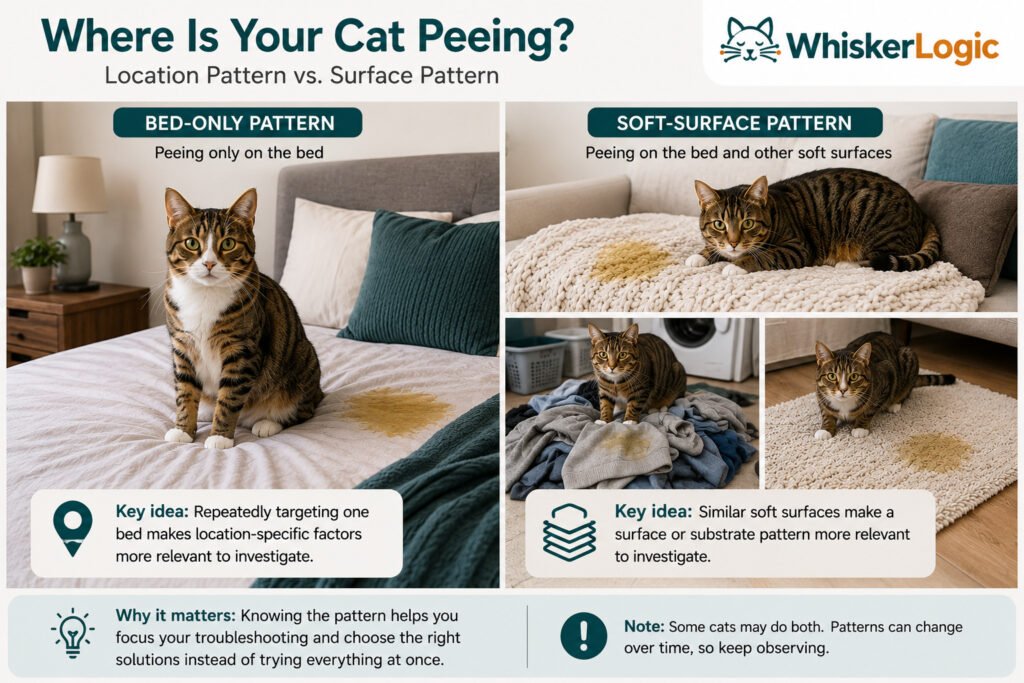
If your cat repeatedly targets one particular bed, factors related to that location become more important to investigate. If your cat also urinates on blankets, laundry, clothing, rugs, or other soft materials, a surface or substrate pattern becomes more relevant. Litter-box conditions, medical problems, environmental or social factors, and urine marking may also contribute—and more than one factor can be involved.
The key is to use the pattern as a clue, not as a diagnosis.
Vet Check: When Bed-Peeing Needs Prompt Attention
A new change in where your cat urinates deserves attention even if your cat continues using the litter box. Cornell Feline Health Center explains that lower urinary tract signs in cats can have multiple causes and may include painful or difficult urination, increased frequency, crying while urinating, blood in the urine, and urinating outside the litter box.
Contact your veterinarian if the bed-peeing is new, persistent, or accompanied by changes in your cat’s urinary habits or general condition.
Warning signs include:
- repeated attempts to urinate
- straining to urinate
- frequent trips to the litter box
- passing unusually small amounts of urine
- blood in the urine
- crying or vocalizing while urinating
- obvious pain or distress
- excessive licking around the genital area
- a meaningful change in urine volume
- vomiting
- lethargy
- reduced appetite
Emergency: If your cat repeatedly tries to urinate but produces little or no urine, seek immediate veterinary care. Cornell describes urethral obstruction as a true medical emergency. Male and neutered male cats are at greater risk because their urethra is longer and narrower.
Peeing on a bed alone cannot tell you whether your cat has a urinary tract infection, feline lower urinary tract disease, cystitis, kidney disease, diabetes, arthritis, or another medical condition. Those possibilities require veterinary evaluation rather than diagnosis from the location of an accident.
Table of Contents
Start With the Pattern: What Is Your Cat Actually Doing?
Before changing the litter, replacing the box, or assuming your cat is stressed, collect a few basic observations.
The useful question isn’t simply:
“Why did my cat pee outside the litter box?”
It’s:
“What is different about the times and places where my cat doesn’t use the box?”
Start with these questions:
- Is it always the same bed?
- Does your cat also pee on blankets, laundry, clothing, towels, rugs, or other soft materials?
- Has it happened once, occasionally, or repeatedly?
- Did the behavior begin suddenly?
- Is your cat still producing apparently normal amounts of urine in the litter box?
- Has the frequency or amount of urine changed?
- Does your cat use one litter box but avoid another?
- Did you recently change the litter, box, box location, cleaning routine, household routine, or bedroom access?
- Are there other cats in the home?
- If you have seen an episode, did your cat squat or stand?
- Was there a normal-sized puddle or a smaller amount of urine?
You don’t need every answer immediately. Even a few consistent observations can help narrow what deserves attention.
Only the Bed, or Other Soft Surfaces Too?
One of the most useful distinctions is whether your cat repeatedly chooses a particular location or a particular type of surface.
Merck Veterinary Manual describes toileting preferences involving both location and substrate, including factors such as odor and texture. VCA Animal Hospitals likewise distinguishes location preferences from substrate preferences and notes that more than one preference can occur.
If It’s Always One Particular Bed
Suppose your cat repeatedly urinates on the same bed but not on another bed, laundry, rugs, or similar materials.
That makes the location itself worth investigating.
Ask:
- Is it always the same bed or bedroom?
- Does the accident occur in the same part of the bed?
- Does it happen at a particular time?
- Is litter-box access different from that part of the home?
- Are other animals or household activities affecting the route to a box?
Repeatedly choosing one bed does not prove that your cat has a location preference. It simply makes location-specific factors more relevant to investigate.
If It’s the Bed Plus Laundry, Blankets, or Other Soft Surfaces
Now consider a different pattern.
Your cat urinates on the bed, but you also find urine on laundry, blankets, clothing, towels, rugs, or other soft materials.
That makes the physical characteristics of those surfaces more relevant.
Merck specifically identifies fabric and soft porous surfaces as examples that can appear in a substrate-preference pattern. That makes repeated accidents across several similar soft surfaces a useful clue—but not a diagnosis.
Instead of immediately concluding that your cat “prefers fabric,” compare what those accident surfaces have in common with the litter surface your cat is being asked to use.
Ask:
- Did the litter texture recently change?
- Is the litter scented or otherwise different from what your cat previously used?
- Does your cat readily dig in the litter?
- Did the soft-surface accidents begin after a litter change?
A surface pattern and a location pattern can overlap. More than one factor may be operating at the same time.
Why a Cat Peeing on Bed but Still Using Litter Box Can Still Point to the Box
One of the easiest mistakes to make is:
“My cat still uses the litter box, so there can’t be anything wrong with it.”
A cat does not have to stop using the litter box completely for an aversion, access problem, or competing surface or location preference to matter. Merck lists location, litter-box characteristics, substrate characteristics, cleanliness, and medical problems among factors associated with toileting aversions.
The useful question is therefore not simply whether your cat uses the box. It is how the cat uses it and under what conditions.
Litter
Consider whether you recently changed:
- litter type
- texture
- scent
- depth
Pay particular attention to changes that occurred shortly before the bed-peeing began.
Cleanliness
If accidents are more likely when a particular box has gone longer between cleanings, that pattern is useful information.
Box Size and Design
Watch whether your cat can enter, turn, position the body, dig, and leave comfortably.
A box can technically be usable without being equally comfortable for every cat or in every circumstance.
Accessibility
Consider high entrances, stairs, closed doors, awkward routes, and other obstacles that could make reaching or entering a box harder.
Mobility changes can make accessibility especially important. VCA notes that medical problems affecting mobility can make reaching, entering, or positioning inside a litter box difficult.
Location
Consider whether the box is in a noisy, busy, difficult-to-reach, or socially uncomfortable location.
Instead of changing everything at once, look for factors that match the pattern you are actually seeing.
Watch What Happens When Your Cat Uses the Litter Box
Your cat’s behavior around the litter box can tell you more than simply knowing that urine sometimes appears inside it.
When possible, quietly observe normal litter-box visits.
Does your cat:
- approach and enter without hesitation?
- dig normally?
- have enough room to position the body comfortably?
- remain long enough to urinate normally?
- leave calmly or rush out?
- use one box readily while rarely using another?
- struggle with the entrance?
- behave differently after the litter is changed?
- repeatedly look around when another cat is nearby?
These observations are clues, not diagnoses.
For example, quickly leaving a litter box does not prove that the box caused the bed-peeing. But if your cat repeatedly avoids one box, readily uses another, and has accidents when the preferred box is unavailable, you now have a more specific pattern to investigate.

If your cat actually gets into the box but urine crosses its physical edge, that is a different pattern. See Why Is My Cat Peeing Over the Edge of the Litter Box? for that specific situation.
Could Another Cat Be Affecting Safe Litter-Box Access?
In a multi-cat home, counting litter boxes is useful—but it isn’t enough.
A better question is:
Can your cat reach a litter box, use it, and leave without being blocked or pressured by another cat?
VCA notes that in multi-cat homes, one cat may feel threatened when trying to reach a litter box and that multiple boxes in multiple locations may be necessary.
Watch for observable patterns such as staring, blocking, stalking, chasing, or one cat repeatedly withdrawing when another approaches.
Also consider how litter boxes are distributed. Multiple boxes placed together may not provide the same practical alternatives as boxes available in separate locations.
If bed-peeing occurs mainly when a particular cat is nearby or when access to a preferred box appears more difficult, that pattern deserves attention.
Don’t assume another cat is responsible simply because you have a multi-cat household. Look for evidence of how the cats actually use space and resources.
Is It Ordinary Urination or Could It Be Urine Marking?
Not every deposit of urine outside the litter box represents the same behavior.
Merck’s comparison of urine marking and undesirable toileting provides several useful observations.
Ordinary Urination Is More Commonly Associated With:
- squatting
- a larger or normal amount of urine
- a horizontal surface
A puddle on horizontal bedding after the cat squats is therefore more consistent with ordinary urination than with the classic spraying pattern.
Urine Marking More Commonly Involves:
- standing rather than squatting
- an upright tail that may twitch or quiver
- a smaller amount of urine
- vertical surfaces
But these are patterns, not absolute rules.
Merck notes that urine marking can occur on horizontal surfaces, although this is less common. So urine on a bed does not automatically rule out marking, and posture alone should not be used to classify the behavior with certainty.
If you witness an episode, note the posture, approximate amount of urine, target surface, and surrounding circumstances. Those details can be more useful than simply reporting that your cat “peed on the bed.”

What Changed Before Your Cat Started Peeing on the Bed?
If the behavior is new, work backward.
Ask what changed shortly before the first accident.
Check for changes involving:
- litter type or brand
- litter-box design
- box location
- number of available boxes
- cleaning routine
- bedroom access
- household schedule
- people or animals in the home
- relationships between household cats
- furniture or room arrangements
- your cat’s ability to reach or enter the box
Timing matters, but timing is not proof.
If bed-peeing began shortly after a litter change, for example, that change deserves investigation. It does not prove that the new litter caused the behavior.
The same principle applies to environmental changes.
Calling the problem simply “stress” can hide useful details. Identifying what actually changed, when it changed, and what happened afterward gives you much more to work with.
What to Do Next: A Pattern-Based Troubleshooting Plan
Instead of trying many unrelated fixes at once, work through the problem in an order that preserves useful information.
1. Check for Urinary Warning Signs First
If your cat is straining, repeatedly attempting to urinate, passing little or no urine, showing pain, or displaying other concerning urinary or general signs, prioritize veterinary care.
Do not wait for a litter-box experiment to solve a potentially medical problem.
2. Map Where the Accidents Occur
For the next few incidents, record:
- exact location
- type of surface
- approximate amount of urine
- posture, if witnessed
- time of day
- which litter boxes were available
- anything notable happening in the household
You don’t need an elaborate diary. The goal is to find repetition.
3. Compare Bed-Only With Soft-Surface Accidents
If one particular bed is consistently targeted, investigate the location and circumstances.
If the pattern includes bedding, laundry, clothing, rugs, and similar materials, investigate what those surfaces have in common.
4. Observe Actual Litter-Box Use
Don’t stop the investigation at “my cat still uses it.”
Look at which box is used, how your cat enters and leaves, whether there is enough usable space, and whether use changes with cleanliness, litter, location, or the presence of another cat.
If the urine instead appears immediately beside the litter box, that is a distinct pattern. See Why Is My Cat Peeing Right Next to the Litter Box? for troubleshooting focused specifically on accidents beside the box.
If the problem is broader—your cat urinates in different places outside the box while still defecating inside it—see Why Is My Cat Peeing Outside the Litter Box but Still Pooping in It?.
5. Review What Changed Before the Problem Began
Focus especially on changes that closely preceded the first accidents.
When practical, correct one plausible issue at a time rather than changing the entire environment simultaneously. That makes it easier to see what actually affects the pattern.
6. Check Safe Access in Multi-Cat Homes
Look at routes and interactions, not only box count.
Provide practical litter-box alternatives in separate, accessible locations and pay attention to whether another cat can block access.
7. Correct Litter-Box Problems You Can Identify
If your observations point toward an undersized box, difficult entrance, unsuitable location, cleanliness problem, litter change, or another specific issue, address that issue.
Avoid repeatedly switching products without a reason tied to the observed pattern.
8. Prevent Easy Repetition While You Investigate
When practical, temporarily limiting unsupervised access to the bed can help prevent repeated accidents while you investigate the underlying problem.
This is management, not a diagnosis or complete solution.
Make sure your cat still has convenient access to appropriate litter boxes elsewhere.
9. Clean Urine-Contaminated Areas Thoroughly
Clean urine-contaminated bedding and surfaces thoroughly using a pet-urine cleaning product appropriate for the material, following the product instructions and fabric-care directions.
VCA also recommends thorough cleaning and odor removal from previously soiled areas as part of managing house-soiling.
Do not punish your cat for an accident.
10. Get Additional Help if the Pattern Persists
If bed-peeing continues despite reasonable litter-box and environmental changes—or if you cannot identify a consistent pattern—talk with your veterinarian.
Once medical concerns have been appropriately evaluated, persistent cases may benefit from a more detailed behavioral and environmental assessment.
What Not to Assume About a Cat Peeing on Your Bed
Because the target is your bed, the behavior can feel personal. That can lead to explanations that sound convincing but don’t help identify the problem.
“My Cat Is Getting Revenge”
The AAFP/ISFM house-soiling guidelines specifically caution that house-soiling is not caused by spite or anger toward the caregiver.
Look for medical, environmental, social, litter-box, location, surface, or marking factors instead.
“My Cat Is Jealous”
Changes involving people or other animals may matter, but labeling the behavior “jealousy” does not establish why your cat is urinating on the bed.
Look for observable changes and patterns.
“My Cat Pees There Because the Bed Smells Like Me and Makes Them Feel Safe”
This is a popular explanation online, but it should not be treated as the default explanation for bed-peeing.
The fact that the target is your bed does not by itself tell you the cat’s motivation.
“The Litter Box Can’t Be Involved Because My Cat Still Uses It”
Continued use tells you the box has not been completely abandoned. It does not tell you whether every aspect of the litter, box, location, accessibility, or surrounding environment works well in every situation.
“It Must Be Behavioral Because My Cat Looks Healthy”
A cat can have a medical problem without appearing obviously ill at home.
A new or persistent change in urinary behavior deserves appropriate veterinary consideration.
When Cat Peeing on Bed but Still Using Litter Box Still Doesn’t Make Sense
If reasonable changes do not resolve the problem, don’t keep guessing.
A new, persistent, increasing, or medically concerning urinary behavior warrants veterinary evaluation. If medical problems have been appropriately evaluated and the bed-peeing continues, a more detailed behavioral and environmental assessment may be appropriate.
The useful clue is the combination: your cat is peeing on the bed but still using the litter box.
Determine whether the pattern is bed-specific or extends to other soft surfaces, observe what litter-box use actually looks like, check for urinary changes and recent environmental changes, and consider safe access in multi-cat homes.
Those observations won’t diagnose the cause, but they can tell you what deserves attention next.
Sources
- Cornell Feline Health Center — Feline Lower Urinary Tract Disease
- Merck Veterinary Manual — Behavior Problems of Cats
- Merck Veterinary Manual — Distinguishing Urine Marking From Undesirable Toileting in Cats
- AAFP/ISFM — Guidelines for Diagnosing and Solving House-Soiling Behavior in Cats
- VCA Animal Hospitals — Cat Behavior Problems: House Soiling