
If your cat won’t use a covered litter box but will use an open one, the cover may matter—but that does not necessarily mean your cat simply “hates” covered litter boxes.
Adding a hood can change several things at once: usable space, the entrance, airflow, visibility, and how easily your cat can enter, turn around, and leave. In a multi-cat home, it may also change what your cat can see while inside the box.
So instead of assuming the cover is the problem, start with a more useful question:
What changed when the litter box became covered?
Quick Answer
Cats do not appear to have a universal preference for uncovered litter boxes. A controlled study comparing covered and uncovered litter boxes found no significant overall difference in use. Some individual cats did show a preference in either direction.
If your cat avoids a covered box, compare it with an appropriate uncovered option while keeping the litter, cleaning, usable size, and other important variables as similar as practical.
Then watch the pattern.
If your cat consistently uses the uncovered box but avoids the covered one, investigate what the covered setup changes—such as usable space, the entrance, conditions inside the box, visibility, or access.
If your cat avoids both covered and uncovered boxes, the problem is probably broader than the cover alone.
Vet Check
A sudden change in litter-box behavior can sometimes accompany pain or a medical problem. Don’t assume a new refusal is purely a box preference.
Contact your veterinarian about a significant or unexplained change, especially if you also notice straining, repeated litter-box visits, blood in the urine, vocalizing during elimination, constipation or difficult defecation, vomiting, reduced appetite, lethargy, obvious discomfort, or new difficulty moving.
According to the Cornell Feline Health Center, cats with a urethral obstruction may make repeated attempts to urinate while producing little or no urine.
If your cat repeatedly tries to urinate but produces little or no urine, seek immediate veterinary care. Urethral obstruction is a medical emergency, and male cats are at greater risk.
Table of Contents
Why Your Cat Won’t Use a Covered Litter Box: First Test the Cover
When your cat won’t use a covered litter box, start with what your cat actually does rather than assuming the hood is responsible.
The most useful first comparison is simple:
Will your cat use an appropriate uncovered box when one is available?
Your cat uses the uncovered box but avoids the covered one
That makes something associated with the covered setup worth investigating.
You might see your cat:
- use the box normally until the cover is added
- approach the covered box and back away
- put their head or front half inside but not fully enter
- enter but appear cramped or have difficulty turning
- repeatedly choose an uncovered box placed nearby
These observations do not prove why your cat avoids the covered box. They tell you what to test next.
For example, hesitation at the entrance makes the doorway worth examining. Difficulty turning points toward usable space. Comfortable use of an otherwise similar uncovered box makes something associated with the covered setup more plausible.
Your cat avoids both boxes
Stop focusing exclusively on the cover.
The problem could instead involve litter, cleanliness, location, accessibility, a negative association with the box or its location, social pressure from another cat, or medical discomfort.
If the pattern involves urination outside the box while your cat still defecates in it, see our guide to why a cat may pee outside the litter box but still poop in it.
If your cat specifically urinates immediately beside the box, the troubleshooting path is somewhat different; see why a cat may pee right next to the litter box.
Your cat used the covered box reliably and then stopped
This is different from rejecting a newly covered box immediately.
Ask what else changed.
Has your cat’s mobility changed? Is the entrance now difficult to negotiate? Has your cat’s body size changed? Has the cleaning routine changed? Is another cat spending more time around the box?
A sudden unexplained change also deserves veterinary attention rather than automatically being treated as a new preference.
Does the Covered Box Leave Enough Usable Space?
“Covered” and “too small” are not the same problem.
A large covered box may be acceptable to a particular cat, while a small one may make entering, turning, digging, squatting, or positioning difficult.
That distinction is especially important because the dimensions advertised for a litter box may describe its exterior rather than the floor space your cat can actually use.
The AAFP/ISFM house-soiling guidelines recommend a rectangular litter box approximately 1.5 times the cat’s length from the nose to the base of the tail.
Treat that as a practical guideline, not a guarantee that a particular box will work for every cat.
Then inspect the actual interior.
Ask:
- Can your cat enter completely without squeezing through the opening?
- Can they turn around comfortably?
- Can they squat and position normally?
- Is there enough room to dig and reposition?
- Does the hood reduce usable space?
- Does your cat’s body frequently contact the hood or sides?
If your cat enters but appears cramped, compare the current box with a larger option. Otherwise, you may mistake a space problem for a cover preference.
If your cat gets inside the box but urine frequently goes over its side or edge, that is a different pattern. Our guide to why cats pee over the edge of the litter box explains how box dimensions, posture, and other factors can affect that situation.
Could the Entrance Be the Problem?
Sometimes the relevant difference is not the roof. It is the doorway.
Covered boxes typically require the cat to pass through a defined opening. Depending on the design, that can introduce a higher threshold, narrower opening, or more restricted entry than an open tray.
Watch what happens at that exact point.
A cat that approaches normally but repeatedly stops with only their head or front half inside is giving you a useful observation—not a diagnosis, but something specific to investigate.
Check:
- entrance width
- entrance height
- threshold height
- room immediately inside the entrance
- ease of stepping in and out
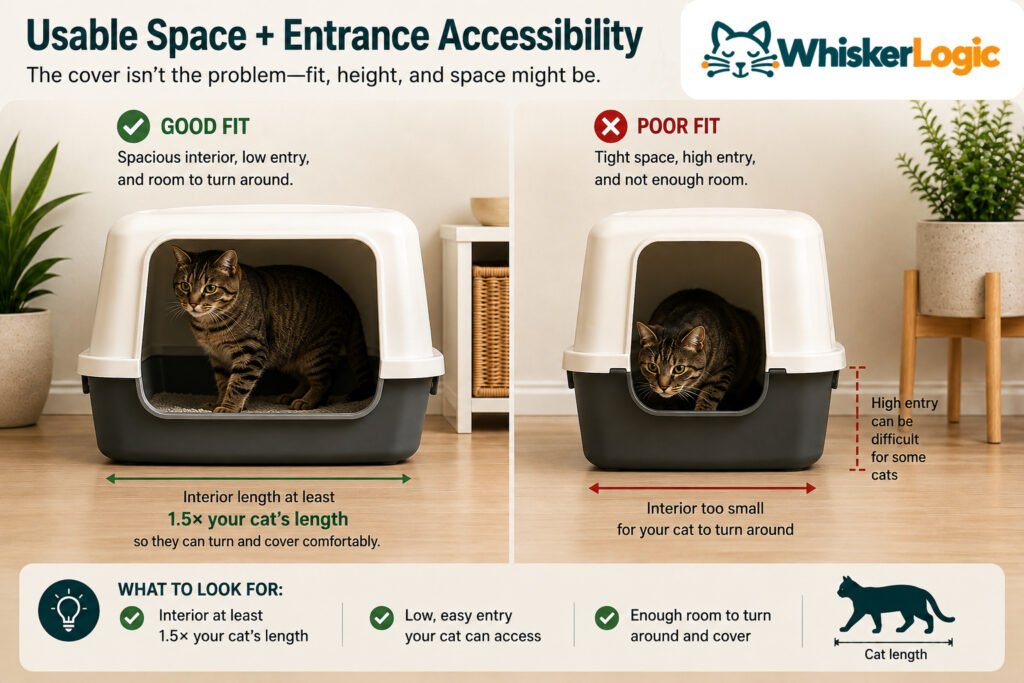
If the box has a swinging flap or door, that is another variable you can test separately rather than assuming the entire hood is unacceptable.
The principle is simple:
Identify the change before trying to fix it.
What About Odor, Cleaning, and Ventilation?
A covered box and a dirty box are not the same thing.
An enclosed box changes airflow compared with an open tray, and conditions inside the box can become another variable when cleaning is inadequate. But that does not mean every covered litter box inevitably becomes unacceptable to every cat.
Cleaning therefore needs to be evaluated separately from box style.
Scoop waste at least daily and maintain the box regularly. Don’t let the hood make waste easier for you to overlook simply because it is out of sight. Daily cleaning was also part of the protocol in the covered-versus-uncovered litter-box study.
This distinction matters when testing preferences.
If the uncovered box is cleaner than the covered one, you are not really testing:
covered vs. uncovered.
You may be testing:
cleaner vs. dirtier.
Maintain both options to the same standard before drawing conclusions about the cover.
Does the Covered Box Limit Visibility or a Safe Exit?
A covered box changes what your cat can see while inside.
Whether that matters depends on the individual cat and the environment around the box.
Rather than assuming all cats feel trapped in covered boxes, inspect the actual setup.
Ask:
- Can your cat enter and leave easily?
- Is the entrance facing a wall or narrow passage?
- Is there enough open space outside the entrance?
- Does another pet regularly sit or pass nearby?
- Does your cat pause and scan the area before entering?
- Does your cat behave differently when another cat is nearby?
This becomes particularly important in a multi-cat household.
If your cat uses the box comfortably when alone but hesitates when another cat is nearby, investigate access and social tension rather than blaming the enclosure alone.
What Changes for Older Cats or Cats With Mobility Problems?
A litter box that worked when your cat was younger may not remain equally easy to use throughout life.
Changes in mobility can make stepping over an entrance, passing through a restricted opening, turning inside a small box, or getting out more difficult.
That can produce a confusing pattern:
Your cat used the same covered box for years but now hesitates to use it.
Watch whether your cat:
- hesitates before stepping over the entrance
- struggles to turn inside
- appears stiff entering or leaving
- takes longer to get into position
- has also become reluctant to jump or climb
- chooses an easier, lower-entry box when given the option
These observations do not diagnose arthritis, pain, or any other condition.
If you notice new mobility changes or signs of discomfort, discuss them with your veterinarian.
For the litter-box setup itself, an appropriately large box with easier access may be worth testing.
What Changes in a Multi-Cat Home?
You do not need to see a dramatic fight for another cat to interfere with litter-box access.
Intercat tension can be subtle.
The 2024 AAFP Intercat Tension Guidelines identify subtle behaviors such as staring and blocking as possible signs of tension. The guidelines also describe how these behaviors can interfere with a cat’s access to areas containing litter boxes.
So watch what happens around the litter box.
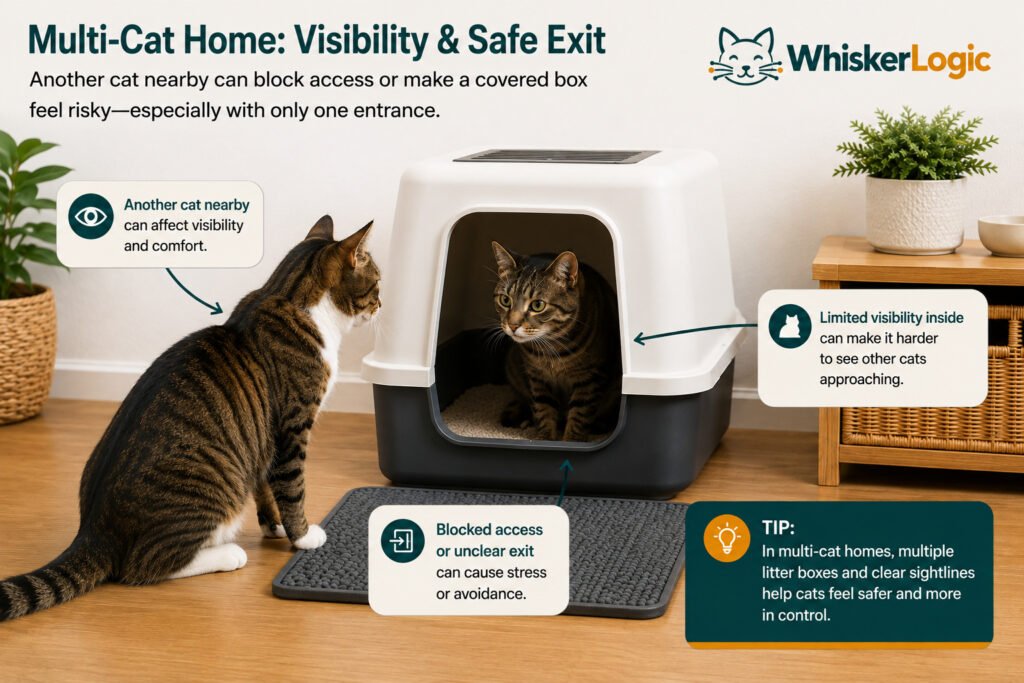
Does another cat:
- sit or wait near the route to the box?
- stare at the cat approaching it?
- block a hallway or doorway?
- follow the cat toward the box?
- stalk, chase, or ambush the cat around the litter-box area?
A covered box with a defined entrance may interact differently with this situation because visibility and entry/exit differ from an open tray.
That does not prove the hood causes the social problem.
It means you should evaluate box design + placement + the other cats’ behavior together.
In multi-cat homes, litter boxes should also be distributed across separate locations rather than treated as one cluster of resources.
How to Compare a Covered vs. Uncovered Litter Box
This is one of the most useful ways to stop guessing.
In the original covered-versus-uncovered litter-box study by Grigg and colleagues, 28 cats were enrolled and offered both box styles while important variables such as litter, box size, and cleaning were controlled.
At the group level, there was no significant difference in use between covered and uncovered boxes.
Eight individual cats did show a significant preference:
- 4 preferred the covered box
- 4 preferred the uncovered box
Most cats did not show a significant preference between the two box types.
The study was relatively small, so it should not be interpreted as proof that box style never matters.
What it does show is that the evidence does not support a blanket rule that all cats prefer uncovered litter boxes.
Individual preference matters.
Run a simple comparison at home
You can use the same basic reasoning without treating your home test as a scientific experiment.
Provide an appropriate covered and uncovered option while keeping other important conditions as similar as reasonably possible:
- similar usable size
- same litter
- similar litter depth
- comparable placement
- same cleaning standard
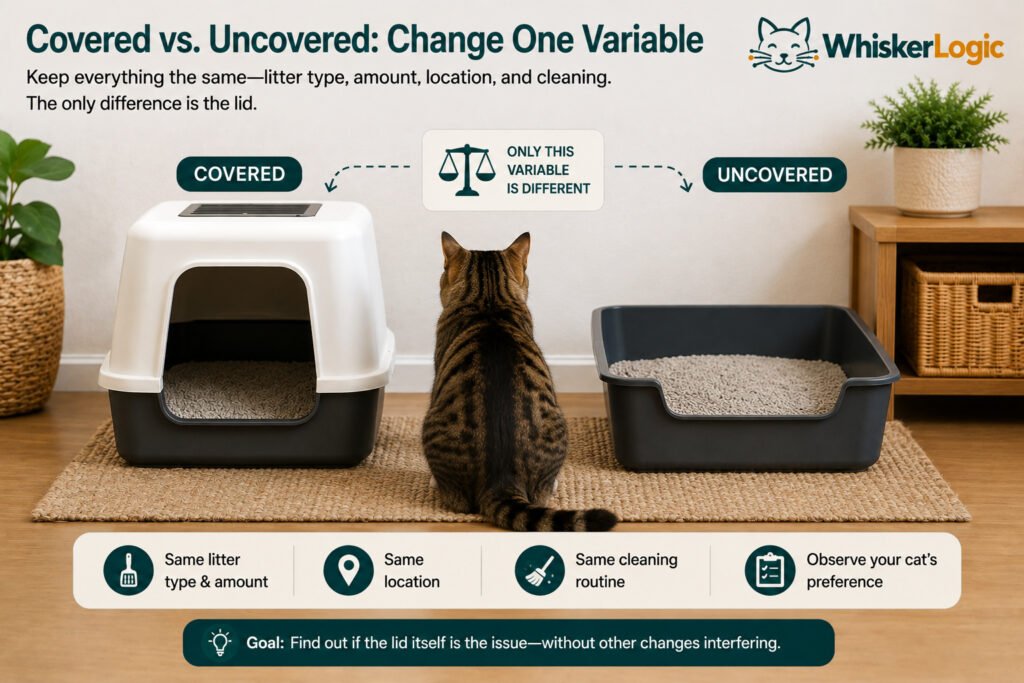
Then observe repeated use.
Most importantly:
Change one important variable at a time.
If you remove the hood, buy a much larger box, change the litter, move the box to another room, and start cleaning it more often all at once, your cat may improve—but you won’t know which change mattered.
How to interpret what happens
Uncovered used, covered repeatedly avoided
Something associated with the covered setup becomes more plausible. Check the entrance, usable space, enclosure, cleanliness, and conditions inside.
Both used
Your cat may not have a meaningful covered-versus-uncovered preference under those conditions.
Covered used, uncovered avoided
Keep the option your cat accepts. There is no evidence-based reason to force an uncovered box simply because you’ve heard that cats universally prefer them.
Both avoided
Broaden the investigation. The cover probably does not explain the entire problem.
A home preference test cannot diagnose a behavioral or medical condition. Its purpose is to isolate variables and give you better information.
What to Try, in Order
Avoid changing everything at once.
1. Check for medical or mobility changes
If the behavior changed suddenly—or you notice urinary, digestive, pain, or mobility signs—address the veterinary question first.
2. Observe where the hesitation occurs
Does your cat:
- refuse to approach?
- approach and back away?
- stop at the doorway?
- enter but struggle to turn?
- use the box when alone but hesitate when another cat is nearby?
The pattern helps determine the next test.
3. Check usable space
Look at the interior dimensions and your cat’s movement inside, not just the measurements printed on the package.
If the box appears cramped, test a larger option.
4. Check the entrance
Evaluate the opening and threshold.
If entering appears difficult, test easier access rather than assuming the roof itself is responsible.
5. Check cleanliness and conditions inside
Scoop at least daily and maintain comparison boxes equally.
6. Check placement and social access
Make sure your cat can reach and leave the box without another cat controlling the route.
7. Compare covered and uncovered options
Keep the major variables as similar as practical and observe which option your cat repeatedly chooses.
8. Keep the setup that works
The goal is not to prove that covered or uncovered boxes are universally better.
It is to provide a box your individual cat can access and use comfortably and consistently.
When It’s Probably Not About the Cover
If your cat also refuses an appropriate uncovered box, the covered design becomes a much weaker explanation.
Broaden the investigation to:
- litter type or texture
- cleanliness
- box size
- location
- accessibility
- negative associations with the box or area
- social pressure
- medical discomfort
The exact elimination pattern can help determine what to investigate next.
If your cat still urinates in the box but defecates elsewhere, see why a cat may poop outside the litter box but still pee in it.
If the stool is consistently deposited immediately beside the box, see why a cat may poop right next to the litter box.
Timing matters too.
If your cat used the same covered box reliably and then suddenly stopped without an obvious change to the box, don’t assume they spontaneously decided that covered boxes are unacceptable.
The better question becomes:
What changed for my cat?
When to Call Your Veterinarian
Litter-box avoidance is a behavior, not a diagnosis.
Medical discomfort can change where or how a cat eliminates, so veterinary assessment is appropriate for significant, persistent, or unexplained changes—particularly when other symptoms are present.
Contact your veterinarian if you notice:
- straining to urinate or defecate
- unusually frequent litter-box visits
- blood in the urine
- vocalizing during elimination
- constipation or significant stool changes
- vomiting
- reduced appetite
- lethargy
- apparent pain
- new difficulty moving or entering the box
The Cornell Feline Health Center’s guidance on feline lower urinary tract disease emphasizes that urethral obstruction requires immediate veterinary treatment.
If your cat repeatedly attempts to urinate but produces little or no urine, seek immediate veterinary care. Urethral obstruction is a medical emergency, and male cats are at greater risk.
Do not delay emergency care while experimenting with different litter boxes.
Frequently Asked Questions
Do cats prefer covered or uncovered litter boxes?
There is no evidence of a universal preference.
In the controlled covered-versus-uncovered study, researchers found no significant overall difference between use of the two box styles. A minority of individual cats preferred one design or the other.
Your individual cat’s behavior matters more than a blanket rule.
Should I remove the lid if my cat won’t use the covered litter box?
Removing the lid can be a useful test, particularly if the problem began when the cover was added.
Keep the other major variables as consistent as practical. If your cat begins using the otherwise similar box without the hood, something associated with the covered setup deserves further investigation.
If your cat still avoids it, look beyond the cover.
Can a covered litter box be too small?
Yes.
A covered box can provide less usable room than its exterior dimensions suggest. The AAFP/ISFM guidelines recommend a rectangular box approximately 1.5 times the cat’s length from nose to the base of the tail as a practical sizing guideline.
Your cat should also be able to enter, turn, position, dig, and eliminate comfortably.
Can another cat affect whether my cat uses a covered litter box?
Yes. Another cat can interfere with access to litter-box resources even without obvious fighting.
Watch for subtle behaviors such as staring and blocking as well as following, stalking, chasing, or waiting around access routes.
If your cat’s behavior changes depending on whether another cat is nearby, investigate the social environment and box placement rather than the cover alone.
Why did my cat suddenly stop using a covered litter box they used before?
Previous acceptance only tells you that the setup worked under earlier conditions.
Something may have changed in mobility, accessibility, cleanliness, location, litter, household relationships, or health.
A sudden unexplained change—especially when accompanied by other symptoms—deserves veterinary attention.
Are covered litter boxes bad for cats?
Not inherently.
Available evidence does not justify saying that covered boxes are bad for all cats or that all cats prefer open boxes.
What matters is whether the individual cat can comfortably access and use the box and whether it is appropriately sized, located, and maintained.
Sources
- Grigg EK, Pick L, Nibblett B. Litter box preference in domestic cats: covered versus uncovered. Journal of Feline Medicine and Surgery.
- AAFP and ISFM Guidelines for Diagnosing and Solving House-Soiling Behavior in Cats.
- 2024 AAFP Intercat Tension Guidelines: Recognition, Prevention and Management.
- Cornell Feline Health Center — Feline Lower Urinary Tract Disease.